

The DOI matches its Crossref record.
Swearing in informal spoken English: 1990s–2010s
Abstract
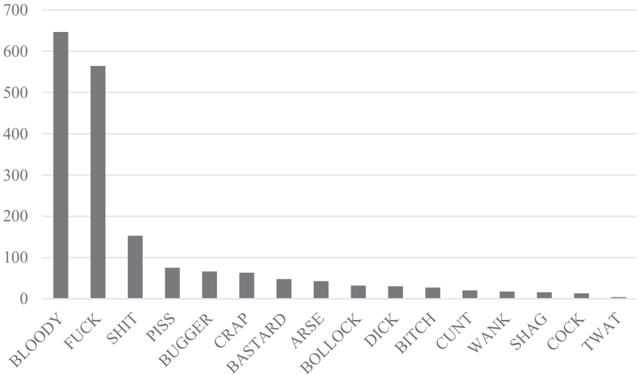
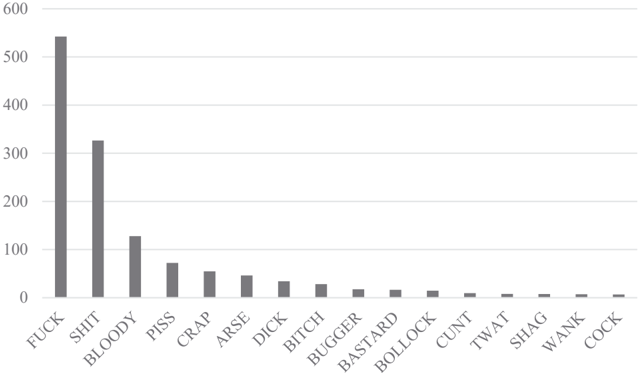
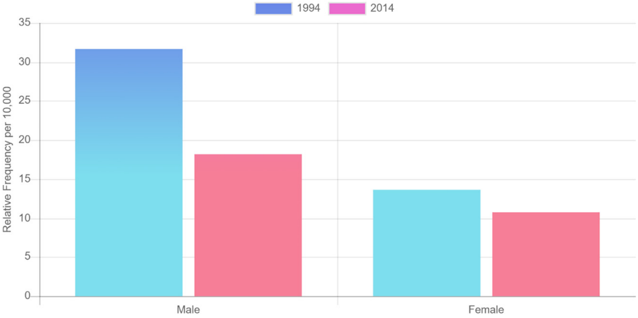
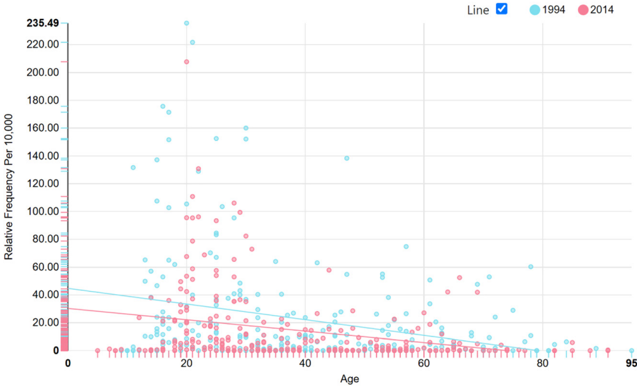
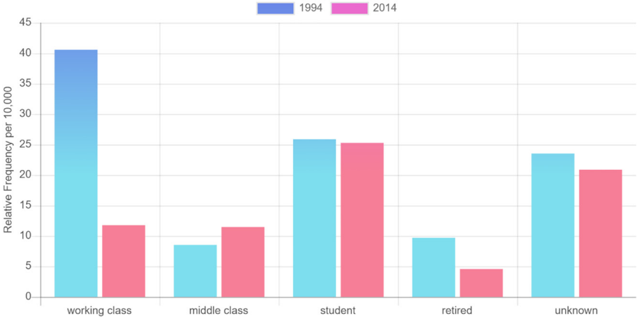
This paper investigates changes in swearing usage in informal speech using large-scale corpus data, comparing the occurrence and social distribution of swear words in two corpora of informal spoken British English: the demographically-sampled part of the Spoken British National Corpus 1994 (BNC1994) and the Spoken British National Corpus 2014 (BNC2014); the compilation of the latter has facilitated large-scale, diachronic analyses of authentic spoken data on a scale which has, until now, not been possible. A form and frequency analysis of a set of 16 ‘pure’ swear word lemma forms is presented. The findings reveal that swearing occurrence is significantly lower in the Spoken BNC2014 but still within a comparable range to previous studies. Furthermore, FUCK is found to overtake BLOODY as the most popular swear word lemma. Finally, the social distribution of swearing across gender and age groups generally supports the findings of previous research: males still swear more than females, and swearing still peaks in the twenties and declines thereafter. However, the distribution of swearing according to socio-economic status is found to be more complex than expected in the 2010s and requires further investigation. This paper also reflects on some of the methodological challenges associated with making comparisons between the two corpora.
Overview
The claims and statistics of this paper haven’t been checked yet.
Run the check — free, no account needed. It reads the open-access text and checks the sources it cites.
Integrity signals
Registry
Cites
Statistics
Figures
Verification
Claims the paper makes
The claims and statistics of this paper haven’t been checked yet.
Run the check — free, no account needed. It reads the open-access text and checks the sources it cites.
Claims other papers make about this one
Each is checked against this paper’s own text: does it say what the citing paper says it does?
The check wasn’t confident either way, so it gives no verdict — never disputed.
In the citing paper
“Furthermore, in the British National Corpus (BNC), swearing is more frequent in the spoken section than the written section (McEnery, 2004;Love, 2017Love, , 2021)).”
From Swear(ING) ain't play(ING): The interaction of taboo language and the sociolinguistic variable (2023) · cites this paper as Love, 2021
Experimental — accuracy not yet measured
Self-check
Percentages, sums and reported differences re-computed from the paper’s own numbers.
The self-check needs the paper’s full text.
Citations
Cites
No references could be resolved yet.
Research works printed but not linked: 41
- Aijmer, Karin. 2018. “That’s well bad”: Some new intensifiers in spoken British English. In Vaclav Brezina, Robbie Love & Karin Aijmer (eds.), Corpus approaches to contemporary British speech: Sociolinguistic studies of the spoken BNC2014, 60–95. London: Routledge. · DOI
- Andersson, Lars & Peter Trudgill. 1992. Bad language. London: Penguin.
- Andersson, Lars & Peter Trudgill. 2007. Swearing. In Leila Monaghan, Jane Goodman & Jennifer Robinson (eds.), A cultural approach to interpersonal communication, 195–199. Oxford: Blackwell.
- Beers Fägersten, Kristy. 2012. Who’s swearing now? The social aspects of conversational swearing. Newcastle-upon-Tyne: Cambridge Scholars Publishing.
- Bowers, Jeffrey S. & Christopher W. Pleydell-Pearce. 2011. Swearing, euphemisms, and linguistic relativity. PloS One 6(7). e22341. https://doi.org/10.1371/journal.pone.0022341. · DOI
- Brezina, Vaclav & Miriam Meyerhoff. 2014. Significant or random? A critical review of sociolinguistic generalisations based on large corpora. International Journal of Corpus Linguistics 19(1). 1–28. https://doi.org/10.1075/ijcl.19.1.01bre. · DOI
- Cheshire, Jenny. 1982. Variation in an English Dialect. Cambridge: Cambridge University Press.
- Crowdy, Steve. 1993. Spoken corpus design. Literary and Linguistic Computing 8(4). 259–265. https://doi.org/10.1093/llc/8.4.259. · DOI
- Drange, Eli-Marie Danbolt, Ingrid Kristine Hasund & Anna-Brita Stenström. 2014. “Your mum!”: Teenagers’ swearing by mother in English, Spanish and Norwegian. International Journal of Corpus Linguistics 19(1). 29–59. https://doi.org/10.1075/ijcl.19.1.02dra. · DOI
- Drummond, Rob. 2020. Teenage swearing in the UK. English World-Wide 41(1). 59–88. [pre-print]. https://doi.org/10.1075/eww.00040.dru. · DOI
- Dynel, Marta. 2012. Swearing methodologically: The (im)politeness of expletives in anonymous commentaries on YouTube. Journal of English Studies 10. 25–50. https://doi.org/10.18172/jes.179. · DOI
- Egbert, Jesse, Stacey Wizner, Daniel Keller, Doug Biber, Paul Baker & Tony McEnery. 2021. Identifying and describing functional conversation units in the BNC Spoken 2014. Text & Talk 41(5–6). 715–737. · DOI
- Güvendir, Emre. 2015. Why are males inclined to use strong swear words more than females? An evolutionary explanation based on male intergroup aggressiveness. Language Sciences 50. 133–139. https://doi.org/10.1016/j.langsci.2015.02.003. · DOI
- Hardie, Andrew. 2012. CQPweb – Combining power, flexibility and usability in a corpus analysis tool. International Journal of Corpus Linguistics 17(3). 380–409. https://doi.org/10.1075/ijcl.17.3.04har. · DOI
- Janschewitz, Kristin. 2008. Taboo, emotionally-valenced, and emotionally-neutral word norms. Behavior Research Methods, Instruments, & Computers 40. 1065–1074. https://doi.org/10.3758/brm.40.4.1065. · DOI · Paper page
- Jay, Timothy. 2009a. The utility and ubiquity of taboo words. Perspectives on Psychological Science 4. 153–161. https://doi.org/10.1111/j.1745-6924.2009.01115.x. · DOI · Paper page
- Jay, Timothy. 2009b. Do offensive words harm people? Psychology, Public Policy, and Law 15. 81–101. https://doi.org/10.1037/a0015646. · DOI
- Jay, Timothy, Catherine Caldwell-Harris & Krista King. 2008. Recalling taboo and nontaboo words. American Journal of Psychology 121. 83–103. https://doi.org/10.2307/20445445. · DOI
- Jay, Timothy & Kristin Janschewitz. 2008. The pragmatics of swearing. Journal of Politeness Research 4. 267–288. https://doi.org/10.1515/jplr.2008.013. · DOI · Paper page
- Labov, William. 1972. Language in the inner city. Philadelphia: University of Pennsylvania Press.
- van Lancker, Diana & Jeffrey L. Cummings. 1999. Expletives: Neurolinguistic and neurobehavioural perspectives on swearing. Brain Research Reviews 31. 83–104. https://doi.org/10.1016/s0165-0173(99)00060-0. · DOI
- Leech, Geoff. 1993. 100 million words of English. English Today 9(1). 9–15. https://doi.org/10.1017/s0266078400006854. · DOI
- Leech, Geoff & Nick Smith. 2005. Extending the possibilities of corpus-based research in the twentieth century: A prequel to LOB and FLOB. ICAME Journal 29. 83–98.
- Ljung, Magnus. 2011. Swearing: A cross-cultural linguistic study. New York: Palgrave Macmillan. · DOI · Paper page
- Love, Robbie. 2020. Overcoming challenges in corpus construction: The Spoken British National Corpus 2014. New York: Routledge. · DOI
- Love, Robbie, Claire Dembry, Andrew Hardie, Vaclav Brezina & Tony McEnery. 2017. The Spoken BNC2014: Designing and building a spoken corpus of everyday conversations. International Journal of Corpus Linguistics 22(3). 319–344. https://doi.org/10.1075/ijcl.22.3.02lov. · DOI
- Love, Robbie, Vaclav Brezina, Tony McEnery, Abi Hawtin, Andrew Hardie & Claire Dembry. 2019. Functional variation in the Spoken BNC2014 and the potential for register analysis. Register Studies 1(2). 296–317. https://doi.org/10.1075/rs.18013.lov. · DOI
- Lutzky, Ursula & Andrew Kehoe. 2015. Your blog is (the) shit: A corpus linguistic approach to the identification of swearing in computer mediated communication. International Journal of Corpus Linguistics 21(2). 165–191. · DOI
- McEnery, Tony. 2006. Swearing in English: Bad language, purity and power from 1586 to the present. New York: Routledge.
- McEnery, Tony, Paul Baker & Andrew Hardie. 1999. Assessing claims about language use with corpus data – swearing and abuse. In John M. Kirk (ed.), Corpora galore: Papers from ICAME 1998, 45–55. Amsterdam: Rodopi. · DOI
- McEnery, Tony, Paul Baker & Andrew Hardie. 2000. Swearing and abuse in modern British English. In Barbara Lewandowska-Tomaszczyk & Patrick James Melia (eds.), PALC ’99: Practical Applications in Language Corpora, 37–48. Frankfurt am Main: Peter Lang.
- McEnery, Tony & Andrew Hardie. 2012. Corpus linguistics: method, theory and practice. Cambridge: Cambridge University Press. · DOI
- McEnery, Tony & Richard Xiao. 2004. Swearing in modern British English: the case of FUCK in the BNC. Language and Literature 13(3). 235–268. https://doi.org/10.1177/0963947004044873. · DOI
- Nevalainen, Terttu. 2018. Research methods: Periodization and statistical techniques. In Terttu Nevalainen, Minna Palander-Collin & Tanja Säily (eds.), Patterns of change in 18th-century English: A sociolinguistic approach, 61–74. Amsterdam: John Benjamins. · DOI
- Rayson, Paul, Geoff Leech & Mary Hodges. 1997. Social differentiation in the use of English vocabulary: some analyses of the conversational component of the British National Corpus. International Journal of Corpus Linguistics 2(1). 133–152. https://doi.org/10.1075/ijcl.2.1.07ray. · DOI
- Schweinberger, Martin. 2018. Swearing in Irish English -- A corpus-based quantitative analysis of the sociolinguistics of swearing. Lingua 209. 1–20. https://doi.org/10.1016/j.lingua.2018.03.008. · DOI
- Singleton, David. 2009. Unspeakable words: the taboo fringe of the lexicon. In Marta Dynel (ed.), Advances in discourse approaches, 130–146. Newcastle-upon-Tyne: Cambridge Scholars Publishing.
- Stapleton, Karyn. 2010. Swearing. In Miriam A. Locher & Sage L. Graham (eds.), Interpersonal pragmatics, 289–306. Berlin: De Gruyter Mouton. https://doi.org/10.1515/9783110214338.2.289. · DOI · Paper page
- Stenström, Anna-Brita. 2006. Taboo words in teenage talk: London and Madrid girls’ conversations compared. Spanish in Context 3(1). 115–38. https://doi.org/10.1075/sic.3.1.08ste. · DOI
- Stenström, Anna-Brita, Gisle Andersen & Ingrid Kristine Hasund. 2002. Trends in Teenage Talk: Corpus compilation, analysis and findings. Amsterdam: John Benjamins. · DOI
- Strawson, Harry. 2017. Diary: The British National Corpus. London Review of Books 39(6). https://www.lrb.co.uk/v39/n06/harry-strawson/diary (accessed 1 December 2020).
Cited by
Sorted by citations
Swear(ING) ain't play(ING): The interaction of taboo language and the sociolinguistic variable
Hunt, M., Cotter, C., Pearson, H., & Stockall, L. (2023) · Journal of Sociolinguistics · doi:10.1111/josl.12588 · Cited by 5
Metadata
- Authors
- Love, R.
- Affiliations
- School of Social Sciences and Humanities, Aston University , Birmingham , UK
- ORCID
- Love, Robbie
- Venue
- Text & Talk
- Publisher
- Walter de Gruyter GmbH
- Published
- 2021-08-16
- Volume
- 41
- Issue
- 5-6
- Pages
- 739-762
- ISSN
- 1860-7330
- 1860-7349
- Cited by
- 40
- References
- 0
- Language
- en
About these checks
Registry, retraction, Cites and statistics results are computed, not judged, with one exception: a printed reference that no index lists is read once by a model before it counts as a citation error. Claims are extracted by a model and kept only when their quote appears verbatim in the text; each cited source is then checked, with a model’s help, for whether it says what the claim relies on. Those verdicts can be wrong — read the claim’s quote and the cited source before relying on one.
Statistics and arithmetic are recomputed, not judged.
Confidence bands are shown only for fields calibrated on our annotated test set. None is calibrated yet, so no band is shown.
What counts as a claim ›How we measure confidence ›How we check this ›
Are you an author, or do you see a problem with this page? Request a review
