

Gene sll0033 from Synechocystis 6803 Encodes a Carotene Isomerase Involved in the Biosynthesis of all-E Lycopene
Open accessThe DOI matches its Crossref record; 3 of the 3 references it cites were found in a registry or an index.
Abstract
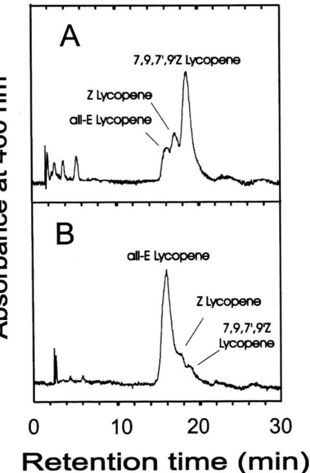
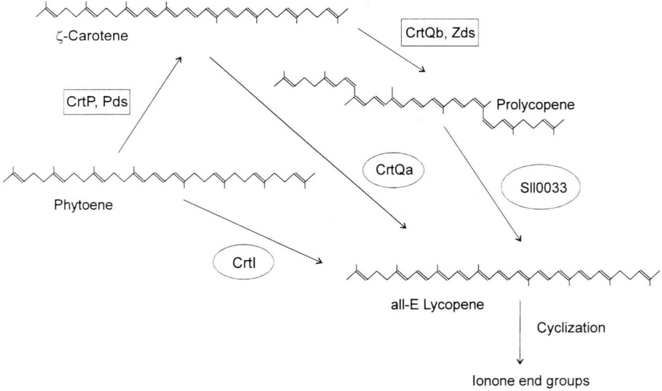
The function of gene sll0033 from Synechocystis 6803 which is homologous to the bacterial crtI-type phytoene desaturase genes was elucidated as a novel carotene isomerase. Escherichia coli transformed with all genes necessary for the formation of ζ-carotene and expressing a ζ-carotene desaturase synthesized the positional isomer prolycopene (7,9,7′,9′Z lycopene) which cannot be cyclized in the subsequent reactions to a- and β-carotene. Upon cotransformation with sll0033, the formation of all-E lycopene is mediated instead.
Overview
The claims and statistics of this paper haven’t been checked yet.
Free: it reads the open-access text and checks the first 5 claims that cite a source we can check. Create a free account to check every claim.
Integrity signals
Registry
Cites
Statistics
Figures
Verification
Claims the paper makes
The claims and statistics of this paper haven’t been checked yet.
Free: it reads the open-access text and checks the first 5 claims that cite a source we can check. Create a free account to check every claim.
Claims other papers make about this one
Each is checked against this paper’s own text: does it say what the citing paper says it does?
The source backs part of the claim, not all of it — or backs it for a different population, condition or comparison.
In the citing paper
“Cyanobacterial and plant CrtIso catalyze the isomerization of (7Z,9Z,9′Z,7′Z)-tetra-cis-lycopene (prolycopene) to all-trans-lycopene.200−203 This enzyme-mediated isomerization employing redox cofactors occurs through a reversible saturation–desaturation reaction of the cis-double bonds.204”
From Chemistry of the Retinoid (Visual) Cycle (2014) · cites this paper as [202]
Experimental — accuracy not yet measured
Self-check
Percentages, sums and reported differences re-computed from the paper’s own numbers.
The self-check needs the paper’s full text.
Citations
Cites
Kaneko, T., Sato, S., Kotani, H., Tanaka, A., Asamizu, E., Nakamura, Y., Miyajima, N., Hirosawa, M., Sugiura, M., Sasamoto, S., et al. (1996) · DNA Research · doi:10.1093/dnares/3.3.109 · Cited by 2,132
Poly-cis carotene pathway in the Scenedesmus mutant C-6D
Ernst, S., & Sandmann, G. (1988) · Archives of Microbiology · doi:10.1007/bf00408255 · Cited by 49
Self-citationPhylogeny of Carotenogenic Genes and Enzymes in Cyanobacteria
Sandmann, G., & Vioque, A. (1999) · Springer eBooks · doi:10.1007/978-1-4615-4827-0_93 · Cited by 6
Self-citation
Cited by
Carotenoids in Algae: Distributions, Biosyntheses and Functions
Takaichi, S. (2011) · Marine Drugs · doi:10.3390/md9061101 · Cited by 802
Regulation of carotenoid formation during tomato fruit ripening and development
Bramley, P. M. (2002) · Journal of Experimental Botany · doi:10.1093/jxb/erf059 · Cited by 418
“The isolation of a carotene isomerase gene from Synechocystis (Breitenbach et al., 2001) and tomato (Isaacson et al., 2002) has ®nally established the mechanism by which cis-trans isomerizations occur during the desaturation of phytoene into lycopene.”
BackgroundChemistry of the Retinoid (Visual) Cycle
Kiser, P. D., Golczak, M., & Palczewski, K. (2014) · Chemical Reviews · doi:10.1021/cr400107q · Cited by 353
Mechanistic Aspects of Carotenoid Biosynthesis
Moise, A. R., Al-Babili, S., & Wurtzel, E. T. (2014) · Chemical Reviews · doi:10.1021/cr400106y · Cited by 327
Rodrigo, M.-J. (2003) · Journal of Experimental Botany · doi:10.1093/jxb/erg083 · Cited by 221
“…Scenedesmus, and Synechocystis mutants which have lost or impaired CRTISO function, accumulate poly-cis-carotenes, mainly poly-cis lycopene, and indicates that an all-trans-conformation of lycopene is necessary for its cyclation (Breitenbach et al., 2001; Isaacson et al., 2002; Park et al., 2002).”
BackgroundCarotenoids and carotenogenesis in cyanobacteria: unique ketocarotenoids and carotenoid glycosides
Takaichi, S., & Mochimaru, M. (2007) · Cellular and Molecular Life Sciences · doi:10.1007/s00018-007-7190-z · Cited by 205
Isaacson, T., Ohad, I., Beyer, P., & Hirschberg, J. (2004) · Plant Physiology · doi:10.1104/pp.104.052092 · Cited by 203
“An ortholog of CrtISO was also found in the cyanobacterium Synechocystis sp. PCC 6803 (Breitenbach et al., 2001; Masamoto et al., 2001).”
BackgroundUnderstanding carotenoid metabolism as a necessity for genetic engineering of crop plants
Sandmann, G., Römer, S., & Fraser, P. D. (2006) · Metabolic Engineering · doi:10.1016/j.ymben.2006.01.005 · Cited by 198
Self-citationTravel advice on the road to carotenoids in plants
Farré, G., Sanahuja, G., Naqvi, S., Bai, C., Capell, T., Zhu, C., & Christou, P. (2010) · Plant Science · doi:10.1016/j.plantsci.2010.03.009 · Cited by 176
Maize Y9 Encodes a Product Essential for 15-cis-ζ-Carotene Isomerization
Li, F., Murillo, C., & Wurtzel, E. T. (2007) · Plant Physiology · doi:10.1104/pp.107.098996 · Cited by 177
“…regarding the required number of carotene isomerases (CRTISO) needed in plant carotenoid biosynthesis, especially since reports of cloning of the CRTISO gene encoding CRTISO from cyanobacteria and plants (Breitenbach et al., 2001; Masamoto et al., 2001; Isaacson et al., 2002; Park et al., 2002).”
BackgroundMethodInfluentialRelated enzymes solve evolutionarily recurrent problems in the metabolism of carotenoids
MOISE, A., VONLINTIG, J., & PALCZEWSKI, K. (2005) · Trends in Plant Science · doi:10.1016/j.tplants.2005.02.006 · Cited by 153
Matthews, P. D. (2003) · Journal of Experimental Botany · doi:10.1093/jxb/erg235 · Cited by 150
“Since only one carotene isomerase has been identi®ed within algae (Breitenbach et al., 2001; Masamoto et al., 2001) and within plants (Isaacson et al.”
BackgroundInfluentialBreitenbach, J., & Sandmann, G. (2004) · Planta · doi:10.1007/s00425-004-1395-2 · Cited by 154
“3e), three different isomers were detected with an NMR-characterized b-carotene isomeric standard (Breitenbach et al. 2001b): b1 was identified as 13-cis, the dominant b2 as all-trans and b3 as 9-cis-b-carotene (Fig.”
BackgroundMethodInfluentialSelf-citationCarotenoids biosynthesis and cleavage related genes from bacteria to plants
Liang, M., Zhu, J., & Jiang, J. (2017) · Critical Reviews in Food Science and Nutrition · doi:10.1080/10408398.2017.1322552 · Cited by 140
“Carotenoid isomerase enzyme (EC 5.2.1.13) is known as CRTISO in plants (Isaacson et al., 2002, Park et al., 2002) and as CrtH in cyanobacteria (Breitenbach et al., 2001, Masamoto et al., 2001) that converts 7,9,70,90-tetra-cis-lycopene (prolycopene) to all trans-lycopene (Figure 2).”
BackgroundInfluentialA study in scarlet: enzymes of ketocarotenoid biosynthesis in the flowers of Adonis aestivalis
Cunningham, F. X., & Gantt, E. (2005) · The Plant Journal · doi:10.1111/j.1365-313x.2004.02309.x · Cited by 125
Molecular evolution of carotenoid biosynthesis from bacteria to plants
Sandmann, G. (2002) · Physiologia Plantarum · doi:10.1034/j.1399-3054.2002.1160401.x · Cited by 125
Self-citationSandmann, G. (2021) · New Phytologist · doi:10.1111/nph.17655 · Cited by 123
Self-citationThe biochemical basis for structural diversity in the carotenoids of chlorophototrophic bacteria
Maresca, J. A., Graham, J. E., & Bryant, D. A. (2008) · Photosynthesis Research · doi:10.1007/s11120-008-9312-3 · Cited by 122
“Cyanobacteria, Chlorobi, and the phototrophic acidobacterium Candidatus Chloracidobacterium (Cab.) thermophilum, whose genomes encode CrtH, are species that appear to desaturate phytoene via the CrtP-CrtQ desaturases.”
InfluentialEvolution of carotene desaturation: The complication of a simple pathway
Sandmann, G. (2008) · Archives of Biochemistry and Biophysics · doi:10.1016/j.abb.2008.10.004 · Cited by 121
Self-citationKlassen, J. L. (2010) · PLoS ONE · doi:10.1371/journal.pone.0011257 · Cited by 123
“Whereas CrtP and CrtQ are highly homologous to each other but only distantly related to CrtI [34], CrtH is more closely related to CrtI and its relatives [63].”
BackgroundOccurrence and biosynthesis of carotenoids in phytoplankton
Huang, J. J., Lin, S., Xu, W., & Cheung, P. C. K. (2017) · Biotechnology Advances · doi:10.1016/j.biotechadv.2017.05.001 · Cited by 120
Identification of All-trans-Retinol:All-trans-13,14-dihydroretinol Saturase
Moise, A. R., Kuksa, V., Imanishi, Y., & Palczewski, K. (2004) · Journal of Biological Chemistry · doi:10.1074/jbc.m409130200 · Cited by 103
Identification of a fourth family of lycopene cyclases in photosynthetic bacteria
Maresca, J. A., Graham, J. E., Wu, M., Eisen, J. A., & Bryant, D. A. (2007) · Proceedings of the National Academy of Sciences · doi:10.1073/pnas.0702984104 · Cited by 111
A novel type of lycopene ε-cyclase in the marine cyanobacterium Prochlorococcus marinus MED4
Stickforth, P., Steiger, S., Hess, W. R., & Sandmann, G. (2003) · Archives of Microbiology · doi:10.1007/s00203-003-0545-4 · Cited by 104
Self-citationCarotenoid Biosynthesis in the Primitive Red Alga Cyanidioschyzon merolae
Cunningham, F. X., Lee, H., & Gantt, E. (2007) · Eukaryotic Cell · doi:10.1128/ec.00265-06 · Cited by 88
Carotenoid isomerase: a tale of light and isomers
Giuliano, G., Giliberto, L., & Rosati, C. (2002) · Trends in Plant Science · doi:10.1016/s1360-1385(02)02329-4 · Cited by 79
Tsuchiya, T., Takaichi, S., Misawa, N., Maoka, T., Miyashita, H., & Mimuro, M. (2005) · FEBS Letters · doi:10.1016/j.febslet.2005.02.066 · Cited by 70
“into all-trans lycopene [15,16].”
ZEBRA2, encoding a carotenoid isomerase, is involved in photoprotection in rice
Chai, C., Fang, J., Liu, Y., Tong, H., Gong, Y., Wang, Y., Liu, M., Wang, Y., Qian, Q., Cheng, Z., et al. (2010) · Plant Molecular Biology · doi:10.1007/s11103-010-9719-z · Cited by 82
“…China Q. Qian China National Rice Research Institute, Chinese Academy of Agricultural Sciences, 310006 Hangzhou, Zhejiang Province, China cis-lycopene to all-trans lycopene via cis-configuration intermediates (Breitenbach et al. 2001; Masamoto et al. 2001; Isaacson et al. 2002; Park et al. 2002).”
BackgroundMaresca, J. A., Romberger, S. P., & Bryant, D. A. (2008) · Journal of Bacteriology · doi:10.1128/jb.00758-08 · Cited by 72
“Although a single enzyme, CrtI, can perform the same suite of reactions (22, 25, 34, 46, 50), two desaturases and at least one isomerase are required to convert phytoene into lycopene in GSB and most cyanobacteria (1, 3, 4, 6, 7, 19, 21, 34, 40, 43).”
BackgroundSchäfer, L., Sandmann, M., Woitsch, S., & Sandmann, G. (2006) · Plant Cell & Environment · doi:10.1111/j.1365-3040.2006.01515.x · Cited by 62
Self-citationSteiger, S., Jackisch, Y., & Sandmann, G. (2005) · Archives of Microbiology · doi:10.1007/s00203-005-0004-5 · Cited by 57
“Unlike in other cyanobacteria (Breitenbach et al. 2001b), dicis and tetracis carotenes are no intermediates of the pathway in G. violaceus.”
BackgroundSelf-citationLi, Q., Farré, G., Naqvi, S., Breitenbach, J., Sanahuja, G., Bai, C., Sandmann, G., Capell, T., Christou, P., & Zhu, C. (2010) · Transgenic Research · doi:10.1007/s11248-010-9381-x · Cited by 68
“Plasmid pBBR1MCS2-zds contained a f-carotene desaturase gene (Breitenbach et al. 2001a).”
BackgroundSelf-citationConti, A., Pancaldi, S., Fambrini, M., Michelotti, V., Bonora, A., Salvini, M., & Pugliesi, C. (2004) · Plant and Cell Physiology · doi:10.1093/pcp/pch052 · Cited by 60
“2002) or dark-grown sll033 Synechocystis (Breitenbach et al. 2001), the accumulation of pro-ζ-carotene, in addition to pro-lycopene, suggests that isomerization might be required also to allow ZDS action.”
BackgroundNovel β-carotene ketolases from non-photosynthetic bacteria for canthaxanthin synthesis
Tao, L., & Cheng, Q. (2004) · Molecular Genetics and Genomics · doi:10.1007/s00438-004-1083-8 · Cited by 54
“enzyme is a carotene isomerase from Synechocystis 6803 (Breitenbach et al. 2001).”
BackgroundAn unexpected hydratase synthesizes the green light-absorbing pigment fucoxanthin
Cao, T., Bai, Y. J., Buschbeck, P., Tan, Q., Cantrell, M., Chen, Y., Jiang, Y., Liu, R., Ries, N. K., Shi, X., et al. (2023) · The Plant Cell · doi:10.1093/plcell/koad116 · Cited by 58
Zhu, Y., Jiang, J., Yuan, Y., & Chen, X.-W. (2005) · Journal of Agricultural and Food Chemistry · doi:10.1021/jf0506838 · Cited by 52
Iwai, M., Maoka, T., Ikeuchi, M., & Takaichi, S. (2008) · Plant and Cell Physiology · doi:10.1093/pcp/pcn142 · Cited by 49
Moise, A. R., Isken, A., Domínguez, M., de Lera, A. R., von Lintig, J., & Palczewski, K. (2007) · Biochemistry · doi:10.1021/bi062147u · Cited by 45
Structural diversity and functional novelty of new carotenoid biosynthesis genes
Cheng, Q. (2006) · Journal of Industrial Microbiology & Biotechnology · doi:10.1007/s10295-006-0121-4 · Cited by 47
“Upon co-expression of crtH, formation of all-E lycopene was mediated [8].”
Mochimaru, M., Masukawa, H., Maoka, T., Mohamed, H. E., Vermaas, W. F. J., & Takaichi, S. (2008) · Journal of Bacteriology · doi:10.1128/jb.01881-07 · Cited by 42
Mohamed, H. E., & Vermaas, W. F. J. (2004) · Journal of Bacteriology · doi:10.1128/jb.186.17.5621-5628.2004 · Cited by 36
“For example, the carotene isomerase (CrtH) (4, 22) encoded by sll0033 may have a role in providing the proper isomer required for Slr1293 and thus control the ratio of the precursors for monocyclic versus bicyclic carotenoids in this cyanobacterium.”
BackgroundMasamoto, K., Hisatomi, S.-I., Sakurai, I., Gombos, Z., & Wada, H. (2004) · Plant and Cell Physiology · doi:10.1093/pcp/pch144 · Cited by 38
“…on higher plants and a cyanobacterium indicated the participation of a new gene, crtISO or crtH, which encodes a cis-to-trans carotene isomerase (Breitenbach et al. 2001, Masamoto et al. 2001, Giuliano et al. 2002, Isaacson et al. 2002, Park et al. 2002), and the accumulation of poly-cis…”
BackgroundRetinol Saturase: More than the Name Suggests
Weber, P., Flores, R. E., Kiefer, M. F., & Schupp, M. (2020) · Trends in Pharmacological Sciences · doi:10.1016/j.tips.2020.03.007 · Cited by 38
Carotenoid metabolism in phytoplankton
Lohr, M. (2011) · Cambridge University Press eBooks · doi:10.1017/cbo9780511732263.006 · Cited by 36
Carotenogenesis in cyanobacteria: CruA/CruP-type and CrtL-type lycopene cyclases
Sugiyama, K., & Takaichi, S. (2020) · The Journal of General and Applied Microbiology · doi:10.2323/jgam.2020.01.005 · Cited by 30
“CrtH converts poly-cis neurosporene and lycopene to all-trans neurosporene and lycopene, respectively (Breitenbach et al., 2001; Masamoto et al., 2001).”
BackgroundKosourov, S. N., Murukesan, G., Jokela, J., & Allahverdiyeva, Y. (2016) · Plant and Cell Physiology · doi:10.1093/pcp/pcw143 · Cited by 29
Takaichi, S. (2013) · Springer eBooks · doi:10.1007/978-3-642-22144-6_141 · Cited by 31
Distribution, Biosynthesis, and Function of Carotenoids in Oxygenic Phototrophic Algae
Takaichi, S. (2025) · Marine Drugs · doi:10.3390/md23020062 · Cited by 29
Mutations in the MIT3 gene encoding a caroteniod isomerase lead to increased tiller number in rice
Liu, L., Xie, T., Peng, P., Qiu, H., Zhao, J., Fang, J., Patil, S. B., Wang, Y., Fang, S., Chu, J., et al. (2017) · Plant Science · doi:10.1016/j.plantsci.2017.11.001 · Cited by 28
Carotenoid Isomerase Is Key Determinant of Petal Color of Calendula officinalis
Kishimoto, S., & Ohmiya, A. (2011) · Journal of Biological Chemistry · doi:10.1074/jbc.m111.300301 · Cited by 22
Carotenoids in Phototrophic Microalgae: Distributions and Biosynthesis
Takaichi, S. (2020) · Springer eBooks · doi:10.1007/978-3-030-50971-2_2 · Cited by 24
Cooperation of two carotene desaturases in the production of lycopene in Myxococcus xanthus
Iniesta, A. A., Cervantes, M., & Murillo, F. J. (2007) · FEBS Journal · doi:10.1111/j.1742-4658.2007.05960.x · Cited by 22
Diversity and Evolution of Carotenoid Biosynthesis from Prokaryotes to Plants
Sandmann, G. (2021) · Advances in experimental medicine and biology · doi:10.1007/978-981-15-7360-6_7 · Cited by 13
Self-citationPhotosynthesis | Carotenoids in Photosynthesis – Structure and Biosynthesis
Canniffe, D. P., & Hitchcock, A. (2020) · Elsevier eBooks · doi:10.1016/b978-0-12-819460-7.00087-6 · Cited by 15
Li, P., Zhang, S., Zhang, S., Li, F., Zhang, H., Liu, X., Wu, J., Wang, X., & Sun, R. (2015) · Molecular Breeding · doi:10.1007/s11032-015-0190-z · Cited by 15
Genetic enhancement of phytochemicals: the case of carotenoids
Bramley, P. M. (2003) · Elsevier eBooks · doi:10.1533/9781855736986.2.253 · Cited by 19
Carotenoid modifying enzymes in metazoans
Moise, A. R., Bandara, S., & Lintig, J. V. (2022) · Methods in enzymology on CD-ROM/Methods in enzymology · doi:10.1016/bs.mie.2022.05.005 · Cited by 13
Zhu, Y., Jiang, J., & Chen, X. (2007) · Journal of the Science of Food and Agriculture · doi:10.1002/jsfa.2922 · Cited by 8
Origin and evolution of yeast carotenoid pathways
Sandmann, G. (2024) · Biochimica et Biophysica Acta (BBA) - Molecular and Cell Biology of Lipids · doi:10.1016/j.bbalip.2024.159586 · Cited by 10
Self-citationKlassen, J. L. (2009) · ERA: Education and Research Archive (University of Alberta) · doi:10.7939/r36s8p · Cited by 5
Brown is the new green: Discovery of an algal enzyme for the final step of fucoxanthin biosynthesis
Chan, C. (2023) · The Plant Cell · doi:10.1093/plcell/koad138 · Cited by 2
“CRTISO proteins are isomerases that catalyze C=C double bond isomerization in cyanobacteria (Breitenbach et al. 2001; Masamoto et al. 2001), Arabidopsis (Park et al.”
Carotenoids, Microbial Processes
Schmidt‐Dannert, C., & Lee, P. C. (2009) · Wiley eBooks · doi:10.1002/9780470054581.eib178 · Cited by 2
Carotenoids in Carotenogenic Organisms: Distribution, Biosynthesis, and Functions
Takaichi, S. (2025) · Springer eBooks · doi:10.1007/978-3-642-36202-6_141-1 · Cited by 3
Oxidative Dehydrogenation—Biological
Bartley, G. E. (2010) · Wiley eBooks · doi:10.1002/0471227617.eoc163.pub2
Li, Z., Ji, J., & Wang, G. (2015) · Transactions of Tianjin University · doi:10.1007/s12209-015-2559-9
“[15] Breitenbach J, Vioque A, Sandmann G.”
BackgroundCarotenoids in Oxygenic Phototrophic Microalgae: Distributions and Biosynthesis
Takaichi, S. (2026) · Springer eBooks · doi:10.1007/978-3-031-93945-7_3
Harada, J., Yamamoto, K., & Takaichi, S. (2026) · Genes · doi:10.3390/genes17101189
“The other is the plant-type enzyme observed in GSBs, cyanobacteria, and plants, and involves the two-step phytoene desat-urase CrtP and the two-step ζ -carotene desaturase CrtQ to synthesize lycopene, together with the carotene isomerase CrtH [13,18,20,25,26] (see Figure S1).”
Metadata
- Authors
- Breitenbach, J., Vioque, A., & Sandmann, G.
- Affiliations
- Goethe University Frankfurt (DE)
- Instituto de Biochímica Vegetal y Fotosíntesis, Universidad de Sevilla-CSIC, Americo Vespucio s/n, 41092, Spain
- Corresponding author
- Sandmann, Gerhard
- Venue
- Zeitschrift für Naturforschung C
- Publisher
- Walter de Gruyter GmbH
- Published
- 2001-10-01
- Volume
- 56
- Issue
- 9-10
- Pages
- 915-917
- ISSN
- 0341-0471 (ISSN-L)
- 1865-7125
- 0939-5075
- OpenAlex
- W1973577090
- Cited by
- 67
- References
- 3
- Citations by year
- 2026: 2 · 2025: 2 · 2024: 1 · 2023: 2 · 2022: 1 · 2021: 2 · 2020: 4 · 2017: 3 · 2016: 1 · 2015: 2 · 2013: 3
- FWCI
- 1.62
- Type
- journal article
- Language
- en
- Open access
- hybrid
- doi.org
- Licence
- Locations
- Zeitschrift für Naturforschung C (publishedVersion, cc-by-nc-nd)
- PubMed (publishedVersion)
- Publication Server of Goethe University Frankfurt am Main (Goethe University Frankfurt) (submittedVersion, cc-by-nc-nd)
- Topics
- Life Sciences › Biochemistry, Genetics and Molecular Biology › Molecular Biology › Plant biochemistry and biosynthesis
- Life Sciences › Biochemistry, Genetics and Molecular Biology › Biotechnology › Microbial Metabolism and Applications
- Life Sciences › Biochemistry, Genetics and Molecular Biology › Molecular Biology › Microbial Metabolic Engineering and Bioproduction
- Keywords
- Synechocystis sp. PCC 6803, phytoene desaturase, zeta-carotene desaturase, carotenoid biosynthesis, bacterial carotenoids, Escherichia coli expression
- MeSH terms
- Lycopene, Cyanobacteria, Antioxidants, Carotenoids, Chromatography, High Pressure Liquid, Escherichia coli, Genes, Bacterial, Isomerases, cis-trans-Isomerases
About these checks
Registry, retraction, Cites and statistics results are computed, not judged, with one exception: a printed reference that no index lists is read once by a model before it counts as a citation error. Claims are extracted by a model and kept only when their quote appears verbatim in the text; each cited source is then checked, with a model’s help, for whether it says what the claim relies on. Those verdicts can be wrong — read the claim’s quote and the cited source before relying on one.
Statistics and arithmetic are recomputed, not judged.
Confidence bands are shown only for fields calibrated on our annotated test set. None is calibrated yet, so no band is shown.
What counts as a claim ›How we measure confidence ›How we check this ›
Are you an author, or do you see a problem with this page? Request a review
Data sources
Bibliographic data: Semantic Scholar, OpenAlex, Crossref.
Contains information from the Semantic Scholar Academic Graph Datasets, made available under the ODC Attribution License (ODC-BY 1.0).
Semantic Scholar’s data is described in: Kinney, R., et al. (2023). The Semantic Scholar Open Data Platform. arXiv:2301.10140.
