

Arachidonic acid as a possible negative feedback inhibitor of nicotinic acetylcholine receptors on neurons
The DOI matches its Crossref record; 1 of the 1 references it cites were found in a registry or an index.
Abstract
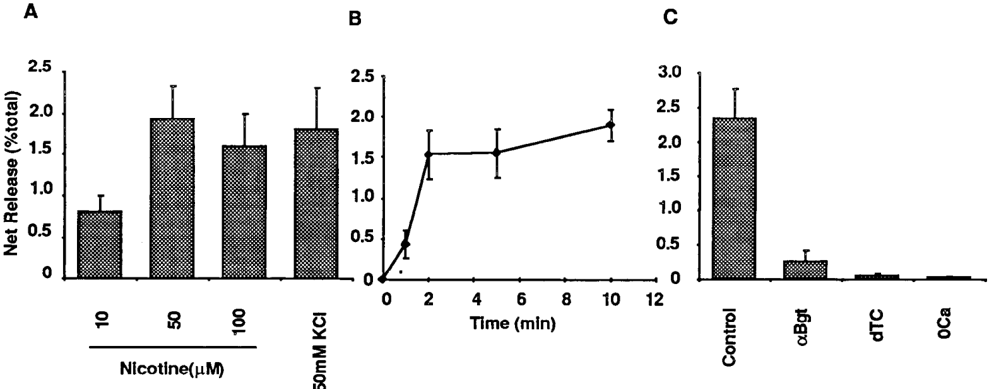
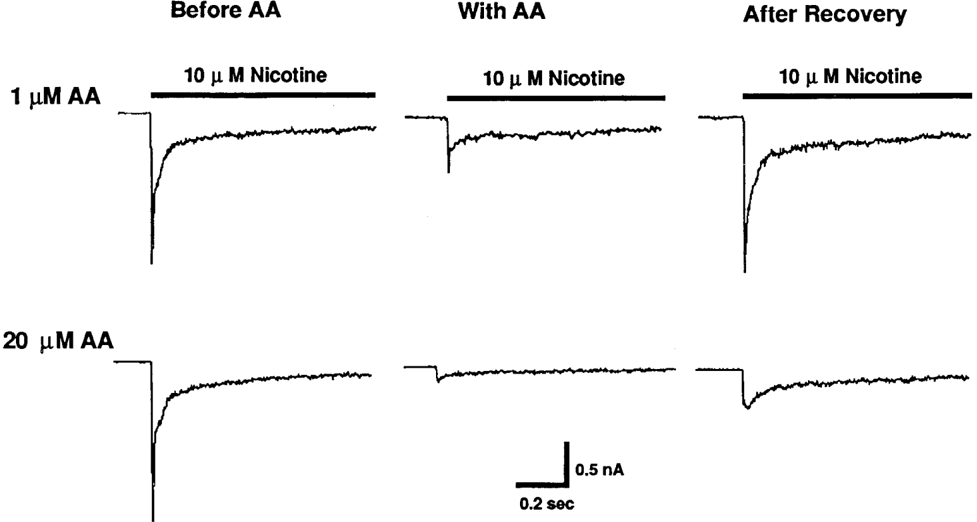
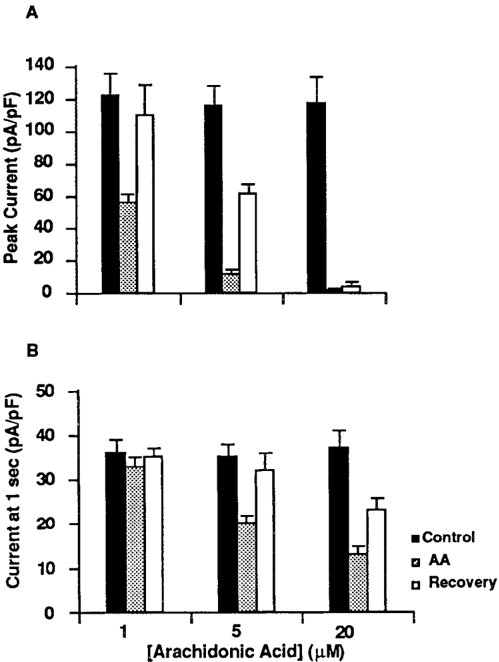
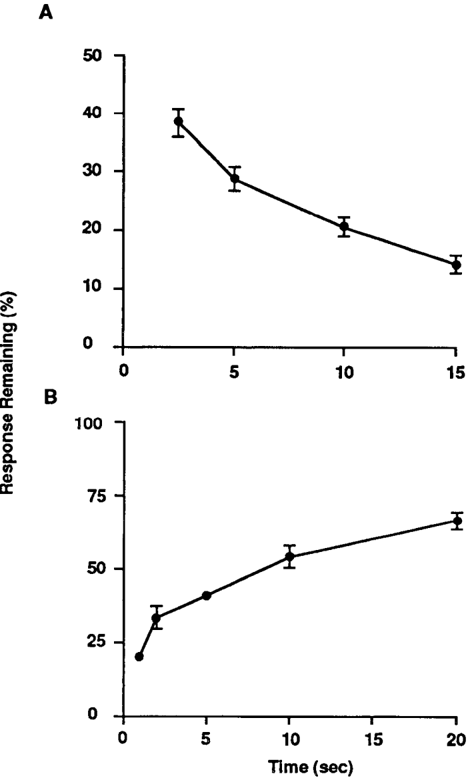
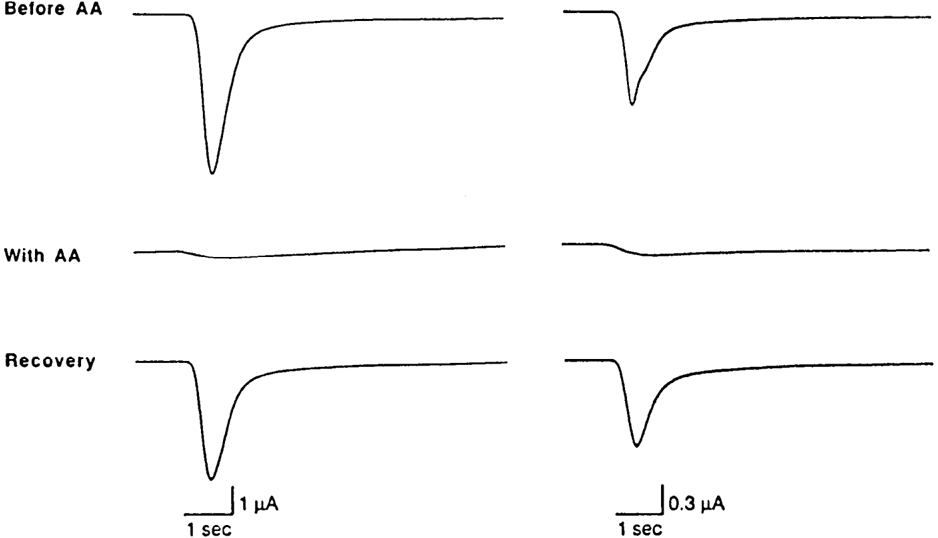
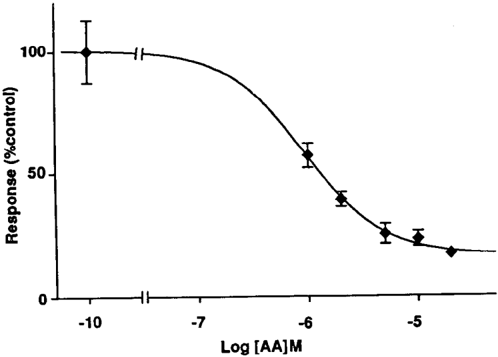
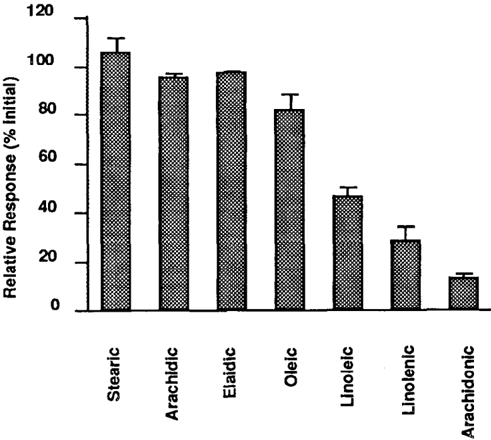
Neuronal acetylcholine receptors, being highly permeable to calcium, are likely to regulate calcium-dependent events in neurons. Arachidonic acid is a membrane-permeant second messenger that can be released from membrane phospholipids by phospholipases in a calcium-dependent manner. We show here that activation of neuronal acetylcholine receptors triggers release of 3H-arachidonic acid in a calcium-dependent manner from neurons preloaded with the fatty acid. Moreover, low concentrations of arachidonic acid reversibly inhibit the receptors and act most efficiently on receptors likely to have the highest permeability to calcium, namely receptors containing alpha 7 subunits. Low concentrations of arachidonic acid also reversibly inhibit alpha 7- containing receptors expressed in Xenopus oocytes following injection of alpha 7 cRNA. The oocyte results indicate following injection of alpha 7 cRNA. The oocyte results indicate that the inhibition is a feature of the receptors rather than a consequence of neuron-specific machinery. The inhibition is not mediated by specific metabolites of arachidonic acid because the effects can be mimicked by other fatty acids; their effectiveness correlates with their content of double bonds. In contrast to arachidonic effects on calcium currents, inhibition of neuronal nicotinic receptors by the fatty acid cannot be prevented by blocking production of free radicals or by inhibiting protein kinase C. An alternative mechanism is that arachidonic acid binds directly to the receptors or perturbs the local environment in such a manner as to constrain receptor function.
Overview
The claims and statistics of this paper haven’t been checked yet.
Free: it reads the open-access text and checks the first 5 claims that cite a source we can check. Create a free account to check every claim.
Integrity signals
Registry
Cites
Statistics
Figures
Verification
Claims the paper makes
The claims and statistics of this paper haven’t been checked yet.
Free: it reads the open-access text and checks the first 5 claims that cite a source we can check. Create a free account to check every claim.
Claims other papers make about this one
Each is checked against this paper’s own text: does it say what the citing paper says it does?
The cited source says what the claim attributes to it.
In the citing paper
“Last, but not least, the activation of nicotinic receptors on peripheral neurons has also been linked to altered phospholipid and fatty-acid metabolism (e.g., Vijayaraghavan et al., 1995; Marin et al., 1997; Stella and Piomelli, 2001; Tieman et al., 2001, and references therein).”
From Nicotinic receptor‐mediated effects on appetite and food intake (2002) · cites this paper as Vijayaraghavan et al., 1995
Self-check
Percentages, sums and reported differences re-computed from the paper’s own numbers.
The self-check needs the paper’s full text.
Citations
Cites
The Diversity of Neuronal Nicotinic Acetylcholine Receptors
Sargent, P. B. (1993) · Annual Review of Neuroscience · doi:10.1146/annurev.ne.16.030193.002155 · Cited by 1,052
Cited by
Nicotinic Receptors in the Development and Modulation of CNS Synapses
Role, L. W., & Berg, D. K. (1996) · Neuron · doi:10.1016/s0896-6273(00)80134-8 · Cited by 762
Self-citationNeuronal Nicotinic Acetylcholine Receptors as Targets for Drug Discovery
Holladay, M. W., Dart, M. J., & Lynch, J. K. (1997) · Journal of Medicinal Chemistry · doi:10.1021/jm970377o · Cited by 444
The Essentiality of Arachidonic Acid in Infant Development
Hadley, K., Ryan, A., Forsyth, S., Gautier, S., & Salem, N. (2016) · Nutrients · doi:10.3390/nu8040216 · Cited by 373
β-Amyloid peptide blocks the response of α7-containing nicotinic receptors on hippocampal neurons
Liu, Q.-S., Kawai, H., & Berg, D. K. (2001) · Proceedings of the National Academy of Sciences · doi:10.1073/pnas.081553598 · Cited by 331
Self-citationNicotinic receptor‐mediated effects on appetite and food intake
Jo, Y., Talmage, D. A., & Role, L. W. (2002) · Journal of Neurobiology · doi:10.1002/neu.10147 · Cited by 323
“…interaction of nicotinic and lipid-signaling pathways may constitute an important “feedback” (pun intended) mechanism for regulating peripheral signals and circuits controlling food intake (e.g., Vijayaraghavan et al., 1995; Marin et al., 1997; Bray, 2000; Du and Role, 2001; Tieman et al., 2001).”
BackgroundMembrane phospholipid abnormalities in postmortem brains from schizophrenic patients
Yao, J. K., Leonard, S., & Reddy, R. D. (2000) · Schizophrenia Research · doi:10.1016/s0920-9964(99)00095-x · Cited by 290
Nicotinic Receptor-Induced Apoptotic Cell Death of Hippocampal Progenitor Cells
Berger, F., Gage, F. H., & Vijayaraghavan, S. (1998) · The Journal of Neuroscience · doi:10.1523/jneurosci.18-17-06871.1998 · Cited by 232
“Role of calcium in nicotine-mediated apoptosis An obvious mechanism by which a-Bgt-AChRs could mediate the effects of nicotine is by increasing [Ca]i (MacNicol and Schulman, 1992; Vijayaraghavan et al., 1992, 1995 ).”
InfluentialSelf-citationViolet, J. M., Downie, D. L., Nakisa, R. C., Lieb, W. R., & Franks, N. P. (1997) · Anesthesiology · doi:10.1097/00000542-199704000-00017 · Cited by 209
Nicotine Promotes Tumor Growth and Metastasis in Mouse Models of Lung Cancer
Davis, R., Rizwani, W., Banerjee, S., Kovacs, M., Haura, E., Coppola, D., & Chellappan, S. (2009) · PLoS ONE · doi:10.1371/journal.pone.0007524 · Cited by 193
“transmitter release, regulation of second messenger cascades [16,17], cell survival [18] and apoptosis [19].”
BackgroundSynaptic Currents Generated by Neuronal Acetylcholine Receptors Sensitive to α-Bungarotoxin
Zhang, Z.-W., Coggan, J. S., & Berg, D. K. (1996) · Neuron · doi:10.1016/s0896-6273(00)80253-6 · Cited by 182
“One of the most abun- calcium-dependent processes including neurite retracdant is a class of receptors that contains the a7 gene tion (Pugh and Berg, 1994) and release of arachidonic product, has a high relative permeability to calcium, acid (Vijayaraghavan et al., 1995).”
Self-citationStructural basis for lipid modulation of nicotinic acetylcholine receptor function
Barrantes, F. J. (2004) · Brain Research Reviews · doi:10.1016/j.brainresrev.2004.06.008 · Cited by 175
“Some cis-unsaturated fatty acids have been reported to affect the function of several voltage[88,168] and ligand- ([44,135,185]) gated ion channels.”
BackgroundReceptor-independent actions of cannabinoids on cell membranes: Focus on endocannabinoids
Oz, M. (2006) · Pharmacology & Therapeutics · doi:10.1016/j.pharmthera.2005.09.009 · Cited by 165
Nicotine, Brain Nicotinic Receptors, and Neuropsychiatric Disorders
Mihailescu, S., & Drucker-Colı́n, R. (2000) · Archives of Medical Research · doi:10.1016/s0188-4409(99)00087-9 · Cited by 162
Alkondon, M., Pereira, E. F. R., Barbosa, C. T. F., & Albuquerque, E. X. (1997) · The Journal of Pharmacology and Experimental Therapeutics · doi:10.1016/s0022-3565(24)37139-3 · Cited by 127
Qu, Y., Chang, L., Klaff, J., Balbo, A., & Rapoport, S. I. (2003) · Neuropsychopharmacology · doi:10.1038/sj.npp.1300022 · Cited by 46
“PLA2 can also be activated when Ca 2+ enters cells by glutamate acting at N-methyl-d-aspartate (NMDA) receptors or by acetylcholine acting at nicotinic receptors (Brooks et al, 1989; Cooper et al, 1996; Vijayaraghavan et al, 1995).”
Metadata
- Authors
- Vijayaraghavan, S., Huang, B., Blumenthal, E., & Berg, D.
- Venue
- The Journal of Neuroscience
- Publisher
- Society for Neuroscience
- Published
- 1995-05-01
- Volume
- 15
- Issue
- 5
- Pages
- 3679-3687
- ISSN
- 0270-6474
- 1529-2401
- Cited by
- 89
- References
- 1
- Language
- en
About these checks
Registry, retraction, Cites and statistics results are computed, not judged, with one exception: a printed reference that no index lists is read once by a model before it counts as a citation error. Claims are extracted by a model and kept only when their quote appears verbatim in the text; each cited source is then checked, with a model’s help, for whether it says what the claim relies on. Those verdicts can be wrong — read the claim’s quote and the cited source before relying on one.
Statistics and arithmetic are recomputed, not judged.
Confidence bands are shown only for fields calibrated on our annotated test set. None is calibrated yet, so no band is shown.
What counts as a claim ›How we measure confidence ›How we check this ›
Are you an author, or do you see a problem with this page? Request a review
Data sources
Bibliographic data: Semantic Scholar, OpenAlex, Crossref.
Contains information from the Semantic Scholar Academic Graph Datasets, made available under the ODC Attribution License (ODC-BY 1.0).
Semantic Scholar’s data is described in: Kinney, R., et al. (2023). The Semantic Scholar Open Data Platform. arXiv:2301.10140.
