

The DOI matches its Crossref record; 45 of the 45 references it cites were found in a registry or an index.
Increased Probability of GABA Release during Withdrawal from Morphine
Open accessAbstract
Opioid receptors located on interneurons in the ventral tegmental area (VTA) inhibit GABA A -mediated synaptic transmission to dopamine projection neurons. The resulting disinhibition of dopamine cells in the VTA is thought to play a pivotal role in drug abuse; however, little is known about how this GABA A synapse is affected after chronic morphine treatment. The regulation of GABA release during acute withdrawal from morphine was studied in slices from animals treated for 6–7 d with morphine. Slices containing the VTA were prepared and maintained in morphine-free solutions, and GABA A IPSCs were recorded from dopamine cells. The amplitude of evoked IPSCs and the frequency of spontaneous miniature IPSCs measured in slices from morphine-treated guinea pigs were greater than placebo-treated controls. In addition, activation of adenylyl cyclase, with forskolin, and cAMP-dependent protein kinase, with Sp-cAMPS, caused a larger increase in IPSCs in slices from morphine-treated animals. Conversely, the kinase inhibitors staurosporine and Rp-CPT-cAMPS decreased GABA IPSCs to a greater extent after drug treatment. The results indicate that the probability of GABA release was increased during withdrawal from chronic morphine treatment and that this effect resulted from an upregulation of the cAMP-dependent cascade. Increased transmitter release from opioid-sensitive synapses during acute withdrawal may be one adaptive mechanism that results from prolonged morphine treatment.
Overview
The claims and statistics of this paper haven’t been checked yet.
Run the check — free, no account needed. It reads the open-access text and checks the sources it cites.
Integrity signals
Registry
Cites
Statistics
Figures
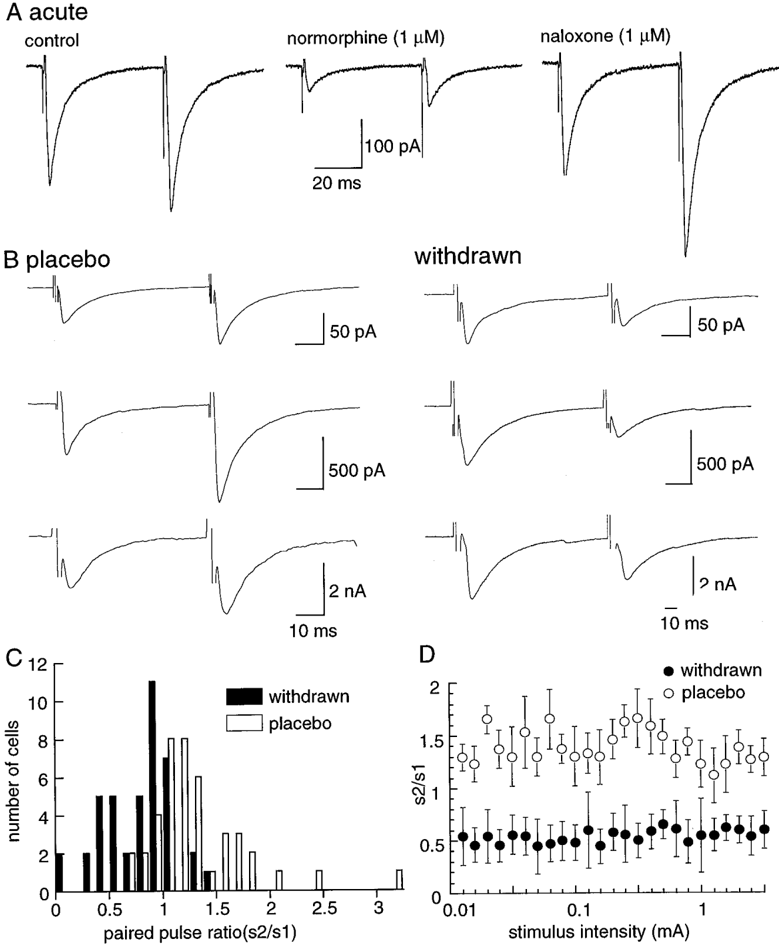
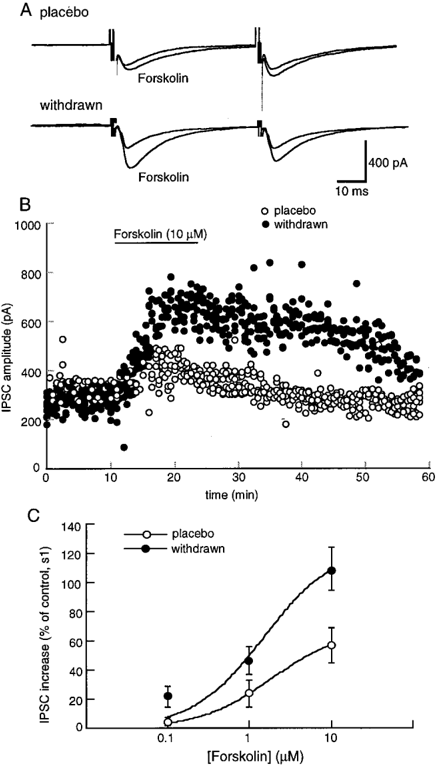
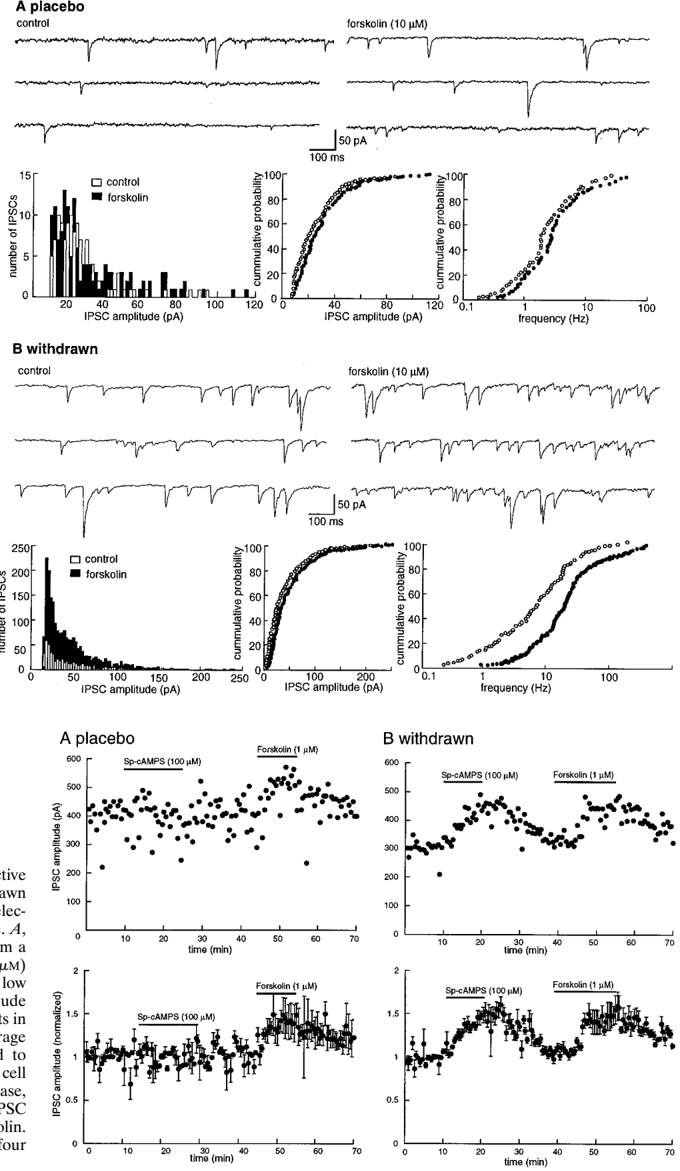
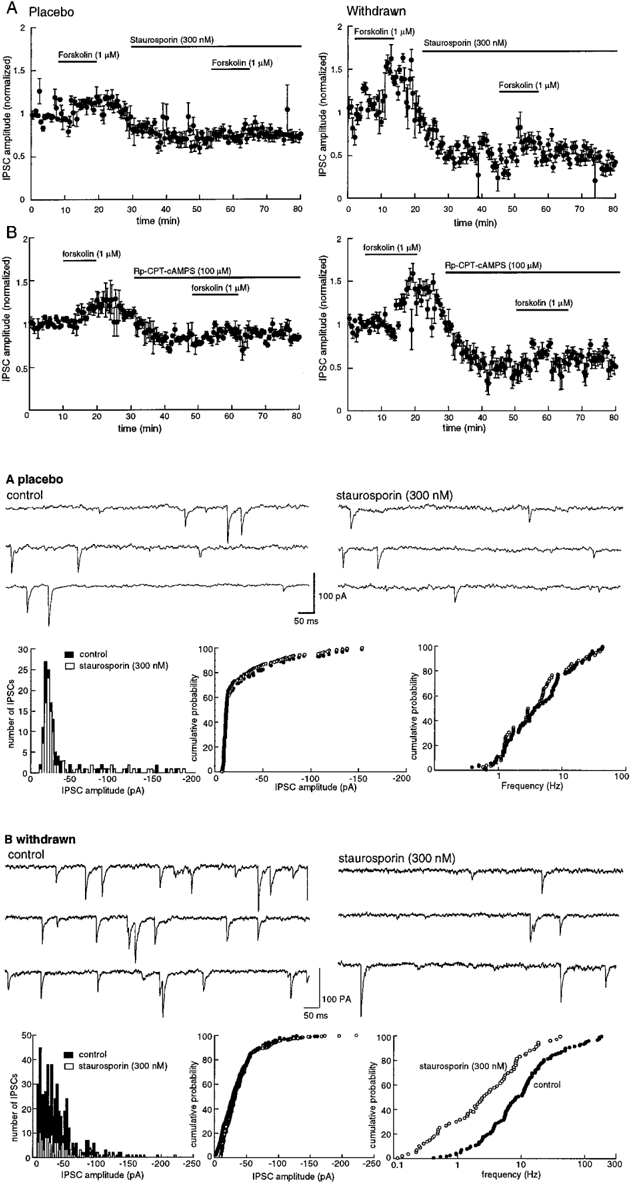
Verification
Claims the paper makes
The claims and statistics of this paper haven’t been checked yet.
Run the check — free, no account needed. It reads the open-access text and checks the sources it cites.
Claims other papers make about this one
Each is checked against this paper’s own text: does it say what the citing paper says it does?
In the citing paper
“A prominent observation is a chronic opioid-induced cAMP-dependent increase in the probability of GABA release in the VTA, which would inhibit dopamine neurons (Bonci and Williams, 1997).”
From Drug Addiction: Hyperkatifeia/Negative Reinforcement as a Framework for Medications Development (2021) · cites this paper as Bonci and Williams, 1997
Self-check
Percentages, sums and reported differences re-computed from the paper’s own numbers.
The self-check needs the paper’s full text.
Citations
Cites
Wise, R. A., & Rompre, P.-P. (1989) · Annual Review of Psychology · doi:10.1146/annurev.ps.40.020189.001203 · Cited by 1,968
Opioids excite dopamine neurons by hyperpolarization of local interneurons
Johnson, S., & North, R. (1992) · The Journal of Neuroscience · doi:10.1523/jneurosci.12-02-00483.1992 · Cited by 1,637
Aghajanian, G. K. (1978) · Nature · doi:10.1038/276186a0 · Cited by 800
Local and diffuse synaptic actions of GABA in the hippocampus
Isaacson, J. S., Solis, J. M., & Nicoll, R. A. (1993) · Neuron · doi:10.1016/0896-6273(93)90308-e · Cited by 688
Two types of neurone in the rat ventral tegmental area and their synaptic inputs.
Johnson, S. W., & NORTH, R. A. (1992) · The Journal of Physiology · doi:10.1113/jphysiol.1992.sp019136 · Cited by 672
Dual regulation of adenylate cyclase accounts for narcotic dependence and tolerance.
Sharma, S. K., Klee, W. A., & Nirenberg, M. W. (1975) · Proceedings of the National Academy of Sciences · doi:10.1073/pnas.72.8.3092 · Cited by 671
Molecular Mechanisms of Drug Reinforcement and Addiction
Self, D. W., & Nestler, E. J. (1995) · Annual Review of Neuroscience · doi:10.1146/annurev.ne.18.030195.002335 · Cited by 571
Drug addiction: A model for the molecular basis of neural plasticity
Nestler, E. J., Hope, B. T., & Widnell, K. L. (1993) · Neuron · doi:10.1016/0896-6273(93)90213-b · Cited by 535
Terwilliger, R. Z., Beitner‐Johnson, D., Sevarino, K. A., Crain, S. M., & Nestler, E. J. (1991) · Brain Research · doi:10.1016/0006-8993(91)91111-d · Cited by 534
Intracranial self-administration of morphine into the ventral tegmental area in rats
Bozarth, M. A., & Wise, R. A. (1981) · Life Sciences · doi:10.1016/0024-3205(81)90148-x · Cited by 507
Cited by
Sorted by citations
Items 201–286 of 286
EGFR dependent subcellular communication was responsible for morphine mediated AC superactivation
Zhao, H., Wu, G.-C., & Cao, X.-D. (2012) · Cellular Signalling · doi:10.1016/j.cellsig.2012.10.016 · Cited by 12
The role of adenosine A1 receptors in the nucleus accumbens during morphine withdrawal
Demirkapu, M. J., Yananlı, H. R., Kaleli, M., Sakallı, H. E., Gören, M. Z., & Topkara, B. (2019) · Clinical and Experimental Pharmacology and Physiology · doi:10.1111/1440-1681.13224 · Cited by 12
β-Phenylethylamines and the isoquinoline alkaloids
Bentley, K. W. (1998) · Natural Product Reports · doi:10.1039/a815341y · Cited by 12
Opioid Withdrawal Abruptly Disrupts Amygdala Circuit Function by Reducing Peptide Actions
Gregoriou, G. C., Patel, S., Pyne, S., Winters, B. L., & Bagley, E. E. (2023) · Journal of Neuroscience · doi:10.1523/jneurosci.1317-22.2022 · Cited by 11
Bell, J. A., & Grant, S. J. (1998) · Brain Research · doi:10.1016/s0006-8993(98)00003-1 · Cited by 11
Cellular and molecular mechanisms of opioid action
Ingram, S. (2000) · Progress in brain research · doi:10.1016/s0079-6123(00)29035-3 · Cited by 11
Opioid Tolerance in Adult and Neonatal Rats
Pan, Z. Z. (2003) · Humana Press eBooks · doi:10.1385/1-59259-379-8:223 · Cited by 11
Rafati, A., Noorafshan, A., & Torabi, N. (2013) · Anatomy & Cell Biology · doi:10.5115/acb.2013.46.3.191 · Cited by 10
Role of DOR in neuronal plasticity changes promoted by food-seeking behaviour
Mancino, S., Mendonça-Netto, S., Martín‐García, E., & Maldonado, R. J. (2016) · Addiction Biology · doi:10.1111/adb.12401 · Cited by 10
Laurent, R. S., & Kauer, J. A. (2019) · eNeuro · doi:10.1523/eneuro.0137-19.2019 · Cited by 10
Nimitvilai, S., Arora, D. S., McElvain, M. A., & Brodie, M. S. (2012) · Neuroscience · doi:10.1016/j.neuroscience.2012.08.045 · Cited by 9
Estimating Mental Health Conditions of Patients with Opioid Use Disorder
Minnerly, C., Bressler, S. L., Shokry, I. M., & Tao, R. (2019) · Journal of Addiction · doi:10.1155/2019/8586153 · Cited by 9
Olanzapine suppresses the rewarding and discriminative stimulus effects induced by morphine
Torigoe, K., Mori, T., Shibasaki, M., Yoshizawa, K., Narita, M., & Suzuki, T. (2011) · Synapse · doi:10.1002/syn.21500 · Cited by 9
Buprenorphine blocks withdrawal in morphine‐dependent rat pups
Stoller, D. C., & Smith, F. L. (2004) · Pediatric Anesthesia · doi:10.1111/j.1460-9592.2004.01264.x · Cited by 9
Wu, Y., Perez‐Rosello, T., Awatramani, R. B., & Surmeier, D. J. (2025) · Journal of Neuroscience · doi:10.1523/jneurosci.1194-24.2025 · Cited by 9
Enrico, P., Migliore, M., Spiga, S., Mulas, G., Caboni, F., & Diana, M. (2016) · Neuroscience · doi:10.1016/j.neuroscience.2016.02.006 · Cited by 8
Jones, G. C., Small, C. A., Otteson, D. Z., Hafen, C. W., Breinholt, J., Flora, P. D., Burris, M., Sant, D., Ruchti, T., Yorgason, J. T., et al. (2023) · International Journal of Molecular Sciences · doi:10.3390/ijms241814147 · Cited by 8
Chen, H., Lin, Y.-R., & Chan, M. (2011) · Toxicology Letters · doi:10.1016/j.toxlet.2011.06.026 · Cited by 8
Wittenkeller, L. M., Gudelsky, G. A., Winhusen, T. M., & Amato, D. (2025) · British Journal of Pharmacology · doi:10.1111/bph.70181 · Cited by 7
Functional Adaptation in the Brain Habenulo–Mesencephalic Pathway During Cannabinoid Withdrawal
Aroni, S., Sagheddu, C., Pistis, M., & Muntoni, A. L. (2024) · Cells · doi:10.3390/cells13211809 · Cited by 7
Mazaheri, S., Zendehdel, M., & Haghparast, A. (2022) · Progress in Neuro-Psychopharmacology and Biological Psychiatry · doi:10.1016/j.pnpbp.2022.110539 · Cited by 7
Loss of Plasticity in the D2-Accumbens Pallidal Pathway Promotes Cocaine Seeking
Heinsbroek, J. A., Neuhofer, D. N., Griffin, W. C., Siegel, G. S., Bobadilla, A., Kupchik, Y. M., & Kalivas, P. W. (2017) · Journal of Neuroscience · doi:10.1523/jneurosci.2659-16.2017 · Cited by 7
EFFECT OF GABA RECEPTOR AGONISTS OR ANTAGONISTS ON MORPHINE-INDUCED STRAUB TAIL IN MICE
Zarrindast, M., GHADIMI, M., Ramezani-Tehrani, B., & Sahebgharani, M. (2006) · International Journal of Neuroscience · doi:10.1080/00207450600550428 · Cited by 7
Simmons, S. J., Gentile, T. A., Mo, L., Tran, F. H., Ma, S., & Muschamp, J. W. (2016) · Behavioural Brain Research · doi:10.1016/j.bbr.2016.07.053 · Cited by 7
Modulation of miR-139-5p on chronic morphine-induced, naloxone-precipitated cAMP overshoot in vitro
Cao, D., Shi, J., Wu, N., & Li, J. (2018) · Metabolic Brain Disease · doi:10.1007/s11011-018-0257-8 · Cited by 7
Koob, G. F., & Moal, M. L. (2006) · Elsevier eBooks · doi:10.1016/b978-012419239-3/50041-2 · Cited by 8
Merz, S. F., Bengtson, C. P., Tepohl, C., Hagenston, A. M., Bading, H., & Orth, C. B. (2020) · Molecular Brain · doi:10.1186/s13041-020-00641-1 · Cited by 7
Ram, A., Edwards, T. M., McCarty, A., McDermott, M., & Bobeck, E. N. (2021) · Journal of Neurochemistry · doi:10.1111/jnc.15506 · Cited by 6
Ciccocioppo, R., de Guglielmo, G., Li, H., Melis, M., Caffino, L., Shen, Q., Domi, A., Fumagalli, F., Demopulos, G. A., & Gaitanaris, G. (2021) · Journal of Neuroscience · doi:10.1523/jneurosci.3180-20.2021 · Cited by 7
Opioid-Induced Reductions in Amygdala Lateral Paracapsular GABA Neuron Circuit Activity
Ronström, J. W., Johnson, N. L., Jones, S. T., Werner, S. J., Wadsworth, H. A., Brundage, J., Stolp, V., Graziane, N., Silberman, Y., Steffensen, S. C., et al. (2023) · International Journal of Molecular Sciences · doi:10.3390/ijms24031929 · Cited by 6
Navidhamidi, M., Semnanian, S., Javan, M., Goudarzvand, M., Rohampour, K., & Azizi, H. (2011) · Behavioural Brain Research · doi:10.1016/j.bbr.2011.09.043 · Cited by 6
Bills, K. B., Otteson, D. Z., Jones, G. C., Brundage, J., Baldwin, E. K., Small, C. A., Kim, H. Y., Yorgason, J. T., Blotter, J. D., & Steffensen, S. C. (2022) · International Journal of Molecular Sciences · doi:10.3390/ijms232012630 · Cited by 6
Zanjani, T. M., & Sabetkasaei, M. (2010) · Europe PMC (PubMed Central) · Cited by 6
Parsing Spontaneous and Evoked Neurotransmission on Both Sides of the Synapse
Rothwell, P. E. (2010) · Journal of Neuroscience · doi:10.1523/jneurosci.1177-10.2010 · Cited by 5
Central Amygdala Neuroplasticity in Alcohol Dependence
Roberto, M., & Gilpin, N. (2014) · Elsevier eBooks · doi:10.1016/b978-0-12-405941-2.00011-0 · Cited by 9
Neuroimaging and mechanisms of drug abuse: interface of molecular imaging and molecular genetics
Monique Ernst, D., Kimes, A. S., & Jazbec, S. (2003) · Neuroimaging Clinics of North America · doi:10.1016/s1052-5149(03)00109-6 · Cited by 5
Gooding, S. W., Lewis, E., Chau, C., Sandhu, S., Glienke, J., & Whistler, J. L. (2024) · bioRxiv (Cold Spring Harbor Laboratory) · doi:10.1101/2024.06.28.601282 · Cited by 6
Effect of ethanolic extract of Safflower on naloxone-induced morphine withdrawal signs in mice
Abbasi-Maleki, S. (2016) · DOAJ (DOAJ: Directory of Open Access Journals) · Cited by 4
ElShebiney, S. A., Elgohary, R., El-Shamarka, M. E.-S., Mabrouk, M., & Beheri, H. H. (2024) · Behavioural Pharmacology · doi:10.1097/fbp.0000000000000778 · Cited by 4
Woodward, T. J., Tešić, V., Stamenić, T. T., Jevtović‐Todorović, V., & Todorovic, S. M. (2019) · Frontiers in Pharmacology · doi:10.3389/fphar.2019.01402 · Cited by 5
Pro-addictive and anti-addictive factors for drug dependence.
Yamada, K. (2008) · PubMed · doi:10.18999/nagjms.70.3-4.67 · Cited by 3
Chandler, L. J., Bonci, A., Wand, G. S., & Morrisett, R. A. (2004) · Alcoholism Clinical and Experimental Research · doi:10.1097/01.alc.0000131980.53097.11 · Cited by 3
Self-citationCoffey, K. R., Lesiak, A. J., Marx, R. G., Vo, E. K., Garden, G. A., & Neumaier, J. F. (2020) · bioRxiv (Cold Spring Harbor Laboratory) · doi:10.1101/2020.02.10.942953 · Cited by 3
Neurobiology of opioid use disorder
Cucinello‐Ragland, J. A., Lintz, T., & Morón, J. A. (2025) · Elsevier eBooks · doi:10.1016/b978-0-443-26504-4.00008-9 · Cited by 2
Acute Dystonia Following Opioid Withdrawal: An Uncommon Presentation
Nath, S., Mishra, B. R., Mishra, S., & Pattnaik, J. I. (2019) · Indian Journal of Psychological Medicine · doi:10.4103/ijpsym.ijpsym_422_18 · Cited by 2
Persistent dystonia following opioid withdrawal
Aggarwal, A., Kumar, R., Sharma, R., & Sharma, D. D. (2010) · Progress in Neuro-Psychopharmacology and Biological Psychiatry · doi:10.1016/j.pnpbp.2010.05.033 · Cited by 2
Protein kinase inhibitors reduce GABA but not glutamate release in the nucleus accumbens
Warrier, A., & Hjelmstad, G. O. (2007) · Neuropharmacology · doi:10.1016/j.neuropharm.2007.09.004 · Cited by 2
Koob, G. F., Arends, M. A., McCracken, M. L., & Moal, M. L. (2023) · Elsevier eBooks · doi:10.1016/b978-0-12-816988-9.00001-1 · Cited by 2
Gomez, D. M., Kahl, T., Berrington, E., & Hearing, M. C. (2023) · bioRxiv (Cold Spring Harbor Laboratory) · doi:10.1101/2023.01.29.526129 · Cited by 2
Donka, R. M., Loh, M. K., Schrank, S., Sevigny, J. P., Patel, S. M., McAndrew, D. A., Sparta, D. R., & Roitman, J. D. (2025) · Physiology & Behavior · doi:10.1016/j.physbeh.2025.114987 · Cited by 2
Essmat, N., Boldizsár, I., Chalabiani, Y., Varga, B. T., Abbood, S. K., Kirchlechner-Farkas, J. M., Király, K. P., Miklya, I., Gyertyán, I., Tábi, T., et al. (2025) · International Journal of Molecular Sciences · doi:10.3390/ijms262110526 · Cited by 1
VTA GABAergic Plasticity: An Inhibitory Synaptic Model of Drug Addiction
Nugent, F. S. (2010) · Springer eBooks · doi:10.1007/978-1-4419-6978-1_5 · Cited by 1
Augmentation of paired pulse index as short-term plasticity due to morphine dependence
Hoseinmardi, N., Azimi, L., Javan, M., Naghdi, N., & Fathollahi, Y. (2009) · Cited by 1
The effects of naltrexone on neural responses to methamphetamine cues
Courtney, K. E., Ghahremani, D. G., & Ray, L. A. (2017) · Drug and Alcohol Dependence · doi:10.1016/j.drugalcdep.2016.08.141 · Cited by 1
Sayın, Ü. (2019) · Forensic Science & Addiction Research · doi:10.31031/fsar.2019.04.000599 · Cited by 1
Ducrot, C., & Trudeau, L. (2021) · European Journal of Neuroscience · doi:10.1111/ejn.15268 · Cited by 1
The Periaqueductal Grey in Opioid Tolerance and Chronic Pain
Ram, A. (2021) · Digital Commons - USU (Utah State University) · doi:10.26076/176b-0d1f · Cited by 1
Spoken and Unspoken Matters Regarding the Use of Opioids in Cancer
Rogers, J. B., & Higa, G. M. (2022) · Journal of Pain Research · doi:10.2147/jpr.s349107 · Cited by 1
Mishra, D., Pena-Bravo, J. I., Ghee, S. M., Berini, C., Reichel, C. M., & Lavín, A. (2021) · bioRxiv (Cold Spring Harbor Laboratory) · doi:10.1101/2021.04.22.440987 · Cited by 1
Synaptic Plasticity in GABAergic Inhibition of VTA Neurons
Mabey, J. K. (2014) · ScholarsArchive (Brigham Young University)
Cocaine and mefloquine-induced acute effects in ventral tegmental area dopamine and GABA neurons
Allison, D. W. (2009) · ScholarsArchive (Brigham Young University)
Opioid Withdrawal: Creating More Problems
Prommer, E. (2007) · Journal of Pain and Symptom Management · doi:10.1016/j.jpainsymman.2006.09.010
Neurochemische Befunde bei Wistar-Ratten im akuten und protrahierten Opiatentzug
Tübingen, P., Buchkremer, G., & Wolffgramm, J. (2005)
Charkhpour, M., & Reza, M. N. A. (2005)
Bird, M. F. (2015) · Leicester Research Archive (University of Leicester)
Ventral Tegmental Area Regulation Of Stress-Induced Reinstatement Of Cocaine-Seeking Behavior
Blacktop, J. M. (2014) · e-Publications@Marquette (Marquette University)
Issues Associated with Opioid Use
Issa, M., Celestin, J., & Wasan, A. D. (2013) · Elsevier eBooks · doi:10.1016/b978-0-323-08340-9.00051-7
West, K. M. (2022) · Digital Archive @ GSU · doi:10.57709/12454585
Investigating the Role of the Growth Hormone Secretagogue Receptor in Food-Motivated Behaviours
King, S. (2018) · Carleton University's Institutional Repository (MacOdrum Library, Carleton University) · doi:10.22215/etd/2018-13208
Faculty Opinions recommendation of Biased signaling by endogenous opioid peptides.
Darcq, E. (2021) · Faculty Opinions – Post-Publication Peer Review of the Biomedical Literature · doi:10.3410/f.737936344.793581989
Pumping the brakes: rostromedial tegmental inhibition of compulsive cocaine seekingPreprint
Vento, P. J., Watson, J. R., Pullmann, D., Black, S. L., Tomberlin, J., & Jhou, T. C. (2023) · bioRxiv (Cold Spring Harbor Laboratory) · doi:10.1101/2023.10.04.560908
Taylor, D. H. (2011) · ScholarsArchive (Brigham Young University)
Galaj, E., Morris, C., Fleischer, A., Xie, C., Shortell, H., Slama, J., Litchfield, C., Petersohn, S., Burdick, E., Persaud, K., et al. (2026) · Psychopharmacology · doi:10.1007/s00213-026-07005-y
Edwards, J. G., Ostlund, I., & Gunten, M. V. (2026) · Neuropharmacology · doi:10.1016/j.neuropharm.2026.110925
Bonneau, N. (2010) · theses.fr (ABES) · doi:10.70675/70b0c65bzc1a6z4af4zb70fz2aee94ac71e1
Allichon, M., Espinosa, J., Cole, R. H., Ko, M.-C., Vanhoutte, P., & Joffe, M. E. (2026) · Frontiers in Cellular Neuroscience · doi:10.3389/fncel.2026.1774384 · Cited by 1
Hamedanian, N., Karimipoor, M., Amidfar, M., & Yoosefee, S. (2026) · Addiction and Health · doi:10.34172/ahj.1714
Opioid Modulation of Major Neurotransmitter Systems: Acute, Chronic, and Withdrawal Effects
Nováková, D., Pritulova, E., & Novotný, J. (2026) · European Journal of Neuroscience · doi:10.1111/ejn.70735
Role of α6 nAChRs in Ethanol Modulation of VTA Neurons
Shin, S. I. (2014) · ScholarsArchive (Brigham Young University)
Xie, J. Y. (2005) · UA Campus Repository (The University of Arizona)
Metadata
- Authors
- Bonci, A., & Williams, J. T.
- Affiliations
- Oregon Health & Science University (US)
- Venue
- The Journal of Neuroscience
- Publisher
- Society for Neuroscience
- Published
- 1997-01-15
- Volume
- 17
- Issue
- 2
- Pages
- 796-803
- ISSN
- 0270-6474 (ISSN-L)
- 1529-2401
- PMC
- PMC6573250
- OpenAlex
- W2169322025
- Cited by
- 286
- References
- 45
- Citations by year
- 2026: 4 · 2025: 8 · 2024: 3 · 2023: 12 · 2022: 7 · 2021: 11 · 2020: 6 · 2019: 10 · 2018: 10 · 2017: 9 · 2016: 10 · 2015: 8 · 2014: 15 · 2013: 5 · 2012: 12
- FWCI
- 2.36
- Type
- journal article
- Language
- en
- Open access
- hybrid
- doi.org
- Licence
- Locations
- Journal of Neuroscience (publishedVersion, cc-by-nc-sa)
- Europe PMC (PubMed Central) (publishedVersion)
- PubMed Central (publishedVersion)
- PubMed (publishedVersion)
- Funders
- National Institutes of Health
- National Institute on Drug Abuse (R01DA008163, DA-08163)
- Topics
- Life Sciences › Neuroscience › Cellular and Molecular Neuroscience › Neuroscience and Neuropharmacology Research
- Life Sciences › Neuroscience › Cellular and Molecular Neuroscience › Neurotransmitter Receptor Influence on Behavior
- Life Sciences › Neuroscience › Cellular and Molecular Neuroscience › Neuropeptides and Animal Physiology
- Keywords
- morphine withdrawal, GABA release, ventral tegmental area, dopaminergic neurons, miniature IPSCs, opioid receptors, cAMP signaling, adenylate cyclase, protein kinase A, chronic morphine administration, synaptic plasticity, drug addiction
- MeSH terms
- Adenylyl Cyclase Inhibitors, Action Potentials, Cyclic AMP, Adenylyl Cyclases, Animals, Dopamine, Enzyme Activation, Enzyme Inhibitors, Colforsin, gamma-Aminobutyric Acid, Guinea Pigs, Interneurons, Morphine, Nerve Tissue Proteins, Organophosphorus Compounds, Picrotoxin, Receptors, GABA-A, Salicylamides, Serotonin, Strychnine, Substance Withdrawal Syndrome, Tegmentum Mesencephali, Thionucleotides, Phorbol 12,13-Dibutyrate, Signal Transduction, 2-Amino-5-phosphonovalerate, Cyclic AMP-Dependent Protein Kinases, Patch-Clamp Techniques, Dopamine Antagonists, Excitatory Amino Acid Antagonists, 6-Cyano-7-nitroquinoxaline-2,3-dione, GABA Antagonists, Staurosporine
About these checks
Registry, retraction, Cites and statistics results are computed, not judged, with one exception: a printed reference that no index lists is read once by a model before it counts as a citation error. Claims are extracted by a model and kept only when their quote appears verbatim in the text; each cited source is then checked, with a model’s help, for whether it says what the claim relies on. Those verdicts can be wrong — read the claim’s quote and the cited source before relying on one.
Statistics and arithmetic are recomputed, not judged.
Confidence bands are shown only for fields calibrated on our annotated test set. None is calibrated yet, so no band is shown.
What counts as a claim ›How we measure confidence ›How we check this ›
Are you an author, or do you see a problem with this page? Request a review
