

Transcriptional repression of NFKBIA triggers constitutive IKK‐ and proteasome‐independent p65/RelA activation in senescence
Open accessPublished version of a preprint
The DOI matches its Crossref record; 53 of the 53 references it cites were found in a registry or an index.
Abstract
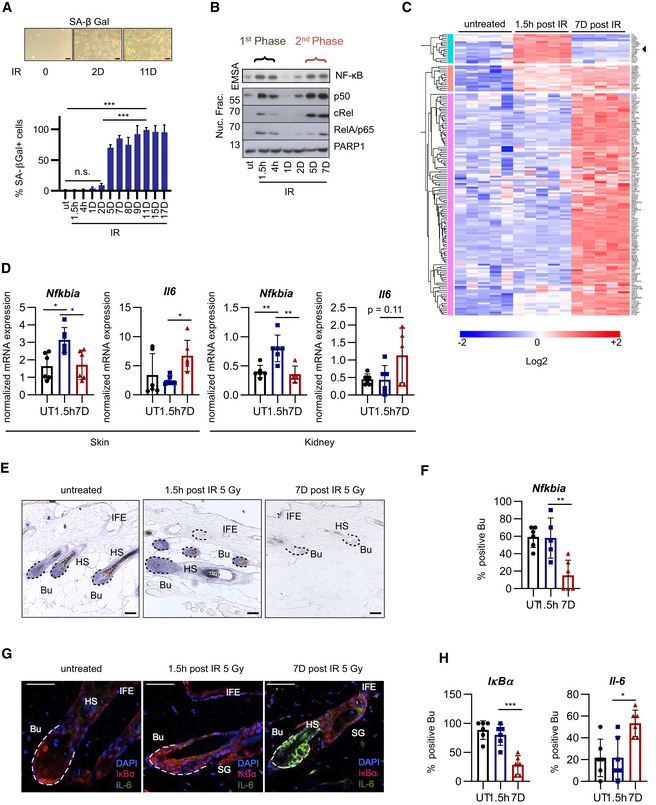
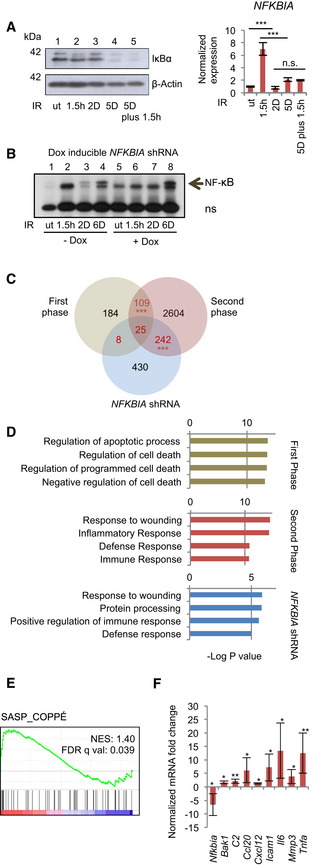
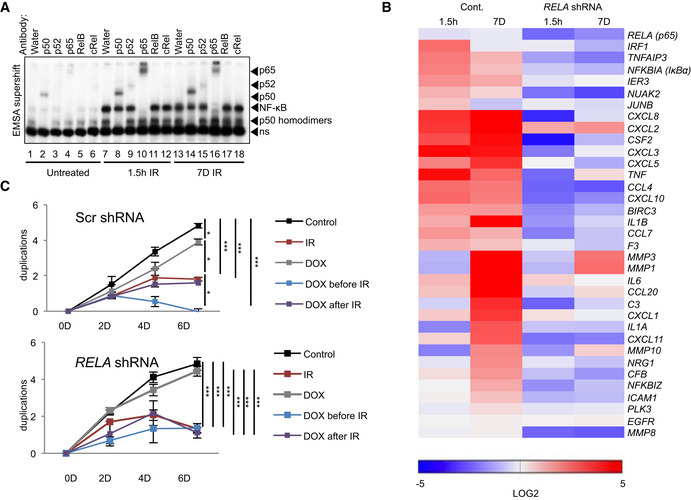
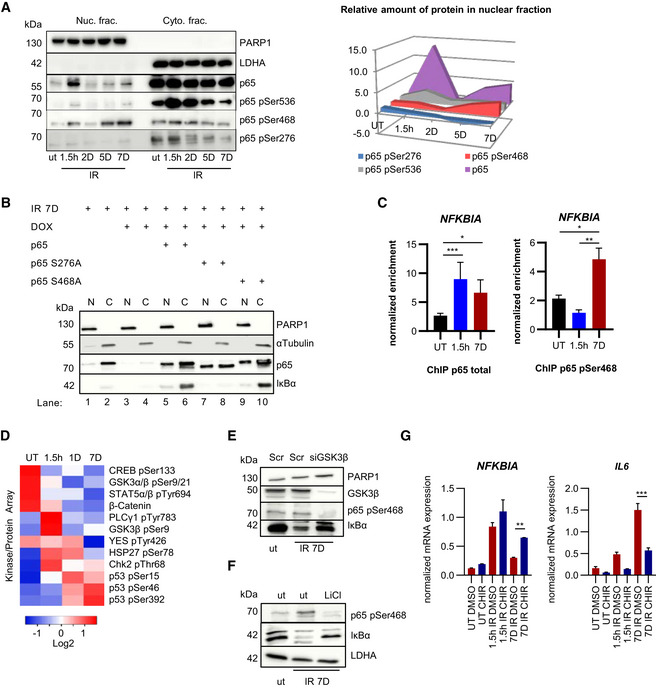
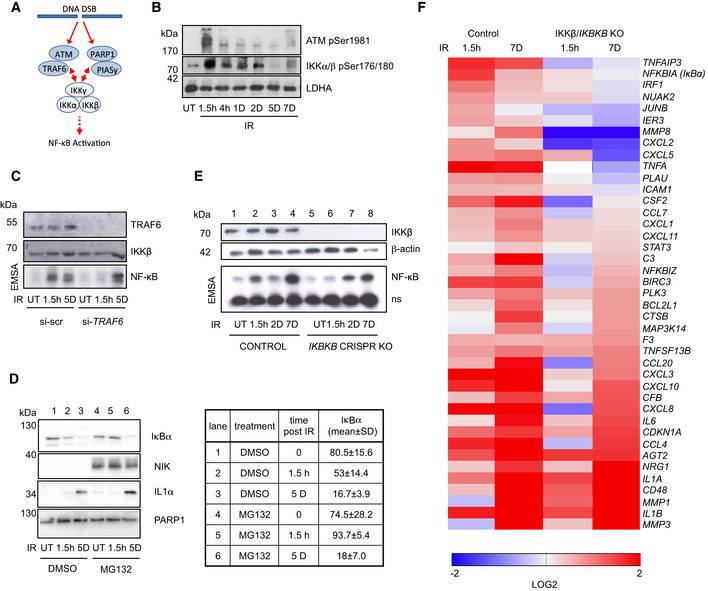
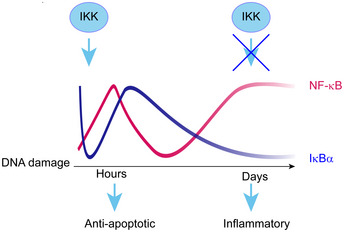
The IκB kinase (IKK)‐NF‐κB pathway is activated as part of the DNA damage response and controls both inflammation and resistance to apoptosis. How these distinct functions are achieved remained unknown. We demonstrate here that DNA double‐strand breaks elicit two subsequent phases of NF‐κB activation in vivo and in vitro, which are mechanistically and functionally distinct. RNA‐sequencing reveals that the first‐phase controls anti‐apoptotic gene expression, while the second drives expression of senescence‐associated secretory phenotype (SASP) genes. The rapidly activated first phase is driven by the ATM‐PARP1‐TRAF6‐IKK cascade, which triggers proteasomal destruction of inhibitory IκBα, and is terminated through IκBα re‐expression from the NFKBIA gene. The second phase, which is activated days later in senescent cells, is on the other hand independent of IKK and the proteasome. An altered phosphorylation status of NF‐κB family member p65/RelA, in part mediated by GSK3β, results in transcriptional silencing of NFKBIA and IKK‐independent, constitutive activation of NF‐κB in senescence. Collectively, our study reveals a novel physiological mechanism of NF‐κB activation with important implications for genotoxic cancer treatment.
Overview
The claims and statistics of this paper haven’t been checked yet.
Free: it reads the open-access text and checks the first 5 claims that cite a source we can check. Create a free account to check every claim.
Integrity signals
Registry
Cites
Statistics
Figures
Verification
Claims the paper makes
The claims and statistics of this paper haven’t been checked yet.
Free: it reads the open-access text and checks the first 5 claims that cite a source we can check. Create a free account to check every claim.
Claims other papers make about this one
Each is checked against this paper’s own text: does it say what the citing paper says it does?
The source backs part of the claim, not all of it — or backs it for a different population, condition or comparison.
In the citing paper
“Like many other senescence- associated features, however, the SASP is not stable, instead being highly dynamic 6,70,71 .”
From Senescence and cancer — role and therapeutic opportunities (2022) · cites this paper as [71]
Experimental — accuracy not yet measuredThe source backs part of the claim, not all of it — or backs it for a different population, condition or comparison.
In the citing paper
“Induction of p21 and a Notch- driven SASP are considered early events 70,75,76 , whereas upregulation of p16 INK4a and an NF- κB- driven SASP are evident at later stages of senescence 71,77,78 .”
From Senescence and cancer — role and therapeutic opportunities (2022) · cites this paper as [71]
Experimental — accuracy not yet measuredThe cited source says what the claim attributes to it.
In the citing paper
“has recently been experimentally verified in U2OS osteosarcoma cells66”
From A new gene set identifies senescent cells and predicts senescence-associated pathways across tissues (2022) · cites this paper as [66]
Self-check
Percentages, sums and reported differences re-computed from the paper’s own numbers.
The self-check needs the paper’s full text.
Citations
Cites
The senescence-associated secretory phenotype: the dark side of tumor suppression
Coppé, J.-P., Desprez, P.-Y., Krtolica, A., & Campisi, J. (2010) · Annual Review of Pathology: Mechanisms of Disease · doi:10.1146/annurev-pathol-121808-102144 · Cited by 5,206
A complex secretory program orchestrated by the inflammasome controls paracrine senescence
Acosta, J. C., Banito, A., Wuestefeld, T., Georgilis, A., Janich, P., Morton, J. P., Athineos, D., Kang, T.-W., Lasitschka, F., Andrulis, M., et al. (2013) · Nature Cell Biology · doi:10.1038/ncb2784 · Cited by 2,278 · cited 1×
“…however, comprises factors that may instigate oncogenic transformation, cell migration, and cancer stemness (Acosta et al , 2008; Reimann et al , 2010; Chien et al , 2011; Freund et al , 2011; Jing et al , 2011; Acosta et al , 2013; Salama et al , 2014; Hoare et al , 2016; Milanovic et al , 2018).”
Persistent DNA damage signalling triggers senescence-associated inflammatory cytokine secretion
Rodier, F., Coppé, J.-P., Patil, C. K., Hoeijmakers, W. A. M., Muñoz, D. P., Raza, S. R., Freund, A., Campeau, E., Davalos, A. R., & Campisi, J. (2009) · Nature Cell Biology · doi:10.1038/ncb1909 · Cited by 2,232
Oncogene-Induced Senescence Relayed by an Interleukin-Dependent Inflammatory Network
Kuilman, T., Michaloglou, C., Vredeveld, L. C. W., Douma, S., van Doorn, R., Desmet, C. J., Aarden, L. A., Mooi, W. J., & Peeper, D. S. (2008) · Cell · doi:10.1016/j.cell.2008.03.039 · Cited by 2,086 · cited 2×
“The majority of SASP factors are transcriptional targets of NF-j B (Acosta et al , 2008; Kuilman et al , 2008; Chien et al , 2011; Freund et al , 2011; Jing et al , 2011; Lasry & Ben-Neriah, 2015).”
Chemokine signaling via the CXCR2 receptor reinforces senescence
Acosta, J. C., O'Loghlen, A., Banito, A., Guijarro, M. V., Augert, A., Raguz, S., Fumagalli, M., Da Costa, M., Brown, C., Popov, N., et al. (2008) · Cell · doi:10.1016/j.cell.2008.03.038 · Cited by 1,801 · cited 3×
“The majority of SASP factors are transcriptional targets of NF-j B (Acosta et al , 2008; Kuilman et al , 2008; Chien et al , 2011; Freund et al , 2011; Jing et al , 2011; Lasry & Ben-Neriah, 2015).”
NF-κB, the first quarter-century: remarkable progress and outstanding questions
Hayden, M. S., & Ghosh, S. (2012) · Genes & Development · doi:10.1101/gad.183434.111 · Cited by 1,693 · cited 1×
“The latter is composed of the regulatory IKK c subunit and the kinases IKK a and IKK b (Hayden & Ghosh, 2012; Hinz & Scheidereit, 2014), which phosphorylate I j B a , targeting it for degradation by the 26S proteasome.”
Senescence in premalignant tumours
Collado, M., Gil, J., Efeyan, A., Guerra, C., Schuhmacher, A. J., Barradas, M., Benguría, A., Zaballos, A., Flores, J. M., Barbacid, M., et al. (2005) · Nature · doi:10.1038/436642a · Cited by 1,482 · cited 1×
“The epigenetically controlled cell cycle cessation serves as a cell-autonomous barrier to tumor formation (Braig et al , 2005; Collado et al , 2005; Reimann et al , 2010).”
Inflammation meets cancer, with NF-κB as the matchmaker
Ben-Neriah, Y., & Karin, M. (2011) · Nature Immunology · doi:10.1038/ni.2060 · Cited by 1,373
Oncogene-induced senescence as an initial barrier in lymphoma development
Braig, M., Lee, S., Loddenkemper, C., Rudolph, C., Peters, A. H. F. M., Schlegelberger, B., Stein, H., Dörken, B., Jenuwein, T., & Schmitt, C. A. (2005) · Nature · doi:10.1038/nature03841 · Cited by 1,220 · cited 1×
“The epigenetically controlled cell cycle cessation serves as a cell-autonomous barrier to tumor formation (Braig et al , 2005; Collado et al , 2005; Reimann et al , 2010).”
Self-citationSenescence-associated reprogramming promotes cancer stemness
Milanovic, M., Fan, D. N. Y., Belenki, D., Däbritz, J. H. M., Zhao, Z., Yu, Y., Dörr, J. R., Dimitrova, L., Lenze, D., Monteiro Barbosa, I. A., et al. (2018) · Nature · doi:10.1038/nature25167 · Cited by 1,131 · cited 1×
“…however, comprises factors that may instigate oncogenic transformation, cell migration, and cancer stemness (Acosta et al , 2008; Reimann et al , 2010; Chien et al , 2011; Freund et al , 2011; Jing et al , 2011; Acosta et al , 2013; Salama et al , 2014; Hoare et al , 2016; Milanovic et al , 2018).”
Self-citation
Cited by
A new gene set identifies senescent cells and predicts senescence-associated pathways across tissues
Saul, D., Kosinsky, R. L., Atkinson, E. J., Doolittle, M. L., Zhang, X., LeBrasseur, N. K., Pignolo, R. J., Robbins, P. D., Niedernhofer, L. J., Ikeno, Y., et al. (2022) · Nature Communications · doi:10.1038/s41467-022-32552-1 · Cited by 1,022
“Interestingly, the control of the SASP itself by RELA/p65, which we detected in two sequencing datasets of aging women, has recently been experimentally verified in U2OS osteosarcoma cells.(64)”
BackgroundThe senescence-associated secretory phenotype and its physiological and pathological implications
Wang, B., Han, J., Elisseeff, J. H., & Demaria, M. (2024) · Nature Reviews Molecular Cell Biology · doi:10.1038/s41580-024-00727-x · Cited by 948
Senescence and cancer — role and therapeutic opportunities
Schmitt, C. A., Wang, B., & Demaria, M. (2022) · Nature Reviews Clinical Oncology · doi:10.1038/s41571-022-00668-4 · Cited by 794
Self-citationThe Cancer SENESCopedia: A delineation of cancer cell senescence
Jochems, F., Thijssen, B., De Conti, G., Jansen, R., Pogacar, Z., Groot, K., Wang, L., Schepers, A., Wang, C., Jin, H., et al. (2021) · Cell Reports · doi:10.1016/j.celrep.2021.109441 · Cited by 201
Single-cell senescence identification reveals senescence heterogeneity, trajectory, and modulators
Tao, W., Yu, Z., & Han, J.-D. J. (2024) · Cell Metabolism · doi:10.1016/j.cmet.2024.03.009 · Cited by 147
Single-cell transcriptomics identifies Mcl-1 as a target for senolytic therapy in cancer
Troiani, M., Colucci, M., D’Ambrosio, M., Guccini, I., Pasquini, E., Varesi, A., Valdata, A., Mosole, S., Revandkar, A., Attanasio, G., et al. (2022) · Nature Communications · doi:10.1038/s41467-022-29824-1 · Cited by 123
Cellular senescence: Neither irreversible nor reversible
Reimann, M., Lee, S., & Schmitt, C. A. (2024) · The Journal of Experimental Medicine · doi:10.1084/jem.20232136 · Cited by 136
“…periods of time increasingly pin-point (epi)genomic reorganization or modulated composition of SASP waves in the course of senescence establishment and the subsequent maintenance phase (Chandra et al., 2015; Hoare et al., 2016; Kolesnichenko et al., 2021; Sadaie et al., 2013; Shah et al., 2013).”
BackgroundSelf-citationPolyphenols as Caloric-Restriction Mimetics and Autophagy Inducers in Aging Research
Yessenkyzy, A., Saliev, T. M., Zhanaliyeva, M., Masoud, A., Umbayev, B. A., Sergazy, S., Кривых, Е. А., Gulyayev, A., & Nurgozhin, T. S. (2020) · Nutrients · doi:10.3390/nu12051344 · Cited by 121
Yu, J.-T., Hu, X., Yang, Q., Shan, R.-R., Zhang, Y., Dong, Z.-H., Li, H.-D., Wang, J.-N., Li, C., Xie, S.-S., et al. (2022) · Kidney International · doi:10.1016/j.kint.2022.05.026 · Cited by 76
A New Gene Set Identifies Senescent Cells and Predicts Senescence-Associated Pathways Across Tissues
(2021) · doi:10.1101/2021.12.10.472095 · Cited by 58
NF‐κB/IKK activation by small extracellular vesicles within the SASP
Fafián‐Labora, J., & O’Loghlen, A. (2021) · Aging Cell · doi:10.1111/acel.13426 · Cited by 53
“Interestingly, a recent study has shown that during the initial activation of senescence, IKKβ is activated by ATM while in the later stages the sSASP is expressed independently of IKKα/β and proteasome degradation of IκB in spite of depending on the NF- κB protein p65 (Kolesnichenko et al., 2021).”
BackgroundMonitoring the Levels of Cellular NF-κB Activation States
Meier‐Soelch, J., Mayr‐Buro, C., Juli, J. U., Leib, L., Linne, U., Dreute, J., Papantonis, A., Schmitz, M. L., & Kracht, M. (2021) · Cancers · doi:10.3390/cancers13215351 · Cited by 57
TSG101 associates with PARP1 and is essential for PARylation and DNA damage‐induced NF‐κB activation
Tufan, A. B., Lazarow, K., Kolesnichenko, M., Sporbert, A., von Kries, J. P., & Scheidereit, C. (2022) · The EMBO Journal · doi:10.15252/embj.2021110372 · Cited by 47
Self-citationWizenty, J., Müllerke, S., Kolesnichenko, M., Heuberger, J., Lin, M., Fischer, A., Mollenkopf, H., Berger, H., Tacke, F., & Sigal, M. J. (2022) · The EMBO Journal · doi:10.15252/embj.2021109996 · Cited by 40
“Supershift protocol was described previously (Kolesnichenko et al , 2021).”
Self-citationLehmann, J., Narcisi, R., Franceschini, N., Chatzivasileiou, D., Boer, C. G., Koevoet, W. J. L. M., Putavet, D. A., Drabek, D., van Haperen, R., de Keizer, P. L. J., et al. (2022) · Cellular and Molecular Life Sciences · doi:10.1007/s00018-021-04035-x · Cited by 41
“Upon induction of senescence in a cancer line of mesenchymal origin (osteosarcoma, U2-OS), phosphorylation of NF-κB subunit p65 by GSK3β paves the way to a persistent SASP because it represses transcription of IκBα, which otherwise acts as the negative feedback loop restricting NF-κB activity [97].”
BackgroundLiu, H., Yang, R., Zhao, S., Zhou, F., Liu, Y., Zhou, Z., Chen, L., & Xie, J. (2022) · Bioengineering & Translational Medicine · doi:10.1002/btm2.10467 · Cited by 33
“Generally, the IκB component of the NFκB and IκB complex was degraded by phosphorylated IKKβ, resulting in NFκB translocation into the nucleus and the induction of proinflammatory gene transcription.(42) Nonetheless, CBS-MSCs may”
BackgroundKment, J. L., Newsted, D., Young, S., Vermeulen, M., Laight, B. J., Greer, P. A., Lan, Y., & Craig, A. W. (2024) · British Journal of Cancer · doi:10.1038/s41416-024-02677-9 · Cited by 34
Wang, J., Zhou, X., Yu, P., Yao, J., Guo, P., Xu, Q., Zhao, Y., Wang, G., Li, Q., Zhu, X., et al. (2025) · Nature Aging · doi:10.1038/s43587-025-00886-2 · Cited by 28
Quake, S. R. (2024) · bioRxiv (Cold Spring Harbor Laboratory) · doi:10.1101/2024.12.03.626516 · Cited by 57
Targeting cIAP2 in a novel senolytic strategy prevents glioblastoma recurrence after radiotherapy
Tomimatsu, N., Cristofaro, L. F. M. D., Kanji, S., Samentar, L., Jordan, B. R., Kittler, R., Habib, A. A., Espíndola‐Netto, J. M., Tchkonia, T., Kirkland, J. L., et al. (2025) · EMBO Molecular Medicine · doi:10.1038/s44321-025-00201-x · Cited by 35
“…upon the NF-κ B pathway (Chien et al, 2011; Ohanna et al, 2011) which is activated in senescent cells by persistent DNA damage or cytosolic dsDNA in a PARP1/ATM-or cGAS/STING-dependent manner (Dou et al, 2017; Dunphy et al, 2018; Kolesnichenko et al, 2021; Ohanna et al, 2011; Yang et al, 2017).”
NF-κB determines Paneth versus goblet cell fate decision in the small intestine
Brischetto, C., Krieger, K., Klotz, C., Krahn, I., Kunz, S., Kolesnichenko, M., Mucka, P., Heuberger, J., Scheidereit, C., & Schmidt‐Ullrich, R. (2021) · Development · doi:10.1242/dev.199683 · Cited by 25
“…required for maturation of Paneth cells Paneth and goblet cells derive from a common secretory lineage progenitor that, among others, expresses Spdef (Gregorieff et al., D E V E LO P M E N T 2009; van Es et al., 2012; Buczacki et al., 2013; Basak et al., 2014) (reviewed by Koo and Clevers, 2014).”
Self-citationHow to tame your genes: mechanisms of inflammatory gene repression by glucocorticoids
Strickland, B. A., Ansari, S. A., Dantoft, W., & Uhlenhaut, N. H. (2022) · FEBS Letters · doi:10.1002/1873-3468.14409 · Cited by 25
Li, X., Li, H., Wang, T., Zhao, Y., Shao, Y., Sun, Y., Zhang, Y., & Liu, Z. (2022) · Pharmaceutical Biology · doi:10.1080/13880209.2022.2086583 · Cited by 20
Nuclear PD-L1 triggers tumour-associated inflammation upon DNA damage
Nihira, N. T., Wu, W., Hosoi, M., Togashi, Y., Sunada, S., Miyoshi, Y., Miki, Y., & Ohta, T. (2025) · EMBO Reports · doi:10.1038/s44319-024-00354-9 · Cited by 21
Priester, J., Dreute, J., Kracht, M., & Schmitz, M. L. (2022) · Biomedicines · doi:10.3390/biomedicines10092108 · Cited by 20
Zhang, Y., Zhu, M., Pan, J., Qiu, Q., Tong, X., Hu, X., & Gong, C. (2023) · Insect Biochemistry and Molecular Biology · doi:10.1016/j.ibmb.2023.103947 · Cited by 17
ATM and IRAK1 orchestrate two distinct mechanisms of NF-κB activation in response to DNA damage
Bournique, E., Sanchez, A., Oh, S., Ghazarian, D., Mahieu, A. L., Manjunath, L., Ednacot, E. M. Q., Ortega, P., Masri, S., Marazzi, I., et al. (2025) · Nature Structural & Molecular Biology · doi:10.1038/s41594-024-01417-0 · Cited by 21
Hou, P., Zhu, H., Chu, F., Gao, Y., Sun, X., Zhang, F., Wang, X., Feng, Y., Li, X., Liu, Y., et al. (2025) · Nature Communications · doi:10.1038/s41467-024-54882-y · Cited by 18
Wu, J., Liu, X., Liu, Y., Su, W., & Zhuo, Y. (2025) · Bioengineering · doi:10.3390/bioengineering12060563 · Cited by 15
CLK2 and CLK4 are regulators of DNA damage-induced NF-κB targeted by novel small molecule inhibitors
Mucka, P., Lindemann, P., Bosco, B., Willenbrock, M., Radetzki, S., Neuenschwander, M., Brischetto, C., von Kries, J. P., Nazaré, M., & Scheidereit, C. (2023) · Cell chemical biology · doi:10.1016/j.chembiol.2023.06.027 · Cited by 15
Self-citationSenescent Astrocytes: A New Player in Brain Aging and Cognitive Decline
Pessoa, B., Hayashide, L. D. S., Dias, G. R., Pontes, B., Pinto, R. S., & Diniz, L. P. (2026) · Brain Sciences · doi:10.3390/brainsci16010076 · Cited by 14
Xiao, H., Zhang, F.-R., Li, S., Guo, F., Jin-li, H., Wang, S.-C., Yu, J., Li, X., & Yang, H. (2024) · Biomedicine & Pharmacotherapy · doi:10.1016/j.biopha.2024.116219 · Cited by 14
SenMayo transcriptomic senescence panel highlights glial cells in the ageing mouse and human retina
Suresh, S., Karthik, G., Ouyang, J. F., Chrysostomou, V., Tang, S. A., Petretto, E. G., Crowston, J. G., & Bell, K. C. (2024) · npj Aging · doi:10.1038/s41514-024-00187-9 · Cited by 13
Seneca Valley virus infection exploits DNA damage response to facilitate viral replication
Song, J., Li, Z., Yang, J., Ma, R., Wang, D., Quan, R., Wen, X., & Liu, J. (2025) · Journal of Virology · doi:10.1128/jvi.02211-24 · Cited by 10
“When DDR signaling is aberrantly activated, ATM initiates multiple antiviral defense mechanisms, including activation of NF-κB, IRF1/IRF7, and upregulation of TNF-α, IL-6, and IL-8 (37, 38, 77–85).”
Pyroptotic Patterns in Blood Leukocytes Predict Disease Severity and Outcome in COVID-19 Patients
Tang, Y., Zhang, P., Liu, Q., Cao, L., & Xu, J. (2022) · Frontiers in Immunology · doi:10.3389/fimmu.2022.888661 · Cited by 16
“The nuclear factor-kappaB (NF-kappaB)/REL family of transcription factors are activated in response to DNA damage to regulate inflammation and apoptosis resistance (73, 74).”
BackgroundPeng, Z., Liang, X., Lin, X., Lin, W., Lin, Z., & Wei, S. (2022) · Lupus · doi:10.1177/09612033221114578 · Cited by 9
Li, Z., Huang, Z., Luo, Y., Yang, H., & Yang, M. (2022) · Acta Biochimica et Biophysica Sinica · doi:10.3724/abbs.2022183 · Cited by 10
“IKK separates the inhibitory binding between NF-κ B inhibitor α (I κ B α ) and nuclear factor kappa B (NF-κ B) through phosphorylation (principally the catalytic subunit named IKK β ), thus releasing multiple cytokines and igniting the canonical IKK inflammatory signaling [14].”
Keenum, M. C., Chatterjee, P., Atalis, A., Pandey, B., Jimenez, A. C., & Roy, K. (2022) · Biomaterials · doi:10.1016/j.biomaterials.2023.122097 · Cited by 12
Yu, J., Zhang, C., Zhang, Q., Lu, B., Lu, G., Zhang, C., Qiu, R., Wang, X., Zou, C., Chu, J., et al. (2025) · Cell Death and Disease · doi:10.1038/s41419-025-07640-x · Cited by 11
“Our fi ndings further highlight the central role of MYC in orchestrating polyamine-mediated proliferation and survival in osteosarcoma.”
Wang, D., & Guan, H. (2025) · Pathology - Research and Practice · doi:10.1016/j.prp.2025.156115 · Cited by 9
Wei, J., Tan, Z., Huang, G., Zeng, Y., Chen, S., Yuan, G., He, S., & Zhou, Y. (2025) · Food Science & Nutrition · doi:10.1002/fsn3.70161 · Cited by 10
Circadian Gene BMAL1 Regulation of Cellular Senescence in Thyroid Aging
Zong, D., Sun, B., Ye, Q., Cao, H., & Guan, H. (2025) · Aging Cell · doi:10.1111/acel.70119 · Cited by 11
“Previous studies have demonstrated that reduced NFKBIA expression accelerates cellular senescence (Kolesnichenko et al. 2021).”
DNA methylation-mediated memory of obesity in CD4 T lymphocytes perpetuates immune dysregulation
Niven, J., Kucuk, S., Gope, A., Certo, M., Cassidy, F. C., Echarri, A. A., Ali, S., Ladoukakis, E., Vidali, S., Macchi, C., et al. (2026) · EMBO Reports · doi:10.1038/s44319-026-00765-w · Cited by 10
“…associated with senescence, Socs (Huang et al, 2024) and Cdkn1a (Maheshwari et al, 2022) with autophagy, and Trem1 , Trem2 and Nfkbia with both cell functions (Kökten et al, 2018; Tammaro et al, 2019; Zhang et al, 2024a; Hickman et al, 2013; Zhu et al, 2017; Kolesnichenko et al, 2021) (Fig.”
Yu, R., Liang, J., Liu, Q., Niu, X.-Z., Lopez, D. H., & Hou, S. (2021) · Experimental Gerontology · doi:10.1016/j.exger.2021.111316 · Cited by 9
Wang, R., Qian, J., Ji, D., Liu, X., & Dong, R. (2023) · Animals · doi:10.3390/ani13030449 · Cited by 12
“nfkbia is the gene encoding the NF-κB complex inhibitory protein IκB [63].”
BackgroundMa, Y., Liu, Y., Luo, D., Guo, Z., Xiang, H., Chen, B., & Wu, X. (2024) · Aging · doi:10.18632/aging.205740 · Cited by 9
“NFKBIA encodes IκBα, which binds to NF-κB proteins p65 and p50, and acts as one of the inhibitors of NF-κB activation [56].”
BackgroundYang, X., Guo, T., Du, Z., Qin, X., Wang, K., Kebreab, E., Wang, D., & Lyu, L. (2022) · The Journal of Steroid Biochemistry and Molecular Biology · doi:10.1016/j.jsbmb.2023.106274 · Cited by 6
Kidney transcriptome and cystic kidney disease genes in zebrafish
Koslow, M., Zhu, P., McCabe, C. E., Xu, X., & Lin, X. (2023) · Frontiers in Physiology · doi:10.3389/fphys.2023.1184025 · Cited by 6
“NFKBIA is implicated in kidney injury through DNA damage/ senescence pathways (Kolesnichenko et al., 2021).”
BackgroundA New Gene Set Identifies Senescent Cells and Predicts Senescence-Associated Pathways Across Tissues
(2021) · doi:10.21203/rs.3.rs-1034608/v1 · Cited by 6
A bird's eye view of the potential role of NFKBIA in pan-cancer
Wang, B., Sun, D., Li, H., & Chen, J. (2024) · Heliyon · doi:10.1016/j.heliyon.2024.e31204 · Cited by 6
“The study of Kolesnichenko et al. showed that in the human osteosarcoma cell line U-2 OS, the inhibition of NFKBIA can induce the activation of IKK-and p65/RelA to further the process of cell senescence [38].”
Sugiyama, S., Yamada, K., Denda, M., Yamanaka, S., Ozawa, S., Morishita, R., & Sawasaki, T. (2022) · Scientific Reports · doi:10.1038/s41598-022-14872-w · Cited by 8
A Histone Code Functionally Linked to Replicative Senescence
Suter, T., Friedman, M. J., Tazearslan, C., Gamliel, A., Merkurjev, D., Ohgi, K. A., Zhou, Z., Rosenfeld, M. G., & Suh, Y. (2026) · Aging Cell · doi:10.1111/acel.70343 · Cited by 3
“…during senescence was associated with occupancy of the NF-κB subunit p65, which progressively increased at S GAINED gene promoters (Figure S1g), consistent with its well-established role in driving inflammatory SASP gene expression (Kolesnichenko et al. 2021; Saul et al. 2022; Suter et al. 2025).”
Shen, X., Tao, J., Wang, Z., Li, G., Zhang, Z., Li, J., & Diliar, A. (2022) · International Heart Journal · doi:10.1536/ihj.22-036 · Cited by 4
Harasawa, A., Ishiyama, S., & Mochizuki, K. (2023) · Nutrition · doi:10.1016/j.nut.2023.112140 · Cited by 4
Cellular Senescence in Cancer: Mechanisms, Roles in Tumor Progression, and Therapeutic Implications
Yan, J., Zhang, Y., Mao, G., Yu, J., Zhou, T., & Hao, J. (2025) · MedComm – Oncology · doi:10.1002/mog2.70029 · Cited by 3
Huang, Q., Xu, J., Zhang, X., Wei, C., Zheng, T.-Z., Liang, X., & Li, X. (2025) · Addiction Biology · doi:10.1111/adb.70077 · Cited by 5
“Nfkbia serves as a pivotal inhibitor of NF-κB (the nuclear factor kappa B) signalling pathway [22].”
Zhao, Q., Ma, R., Huang, K., Wang, J., Zhang, D., Wang, J., Ding, X., Chen, F., Zhao, S., Ni, N., et al. (2025) · hLife · doi:10.1016/j.hlife.2025.10.003 · Cited by 3
Luo, Y., Yang, F., He, Y., Lin, J., & Chen, W. (2025) · European Journal of Clinical Investigation · doi:10.1111/eci.70166 · Cited by 4
“37 Independent of DDR, p38 MAPK activation also drives NF-κ B activity and SASP expression.”
Pritha, A. N., Pasmay, A., Jones, A., Carter, J., & Noor, S. (2025) · Neuropharmacology · doi:10.1016/j.neuropharm.2025.110756 · Cited by 1
“3B) were dominated by various genes involved in inflammatory responses consequent to TLR4, including Nfkbia (NFKB Inhibitor Alpha) (Kolesnichenko et al., 2021), Map3k6 (Mitogen-activated protein kinase kinase kinase 6) (Nyati et al., 2017) and mitochondrial genes including Mt-Nd3 (NADH…”
Zhang, H., Yu, T., Zhuo, N., Zhu, Z., Lin, S., Zhao, S., Yu, H., Zhang, Y., Wu, A., Wang, J., et al. (2025) · Journal of Advanced Research · doi:10.1016/j.jare.2025.12.004 · Cited by 3
“Pathway activation induces I j B kinase (IKK)-mediated phosphorylation of I j B proteins, enabling P65 nuclear translocation from the cytoplasm, thereby initiating the transcription of pro-inflammatory mediators [18,19].”
Epigenetic dynamics of cellular senescence: From mechanistic insights to precision senotherapy
Hu, X., Lai, W., Liu, M., & Wang, B. (2026) · Chinese Medical Journal · doi:10.1097/cm9.0000000000004042 · Cited by 2
“[42] Concurrently, the accumulation of cytoplasmic chromatin DNA fragments (CCFs), is recognized by the cyclic guanosine monophosphate (GMP)-AMP synthase/stimulator of interferon genes (cGAS-STING) pathway, a potent activator of the NF-κ B. [43] To be noted, the cGAS-STING pathway plays a vital…”
Bournique, E., Sanchez, A., Ha, K., Yan, K. M., Manjunath, L., Santiago, G., Ortega, P., & Buisson, R. (2026) · Nucleic Acids Research · doi:10.1093/nar/gkag561 · Cited by 2
Mechanistic Insights into Radiation Resistance in Colorectal Cancer: Gene Exploration Study
Park, B., Lee, S., Jo, I. Y., Kang, D., Kim, T., Ryu, J., Kong, H., Baek, M. J., & Ahn, T. S. (2025) · International Journal of Molecular Sciences · doi:10.3390/ijms26083849 · Cited by 1
Self-citationBalancing senescence and apoptosis: therapeutic insights into aging and cancer
Jan, N., Sofi, S., Mir, A. A., Masoodi, G., & Mir, M. A. (2025) · Molecular and Cellular Biochemistry · doi:10.1007/s11010-025-05355-3 · Cited by 4
“In contrast, the later senescence phases are characterized by the NF-κB-driven SASP and the overexpression of p16 INK4a [128].”
Deep learning, deeper relief: pipeline toward tailored analgesia for experimental animal models
Barleben, L., Simon, M., Drees, L., Flohr, F., Jochum, C., Virgilio, M. D., Tacke, F., Bröer, S., Wolf, J., & Kolesnichenko, M. (2025) · Frontiers in Immunology · doi:10.3389/fimmu.2025.1639881 · Cited by 1
Self-citationRejuvenating the aging gut by targeting senescence
Kolesnichenko, M. (2026) · Nature Aging · doi:10.1038/s43587-025-01045-3 · Cited by 1
Self-citationRentschler, M., Ali-Jarboui, M., Griessinger, C. M., Rosen, M., Doré, G. R. G., Bischof, O., Kneilling, M., Röcken, M., Braumüller, H., & Wieder, T. (2026) · GeroScience · doi:10.1007/s11357-026-02100-6 · Cited by 1
“In addition, a novel biphasic pattern of NF-κB activation was currently identified in senescent cells [52].”
The vicious cycle of SASP and inflammaging promotes aging and age-related diseases
Liu, Q., Zheng, Y., & Sun, C. (2026) · Communications Biology · doi:10.1038/s42003-026-10826-4 · Cited by 1
“I κ B kinase axis 90,91 .”
ИНФЛАМЕЙДЖИНГ: РОЛЬ СЕНЕСЦЕНТНЫХ КЛЕТОК В ПАТОГЕНЕЗЕ ОСТЕОАРТРИТА
Khabarov, V. N., & Миронова, Е. С. (2025) · Успехи геронтологии · doi:10.34922/ae.2024.37.6.013 · Cited by 1
WITHDRAWN: Mechanistic modelling of Mycobacterium Tuberculosis beta carbonic anhydrase 3 inhibitorsPreprint
Manaithiya, A., Bhowmik, R., Ray, R., Carta, F., Supuran, C. T., Parkkila, S., & Aspatwar, A. (2024) · bioRxiv (Cold Spring Harbor Laboratory) · doi:10.1101/2024.04.30.591915 · Cited by 1
Thoms, H. C., Brant, T. S., Duckett, K., Yang, Y., Dong, J., Wang, H., Derby, F., Akeke, O., Mann, D. A., Millar, F. R., et al. (2023) · bioRxiv (Cold Spring Harbor Laboratory) · doi:10.1101/2023.12.05.570133
“A master driver of the SASP is the NF- B transcription factor(7,10,11).”
BackgroundGeorgiadou, M., Notas, G., Tsomidis, I., Voumbouraki, A., Drygiannakis, I., Emmanouil, G., & Kouroumalis, E. (2024) · Gastroenterology Insights · doi:10.3390/gastroent15030045 · Cited by 1
“It should be noted that DNA damage leads to a transient anti-apoptotic first phase of NF-kB activation followed by a persistent inflammatory second phase [23].”
BackgroundAnti-herpes simplex virus type 1 activity of the Rohdea chinensis (Baker) N. Tanaka aqueous extracts
Jiang, H., Yang, H., Li, H., Wang, Y., Shen, L., Adu, X., Zhang, J., Zhou, H., Pu, L., Zhang, S., et al. (2025) · Journal of Ethnopharmacology · doi:10.1016/j.jep.2025.120024 · Cited by 1
Gautam, A. S., & Singh, R. K. (2026) · Journal of Biochemical and Molecular Toxicology · doi:10.1002/jbt.70721
“Phosphorylation of IκBα may reduce its affinity for NF‐κB, while direct phosphorylation of p65 (Ser536) enhances its transcriptional competence and nuclear activity independently of IκBα proteolysis [55].”
An overview of NF-κB-independent functions of IKK subunits
Zhang, D., Qin, Z.-H., & Wang, Y. (2026) · Biochemical and Biophysical Research Communications · doi:10.1016/j.bbrc.2026.153619 · Cited by 1
Hamed, R., Courbeyrette, R., Foote, A. G., Thibeault, S. L., Fortunel, N. O., Crabbé, L., & Mann, C. (2026) · bioRxiv (Cold Spring Harbor Laboratory) · doi:10.64898/2026.06.24.734246
Ke, H., Wu, G., Wu, Y., & Zhang, Y. (2026) · Letters in Drug Design & Discovery · doi:10.1016/j.lddd.2026.100457 · Cited by 1
Wang, B., Yang, Y., Ho, Y. M., Lin, H., Yuan, J., Long, K., Cheng, K. K. Y., & Li, X. (2026) · Nature Communications · doi:10.1038/s41467-026-76075-5
“Consistent with our study showing the anti-in fl ammatory/SASP effectsofFMO3in β -cells,knockdownofhepatic Fmo3 hasbeenshown to promote in fl ammation in the liver.”
InfluentialWang, Y., Luo, T., Li, C., Zhou, L., Lin, H., & Yang, M. (2026) · Experimental Eye Research · doi:10.1016/j.exer.2026.111189 · Cited by 2
Cellular senescence: six decades of discovery and reinvention
Klaver, M., Steeneken, L. S., Veeningen, N., Altulea, A., & Demaria, M. (2026) · The EMBO Journal · doi:10.1038/s44318-026-00922-w
Epithelial NF-κB shapes protective Treg cell responses to restrain intestinal inflammation
Barleben, L., Schneegans, A. J., Uyar, B., Bruneau, A., Vasileva, G., Flohr, F., Kabrani, E., Vasilakis, T., Hammann, L., Gebert, P., et al. (2026) · Nature Communications · doi:10.1038/s41467-026-78796-z
“In parallel, we used mice with knockout of the direct inhibitor Nfkbia , I κ B α IEC KO , which exhibit constitutive activation of NF-κ B speci fi cally in IEC without affecting the function of the upstream kinases 10,24 .”
Self-citation
Metadata
- Authors
- Kolesnichenko, M., Mikuda, N., Höpken, U. E., Kärgel, E., Uyar, B., Tufan, A. B., Milanovic, M., Sun, W., Krahn, I., Schleich, K., von Hoff, L., Hinz, M., Willenbrock, M., Jungmann, S., Akalin, A., Lee, S., Schmidt‐Ullrich, R., Schmitt, C. A., & Scheidereit, C.
- Affiliations
- Max Delbrück Center (DE)
- Charité – Universitätsmedizin Berlin (DE)
- Corresponding author
- Kolesnichenko, Marina
- Scheidereit, Claus
- ORCID
- Venue
- The EMBO Journal
- Published
- 2021-01-18
- Volume
- 40
- Issue
- 6
- Pages
- e104296-e104296
- ISSN
- 0261-4189 (ISSN-L)
- 1460-2075
- PMC
- PMC7957429
- OpenAlex
- W3124043633
- Cited by
- 81
- References
- 52
- Citations by year
- 2026: 16 · 2025: 22 · 2024: 11 · 2023: 7 · 2022: 17 · 2021: 7
- FWCI
- 4.17
- Type
- journal article
- Language
- en
- Open access
- hybrid
- doi.org
- Licence
- other-oa
- creativecommons.org/licenses/by/4.0/ (tdm)
- creativecommons.org/licenses/by/4.0/ (vor)
- Locations
- The EMBO Journal (publishedVersion, other-oa)
- bioRxiv (Cold Spring Harbor Laboratory) (acceptedVersion)
- PubMed Central (publishedVersion, cc-by)
- PubMed (publishedVersion)
- MDC Repository (Max-Delbrueck-Center for Molecular Medicine) (acceptedVersion)
- MDC Repository (Max-Delbrueck-Center for Molecular Medicine) (submittedVersion)
- Funders
- Deutsche Forschungsgemeinschaft (SCHE277/8‐1)
- Helmholtz Association
- Deutsche Krebshilfe (110678)
- Topics
- Life Sciences › Biochemistry, Genetics and Molecular Biology › Cancer Research › NF-κB Signaling Pathways
- Life Sciences › Biochemistry, Genetics and Molecular Biology › Cell Biology › Telomeres, Telomerase, and Senescence
- Life Sciences › Biochemistry, Genetics and Molecular Biology › Molecular Biology › Genomics and Chromatin Dynamics
- Keywords
- NF-κB activation, NFKBIA, IκBα, transcriptional repression, senescence, DNA double-strand breaks, DNA damage response, proteasomal degradation, GSK3β, senescence-associated secretory phenotype, anti-apoptotic gene expression
- MeSH terms
- Glycogen Synthase Kinase 3 beta, NF-KappaB Inhibitor alpha, Animals, Cell Line, DNA Repair, Female, Humans, Mice, Inbred C57BL, Phosphorylation, Transcription, Genetic, Cellular Senescence, Apoptosis, Gene Silencing, Proteasome Endopeptidase Complex, Cell Proliferation, Mice, I-kappa B Kinase, Transcription Factor RelA, DNA Breaks, Double-Stranded, HEK293 Cells
About these checks
Registry, retraction, Cites and statistics results are computed, not judged, with one exception: a printed reference that no index lists is read once by a model before it counts as a citation error. Claims are extracted by a model and kept only when their quote appears verbatim in the text; each cited source is then checked, with a model’s help, for whether it says what the claim relies on. Those verdicts can be wrong — read the claim’s quote and the cited source before relying on one.
Statistics and arithmetic are recomputed, not judged.
Confidence bands are shown only for fields calibrated on our annotated test set. None is calibrated yet, so no band is shown.
What counts as a claim ›How we measure confidence ›How we check this ›
Are you an author, or do you see a problem with this page? Request a review
Data sources
Bibliographic data: Semantic Scholar, OpenAlex, Crossref.
Contains information from the Semantic Scholar Academic Graph Datasets, made available under the ODC Attribution License (ODC-BY 1.0).
Semantic Scholar’s data is described in: Kinney, R., et al. (2023). The Semantic Scholar Open Data Platform. arXiv:2301.10140.
