

The DOI matches its Crossref record; 50 of the 50 references it cites were found in a registry or an index.
Family factors in adolescent problematic Internet gaming: A systematic review
Open accessAbstract
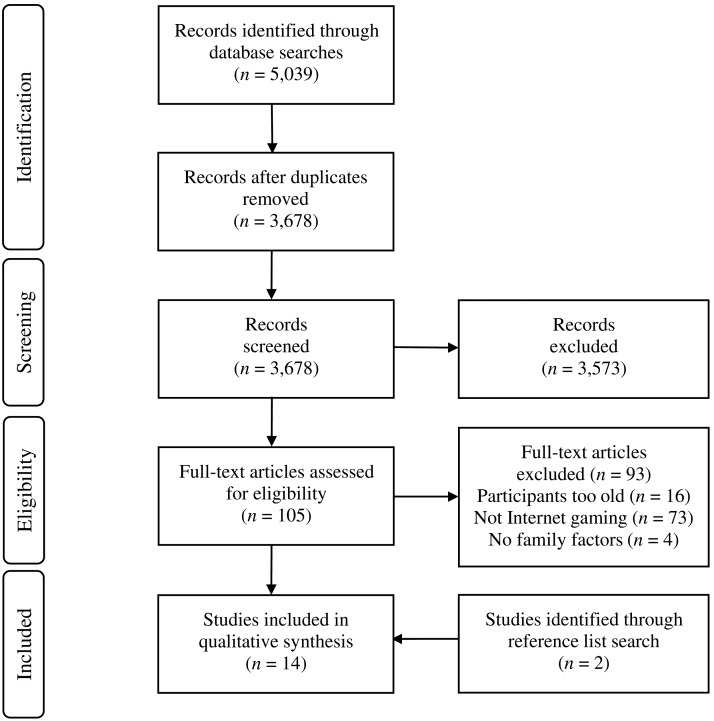
Background and aims Familial influences are known to affect the likelihood of an adolescent becoming a problem gamer. This systematic review examined some of the key findings in empirical research on family factors related to adolescent problem gaming. Methods A total of 14 studies in the past decade were evaluated. Family-related variables included: (a) parent status (e.g., socioeconomic status and mental health), (b) parent-child relationship (e.g., warmth, conflict, and abuse), (c) parental influence on gaming (e.g., supervision of gaming, modeling, and attitudes toward gaming), and (d) family environment (e.g., household composition). Results The majority of studies have focused on parent-child relationships, reporting that poorer quality relationships are associated with increased severity of problem gaming. The paternal relationship may be protective against problem gaming; therefore, prevention programs should leverage the support of cooperative fathers. Discussion The intergenerational effects of problem gaming require further attention, in light of adult gamers raising their children in a gaming-centric environment. Research has been limited by a reliance on adolescent self-report to understand family dynamics, without gathering corroborating information from parents and other family members. The very high rates of problem gaming (>10%) reported in general population samples raise concerns about the validity of current screening tools. Conclusions Interventions for adolescents may be more effective in some cases if they can address familial influences on problem gaming with the active co-participation of parents, rather than enrolling vulnerable adolescents in individual-based training or temporarily isolating adolescents from the family system.
Overview
The claims and statistics of this paper haven’t been checked yet.
Run the check — free, no account needed. It reads the open-access text and checks the sources it cites.
Integrity signals
Registry
Cites
Statistics
Figures
Verification
Claims the paper makes
The claims and statistics of this paper haven’t been checked yet.
Run the check — free, no account needed. It reads the open-access text and checks the sources it cites.
Claims other papers make about this one
Each is checked against this paper’s own text: does it say what the citing paper says it does?
The source backs part of the claim, not all of it — or backs it for a different population, condition or comparison.
In the citing paper
“negative early childhood experiences have been reported as vulnerability factors for gambling disorder (Roberts et al., 2017) and gaming disorder (Schneider et al., 2017)”
From The Interaction of Person-Affect-Cognition-Execution (I-PACE) model for addictive behaviors: Update, generalization to addictive behaviors beyond internet-use disorders, and specification of the process character of addictive behaviors (2019) · cites this paper as Schneider et al., 2017
Experimental — accuracy not yet measured
Self-check
Percentages, sums and reported differences re-computed from the paper’s own numbers.
The self-check needs the paper’s full text.
Citations
Cites
(2012) · The Scientific World JOURNAL · doi:10.1100/tswj · Cited by 2,600
(1998) · Medical Entomology and Zoology · Cited by 1,425
Theory and measurement of generalized problematic internet use : A two-step approach
Caplan, S. E. (2010) · Computers in Human Behavior · doi:10.1016/j.chb.2010.03.012 · Cited by 1,061
The impact of computer use on children's and adolescents' development
Subrahmanyam, K., Greenfield, P. M., Kraut, R. E., & Gross, E. F. (2001) · Journal of Applied Developmental Psychology · doi:10.1016/s0193-3973(00)00063-0 · Cited by 565
Factors associated with Internet addiction among adolescents
Lam, L. T., Peng, Z.-W., Mai, J.-C., & Jing, J. (2009) · CyberPsychology & Behavior · doi:10.1089/cpb.2009.0036 · Cited by 531
King, D. L., Haagsma, M. C., Delfabbro, P., Gradisar, M., & Griffiths, M. D. (2013) · Clinical Psychology Review · doi:10.1016/j.cpr.2013.01.002 · Cited by 499
Self-citationNot so doomed: computer game play and positive adolescent development
Durkin, K., & Barber, B. L. (2002) · Journal of Applied Developmental Psychology · doi:10.1016/s0193-3973(02)00124-7 · Cited by 491
Family factors of Internet addiction and substance use experience in Taiwanese adolescents
Yen, J.-Y., Yen, C.-F., Chen, C.-C., Chen, S.-H., & Ko, C.-H. (2007) · CyberPsychology & Behavior · doi:10.1089/cpb.2006.9948 · Cited by 481
Rehbein, F., Psych, G., Kleimann, M., Mediasci, G., & Mößle, T. (2010) · Cyberpsychology, Behavior, and Social Networking · doi:10.1089/cyber.2009.0227 · Cited by 480
Ferguson, C. J., Coulson, M., & Barnett, J. (2011) · Journal of Psychiatric Research · doi:10.1016/j.jpsychires.2011.09.005 · Cited by 461
Research works printed but not linked: 1
- American Psychiatric Association. (2013). Diagnostic and statistical manual of mental disorders (DSM-5) (5th ed.). Washington, DC: American Psychiatric Association.
Cited by
Sorted by citations
Brand, M., Wegmann, E., Stark, R., Müller, A., Wölfling, K., Robbins, T. W., & Potenza, M. N. (2019) · Neuroscience & Biobehavioral Reviews · doi:10.1016/j.neubiorev.2019.06.032 · Cited by 2,126
Gao, Y., Wang, J.-Y., & Dong, G. (2022) · Journal of Psychiatric Research · doi:10.1016/j.jpsychires.2022.06.049 · Cited by 413
Manifesto for a European research network into Problematic Usage of the Internet
Fineberg, N., Demetrovics, Z., Stein, D., Ioannidis, K., Potenza, M., Grünblatt, E., Brand, M., Billieux, J., Carmi, L., King, D., et al. (2018) · European Neuropsychopharmacology · doi:10.1016/j.euroneuro.2018.08.004 · Cited by 334
Self-citationKaimara, P., Οικονόμου, Α., & Deliyannis, I. (2021) · Virtual Reality · doi:10.1007/s10055-021-00563-w · Cited by 247
Interactional theory of childhood problematic media use
Domoff, S. E., Borgen, A. L., & Radesky, J. S. (2020) · Human Behavior and Emerging Technologies · doi:10.1002/hbe2.217 · Cited by 220
Metadata
- Authors
- Schneider, L. A., King, D. L., & Delfabbro, P. H.
- Affiliations
- The University of Adelaide (AU)
- Corresponding author
- King, Daniel L.
- Venue
- Journal of Behavioral Addictions
- Publisher
- Akademiai Kiado Zrt.
- Published
- 2017-06-28
- Volume
- 6
- Issue
- 3
- Pages
- 321-333
- ISSN
- 2062-5871 (ISSN-L)
- 2063-5303
- PMC
- PMC5700711
- OpenAlex
- W2741062752
- Cited by
- 382
- References
- 50
- Citations by year
- 2026: 58 · 2025: 57 · 2024: 55 · 2023: 53 · 2022: 51 · 2021: 45 · 2020: 36 · 2019: 15 · 2018: 12
- FWCI
- 5.31
- Type
- journal article
- Language
- en
- Open access
- gold
- doi.org
- Licence
- Locations
- Journal of Behavioral Addictions (publishedVersion, cc-by-nc)
- PubMed Central (publishedVersion, cc-by-nc)
- PubMed (publishedVersion)
- Repository of the Academy's Library (Library of the Hungarian Academy of Sciences) (acceptedVersion)
- Adelaide Research & Scholarship (AR&S) (University of Adelaide) (submittedVersion)
- Topics
- Social Sciences › Sociology and Political Science › Impact of Technology on Adolescents
- Social Sciences › Psychology › Clinical Psychology › Gambling Behavior and Treatments
- Social Sciences › Education › Child Development and Digital Technology
- Keywords
- adolescent gaming, family factors, parent-child relationship, parental influence, parental supervision, parental role modeling, father-child relationship, family environment, household composition, socioeconomic status, parental mental health, intergenerational effects, prevention programs, screening tool
- MeSH terms
- Adolescent, Family, Humans, Parent-Child Relations, Social Environment, Behavior, Addictive, Video Games
About these checks
Registry, retraction, Cites and statistics results are computed, not judged, with one exception: a printed reference that no index lists is read once by a model before it counts as a citation error. Claims are extracted by a model and kept only when their quote appears verbatim in the text; each cited source is then checked, with a model’s help, for whether it says what the claim relies on. Those verdicts can be wrong — read the claim’s quote and the cited source before relying on one.
Statistics and arithmetic are recomputed, not judged.
Confidence bands are shown only for fields calibrated on our annotated test set. None is calibrated yet, so no band is shown.
What counts as a claim ›How we measure confidence ›How we check this ›
Are you an author, or do you see a problem with this page? Request a review
