

The DOI matches its Crossref record; 82 of the 86 references it cites were found in a registry or an index; none of the 39 sources its claims cite is checked for support yet.
Instagram addiction and the Big Five of personality: The mediating role of self-liking
Open accessAbstract
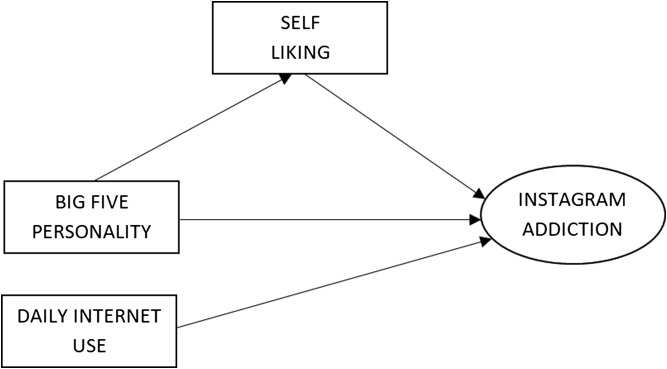
Background and aims: Recent research has suggested that social networking site use can be addictive. Although extensive research has been carried out on potential addiction to social networking sites, such as Facebook, Twitter, YouTube, and Tinder, only one very small study has previously examined potential addiction to Instagram. Consequently, the objectives of this study were to examine the relationships between personality, self-liking, daily Internet use, and Instagram addiction, as well as exploring the mediating role of self-liking between personality and Instagram addiction using path analysis. Methods: A total of 752 university students completed a self-report survey, including the Instagram Addiction Scale (IAS), the Big Five Inventory (BFI), and the Self-Liking Scale. Results: Results indicated that agreeableness, conscientiousness, and self-liking were negatively associated with Instagram addiction, whereas daily Internet use was positively associated with Instagram addiction. The results also showed that self-liking partially mediated the relationship of Instagram addiction with agreeableness and fully mediated the relationship between Instagram addiction with conscientiousness. Discussion and conclusions: This study contributes to the small body of literature that has examined the relationship between personality and social networking site addiction and is one of only two studies to examine the addictive use of Instagram and the underlying factors related to it.
Overview
AI snapshot
Written from the paper’s full text.
TL;DR
This cross-sectional study examined Big Five personality traits, self-liking, daily Internet use, and Instagram addiction among 752 university students using a newly developed Instagram Addiction Scale. Agreeableness, conscientiousness, and self-liking were negatively associated with Instagram addiction, daily Internet use was positively associated, and self-liking mediated the links for agreeableness and conscientiousness.
Key findings
- Among 752 participants, 33.5% were classified as risky Instagram users: 26.5% mildly addicted, 6.1% moderately addicted, and 0.9% severely addicted; 66.5% were non-addicted.
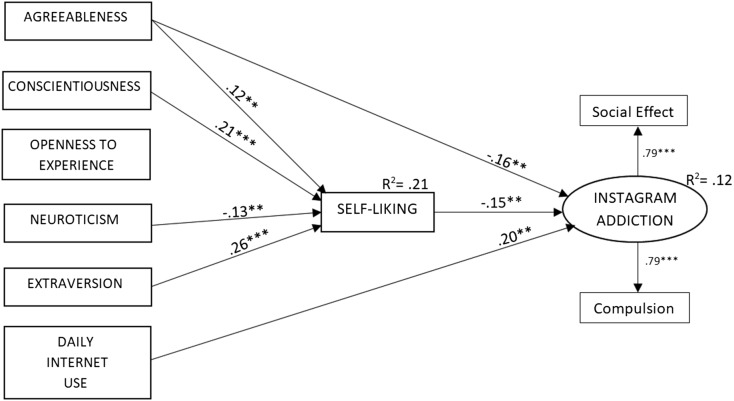
- In path analysis, agreeableness (total effect β = −0.19), self-liking (β = −0.14), and daily Internet use (β = 0.20) were related to Instagram addiction; conscientiousness had a total effect of β = −0.10 and an indirect effect via self-liking of β = −0.03.
- Self-liking partially mediated the relationship between agreeableness and Instagram addiction and fully mediated the relationship between conscientiousness and Instagram addiction; extraversion, neuroticism, and openness to experience were not supported as predictors.
- The model predicted 21% of self-liking and 12% of Instagram addiction; the Instagram Addiction Scale had two factors (social effect and compulsion) with Cronbach’s α of .90 total, .86, and .85, respectively.
Methods
- Cross-sectional self-report survey; 1,124 students participated overall, with 372 in Instagram Addiction Scale development and 752 in the main analysis (69% female; age range 18–24 years, mean = 20.30, SD = 1.46).
- Measures included the short Big Five Inventory, the Self-Liking subscale, and the Instagram Addiction Scale, which was modified from Young’s Internet Addiction Test.
- Analyses used EFA and CFA, descriptive statistics and Pearson correlations, and path analysis/SEM with maximum likelihood estimation and bootstrapping (2,000 bootstrap samples, 95% bias-corrected confidence intervals).
Limitations
- The authors state that data were self-report and subject to biases such as memory recall and social desirability; the sample was cross-sectional, self-selecting, and non-representative, so causal relationships cannot be drawn.
- The authors also note that the model explained only 12% of Instagram addiction variance, meaning other variables were not included, and that the mediation findings may alternatively reflect moderation.
- Evident from the text: the sample was a convenience sample of university students, limiting generalizability, and only the self-liking dimension of self-esteem was measured rather than global self-esteem or self-competence.
Model-written summary. Check it against the paper before relying on it.
Integrity signals
Registry
Cites
Statistics
Figures
Verification
Claims the paper makes
40 Own result · 31 Not checked yet · 14 Own interpretation · 10 Own method
A result the paper reports from its own data — it cites no other source for it, so there is none to check. The quote shows it is in the paper.
In the paper
“According to cut-off points of the IAS, 66.5% of the participants were non-addicted, 26.5% were mildly addicted, 6.1% were moderately addicted, and 0.9% were severely addicted to Instagram. Overall, 33.5% of the participants were risky Instagram users (Table 2).”
§ Instagram addiction and the Big Five of personality: The mediating role of self-liking > Results
plain- Asserted: passes — The authors put it forward as true.
- Checkable: passes — It can be checked against evidence.
- Load-bearing: unclear — It is unclear whether the paper’s conclusions depend on it.
- Based: passes — The paper gives a reason why it holds.
- Rests on an assumption: The IAS cut-off points derived from cluster analysis accurately classify Instagram addiction severity.
A result the paper reports from its own data — it cites no other source for it, so there is none to check. The quote shows it is in the paper.
In the paper
“Results indicated that agreeableness, conscientiousness, and self-liking were negatively associated with Instagram addiction, whereas daily Internet use was positively associated with Instagram addiction.”
§ Instagram addiction and the Big Five of personality: The mediating role of self-liking > Abstract > Results
hedgedcorrelational- Asserted: passes — The authors put it forward as true.
- Checkable: passes — It can be checked against evidence.
- Load-bearing: passes — The paper’s conclusions depend on it.
- Based: passes — The paper gives a reason why it holds.
A result the paper reports from its own data — it cites no other source for it, so there is none to check. The quote shows it is in the paper.
In the paper
“Bivariate correlation coefficients (Table 3) indicated that Instagram addiction was weakly correlated with daily Internet use, agreeableness, self-liking, conscientiousness, and neuroticism.”
§ Instagram addiction and the Big Five of personality: The mediating role of self-liking > Results
hedgedcorrelational- Asserted: passes — The authors put it forward as true.
- Checkable: passes — It can be checked against evidence.
- Load-bearing: unclear — It is unclear whether the paper’s conclusions depend on it.
- Based: passes — The paper gives a reason why it holds.
A result the paper reports from its own data — it cites no other source for it, so there is none to check. The quote shows it is in the paper.
In the paper
“The results also showed that self-liking partially mediated the relationship of Instagram addiction with agreeableness and fully mediated the relationship between Instagram addiction with conscientiousness.”
§ Instagram addiction and the Big Five of personality: The mediating role of self-liking > Abstract > Results
plaincorrelational- Asserted: passes — The authors put it forward as true.
- Checkable: passes — It can be checked against evidence.
- Load-bearing: passes — The paper’s conclusions depend on it.
- Based: passes — The paper gives a reason why it holds.
- Rests on an assumption: The cross-sectional associations among personality, self-liking, and Instagram addiction reflect directional influences from personality and self-liking to Instagram addiction.
A result the paper reports from its own data — it cites no other source for it, so there is none to check. The quote shows it is in the paper.
In the paper
“Self-liking was moderately correlated with extraversion, conscientiousness, neuroticism and weakly with agreeableness, and openness to experience.”
§ Instagram addiction and the Big Five of personality: The mediating role of self-liking > Results
plaincorrelational- Asserted: passes — The authors put it forward as true.
- Checkable: passes — It can be checked against evidence.
- Load-bearing: unclear — It is unclear whether the paper’s conclusions depend on it.
- Based: passes — The paper gives a reason why it holds.
A result the paper reports from its own data — it cites no other source for it, so there is none to check. The quote shows it is in the paper.
In the paper
“According to cut-off points of the IAS, 66.5% of the participants were non-addicted, 26.5% were mildly addicted, 6.1% were moderately addicted, and 0.9% were severely addicted to Instagram. Overall, 33.5% of the participants were risky Instagram users (Table 2).”
§ Instagram addiction and the Big Five of personality: The mediating role of self-liking > Results
plain- Asserted: passes — The authors put it forward as true.
- Checkable: passes — It can be checked against evidence.
- Load-bearing: unclear — It is unclear whether the paper’s conclusions depend on it.
- Based: passes — The paper gives a reason why it holds.
- Rests on an assumption: The IAS cut-off points derived from cluster analysis accurately classify Instagram addiction severity.
A result the paper reports from its own data — it cites no other source for it, so there is none to check. The quote shows it is in the paper.
In the paper
“Self-liking was moderately correlated with extraversion, conscientiousness, neuroticism and weakly with agreeableness, and openness to experience.”
§ Instagram addiction and the Big Five of personality: The mediating role of self-liking > Results
plaincorrelational- Asserted: passes — The authors put it forward as true.
- Checkable: passes — It can be checked against evidence.
- Load-bearing: unclear — It is unclear whether the paper’s conclusions depend on it.
- Based: passes — The paper gives a reason why it holds.
A result the paper reports from its own data — it cites no other source for it, so there is none to check. The quote shows it is in the paper.
In the paper
“Results indicated that agreeableness, conscientiousness, and self-liking were negatively associated with Instagram addiction, whereas daily Internet use was positively associated with Instagram addiction.”
§ Instagram addiction and the Big Five of personality: The mediating role of self-liking > Abstract > Results
hedgedcorrelational- Asserted: passes — The authors put it forward as true.
- Checkable: passes — It can be checked against evidence.
- Load-bearing: passes — The paper’s conclusions depend on it.
- Based: passes — The paper gives a reason why it holds.
A result the paper reports from its own data — it cites no other source for it, so there is none to check. The quote shows it is in the paper.
In the paper
“Bivariate correlation coefficients (Table 3) indicated that Instagram addiction was weakly correlated with daily Internet use, agreeableness, self-liking, conscientiousness, and neuroticism.”
§ Instagram addiction and the Big Five of personality: The mediating role of self-liking > Results
hedgedcorrelational- Asserted: passes — The authors put it forward as true.
- Checkable: passes — It can be checked against evidence.
- Load-bearing: unclear — It is unclear whether the paper’s conclusions depend on it.
- Based: passes — The paper gives a reason why it holds.
A result the paper reports from its own data — it cites no other source for it, so there is none to check. The quote shows it is in the paper.
In the paper
“15 items (see Appendix) were able to explain 53.9% of the variance”
§ Instagram addiction and the Big Five of personality: The mediating role of self-liking > Methods > Measures
plain- Asserted: passes — The authors put it forward as true.
- Checkable: passes — It can be checked against evidence.
- Load-bearing: unclear — It is unclear whether the paper’s conclusions depend on it.
- Based: passes — The paper gives a reason why it holds.
- Probably not a substantial claim. 36
- It may state two separate claims as one. 26
A result the paper reports from its own data — it cites no other source for it, so there is none to check. The quote shows it is in the paper.
In the paper
“the scale was composed of two factors, which were named as social effect (eight items, e.g., “How often do you prefer the excitement of Instagram instead of being with your close friends?”) and compulsion (seven items, e.g., “How often do you try to cut down the amount of time you spend on Instagram and fail?”).”
§ Instagram addiction and the Big Five of personality: The mediating role of self-liking > Methods > Measures
plain- Asserted: passes — The authors put it forward as true.
- Checkable: passes — It can be checked against evidence.
- Load-bearing: fails — The paper’s conclusions may not depend on it.
- Based: passes — The paper gives a reason why it holds.
Probably not a substantial claim. The paper’s conclusions may not depend on it. It may state two separate claims as one.
A result the paper reports from its own data — it cites no other source for it, so there is none to check. The quote shows it is in the paper.
In the paper
“The Pearson’s correlation coefficient was 0.61 between social effect and compulsion, 0.89 between social effect and total scale, and 0.90 between compulsion and total scale.”
§ Instagram addiction and the Big Five of personality: The mediating role of self-liking > Methods > Measures
plaincorrelational- Asserted: passes — The authors put it forward as true.
- Checkable: passes — It can be checked against evidence.
- Load-bearing: fails — The paper’s conclusions may not depend on it.
- Based: passes — The paper gives a reason why it holds.
Probably not a substantial claim. The paper’s conclusions may not depend on it.
A result the paper reports from its own data — it cites no other source for it, so there is none to check. The quote shows it is in the paper.
In the paper
“As a result, cut-off points were determined as follows: non-addiction (15–37), mild addiction (38–58), moderate addiction (59–73), and severe addiction (over 73).”
§ Instagram addiction and the Big Five of personality: The mediating role of self-liking > Methods > Measures
plain- Asserted: passes — The authors put it forward as true.
- Checkable: passes — It can be checked against evidence.
- Load-bearing: passes — The paper’s conclusions depend on it.
- Based: passes — The paper gives a reason why it holds.
Probably not a substantial claim. It may state two separate claims as one.
- Rests on an assumption: The IAS cut-off points derived from cluster analysis accurately classify Instagram addiction severity.
A result the paper reports from its own data — it cites no other source for it, so there is none to check. The quote shows it is in the paper.
In the paper
“Self-liking mediated the relationships of conscientiousness (fully) and agreeableness (partially) with Instagram addiction.”
- Also stated in: § Discussion · plain
“self-liking fully mediates the relationship of Instagram addiction with conscientiousness, and partially with agreeableness.”
§ Instagram addiction and the Big Five of personality: The mediating role of self-liking > Results
plaindirect- Asserted: passes — The authors put it forward as true.
- Checkable: passes — It can be checked against evidence.
- Load-bearing: passes — The paper’s conclusions depend on it.
- Based: passes — The paper gives a reason why it holds.
It may state two separate claims as one.
- Also stated in: § Discussion · plain
A result the paper reports from its own data — it cites no other source for it, so there is none to check. The quote shows it is in the paper.
In the paper
“The hypothesized model predicted 21% of self-liking and 12% of Instagram addiction.”
§ Instagram addiction and the Big Five of personality: The mediating role of self-liking > Results
plaincorrelational- Asserted: passes — The authors put it forward as true.
- Checkable: passes — It can be checked against evidence.
- Load-bearing: unclear — It is unclear whether the paper’s conclusions depend on it.
- Based: passes — The paper gives a reason why it holds.
It may state two separate claims as one.
In the paper
“introverted, less agreeable, and less conscientious students are more addicted to Twitter (Kırcaburun, 2016a)”
§ Instagram addiction and the Big Five of personality: The mediating role of self-liking > Theoretical Background to this Study > Big Five personality traits and social networking site use
What the sources say
- Not checked yetcites Kırcaburun, 2016a
plaincorrelational- Asserted: passes — The authors put it forward as true.
- Checkable: passes — It can be checked against evidence.
- Load-bearing: fails — The paper’s conclusions may not depend on it.
- Based: passes — The paper gives a reason why it holds.
Probably not a substantial claim. The paper’s conclusions may not depend on it.
In the paper
“all personality dimensions had a significant effect on Internet addiction”
§ Instagram addiction and the Big Five of personality: The mediating role of self-liking > Theoretical Background to this Study > Big Five personality traits and social networking site use
What the sources say
- Not checked yetcites Kayiş et al., 2016 source
plaindirect- Asserted: passes — The authors put it forward as true.
- Checkable: passes — It can be checked against evidence.
- Load-bearing: fails — The paper’s conclusions may not depend on it.
- Based: passes — The paper gives a reason why it holds.
Probably not a substantial claim. The paper’s conclusions may not depend on it.
In the paper
“being less open to experience, less emotional stable, and less conscientious is associated with Facebook addiction (Błachnio, Przepiorka, Senol-Durak, Durak, & Sherstyuk, 2017)”
§ Instagram addiction and the Big Five of personality: The mediating role of self-liking > Theoretical Background to this Study > Big Five personality traits and social networking site use
What the sources say
- Not checked yetcites Błachnio, Przepiorka, Senol-Durak, Durak, & Sherstyuk, 2017 source
plaincorrelational- Asserted: passes — The authors put it forward as true.
- Checkable: passes — It can be checked against evidence.
- Load-bearing: fails — The paper’s conclusions may not depend on it.
- Based: passes — The paper gives a reason why it holds.
Probably not a substantial claim. The paper’s conclusions may not depend on it. It may state two separate claims as one.
In the paper
“Individuals who were less open to experience, agreeable, extraverted, conscientious, and more neurotic reported higher levels of Internet addiction.”
§ Instagram addiction and the Big Five of personality: The mediating role of self-liking > Theoretical Background to this Study > Big Five personality traits and social networking site use
What the sources say
- Not checked yetcites Kayiş et al., 2016 source
plaincorrelational- Asserted: passes — The authors put it forward as true.
- Checkable: passes — It can be checked against evidence.
- Load-bearing: fails — The paper’s conclusions may not depend on it.
- Based: passes — The paper gives a reason why it holds.
Probably not a substantial claim. The paper’s conclusions may not depend on it. It may state two separate claims as one.
None of the sources cited for this claim have been checked yet.
In the paper
“Based on the study of Kırcaburun (2016a) and Karadağ et al. (2015) that demonstrated daily time spent on Internet is positively related to social media addiction”
§ Instagram addiction and the Big Five of personality: The mediating role of self-liking > Theoretical Background to this Study > The present study
What the sources say
- Not checked yetcites Kırcaburun, 2016a
- Not checked yetcites Karadağ et al., 2015 source
boostedcorrelational- Asserted: fails — The authors may not put it forward as true.
- Checkable: passes — It can be checked against evidence.
- Load-bearing: passes — The paper’s conclusions depend on it.
- Based: passes — The paper gives a reason why it holds.
Probably not a substantial claim. The authors may not put it forward as true.
In the paper
“emotional stability, extraversion, and conscientiousness have the strongest effects on self-esteem (Robins, Tracy, Trzesniewski, Potter, & Gosling, 2001)”
§ Instagram addiction and the Big Five of personality: The mediating role of self-liking > Theoretical Background to this Study > Self-liking and social networking site use
What the sources say
- Not checked yetcites Robins, Tracy, Trzesniewski, Potter, & Gosling, 2001 source
plaindirect- Asserted: passes — The authors put it forward as true.
- Checkable: passes — It can be checked against evidence.
- Load-bearing: fails — The paper’s conclusions may not depend on it.
- Based: passes — The paper gives a reason why it holds.
Probably not a substantial claim. The paper’s conclusions may not depend on it.
None of the sources cited for this claim have been checked yet.
In the paper
“Self-liking is claimed to have stronger association with self-esteem than compared with self-competence (Dogan, 2011; Tafarodi & Swann, 2001).”
§ Instagram addiction and the Big Five of personality: The mediating role of self-liking > Theoretical Background to this Study > Self-liking and social networking site use
What the sources say
- Not checked yetcites Dogan, 2011
- Not checked yetcites Tafarodi & Swann, 2001 source
hedgedcorrelational- Asserted: passes — The authors put it forward as true.
- Checkable: passes — It can be checked against evidence.
- Load-bearing: fails — The paper’s conclusions may not depend on it.
- Based: passes — The paper gives a reason why it holds.
Probably not a substantial claim. The paper’s conclusions may not depend on it.
In the paper
“Studies have reported that (a) extraverts and neurotics are more addicted to social media (Wang, Ho, Chan, & Tse, 2015)”
§ Instagram addiction and the Big Five of personality: The mediating role of self-liking > Theoretical Background to this Study > Big Five personality traits and social networking site use
What the sources say
- Not checked yetcites Wang, Ho, Chan, & Tse, 2015 source
plaincorrelational- Asserted: passes — The authors put it forward as true.
- Checkable: passes — It can be checked against evidence.
- Load-bearing: fails — The paper’s conclusions may not depend on it.
- Based: passes — The paper gives a reason why it holds.
Probably not a substantial claim. The paper’s conclusions may not depend on it. It may state two separate claims as one.
In the paper
“the Big Five personality dimensions accounted for 34% of the variance in self-esteem”
§ Instagram addiction and the Big Five of personality: The mediating role of self-liking > Theoretical Background to this Study > Self-liking and social networking site use
What the sources say
- Not checked yetcites Robins, Tracy, Trzesniewski, Potter, & Gosling, 2001 source
plaincorrelational- Asserted: passes — The authors put it forward as true.
- Checkable: passes — It can be checked against evidence.
- Load-bearing: fails — The paper’s conclusions may not depend on it.
- Based: passes — The paper gives a reason why it holds.
Probably not a substantial claim. The paper’s conclusions may not depend on it.
What the paper did — it cites no source for this, so there is none to check. The quote shows it is in the paper.
In the paper
“Bootstrapping was performed with 2,000 bootstrap samples and 95% bias-corrected confidence intervals.”
§ Instagram addiction and the Big Five of personality: The mediating role of self-liking > Methods > Statistical analysis
plainn = 2,000- Asserted: passes — The authors put it forward as true.
- Checkable: passes — It can be checked against evidence.
- Load-bearing: passes — The paper’s conclusions depend on it.
- Based: passes — The paper gives a reason why it holds.
Probably not a substantial claim.
In the paper
“neurotic, introvert, and conscientious students are more likely to be problematic users of Facebook (Marino et al., 2016)”
§ Instagram addiction and the Big Five of personality: The mediating role of self-liking > Theoretical Background to this Study > Big Five personality traits and social networking site use
What the sources say
- Not checked yetcites Marino et al., 2016 source
hedgedcorrelational- Asserted: passes — The authors put it forward as true.
- Checkable: passes — It can be checked against evidence.
- Load-bearing: fails — The paper’s conclusions may not depend on it.
- Based: passes — The paper gives a reason why it holds.
Probably not a substantial claim. The paper’s conclusions may not depend on it. It may state two separate claims as one.
In the paper
“online social networking addiction has the biggest overlap with Internet addiction more generally (Montag et al., 2015)”
§ Instagram addiction and the Big Five of personality: The mediating role of self-liking > Theoretical Background to this Study > Daily Internet use and social networking sites use
What the sources say
- Not checked yetcites Montag et al., 2015 source
plaincorrelational- Asserted: passes — The authors put it forward as true.
- Checkable: passes — It can be checked against evidence.
- Load-bearing: fails — The paper’s conclusions may not depend on it.
- Based: passes — The paper gives a reason why it holds.
Probably not a substantial claim. The paper’s conclusions may not depend on it.
In the paper
“social networking applications are different from other Internet applications, such as gambling, gaming, and shopping, because these needs can also be fulfilled in offline contexts but engaging in social networking applications, such as Instagram, can only be carried out online.”
§ Instagram addiction and the Big Five of personality: The mediating role of self-liking > Theoretical Background to this Study > Daily Internet use and social networking sites use
What the sources say
- Not checked yetcites Griffiths, 2005 source
plain- Asserted: passes — The authors put it forward as true.
- Checkable: passes — It can be checked against evidence.
- Load-bearing: fails — The paper’s conclusions may not depend on it.
- Based: passes — The paper gives a reason why it holds.
Probably not a substantial claim. The paper’s conclusions may not depend on it. It may state two separate claims as one.
A conclusion the paper draws from its own results — it cites no other source for it, so there is none to check. The quote shows it is in the paper.
In the paper
“EFA and CFA results suggest that the scale is valid and reliable in assessing Instagram addiction levels of university students.”
§ Instagram addiction and the Big Five of personality: The mediating role of self-liking > Methods > Measures
hedged- Asserted: passes — The authors put it forward as true.
- Checkable: passes — It can be checked against evidence.
- Load-bearing: passes — The paper’s conclusions depend on it.
- Based: passes — The paper gives a reason why it holds.
It may state two separate claims as one.
In the paper
“students with higher self-liking were more extraverted, conscientious, agreeable, open to experience, and less neurotic (Ramsdal, 2008)”
§ Instagram addiction and the Big Five of personality: The mediating role of self-liking > Theoretical Background to this Study > Self-liking and social networking site use
What the sources say
- Not checked yetcites Ramsdal, 2008 source
plaincorrelational- Asserted: passes — The authors put it forward as true.
- Checkable: passes — It can be checked against evidence.
- Load-bearing: fails — The paper’s conclusions may not depend on it.
- Based: passes — The paper gives a reason why it holds.
Probably not a substantial claim. The paper’s conclusions may not depend on it. It may state two separate claims as one.
None of the sources cited for this claim have been checked yet.
In the paper
“self-esteem is reported to be one of the important factors and it is negatively associated with SNS use and social media addiction (Andreassen et al., 2017; Blachino, Przepiorka, & Pantic, 2016; Kırcaburun, 2016b)”
§ Instagram addiction and the Big Five of personality: The mediating role of self-liking > Theoretical Background to this Study > Self-liking and social networking site use
What the sources say
- Not checked yetcites Andreassen et al., 2017 source
- Not checked yetcites Blachino, Przepiorka, & Pantic, 2016
- Not checked yetcites Kırcaburun, 2016b
plaincorrelational- Asserted: passes — The authors put it forward as true.
- Checkable: passes — It can be checked against evidence.
- Load-bearing: passes — The paper’s conclusions depend on it.
- Based: passes — The paper gives a reason why it holds.
It may state two separate claims as one.
In the paper
“As Ryan et al. (2014) indicated, individuals become addicted, because they are experiencing different gratifications via these platforms that they cannot have in their real life, and problematic use may be expected to continue as long as they keep getting their needed gratifications repeatedly.”
§ Instagram addiction and the Big Five of personality: The mediating role of self-liking > Discussion
What the sources say
- Not checked yetcites Ryan et al. (2014) source
hedgeddirect- Asserted: passes — The authors put it forward as true.
- Checkable: passes — It can be checked against evidence.
- Load-bearing: fails — The paper’s conclusions may not depend on it.
- Based: passes — The paper gives a reason why it holds.
Probably not a substantial claim. The paper’s conclusions may not depend on it. It may state two separate claims as one.
What the paper did — it cites no source for this, so there is none to check. The quote shows it is in the paper.
In the paper
“In addition, cross-sectional nature of the study does not allow the drawing of causal relationships among the variables examined.”
§ Instagram addiction and the Big Five of personality: The mediating role of self-liking > Discussion
plain- Asserted: passes — The authors put it forward as true.
- Checkable: passes — It can be checked against evidence.
- Load-bearing: fails — The paper’s conclusions may not depend on it.
- Based: passes — The paper gives a reason why it holds.
Probably not a substantial claim. The paper’s conclusions may not depend on it.
A conclusion the paper draws from its own results — it cites no other source for it, so there is none to check. The quote shows it is in the paper.
In the paper
“Based on these studies, it may be argued that individuals with low agreeableness are not expected to involve themselves in others’ uploads or to try to compensate their loneliness or real life relations by constructing online relationships.”
§ Instagram addiction and the Big Five of personality: The mediating role of self-liking > Discussion
hedged- Asserted: passes — The authors put it forward as true.
- Checkable: passes — It can be checked against evidence.
- Load-bearing: passes — The paper’s conclusions depend on it.
- Based: passes — The paper gives a reason why it holds.
It may state two separate claims as one.
What the paper did — it cites no source for this, so there is none to check. The quote shows it is in the paper.
In the paper
“The sample was also cross-sectional and self-selecting and therefore non-representative.”
§ Instagram addiction and the Big Five of personality: The mediating role of self-liking > Discussion
plain- Asserted: passes — The authors put it forward as true.
- Checkable: passes — It can be checked against evidence.
- Load-bearing: unclear — It is unclear whether the paper’s conclusions depend on it.
- Based: passes — The paper gives a reason why it holds.
It may state two separate claims as one.
In the paper
“Conscientious individuals are systematic, punctual, and hard working, whereas individuals with lower conscientiousness have lower self-discipline, are emotionally driven, unambitious about what they do, and they tend to behave irresponsibly and inconsistently (Costa & McCrae, 2000).”
§ Instagram addiction and the Big Five of personality: The mediating role of self-liking > Discussion
What the sources say
- Not checked yetcites Costa & McCrae, 2000
plain- Asserted: passes — The authors put it forward as true.
- Checkable: passes — It can be checked against evidence.
- Load-bearing: fails — The paper’s conclusions may not depend on it.
- Based: passes — The paper gives a reason why it holds.
Probably not a substantial claim. The paper’s conclusions may not depend on it. It may state two separate claims as one.
What the paper did — it cites no source for this, so there is none to check. The quote shows it is in the paper.
In the paper
“The data were self-report in relation to questions regarding Instagram addiction, personality, and self-liking. Self-report methods suffer from a number of well-established biases (such as memory recall and social desirability).”
§ Instagram addiction and the Big Five of personality: The mediating role of self-liking > Discussion
boosted- Asserted: passes — The authors put it forward as true.
- Checkable: passes — It can be checked against evidence.
- Load-bearing: fails — The paper’s conclusions may not depend on it.
- Based: passes — The paper gives a reason why it holds.
Probably not a substantial claim. The paper’s conclusions may not depend on it.
None of the sources cited for this claim have been checked yet.
In the paper
“individuals with lower self-liking may be expected to have higher levels of depression (Wilkinson, 2010), which is positively associated with social media addiction (Andreassen et al., 2016; Kırcaburun, 2016b), to be uncomfortable in social settings and to experience attachment issues with their peers and family (Wilkinson, 2010).”
§ Instagram addiction and the Big Five of personality: The mediating role of self-liking > Discussion
What the sources say
hedgedconditional- Asserted: passes — The authors put it forward as true.
- Checkable: passes — It can be checked against evidence.
- Load-bearing: passes — The paper’s conclusions depend on it.
- Based: passes — The paper gives a reason why it holds.
It may state two separate claims as one.
In the paper
“However, this previous study had major methodological flaws and only 100 participants.”
§ Instagram addiction and the Big Five of personality: The mediating role of self-liking > Discussion
What the sources say
- Not checked yetcites Ershad & Aghajani, 2017
plain- Asserted: passes — The authors put it forward as true.
- Checkable: passes — It can be checked against evidence.
- Load-bearing: fails — The paper’s conclusions may not depend on it.
- Based: fails — The paper may give no reason why it holds.
Probably not a substantial claim. The paper’s conclusions may not depend on it. The paper may give no reason why it holds. It may state two separate claims as one.
In the paper
“the previous study (i.e., Ershad & Aghajani, 2017) found neuroticism was associated with Instagram addiction.”
§ Instagram addiction and the Big Five of personality: The mediating role of self-liking > Discussion
What the sources say
- Not checked yetcites Ershad & Aghajani, 2017
plaincorrelationaln = 100- Asserted: passes — The authors put it forward as true.
- Checkable: passes — It can be checked against evidence.
- Load-bearing: fails — The paper’s conclusions may not depend on it.
- Based: passes — The paper gives a reason why it holds.
Probably not a substantial claim. The paper’s conclusions may not depend on it.
A conclusion the paper draws from its own results — it cites no other source for it, so there is none to check. The quote shows it is in the paper.
In the paper
“Finally, the hypothesized model predicted a relatively low proportion of Instagram addiction in terms of overall variance (12%). This means that there are many other variables that affect addictive use of Instagram, which were not included in this study.”
§ Instagram addiction and the Big Five of personality: The mediating role of self-liking > Discussion
plain- Asserted: passes — The authors put it forward as true.
- Checkable: passes — It can be checked against evidence.
- Load-bearing: passes — The paper’s conclusions depend on it.
- Based: passes — The paper gives a reason why it holds.
It may state two separate claims as one.
A conclusion the paper draws from its own results — it cites no other source for it, so there is none to check. The quote shows it is in the paper.
In the paper
“Instagram is arguably a safe and joyous medium for them to escape from real life troubled social relationships.”
§ Instagram addiction and the Big Five of personality: The mediating role of self-liking > Discussion
hedgedconditional- Asserted: passes — The authors put it forward as true.
- Checkable: fails — It may be too vague to check against evidence.
- Load-bearing: fails — The paper’s conclusions may not depend on it.
- Based: passes — The paper gives a reason why it holds.
Probably not a substantial claim. It may be too vague to check against evidence. The paper’s conclusions may not depend on it.
None of the sources cited for this claim have been checked yet.
In the paper
“Some may argue that the moderate correlation is not a sufficient explanation for a mediation effect. A bivariate correlation or an assumed interaction could also be a sign of a moderation effect.”
§ Instagram addiction and the Big Five of personality: The mediating role of self-liking > Discussion
What the sources say
hedged- Asserted: passes — The authors put it forward as true.
- Checkable: passes — It can be checked against evidence.
- Load-bearing: passes — The paper’s conclusions depend on it.
- Based: passes — The paper gives a reason why it holds.
Probably not a substantial claim. It may state two separate claims as one.
A conclusion the paper draws from its own results — it cites no other source for it, so there is none to check. The quote shows it is in the paper.
In the paper
“Individuals with lower agreeableness may be expected to experience rejection and negative remarks from their friends or surroundings, resulting in a decrease in self-liking.”
§ Instagram addiction and the Big Five of personality: The mediating role of self-liking > Discussion
hedgedconditional- Asserted: passes — The authors put it forward as true.
- Checkable: passes — It can be checked against evidence.
- Load-bearing: passes — The paper’s conclusions depend on it.
- Based: passes — The paper gives a reason why it holds.
Probably not a substantial claim.
In the paper
“Stefanone, Lackaff, and Rosen (2011) reported that public-based and appearance contingencies of self-worth were positively related to online photo sharing.”
§ Instagram addiction and the Big Five of personality: The mediating role of self-liking > Discussion
What the sources say
- Not checked yetcites Stefanone, Lackaff, and Rosen (2011) source
plaincorrelational- Asserted: passes — The authors put it forward as true.
- Checkable: passes — It can be checked against evidence.
- Load-bearing: fails — The paper’s conclusions may not depend on it.
- Based: passes — The paper gives a reason why it holds.
Probably not a substantial claim. The paper’s conclusions may not depend on it.
In the paper
“Individuals with higher self-liking are comfortable in social settings and in communicating with others (Tafarodi & Swann, 1995).”
§ Instagram addiction and the Big Five of personality: The mediating role of self-liking > Discussion
What the sources say
- Not checked yetcites Tafarodi & Swann, 1995 source
plaincorrelational- Asserted: passes — The authors put it forward as true.
- Checkable: passes — It can be checked against evidence.
- Load-bearing: passes — The paper’s conclusions depend on it.
- Based: passes — The paper gives a reason why it holds.
It may state two separate claims as one.
A conclusion the paper draws from its own results — it cites no other source for it, so there is none to check. The quote shows it is in the paper.
In the paper
“The findings of this study indicate that some individuals use Instagram problematically and different personality constructs are associated with this problematic use.”
§ Instagram addiction and the Big Five of personality: The mediating role of self-liking > Discussion
hedgedcorrelational- Asserted: passes — The authors put it forward as true.
- Checkable: passes — It can be checked against evidence.
- Load-bearing: passes — The paper’s conclusions depend on it.
- Based: passes — The paper gives a reason why it holds.
It may state two separate claims as one.
In the paper
“Neurotics are mostly unstable and impatient, and they tend to get angry quickly and perceive life negatively (McCrae & John, 1992).”
§ Instagram addiction and the Big Five of personality: The mediating role of self-liking > Discussion
What the sources say
- Not checked yetcites McCrae & John, 1992 source
plain- Asserted: passes — The authors put it forward as true.
- Checkable: passes — It can be checked against evidence.
- Load-bearing: fails — The paper’s conclusions may not depend on it.
- Based: passes — The paper gives a reason why it holds.
Probably not a substantial claim. The paper’s conclusions may not depend on it. It may state two separate claims as one.
In the paper
“Wilkinson (2010) noted that students with higher self-liking demonstrated lower avoidance and anxiety in friendship attachments and that they had a higher quality of attachment with their parents and peers.”
§ Instagram addiction and the Big Five of personality: The mediating role of self-liking > Discussion
What the sources say
- Not checked yetcites Wilkinson (2010) source
boostedcorrelational- Asserted: passes — The authors put it forward as true.
- Checkable: passes — It can be checked against evidence.
- Load-bearing: passes — The paper’s conclusions depend on it.
- Based: passes — The paper gives a reason why it holds.
Probably not a substantial claim. It may state two separate claims as one.
In the paper
“The non-significant relationship between extraversion and Instagram addiction might be because Wang et al. (2015) reported an association between extraversion and addictive use of social media in general rather than being specific to Instagram addiction.”
§ Instagram addiction and the Big Five of personality: The mediating role of self-liking > Discussion
What the sources say
- Not checked yetcites Wang et al. (2015) source
hedged- Asserted: passes — The authors put it forward as true.
- Checkable: passes — It can be checked against evidence.
- Load-bearing: fails — The paper’s conclusions may not depend on it.
- Based: passes — The paper gives a reason why it holds.
Probably not a substantial claim. The paper’s conclusions may not depend on it.
In the paper
“Dumas, Maxwell-Smith, Davis, and Giulietti (2017) noted that a weaker sense of peer belonging among teenagers was positively related to deceptive like-seeking on Instagram.”
§ Instagram addiction and the Big Five of personality: The mediating role of self-liking > Discussion
What the sources say
- Not checked yetcites Dumas, Maxwell-Smith, Davis, and Giulietti (2017) source
plaincorrelational- Asserted: passes — The authors put it forward as true.
- Checkable: passes — It can be checked against evidence.
- Load-bearing: fails — The paper’s conclusions may not depend on it.
- Based: passes — The paper gives a reason why it holds.
Probably not a substantial claim. The paper’s conclusions may not depend on it.
A conclusion the paper draws from its own results — it cites no other source for it, so there is none to check. The quote shows it is in the paper.
In the paper
“personality traits may have an effect on which form of online communication individuals prefer in the first place.”
§ Instagram addiction and the Big Five of personality: The mediating role of self-liking > Discussion
hedgedconditional- Asserted: passes — The authors put it forward as true.
- Checkable: passes — It can be checked against evidence.
- Load-bearing: fails — The paper’s conclusions may not depend on it.
- Based: fails — The paper may give no reason why it holds.
Probably not a substantial claim. The paper’s conclusions may not depend on it. The paper may give no reason why it holds.
In the paper
“The findings of this study support the assertions made almost two decades ago that addictions on the Internet are not the same as addictions to the Internet (Griffiths, 1998), and that even among social media addictions, there are differences in the personality characteristics of potentially addicted Instagram users and other types of SNS addicts using different platforms (e.g., Facebook, Twitter,”
§ Instagram addiction and the Big Five of personality: The mediating role of self-liking > Discussion
What the sources say
- Not checked yetcites Griffiths, 1998
plaincorrelational- Asserted: passes — The authors put it forward as true.
- Checkable: passes — It can be checked against evidence.
- Load-bearing: passes — The paper’s conclusions depend on it.
- Based: passes — The paper gives a reason why it holds.
It may state two separate claims as one.
None of the sources cited for this claim have been checked yet.
In the paper
“Kim and Chock (2016) and Choi et al. (2017) reported that agreeableness was related positively to posting group selfies, involvement in others’ responses, observing others’ selfies, and commenting or posting “likes” on others’ selfies.”
§ Instagram addiction and the Big Five of personality: The mediating role of self-liking > Discussion
What the sources say
plaincorrelational- Asserted: passes — The authors put it forward as true.
- Checkable: passes — It can be checked against evidence.
- Load-bearing: fails — The paper’s conclusions may not depend on it.
- Based: passes — The paper gives a reason why it holds.
Probably not a substantial claim. The paper’s conclusions may not depend on it. It may state two separate claims as one.
A conclusion the paper draws from its own results — it cites no other source for it, so there is none to check. The quote shows it is in the paper.
In the paper
“Here, both introverted and extraverted students might have become similarly addicted to Instagram due to different usage aims and motivations.”
§ Instagram addiction and the Big Five of personality: The mediating role of self-liking > Discussion
hedgedconditional- Asserted: passes — The authors put it forward as true.
- Checkable: passes — It can be checked against evidence.
- Load-bearing: fails — The paper’s conclusions may not depend on it.
- Based: passes — The paper gives a reason why it holds.
Probably not a substantial claim. The paper’s conclusions may not depend on it.
In the paper
“Kırcaburun (2016a) who argued that less agreeable individuals may become pathological users of SNSs, such as Twitter, because they have difficulties in constructing new relationships and pursue existing ones.”
§ Instagram addiction and the Big Five of personality: The mediating role of self-liking > Discussion
What the sources say
- Not checked yetcites Kırcaburun (2016a)
hedgedconditional- Asserted: passes — The authors put it forward as true.
- Checkable: passes — It can be checked against evidence.
- Load-bearing: passes — The paper’s conclusions depend on it.
- Based: passes — The paper gives a reason why it holds.
Probably not a substantial claim.
The paper relies on this without support.
The IAS cut-off points derived from cluster analysis accurately classify Instagram addiction severity.
“To determine the cut-off points of the scale, two-step cluster analysis was utilized. As a result, cut-off points were determined as follows: non-addiction (15–37), mild addiction (38–58), moderate addiction (59–73), and severe addiction (over 73).”
The paper relies on this without support.
The cross-sectional associations among personality, self-liking, and Instagram addiction reflect directional influences from personality and self-liking to Instagram addiction.
“However, given that these studies are cross-sectional, the direction of effects is unknown. SNS interactions might have led to a change in self-esteem levels or low self-esteem might have been led to such interactions and uses in the first place.”
The paper relies on this without support.
The convenience sample of 752 university students is representative of university students for prevalence and relationships.
“pencil and paper questionnaires were distributed to a convenience sample of university students by the research team.”
Claims other papers make about this one
Each is checked against this paper’s own text: does it say what the citing paper says it does?
The source backs part of the claim, not all of it — or backs it for a different population, condition or comparison.
In the citing paper
“Research has shown that the personality traits that make up dark triad play a crucial role in adding to the Internet and social networks [19,20,21].”
From Dark Personality Traits and Online Behaviors: Portuguese Versions of Cyberstalking, Online Harassment, Flaming and Trolling Scales (2023) · cites this paper as [20]
Experimental — accuracy not yet measuredThe source backs part of the claim, not all of it — or backs it for a different population, condition or comparison.
In the citing paper
“For its part, narcissism is associated with online self-promotion behaviors and trying to be more popular, which can cause problematic Internet use [20,32,38,39]; this coincides with our results.”
From Dark Personality Traits and Online Behaviors: Portuguese Versions of Cyberstalking, Online Harassment, Flaming and Trolling Scales (2023) · cites this paper as [20]
Experimental — accuracy not yet measuredThe source backs part of the claim, not all of it — or backs it for a different population, condition or comparison.
In the citing paper
“These associations reinforce the behavioral characteristics of these individuals and how they may behave on the Internet, allowing us to suggest that dimensions of the dark triad of personality explain online behaviors [4,9,10,16,20,32,34,35,38,39,63].”
From Dark Personality Traits and Online Behaviors: Portuguese Versions of Cyberstalking, Online Harassment, Flaming and Trolling Scales (2023) · cites this paper as [20]
Experimental — accuracy not yet measuredThe cited source says what the claim attributes to it.
In the citing paper
“Similarly, according to the U> approach, personality traits also motivate and provide gratification for individuals (Sheldon and Bryant 2016) and for PSMU (Kircaburun 2016a;Kircaburun and Griffiths 2018a).”
From Uses and Gratifications of Problematic Social Media Use Among University Students: a Simultaneous Examination of the Big Five of Personality Traits, Social Media Platforms, and Social Media Use Motives (2020) · cites this paper as Kircaburun and Griffiths 2018a
The check wasn’t confident either way, so it gives no verdict — never disputed.
In the citing paper
“They also tend to engage in antisocial online behaviors such as cyberbullying, trolling, cyberstalking intimate partners, and playing violent games [9,20,32].”
From Dark Personality Traits and Online Behaviors: Portuguese Versions of Cyberstalking, Online Harassment, Flaming and Trolling Scales (2023) · cites this paper as [20]
Experimental — accuracy not yet measured
The check wasn’t confident either way, so it gives no verdict — never disputed.
In the citing paper
“Narcissism is associated with a great involvement with problematic use of the Internet and social networks [20,32,38,39].”
From Dark Personality Traits and Online Behaviors: Portuguese Versions of Cyberstalking, Online Harassment, Flaming and Trolling Scales (2023) · cites this paper as [20]
Experimental — accuracy not yet measuredThe check wasn’t confident either way, so it gives no verdict — never disputed.
In the citing paper
“In turn, psychopathy is associated with emotional dysregulation and a low level of positive mood.”
From Dark Personality Traits and Online Behaviors: Portuguese Versions of Cyberstalking, Online Harassment, Flaming and Trolling Scales (2023) · cites this paper as [20]
Experimental — accuracy not yet measuredThe check wasn’t confident either way, so it gives no verdict — never disputed.
In the citing paper
“Psychopathy has been associated with cyberbullying, trolling, intimate partner cyberbullying, and violent gaming [9,20,32].”
From Dark Personality Traits and Online Behaviors: Portuguese Versions of Cyberstalking, Online Harassment, Flaming and Trolling Scales (2023) · cites this paper as [20]
Experimental — accuracy not yet measuredThe check wasn’t confident either way, so it gives no verdict — never disputed.
In the citing paper
“For example, Machiavellianism has been associated with problematic network use, trolling with online games, and online self-promotion, which is consistent with the explanation given by other studies indicating that this correlation is expected, as Machiavellianism manipulative behavior can be shown to be problematic on the Internet, being violent and controlling [2,20,37].”
From Dark Personality Traits and Online Behaviors: Portuguese Versions of Cyberstalking, Online Harassment, Flaming and Trolling Scales (2023) · cites this paper as [20]
Experimental — accuracy not yet measuredThe check wasn’t confident either way, so it gives no verdict — never disputed.
In the citing paper
“The results of this study have theoretical and practical implications, since, on the one hand, they reinforces the findings of other studies showing that dimensions of the dark personality triad play an important role in Internet and social network addition [20,21], contributing to the literature;”
From Dark Personality Traits and Online Behaviors: Portuguese Versions of Cyberstalking, Online Harassment, Flaming and Trolling Scales (2023) · cites this paper as [20]
Experimental — accuracy not yet measured
Self-check
Percentages, sums and reported differences re-computed from the paper’s own numbers.
Each contradiction between two passages listed here was confirmed by an independent check.
Rated minor: it would not touch a result — a value no result rests on, a p-value that stays on the same side of the significance level, or a conflict that is clerical, resolved elsewhere in the paper, or outside its own findings.
In the paper
§ Instagram addiction and the Big Five of personality: The mediating role of self-liking > Results
“agreeableness (β = −.16, p < .05; 95% CI [−0.26, −0.05])”
§ Instagram addiction and the Big Five of personality: The mediating role of self-liking > Results
“| Agreeableness → IA (direct effect) | | −0.17** | 0.06 | 90 |”
Citations
Cites
Hu, L., & Bentler, P. M. (1999) · Structural Equation Modeling A Multidisciplinary Journal · doi:10.1080/10705519909540118 · Cited by 108,788
Principles and Practice of Structural Equation Modeling
Tabri, N., & Elliott, C. M. (2012) · Canadian Graduate Journal of Sociology and Criminology · doi:10.15353/cgjsc.v1i1.3787 · Cited by 39,094
(1998) · Cited by 36,049
Users of the world, unite! The challenges and opportunities of Social Media
Kaplan, A. M., & Haenlein, M. (2010) · Business Horizons · doi:10.1016/j.bushor.2009.09.003 · Cited by 17,875 · cited 1×
“For instance, scholars have noted that social media and social networking are not the same and that social media is the sum of different speci fi c platforms and applications (Kaplan & Haenlein, 2010; Kuss & Grif fi ths, 2017).”
BackgroundDiagnostic and Statistical Manual of Mental Disorders, 5th ed.
Carter, M. J. (2014) · Therapeutic Recreation Journal · Cited by 15,154
Handbook of Personality: Theory and Research
Krueger, R. F., & Johnson, W. (2008) · Cited by 7,884
An Introduction to the Five‐Factor Model and Its Applications
McCrae, R. R., & John, O. P. (1992) · Journal of Personality · doi:10.1111/j.1467-6494.1992.tb00970.x · Cited by 6,835
Internet Addiction: The Emergence of a New Clinical Disorder
YOUNG, K. S. (1998) · CyberPsychology & Behavior · doi:10.1089/cpb.1998.1.237 · Cited by 5,513
Rogers, C. R. (1961) · Cited by 4,342
Rammstedt, B., & John, O. P. (2007) · Journal of Research in Personality · doi:10.1016/j.jrp.2006.02.001 · Cited by 4,244 · cited 3×
“The short version of the Big Five Inventory was developed by Rammstedt and John (2007) and adapted into Turkish by Horzum, Ayas, and Padır (2017). The inventory comprises 10 items on a 5-point Likert scale from “never” to “always,” with two items for each personality dimension including openness to experience (e.”
Method
Research works printed but not linked: 2
- Ershad, Z. S. , & Aghajani, T. (2017). Prediction of Instagram social network addiction based on the personality, alexithymia and attachment Styles. Sociological Studies of Youth,8(26), 21–34.
- Huang, H. (2012). Social media addiction among adolescents in urban China: An examination of sociopsychological traits, uses and gratifications, academic performance, and social capital. Doctoral thesis, Chinese University of Hong Kong.
Cited by
Sorted by citations
Brand, M., Wegmann, E., Stark, R., Müller, A., Wölfling, K., Robbins, T. W., & Potenza, M. N. (2019) · Neuroscience & Biobehavioral Reviews · doi:10.1016/j.neubiorev.2019.06.032 · Cited by 2,126
Kircaburun, K., Alhabash, S., Tosuntaş, Ş. B., & Griffiths, M. D. (2020) · International Journal of Mental Health and Addiction · doi:10.1007/s11469-018-9940-6 · Cited by 594
Self-citationBalta, S., Emirtekin, E., Kırcaburun, K., & Griffiths, M. D. (2018) · International Journal of Mental Health and Addiction · doi:10.1007/s11469-018-9959-8 · Cited by 374
Self-citationBrailovskaia, J., Schillack, H., & Margraf, J. (2020) · Computers in Human Behavior · doi:10.1016/j.chb.2020.106511 · Cited by 244
Phubbing: Perceptions, reasons behind, predictors, and impacts
Al‐Saggaf, Y., & O’Donnell, S. B. (2019) · Human Behavior and Emerging Technologies · doi:10.1002/hbe2.137 · Cited by 235
Metadata
- Authors
- Kircaburun, K., & Griffiths, M. D.
- Affiliations
- Faculty of Education, Department of Computer and Instructional Technologies, Duzce University, Duzce, Turkey
- Nottingham Trent University (GB)
- ORCID
- Griffiths, Mark D.
- Venue
- Journal of Behavioral Addictions
- Publisher
- Akademiai Kiado Zrt.
- Published
- 2018-02-19
- Volume
- 7
- Issue
- 1
- Pages
- 158-170
- ISSN
- 2062-5871 (ISSN-L)
- 2063-5303
- PMC
- PMC6035031
- OpenAlex
- W2788268593
- Semantic Scholar
- 9b12d4efdf354657ae6d457c7ea907bba4b242be
- Cited by
- 342
- References
- 86
- Citations by year
- 2026: 22 · 2025: 48 · 2024: 41 · 2023: 48 · 2022: 65 · 2021: 53 · 2020: 41 · 2019: 15 · 2018: 8
- FWCI
- 66.55
- Type
- journal article
- Language
- en
- Update notices
- correction (2026-05-20)
- Open access
- gold
- doi.org
- Licence
- Locations
- Journal of Behavioral Addictions (publishedVersion, cc-by-nc)
- Europe PMC (PubMed Central) (publishedVersion, cc-by-nc)
- PubMed Central (publishedVersion, cc-by-nc)
- PubMed (publishedVersion)
- Nottingham Trent University's Institutional Repository (Nottingham Trent Repository) (acceptedVersion)
- Repository of the Academy's Library (Library of the Hungarian Academy of Sciences) (acceptedVersion)
- DSpace - Düzce (Duzce University) (submittedVersion, cc-by-nc-nd)
- Topics
- Social Sciences › Sociology and Political Science › Impact of Technology on Adolescents
- Social Sciences › Psychology › Clinical Psychology › Personality Traits and Psychology
- Social Sciences › Psychology › Clinical Psychology › Sexuality, Behavior, and Technology
- Keywords
- Instagram addiction, Big Five personality traits, self-liking, agreeableness, conscientiousness, daily internet use, mediation, university students
- MeSH terms
- Adolescent, Cross-Sectional Studies, Female, Humans, Male, Models, Psychological, Personality, Personality Tests, Photography, Psychiatric Status Rating Scales, Self Concept, Prevalence, Behavior, Addictive, Young Adult, Self Report, Social Media
About these checks
Registry, retraction, Cites and statistics results are computed, not judged, with one exception: a printed reference that no index lists is read once by a model before it counts as a citation error. Claims are extracted by a model and kept only when their quote appears verbatim in the text; each cited source is then checked, with a model’s help, for whether it says what the claim relies on. Those verdicts can be wrong — read the claim’s quote and the cited source before relying on one.
A language model drew the claims from the paper on 2026-10-08, under version 3 of the claim definition (model deepseek-v4.1-flash, prompt extract-v3).
A second model labelled each claim on 2026-10-08 (model jev-1.13-20260917, definition revision gold-guideline-v0.2).
Statistics and arithmetic are recomputed, not judged.
Confidence bands are shown only for fields calibrated on our annotated test set. None is calibrated yet, so no band is shown.
What counts as a claim ›How we measure confidence ›How we check this ›
Are you an author, or do you see a problem with this page? Request a review
