

Trends in postpartum depressive symptoms- 27 States, 2004, 2008, and 2012
Open accessThe DOI matches its Crossref record; 10 of the 11 references it cites were found in a registry or an index.
Abstract
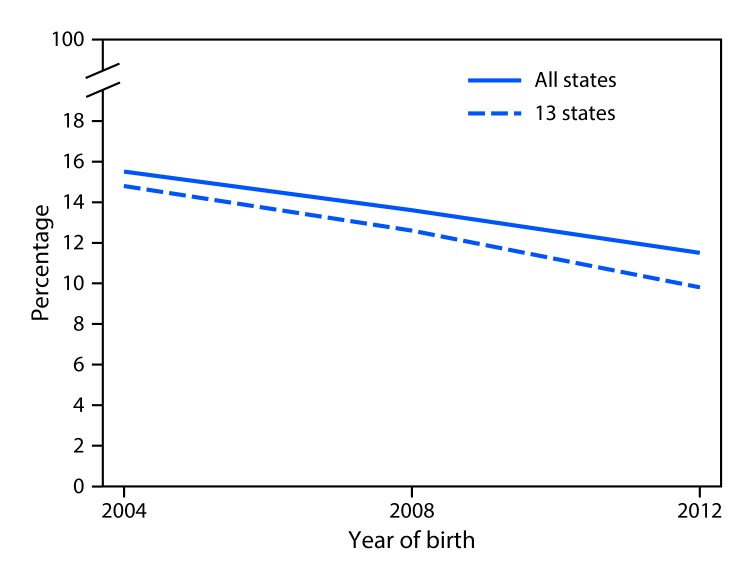
Postpartum depression is common and associated with adverse infant and maternal outcomes (e.g., lower breastfeeding initiation and duration and poor maternal and infant bonding) (1-3). A developmental Healthy People 2020 objective is to decrease the proportion of women delivering a live birth who experience postpartum depressive symptoms (PDS).* To provide a baseline for this objective, CDC sought to describe self-reported PDS overall, by reporting state, and by selected sociodemographic factors, using 2004, 2008, and 2012 data from the Pregnancy Risk Assessment Monitoring System (PRAMS). A decline in the prevalence of PDS was observed from 2004 (14.8%) to 2012 (9.8%) among 13 states with data for all three periods (p<0.01). Statistically significant (p<0.05) declines in PDS prevalence were observed for eight states, and no significant changes were observed for five states. In 2012, the overall PDS prevalence was 11.5% for 27 states and ranged from 8.0% (Georgia) to 20.1% (Arkansas). By selected characteristics, PDS prevalence was highest among new mothers who 1) were aged ≤19 years or 20-24 years, 2) were of American Indian/Alaska Native or Asian/Pacific Islander race/ethnicity, 3) had ≤12 years of education, 4) were unmarried, 5) were postpartum smokers, 6) had three or more stressful life events in the year before birth, 7) gave birth to term, low-birthweight infants, and 8) had infants requiring neonatal intensive care unit admission at birth. Although the study did not investigate reasons for the decline, better recognition of risk factors for depression and improved screening and treatment before and during pregnancy, including increased use of antidepressants, might have contributed to the decline. However, more efforts are needed to reduce PDS prevalence in certain states and subpopulations of women. Ongoing surveillance and activities to promote appropriate screening, referral, and treatment are needed to reduce PDS among U.S. women.
Overview
The claims and statistics of this paper haven’t been checked yet.
Free: it reads the open-access text and checks the first 5 claims that cite a source we can check. Create a free account to check every claim.
Integrity signals
Registry
Cites
Statistics
Figures
Verification
Claims the paper makes
The claims and statistics of this paper haven’t been checked yet.
Free: it reads the open-access text and checks the first 5 claims that cite a source we can check. Create a free account to check every claim.
Self-check
Percentages, sums and reported differences re-computed from the paper’s own numbers.
The self-check needs the paper’s full text.
Citations
Cites
Prenatal and Postpartum Maternal Psychological Distress and Infant Development: A Systematic Review
Kingston, D., Tough, S., & Whitfield, H. (2012) · Child Psychiatry & Human Development · doi:10.1007/s10578-012-0291-4 · Cited by 670 · cited 1×
“Postpartum depression is associated with adverse maternal, infant, and child outcomes, including lower rates of breastfeeding initiation and shorter duration (1), poor maternal and infant bonding (2), and infant developmental disorders (3).”
Earls, M. F., & The Committee on Psychosocial Aspects of Child and Family Health (2010) · Pediatrics · doi:10.1542/peds.2010-2348 · Cited by 497
Committee Opinion No. 630: Screening for Perinatal Depression
(2015) · Obstetrics & Gynecology · doi:10.1097/01.aog.0000465192.34779.dc · Cited by 424
The Relationship between Post-natal Depression and Mother–Child Interaction
Stein, A., Gath, D. H., Bucher, J., Bond, A., Day, A., & Cooper, P. J. (1991) · British Journal of Psychiatry · doi:10.1192/bjp.158.1.46 · Cited by 410 · cited 1×
“Postpartum depression is associated with adverse maternal, infant, and child outcomes, including lower rates of breastfeeding initiation and shorter duration (1), poor maternal and infant bonding (2), and infant developmental disorders (3).”
Depression and treatment among U.S. pregnant and nonpregnant women of reproductive age, 2005–2009
Ko, J. Y., Farr, S. L., Dietz, P. M., & Robbins, C. L. (2012) · Journal of Women's Health · doi:10.1089/jwh.2011.3466 · Cited by 289 · cited 1×
“However, depression is often underdiagnosed and untreated; nearly 60% of women with depressive symptoms do not receive a clinical diagnosis, and 50% of women with a diagnosis do not receive any treatment (8).”
Self-citationFerré, C., Callaghan, W., Olson, C., Sharma, A., & Barfield, W. (2016) · MMWR. Morbidity and Mortality Weekly Report · doi:10.15585/mmwr.mm6543a1 · Cited by 127 · cited 1×
“5% in 2014 (5), reduction of women experiencing self-reported stressful life events in the year preceding birth by 0.”
Wouk, K., Stuebe, A. M., & Meltzer-Brody, S. (2017) · Maternal and Child Health Journal · doi:10.1007/s10995-016-2150-6 · Cited by 115 · cited 1×
“Postpartum depression is associated with adverse maternal, infant, and child outcomes, including lower rates of breastfeeding initiation and shorter duration (1), poor maternal and infant bonding (2), and infant developmental disorders (3).”
Burns, E. R., Farr, S. L., & Howards, P. P. (2015) · PubMed Central · Cited by 107
Self-citationBrief Scales to Detect Postpartum Depression and Anxiety Symptoms
O'Hara, M. W., Stuart, S., Watson, D., Dietz, P. M., Farr, S. L., & D'Angelo, D. (2012) · Journal of Women's Health · doi:10.1089/jwh.2012.3612 · Cited by 66 · cited 1×
“6 157 US Department of Health and Human Services/Centers for Disease Control and Prevention These questions with similar categorization schemes have a sensitivity of 58% and specificity of 85%, compared with clinical assessments of major depressive episodes (10); thus, the results in this report might underestimate th…”
Self-citationUse of Antidepressant Medication in the United States During Pregnancy, 2002–2010
Meunier, M. R., Bennett, I. M., & Coco, A. (2013) · Psychiatric Services · doi:10.1176/appi.ps.201200455 · Cited by 37 · cited 1×
“1% in 2007–2010 (7) might have influenced the observed decline in PDS.”
Cited by
Items 301–334 of 334
Experiences with Technology and Telehealth Among Women with Perinatal DepressionPreprint
Parameswaran, U., Pentecost, R., Williams, M., Smid, M. C., & Latendresse, G. (2021) · Research Square · doi:10.21203/rs.3.rs-999982/v1 · Cited by 1
Postpartum depression in Jamaica: Exploring the lived experiences.
Elmore, S. (2023) · ThinkIR: The University of Louisville's Institutional Repository (University of Louisville) · doi:10.18297/etd/4107 · Cited by 1
Yayna, A. A., Daka, K., Tesfaye, A., & Getachew, S. (2024) · Research Square · doi:10.21203/rs.3.rs-4278746/v1 · Cited by 1
Postpartum depression in the UAE: insights, challenges, and pathways to support
Hanach, N. (2024) · Research Publications (Maastricht University) · doi:10.26481/dis.20240923nh · Cited by 3
Foreword: Depression in the Pregnant Patient.
Schaffir, J. (2018) · Clinical obstetrics and gynecology · doi:10.1097/grf.0000000000000390
Management of Depression in Women
Kransdorf, L. N., & Files, J. A. (2019) · Journal of Women s Health · doi:10.1089/jwh.2019.7908
Vera, J. B., & Semino-Asaro, S. (2020) · Digital USD (University of San Diego) · doi:10.22371/07.2020.044
Review of Allison Auth’s Book Baby and Beyond
Sczweck, C. (2020) · The Linacre Quarterly · doi:10.1177/0024363920924581
Li, L., Chen, C., You, Y., Muhetaer, M., Huang, F., Pan, J., Zhou, S., Hei, Z., Luo, C., & Wang, Y. (2021) · Research Square · doi:10.21203/rs.3.rs-792984/v1
Can hormones get you down? studies on sex steroids and depression
de Wit, A. E. (2021) · University of Groningen research database (University of Groningen / Centre for Information Technology) · doi:10.33612/diss.178483963 · Cited by 1
Liu, S., Ding, X., Belouali, A., Bai, H., Raja, K., & Kharrazi, H. H. K. (2022) · doi:10.2196/preprints.38879
An FP’s guide to identifying—and treating—postpartum depression
LeFevre, N. M., Buck, K., & Strickland, D. P. (2022) · The Journal of Family Practice · doi:10.12788/jfp.0510
Jewell, J. S., Brooks‐Russell, A., & Leiferman, J. A. (2023) · OBM Integrative and Complementary Medicine · doi:10.21926/obm.icm.2301010
PENGARUH ASUHAN KEBIDANAN CONTINUITY OF CARE TERHADAP KEJADIAN DEPRESI POST PARTUM DI SURAKARTA
Parwatiningsih, S. A., Megasari, A. L., Fatsena, R. A., Hutomo, C. S., & Kartikasari, M. N. D. (2023) · Avicenna Journal of Health Research · doi:10.36419/avicenna.v6i1.819
Levels of depression in pregnant women attending the Ticul community hospital, Yucatan, Mexico
Rodríguez-Angulo, E., GIL-GUZMÁN, J., Ojeda-Rodríguez, R., & Andueza-Pech, G. (2023) · Revista de Técnicas de Enfermería y Salud · doi:10.35429/jnt.2023.18.7.9.13 · Cited by 1
Investigating Postpartum Depression in Mothers of Children With Cleft Lip and Palate
Namdar, P., Abdali, H., Shiva, A., Pourasghar, M., & Talebi, S. (2024) · Journal of Pediatrics Review · doi:10.32598/jpr.12.1.830.3
Synthetic Oxytocin and Maternal Postpartum Depression: A Scoping Review
McDonald, M., Datesman, A., Alhusen, J. L., Connelly, J. J., & Perkeybile, A. M. (2025) · The Journal of Perinatal & Neonatal Nursing · doi:10.1097/jpn.0000000000000935
Zagzoog, R., & Alotaibi, F. A. (2025) · Cureus · doi:10.7759/cureus.86037 · Cited by 1
SHUKLA, A. K., & MISRA, S. (2025) · International Journal of Current Pharmaceutical Research · doi:10.22159/ijcpr.2025v17i4.7035
Savell, S. M., Page, E. A., Pan, J., Lillard, T. S., Emery, R. E., & Connelly, J. J. (2025) · Journal of Child and Family Studies · doi:10.1007/s10826-025-03211-y · Cited by 1
Adams, J. B., Kirby, J. K., Sorensen, J. C., Pollard, E. L., & AUDHYA, T. K. (2022) · Figshare · doi:10.6084/m9.figshare.20290992
Chen, X., & Yao, W. (2025) · Science & Sports · doi:10.1016/j.scispo.2025.07.015
The role of medical mistrust in racial and ethnic inequities in postpartum mental health care
Haight, S. C., Daw, J. R., Pence, B. W., Slaughter-Acey, J. C., Martin, C. L., Verbiest, S., & Maselko, J. (2026) · SSM - Mental Health · doi:10.1016/j.ssmmh.2026.100588
Nguyen, H. T. T., Nguyen, H. T., Phan, T. K. A., Duong, G. T. T., Do, L. A., Vu, H. N., Nguyen, T. T., Boyer, L., Boussat, B., Auquier, P., et al. (2026) · Scientific Reports · doi:10.1038/s41598-026-38669-3
Gillham, A. M., Cochran, G., Wiglesworth, A., Aubuchon-Endsley, N. L., Coser, A. D., Wilhelm, R. A., Thompson, W. K., Aupperle, R. L., Paulus, M. P., & White, E. J. (2026) · Adversity and Resilience Science · doi:10.1007/s42844-026-00197-4
Kumar, N. R., Fendrick, A. M., Zivin, K., & Dalton, V. K. (2026) · American Journal of Perinatology · doi:10.1055/a-2849-7918
Fagan, J., Dufour, S., Duet, S., Downs, E., Siddaiah, H., Viswanath, O., Shekoohi, S., & Kaye, A. (2026) · Neuropsychiatric Disease and Treatment · doi:10.2147/ndt.s579920
Palazzolo, G. G., Mwanda, S., & Nechuta, S. (2026) · Paediatric and Perinatal Epidemiology · doi:10.1111/ppe.70151
Huang, L., Wang, C., & Wen, J. (2026) · Journal of Affective Disorders · doi:10.1016/j.jad.2026.122086
Historical trauma as a contributor to postpartum depression among Indigenous mothers
Maxwell, D., & Munoz, R. T. (2026) · Frontiers in Psychiatry · doi:10.3389/fpsyt.2026.1638586
Abedin, F., Das, M., Bishayi, A., Saha, P., Husna, A., Haque, S., Rana, S. S., Sudesh, R., & Ahmad, F. (2026) · Archives of Women s Mental Health · doi:10.1007/s00737-026-01753-8
Aguilar, N., Manzo, M., FAKHOURY, P. I., Surma, J., & Bailey, B. (2026) · Cureus · doi:10.7759/cureus.115659
Jethwa, A., Guo, N., Harrison, N., Chakraborty, D., Carvalho, B., Panelli, D. M., & Sultan, P. (2026) · International Journal of Obstetric Anesthesia · doi:10.1016/j.ijoa.2026.105300
Metadata
- Authors
- Ko, J. Y., Rockhill, K. M., Tong, V. T., Morrow, B., & Farr, S. L.
- Affiliations
- Center for Surveillance, Epidemiology, and Laboratory Services (US)
- Corresponding author
- Ko, Jean Y.
- Venue
- MMWR. Morbidity and Mortality Weekly Report
- Published
- 2017-02-17
- Volume
- 66
- Issue
- 6
- Pages
- 153-158
- ISSN
- 0149-2195 (ISSN-L)
- 1545-861X
- PMC
- PMC5657855
- OpenAlex
- W2588375071
- Cited by
- 334
- References
- 11
- Citations by year
- 2026: 13 · 2025: 23 · 2024: 32 · 2023: 33 · 2022: 43 · 2021: 46 · 2020: 72 · 2019: 45 · 2018: 25 · 2017: 2
- FWCI
- 36.92
- Type
- journal article
- Language
- en
- Open access
- bronze
- doi.org
- Locations
- MMWR Morbidity and Mortality Weekly Report (publishedVersion)
- PubMed Central (publishedVersion, cc-by)
- PubMed (publishedVersion)
- Funders
- U.S. Department of Energy
- Centers for Disease Control and Prevention
- Oak Ridge Institute for Science and Education
- National Center for Chronic Disease Prevention and Health Promotion
- National Center on Birth Defects and Developmental Disabilities
- Topics
- Health Sciences › Medicine › Public Health, Environmental and Occupational Health › Maternal Mental Health During Pregnancy and Postpartum
- Health Sciences › Medicine › Pediatrics, Perinatology and Child Health › Maternal and Neonatal Healthcare
- Health Sciences › Medicine › Obstetrics and Gynecology › Maternal and Perinatal Health Interventions
- Keywords
- postpartum depressive symptoms, postpartum depression, prevalence trends, sociodemographic risk factors, young mothers, racial and ethnic disparities, low educational attainment, marital status, postpartum smoking, life events, low birth weight, neonatal intensive care, antidepressant use, maternal mental health, Healthy People 2020, Pregnancy Risk Assessment Monitoring System
- MeSH terms
- Adolescent, Adult, Female, Humans, Population Surveillance, Pregnancy, United States, Prevalence, Risk Assessment, Depression, Postpartum, Young Adult
About these checks
Registry, retraction, Cites and statistics results are computed, not judged, with one exception: a printed reference that no index lists is read once by a model before it counts as a citation error. Claims are extracted by a model and kept only when their quote appears verbatim in the text; each cited source is then checked, with a model’s help, for whether it says what the claim relies on. Those verdicts can be wrong — read the claim’s quote and the cited source before relying on one.
Statistics and arithmetic are recomputed, not judged.
Confidence bands are shown only for fields calibrated on our annotated test set. None is calibrated yet, so no band is shown.
What counts as a claim ›How we measure confidence ›How we check this ›
Are you an author, or do you see a problem with this page? Request a review
Data sources
Bibliographic data: Semantic Scholar, OpenAlex, Crossref.
Contains information from the Semantic Scholar Academic Graph Datasets, made available under the ODC Attribution License (ODC-BY 1.0).
Semantic Scholar’s data is described in: Kinney, R., et al. (2023). The Semantic Scholar Open Data Platform. arXiv:2301.10140.
