

Trends in postpartum depressive symptoms- 27 States, 2004, 2008, and 2012
Open accessThe DOI matches its Crossref record; 10 of the 11 references it cites were found in a registry or an index.
Abstract
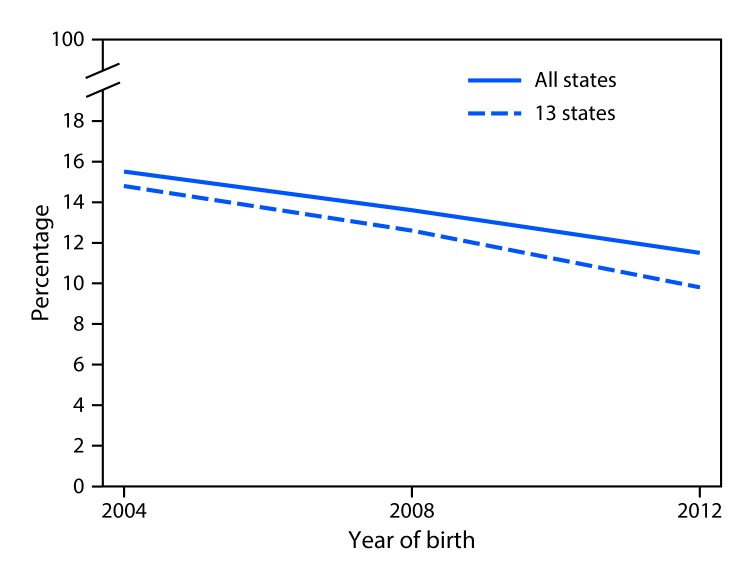
Postpartum depression is common and associated with adverse infant and maternal outcomes (e.g., lower breastfeeding initiation and duration and poor maternal and infant bonding) (1-3). A developmental Healthy People 2020 objective is to decrease the proportion of women delivering a live birth who experience postpartum depressive symptoms (PDS).* To provide a baseline for this objective, CDC sought to describe self-reported PDS overall, by reporting state, and by selected sociodemographic factors, using 2004, 2008, and 2012 data from the Pregnancy Risk Assessment Monitoring System (PRAMS). A decline in the prevalence of PDS was observed from 2004 (14.8%) to 2012 (9.8%) among 13 states with data for all three periods (p<0.01). Statistically significant (p<0.05) declines in PDS prevalence were observed for eight states, and no significant changes were observed for five states. In 2012, the overall PDS prevalence was 11.5% for 27 states and ranged from 8.0% (Georgia) to 20.1% (Arkansas). By selected characteristics, PDS prevalence was highest among new mothers who 1) were aged ≤19 years or 20-24 years, 2) were of American Indian/Alaska Native or Asian/Pacific Islander race/ethnicity, 3) had ≤12 years of education, 4) were unmarried, 5) were postpartum smokers, 6) had three or more stressful life events in the year before birth, 7) gave birth to term, low-birthweight infants, and 8) had infants requiring neonatal intensive care unit admission at birth. Although the study did not investigate reasons for the decline, better recognition of risk factors for depression and improved screening and treatment before and during pregnancy, including increased use of antidepressants, might have contributed to the decline. However, more efforts are needed to reduce PDS prevalence in certain states and subpopulations of women. Ongoing surveillance and activities to promote appropriate screening, referral, and treatment are needed to reduce PDS among U.S. women.
Overview
The claims and statistics of this paper haven’t been checked yet.
Free: it reads the open-access text and checks the first 5 claims that cite a source we can check. Create a free account to check every claim.
Integrity signals
Registry
Cites
Statistics
Figures
Verification
Claims the paper makes
The claims and statistics of this paper haven’t been checked yet.
Free: it reads the open-access text and checks the first 5 claims that cite a source we can check. Create a free account to check every claim.
Self-check
Percentages, sums and reported differences re-computed from the paper’s own numbers.
The self-check needs the paper’s full text.
Citations
Cites
Prenatal and Postpartum Maternal Psychological Distress and Infant Development: A Systematic Review
Kingston, D., Tough, S., & Whitfield, H. (2012) · Child Psychiatry & Human Development · doi:10.1007/s10578-012-0291-4 · Cited by 670 · cited 1×
“Postpartum depression is associated with adverse maternal, infant, and child outcomes, including lower rates of breastfeeding initiation and shorter duration (1), poor maternal and infant bonding (2), and infant developmental disorders (3).”
Earls, M. F., & The Committee on Psychosocial Aspects of Child and Family Health (2010) · Pediatrics · doi:10.1542/peds.2010-2348 · Cited by 497
Committee Opinion No. 630: Screening for Perinatal Depression
(2015) · Obstetrics & Gynecology · doi:10.1097/01.aog.0000465192.34779.dc · Cited by 424
The Relationship between Post-natal Depression and Mother–Child Interaction
Stein, A., Gath, D. H., Bucher, J., Bond, A., Day, A., & Cooper, P. J. (1991) · British Journal of Psychiatry · doi:10.1192/bjp.158.1.46 · Cited by 410 · cited 1×
“Postpartum depression is associated with adverse maternal, infant, and child outcomes, including lower rates of breastfeeding initiation and shorter duration (1), poor maternal and infant bonding (2), and infant developmental disorders (3).”
Depression and treatment among U.S. pregnant and nonpregnant women of reproductive age, 2005–2009
Ko, J. Y., Farr, S. L., Dietz, P. M., & Robbins, C. L. (2012) · Journal of Women's Health · doi:10.1089/jwh.2011.3466 · Cited by 289 · cited 1×
“However, depression is often underdiagnosed and untreated; nearly 60% of women with depressive symptoms do not receive a clinical diagnosis, and 50% of women with a diagnosis do not receive any treatment (8).”
Self-citationFerré, C., Callaghan, W., Olson, C., Sharma, A., & Barfield, W. (2016) · MMWR. Morbidity and Mortality Weekly Report · doi:10.15585/mmwr.mm6543a1 · Cited by 127 · cited 1×
“5% in 2014 (5), reduction of women experiencing self-reported stressful life events in the year preceding birth by 0.”
Wouk, K., Stuebe, A. M., & Meltzer-Brody, S. (2017) · Maternal and Child Health Journal · doi:10.1007/s10995-016-2150-6 · Cited by 115 · cited 1×
“Postpartum depression is associated with adverse maternal, infant, and child outcomes, including lower rates of breastfeeding initiation and shorter duration (1), poor maternal and infant bonding (2), and infant developmental disorders (3).”
Burns, E. R., Farr, S. L., & Howards, P. P. (2015) · PubMed Central · Cited by 107
Self-citationBrief Scales to Detect Postpartum Depression and Anxiety Symptoms
O'Hara, M. W., Stuart, S., Watson, D., Dietz, P. M., Farr, S. L., & D'Angelo, D. (2012) · Journal of Women's Health · doi:10.1089/jwh.2012.3612 · Cited by 66 · cited 1×
“6 157 US Department of Health and Human Services/Centers for Disease Control and Prevention These questions with similar categorization schemes have a sensitivity of 58% and specificity of 85%, compared with clinical assessments of major depressive episodes (10); thus, the results in this report might underestimate th…”
Self-citationUse of Antidepressant Medication in the United States During Pregnancy, 2002–2010
Meunier, M. R., Bennett, I. M., & Coco, A. (2013) · Psychiatric Services · doi:10.1176/appi.ps.201200455 · Cited by 37 · cited 1×
“1% in 2007–2010 (7) might have influenced the observed decline in PDS.”
Cited by
Meltzer-Brody, S., Colquhoun, H., Riesenberg, R., Epperson, C. N., Deligiannidis, K. M., Rubinow, D. R., Li, H., Sankoh, A. J., Clemson, C., Schacterle, A., et al. (2018) · The Lancet · doi:10.1016/s0140-6736(18)31551-4 · Cited by 795
Prevalence and Risk Factors of Postpartum Depression in Women: A Systematic Review and Meta‐analysis
Liu, X., Wang, S., & Wang, G. (2022) · Journal of Clinical Nursing · doi:10.1111/jocn.16121 · Cited by 520
US Preventive Services Task Force, Curry, S. J., Krist, A. H., Owens, D. K., Barry, M. J., Caughey, A. B., Davidson, K. W., Doubeni, C. A., Epling, J. W., Grossman, D. C., et al. (2019) · JAMA · doi:10.1001/jama.2019.0007 · Cited by 494
Bauman, B. L., Ko, J. Y., Cox, S., D’Angelo, M., Warner, L., Folger, S., Tevendale, H. D., Coy, K. C., Harrison, L., & Barfield, W. D. (2020) · MMWR. Morbidity and Mortality Weekly Report · doi:10.15585/mmwr.mm6919a2 · Cited by 399
Self-citationO’Connor, E., Senger, C. A., Henninger, M. L., Coppola, E., & Gaynes, B. N. (2019) · JAMA · doi:10.1001/jama.2018.20865 · Cited by 316
Luca, D. L., Margiotta, C., Staatz, C., Garlow, E., Christensen, A., & Zivin, K. (2020) · American Journal of Public Health · doi:10.2105/ajph.2020.305619 · Cited by 303
Bernard, K., Nissim, G., Vaccaro, S., Harris, J. L., & Lindhiem, O. (2018) · Attachment & Human Development · doi:10.1080/14616734.2018.1430839 · Cited by 266
“Of note, from 2004 to 2012, there was a 25% decline in postpartum depression, which has been attributed in part to improved screening and treatment (Ko et al., 2017).”
Van Niel, M. S., Bhatia, R., Riano, N. S., de Faria, L., Catapano-Friedman, L., Ravven, S., Weissman, B., Nzodom, C., Alexander, A., Budde, K., et al. (2020) · Harvard Review of Psychiatry · doi:10.1097/hrp.0000000000000246 · Cited by 238
Perinatal depression: A review
Van Niel, M. S., & Payne, J. L. (2020) · Cleveland Clinic Journal of Medicine · doi:10.3949/ccjm.87a.19054 · Cited by 227
Brexanolone for postpartum depression: A meta-analysis of randomized controlled studies
Zheng, W., Cai, D.-B., Zheng, W., Sim, K., Ungvari, G. S., Peng, X.-J., Ning, Y.-P., Wang, G., & Xiang, Y.-T. (2019) · Psychiatry Research · doi:10.1016/j.psychres.2019.07.006 · Cited by 218
Cooper, M. C., Kilvert, H. S., Hodgkins, P., Roskell, N. S., & Eldar-Lissai, A. (2019) · CNS Drugs · doi:10.1007/s40263-019-00672-w · Cited by 192
Zuranolone for the Treatment of Postpartum Depression
Deligiannidis, K. M., Meltzer-Brody, S., Maximos, B., Peeper, E. Q., Freeman, M., Lasser, R., Bullock, A., Kotecha, M., Li, S., Forrestal, F., et al. (2023) · American Journal of Psychiatry · doi:10.1176/appi.ajp.20220785 · Cited by 192
Trajectories of Maternal Postpartum Depressive Symptoms
Putnick, D. L., Sundaram, R., Bell, E. M., Ghassabian, A., Goldstein, R. B., Robinson, S. L., Vafai, Y., Gilman, S. E., & Yeung, E. (2020) · Pediatrics · doi:10.1542/peds.2020-0857 · Cited by 154
Pharmacotherapy of Postpartum Depression: Current Approaches and Novel Drug Development
Frieder, A., Fersh, M., Hainline, R., & Deligiannidis, K. M. (2019) · CNS Drugs · doi:10.1007/s40263-019-00605-7 · Cited by 156
Achtyes, E. D., Keaton, S. A., Smart, L., Burmeister, A. R., Heilman, P. L., Krzyżanowski, S., Nagalla, M., Guillemin, G. J., Galvis, M. L. E., Lim, C. K., et al. (2019) · Brain Behavior and Immunity · doi:10.1016/j.bbi.2019.10.017 · Cited by 163
Oxytocin and postpartum depression: A systematic review
Thul, T. A., Corwin, E. J., Carlson, N. S., Brennan, P. A., & Young, L. J. (2020) · Psychoneuroendocrinology · doi:10.1016/j.psyneuen.2020.104793 · Cited by 139
Predicting women with depressive symptoms postpartum with machine learning methods
Andersson, S., Bathula, D. R., Iliadis, S. I., Walter, M., & Skalkidou, A. (2021) · Scientific Reports · doi:10.1038/s41598-021-86368-y · Cited by 135
Allopregnanolone in postpartum depression: Role in pathophysiology and treatment
Meltzer-Brody, S., & Kanes, S. J. (2020) · Neurobiology of Stress · doi:10.1016/j.ynstr.2020.100212 · Cited by 133
Machine Learning-Based Predictive Modeling of Postpartum Depression
Shin, D., Lee, K. J., Adeluwa, T., & Hur, J. (2020) · Journal of Clinical Medicine · doi:10.3390/jcm9092899 · Cited by 129
Azami, M., Badfar, G., Soleymani, A., & Rahmati, S. (2019) · Diabetes Research and Clinical Practice · doi:10.1016/j.diabres.2019.01.034 · Cited by 124
Guglielminotti, J. R., Landau, R., & Li, G. (2019) · Anesthesia & Analgesia · doi:10.1213/ane.0000000000004336 · Cited by 136
Tirumalaraju, V., Suchting, R., Evans, J., Goetzl, L. M., Refuerzo, J., Neumann, A., Anand, D., Ravikumar, R., Green, C. E., Cowen, P. J., et al. (2020) · JAMA Network Open · doi:10.1001/jamanetworkopen.2020.8783 · Cited by 143
Brexanolone (Zulresso): Finally, an FDA-Approved Treatment for Postpartum Depression
Powell, J., Garland, S. G., Preston, K., & Piszczatoski, C. (2019) · Annals of Pharmacotherapy · doi:10.1177/1060028019873320 · Cited by 120
Estimating Transition Probabilities from Published Evidence: A Tutorial for Decision Modelers
Gidwani, R., & Russell, L. B. (2020) · PharmacoEconomics · doi:10.1007/s40273-020-00937-z · Cited by 98
Trajectories of antenatal depression and adverse pregnancy outcomes
Miller, E. S., Saade, G. R., Simhan, H. N., Monk, C. E., Haas, D. M., Silver, R. M., Mercer, B. M., Parry, S. I., Wing, D. A., Reddy, U. M., et al. (2021) · American Journal of Obstetrics and Gynecology · doi:10.1016/j.ajog.2021.07.007 · Cited by 124
Lewkowitz, A. K., Whelan, A. R., Ayala, N. K., Hardi, A., Stoll, C., Battle, C. L., Tuuli, M. G., Ranney, M. L., & Miller, E. S. (2024) · American Journal of Obstetrics and Gynecology · doi:10.1016/j.ajog.2023.06.028 · Cited by 84
Adams, J. B., Kirby, J. K., Sorensen, J. C., Pollard, E. L., & AUDHYA, T. K. (2022) · Maternal Health Neonatology and Perinatology · doi:10.1186/s40748-022-00139-9 · Cited by 107
Loewenstein, K., Barroso, J., & Phillips, S. (2019) · Journal of Perinatal & Neonatal Nursing · doi:10.1097/jpn.0000000000000436 · Cited by 82
Hanach, N., de Vries, N., Radwan, H., & Bissani, N. (2021) · Midwifery · doi:10.1016/j.midw.2020.102906 · Cited by 75
Is the Effect of Postpartum Depression on Mother-Infant Bonding Universal?
Badr, L. K., Ayvazian, N., Lameh, S., & Charafeddine, L. (2018) · Infant Behavior and Development · doi:10.1016/j.infbeh.2018.02.003 · Cited by 71
Cluxton‐Keller, F., & BRUCE, M. L. (2018) · PLoS ONE · doi:10.1371/journal.pone.0198730 · Cited by 84
GABAAR Modulator for Postpartum Depression
Mody, I. (2019) · Cell · doi:10.1016/j.cell.2018.12.016 · Cited by 65
Latendresse, G., Bailey, E., Iacob, E., Murphy, H. J., Pentecost, R., Thompson, N. J., & HOGUE, C. J. R. (2021) · Journal of Midwifery & Women s Health · doi:10.1111/jmwh.13209 · Cited by 70
Oxytocin during breastfeeding and maternal mood symptoms
Whitley, J., Wouk, K., Bauer, A. E., Grewen, K., Gottfredson, N. C., Meltzer-Brody, S., Propper, C., Mills-Koonce, R., Pearson, B., & Stuebe, A. (2020) · Psychoneuroendocrinology · doi:10.1016/j.psyneuen.2019.104581 · Cited by 61
Haight, S. C., Daw, J. R., Martin, C. L., Sheffield-Abdullah, K. M., Verbiest, S., Pence, B. W., & Maselko, J. (2024) · Health Affairs · doi:10.1377/hlthaff.2023.01434 · Cited by 79
Rommel, A., Bergink, V., Liu, X., Munk‐Olsen, T., & Molenaar, N. M. (2020) · The Journal of Clinical Psychiatry · doi:10.4088/jcp.19r12965 · Cited by 72
Maternal Depression in Early Childhood and Developmental Vulnerability at School Entry
Wall‐Wieler, E., Roos, L. L., & Gotlib, I. H. (2020) · PEDIATRICS · doi:10.1542/peds.2020-0794 · Cited by 75
Recorded Diagnoses of Depression During Delivery Hospitalizations in the United States, 2000–2015
Haight, S. C., Byatt, N., Moore Simas, T. A., Robbins, C. L., & Ko, J. Y. (2019) · Obstetrics & Gynecology · doi:10.1097/aog.0000000000003291 · Cited by 53
Self-citationExploring the Link between Maternity Leave and Postpartum Depression
Kornfeind, K. R., & Sipsma, H. L. (2018) · Women s Health Issues · doi:10.1016/j.whi.2018.03.008 · Cited by 67
Prevalence and risk factors of postpartum depression among women living in the United Arab Emirates
Hanach, N., Radwan, H. M., Fakhry, R., Dennis, C., Bani‐Issa, W., Faris, M. E., Obaid, R. S., Marzooqi, S. A., Tabet, C., & de Vries, N. K. (2022) · Social Psychiatry and Psychiatric Epidemiology · doi:10.1007/s00127-022-02372-1 · Cited by 71
Madhoun, L. L., Crerand, C. E., Keim, S. A., & Baylis, A. L. (2019) · The Cleft Palate-Craniofacial Journal · doi:10.1177/1055665619878972 · Cited by 60
Postpartum complications increased in women with polycystic ovary syndrome
Alur-Gupta, S., Boland, M. R., Barnhart, K. T., Sammel, M. D., & Dokras, A. (2020) · American Journal of Obstetrics and Gynecology · doi:10.1016/j.ajog.2020.08.048 · Cited by 53
“It's Hard Being a Mama”: Validation of the Maternal Distress Concept in Becoming a Mother
Copeland, D. B., & Harbaugh, B. L. (2019) · The Journal of Perinatal Education · doi:10.1891/1058-1243.28.1.28 · Cited by 64
Navas, A., Carrascosa, M. D. C., Artigues, C., Ortas, S., Portells, E., Soler, A., Yáñez, A. M., Bennasar‐Veny, M., & Leiva, A. (2021) · Journal of Clinical Medicine · doi:10.3390/jcm10112432 · Cited by 71
The humanistic burden of postpartum depression: a systematic literature review
Simas, T. A. M., Huang, M., Patton, C., Reinhart, M. L., Chawla, A., Clemson, C., & Eldar‐Lissai, A. (2018) · Current Medical Research and Opinion · doi:10.1080/03007995.2018.1552039 · Cited by 58
Effects of mother–infant skin‐to‐skin contact on postpartum depression: A systematic review
Kırca, N., & Adıbelli, D. (2021) · Perspectives In Psychiatric Care · doi:10.1111/ppc.12727 · Cited by 54
Helping Working Mothers Face the Challenges of an Intensive Mothering Culture
Lamar, M. R., Forbes, L. K., & Capasso, L. A. (2019) · Journal of Mental Health Counseling · doi:10.17744/mehc.41.3.02 · Cited by 67
Epperson, C. N., Huang, M., Cook, K., Gupta, D., Chawla, A., Greenberg, P. E., & Eldar‐Lissai, A. (2020) · Current Medical Research and Opinion · doi:10.1080/03007995.2020.1799772 · Cited by 53
Stress and Symptoms of Depression in Fathers of Infants Admitted to the NICU
Cyr-Alves, H., Macken, L., & Hyrkäs, K. E. (2018) · Journal of Obstetric, Gynecologic & Neonatal Nursing · doi:10.1016/j.jogn.2017.12.006 · Cited by 50
Kountanis, J. A., Vahabzadeh, C., Bauer, S., Muzik, M., Cassidy, R., Aman, C., MacEachern, M., & Bauer, M. E. (2020) · Journal of Clinical Anesthesia · doi:10.1016/j.jclinane.2019.109658 · Cited by 45
Reframing the narrative: Black maternal mental health and culturally meaningful support for wellness
Parker, A. (2021) · Infant Mental Health Journal · doi:10.1002/imhj.21910 · Cited by 54
Gardening and Women's Maternal Care in the U.S. Capital: The Unacceptable Chasm
Miles‐Cohen, S. E. (2018) · Women s Reproductive Health · doi:10.1080/23293691.2018.1429377 · Cited by 44
Brexanolone for postpartum depression: clinical evidence and practical considerations
Leader, L. D., O'Connell, M., & VandenBerg, A. (2019) · Pharmacotherapy: The Journal of Human Pharmacology and Drug Therapy · doi:10.1002/phar.2331 · Cited by 43
Webber, E., & Benedict, J. (2019) · Archives of Psychiatric Nursing · doi:10.1016/j.apnu.2019.01.008 · Cited by 63
Testa, A. M., Jackson, D. B., Vaughn, M. G., & Bello, J. K. (2019) · Social Science & Medicine · doi:10.1016/j.socscimed.2019.112777 · Cited by 45
Loss of transient receptor potential channel 5 causes obesity and postpartum depression
Li, Y., Cacciottolo, T. M., Yin, N., He, Y., Liu, H., Liu, H., Yang, Y., Henning, E., Keogh, J. M., Lawler, K., et al. (2024) · Cell · doi:10.1016/j.cell.2024.06.001 · Cited by 46
Sato, A., Kotajima‐Murakami, H., Tanaka, M., Katoh, Y., & Ikeda, K. (2022) · Frontiers in Psychiatry · doi:10.3389/fpsyt.2022.821455 · Cited by 55
Genetic risk scores for major psychiatric disorders and the risk of postpartum psychiatric disorders
Bauer, A. E., Liu, X., Byrne, E. M., Sullivan, P. F., Wray, N. R., Agerbo, E., Nyegaard, M., Grove, J., Musliner, K. L., Ingstrup, K. G., et al. (2019) · Translational Psychiatry · doi:10.1038/s41398-019-0629-9 · Cited by 42
Association between maternal satisfaction with breastfeeding and postpartum depression symptoms
de Avilla, J. C., Giugliani, C., Bizon, A. M. B. L., Martins, A. C. M., de Senna, A. F. K., & Giugliani, E. R. J. (2020) · PLoS ONE · doi:10.1371/journal.pone.0242333 · Cited by 59
Timing of Postpartum Depressive Symptoms
Robbins, C. L., Ko, J. Y., D’Angelo, D. V., von Essen, B. S., Bish, C. L., Kroelinger, C. D., Tevendale, H. D., Warner, L., & Barfield, W. D. (2023) · Preventing Chronic Disease · doi:10.5888/pcd20.230107 · Cited by 56
Self-citationFrequency, trends, and antecedents of severe maternal depression after three million U.S. births
França, U. L., & McManus, M. L. (2018) · PLOS ONE · doi:10.1371/journal.pone.0192854 · Cited by 39
Nagata, J. M., Gomberg, S., Hagan, M. J., Heyman, M. B., & Wojcicki, J. M. (2018) · Journal of Hunger & Environmental Nutrition · doi:10.1080/19320248.2018.1434101 · Cited by 51
The barriers and needs of transgender men in pregnancy and childbirth: A qualitative interview study
van Amesfoort, J. E., van Rooij, F. B., Painter, R. C., den Berg, A. W. V.-V., Kreukels, B. P. C., Steensma, T. D., Huirne, J. A. F., de Groot, C. J. M., & van Mello, N. M. (2023) · Midwifery · doi:10.1016/j.midw.2023.103620 · Cited by 43
Antenatal and postnatal depressive symptoms: Association with quality of mother–infant interaction
Binda, V., Figueroa-Leigh, F., & Olhaberry, M. (2019) · Infant Behavior and Development · doi:10.1016/j.infbeh.2019.101386 · Cited by 53
Young First-Time Mothers’ Parenting of Infants: The Role of Depression and Social Support
Lee, H. Y., Edwards, R. C., & Hans, S. L. (2019) · Maternal and Child Health Journal · doi:10.1007/s10995-019-02849-7 · Cited by 48
Stremler, R., McMurray, J., & Brennenstuhl, S. (2019) · Behavioral Sleep Medicine · doi:10.1080/15402002.2019.1601629 · Cited by 39
Matrisciano, F., & Pinna, G. (2020) · Neurobiology of Stress · doi:10.1016/j.ynstr.2020.100222 · Cited by 41
Cunningham, S. D., Mokshagundam, S., Chai, H., Lewis, J. B., Levine, J., Tobin, J. N., & Ickovics, J. R. (2018) · Journal of Midwifery & Women s Health · doi:10.1111/jmwh.12686 · Cited by 39
Hardin, J. S., Jones, N. A., Mize, K. D., & Platt, M. (2021) · Neuropsychobiology · doi:10.1159/000511604 · Cited by 37
Trajectories of perinatal depressive symptoms in the context of the COVID-19 pandemic
Gustafsson, H., Young, A. S., Doyle, O. J., Nagel, B. J., Seghete, K. L. M., Nigg, J. T., Sullivan, E. L., & Graham, A. M. (2021) · Child Development · doi:10.1111/cdev.13656 · Cited by 35
“Being a mom = having all the feels”: social support in a postpartum depression online support group
Stana, A., & Miller, A. R. (2019) · Atlantic Journal of Communication · doi:10.1080/15456870.2019.1616736 · Cited by 39
Psychometric assessment of the Edinburgh Postnatal Depression Scale in an obstetric population
Long, M. M., Cramer, R. J., Bennington, L. K., Morgan, F. G., Wilkes, C. A., Fontanares, A. J., Sadr, N., Bertolino, S. M., & Paulson, J. F. (2020) · Psychiatry Research · doi:10.1016/j.psychres.2020.113161 · Cited by 37
Deligiannidis, K. M., Kroll-Desrosiers, A. R., Tan, Y., Dubuke, M. L., & Shaffer, S. A. (2020) · Psychoneuroendocrinology · doi:10.1016/j.psyneuen.2020.104827 · Cited by 31
Treatment resistant depression in women with peripartum depression
Cepeda, M. S., Kern, D. M., & Nicholson, S. (2019) · BMC Pregnancy and Childbirth · doi:10.1186/s12884-019-2462-9 · Cited by 31
Wald, J., Henningsson, A., Hanze, E., Hoffmann, E. C., Li, H., Colquhoun, H., & Deligiannidis, K. M. (2022) · Clinical Pharmacokinetics · doi:10.1007/s40262-022-01155-w · Cited by 36
Simas, T. A. M., Huang, M., Packnett, E., Zimmerman, N. M., Moynihan, M., & Eldar‐Lissai, A. (2019) · Journal of Medical Economics · doi:10.1080/13696998.2019.1679157 · Cited by 36
Lin, S. C., Tyus, N., Maloney, M., Ohri, B., & Sripipatana, A. (2020) · PLoS ONE · doi:10.1371/journal.pone.0231243 · Cited by 37
Faden, J., & Citrome, L. (2020) · Therapeutic Advances in Psychopharmacology · doi:10.1177/2045125320968658 · Cited by 35
Lara-Cinisomo, S., Fujimoto, E. M., Oksas, C., Jian, Y., & Gharheeb, A. (2019) · Maternal and Child Health Journal · doi:10.1007/s10995-019-02800-w · Cited by 36
Ren, Z., Wang, M., Aldhabi, M., Zhang, R., Liu, Y., Liu, S., Tang, R., & Chen, Z. (2021) · Neurobiology of Stress · doi:10.1016/j.ynstr.2021.100422 · Cited by 31
The international postpartum depression: action towards causes and treatment (PACT) consortium
Guintivano, J., Putnam, K. T., Sullivan, P. F., & Meltzer-Brody, S. E. (2019) · International Review of Psychiatry · doi:10.1080/09540261.2018.1551191 · Cited by 29
Young, C. A., Burnett, H. Q., Ballinger, A. L., Castro, G. M. P., Steinberg, S., Nau, M., Bakken, E. H., Thomas, M., & Beck, A. L. (2019) · Academic Pediatrics · doi:10.1016/j.acap.2019.08.004 · Cited by 37
Segre, L. S., Mehner, B. T., & Brock, R. L. (2021) · Women s Health Issues · doi:10.1016/j.whi.2020.12.008 · Cited by 36
Ginsburg, D. K., Salinas, D. B., Cosanella, T. M., Wee, C. P., Saeed, M. M., Keens, T. G., & Gold, J. I. (2022) · Journal of Cystic Fibrosis · doi:10.1016/j.jcf.2022.12.002 · Cited by 30
Hayoun, D. H. B., Sultan, P., Rozeznic, J., Guo, N., Carvalho, B., Orbach‐Zinger, S., & Weiniger, C. F. (2023) · Journal of Clinical Anesthesia · doi:10.1016/j.jclinane.2023.111263 · Cited by 34
Drzymalla, E., Crider, K. S., Wang, A., Marta, G., Khoury, M. J., & Rasooly, D. (2023) · Translational Psychiatry · doi:10.1038/s41398-023-02620-1 · Cited by 33
The maternal health of American Indian and Alaska Native people: A scoping review
Burns, A., DeAtley, T., & Short, S. E. (2022) · Social Science & Medicine · doi:10.1016/j.socscimed.2022.115584 · Cited by 31
Health Care Use by Commercially Insured Postpartum and Nonpostpartum Women in the United States
Steenland, M. W., Kozhimannil, K. B., Werner, E. F., & Daw, J. R. (2021) · Obstetrics and Gynecology · doi:10.1097/aog.0000000000004359 · Cited by 30
Ay, Ö. P., & Aktaş, S. (2021) · Health Care For Women International · doi:10.1080/07399332.2021.1973008 · Cited by 35
Postpartum depression and ADHD in the offspring: Systematic review and meta-analysis
Christaki, V., Ismirnioglou, I., Katrali, A., Panagouli, E. D., Tzila, E., Thomaidis, L., Ψαλτοπούλου, Θ., Sergentanis, T. Ν., & Τσίτσικα, Ά. (2022) · Journal of Affective Disorders · doi:10.1016/j.jad.2022.08.055 · Cited by 30
Zhou, Y., Bai, Z., Zhang, W., Xu, S., Feng, Y., Li, Q., Li, L., Ping, A., Chen, L., Wang, S., et al. (2024) · JAMA Network Open · doi:10.1001/jamanetworkopen.2023.53252 · Cited by 30
Eldar‐Lissai, A., Cohen, J. T., Meltzer-Brody, S. E., Gerbasi, M. E., Chertavian, E., Hodgkins, P., Bond, J. C., & Johnson, S. J. (2020) · Journal of Managed Care & Specialty Pharmacy · doi:10.18553/jmcp.2020.19306 · Cited by 35
Deng, C.-M., Ding, T., Li, S., Lei, B., Xu, M.-J., Wang, L., Xu, S.-C., Yang, H.-X., Sun, X.-Y., Li, X.-Y., et al. (2021) · Journal of Affective Disorders · doi:10.1016/j.jad.2020.12.027 · Cited by 24
Perinatal depressive disorder prevalence in Africa: A systematic review and Bayesian analysis
Endomba, F. T., Ndoadoumgue, A. L., Mbanga, C. M., Nkeck, J. R., Ayissi, G., Danwang, C., & Bigna, J. J. (2021) · General Hospital Psychiatry · doi:10.1016/j.genhosppsych.2021.01.006 · Cited by 27
Thompson, M. J., Carlson, D. S., Hackney, K. J., & Vogel, R. M. (2021) · Journal of Organizational Behavior · doi:10.1002/job.2579 · Cited by 33
Experiences of racism and postpartum depression symptoms, care-seeking, and diagnosis
Bossick, A. S., Bossick, N. R., Callegari, L. S., Carey, C. M., Johnson, H., & Katon, J. G. (2022) · Archives of Women s Mental Health · doi:10.1007/s00737-022-01232-w · Cited by 30
Zhang, Q., Dai, X., & Li, W. (2022) · Frontiers in Pharmacology · doi:10.3389/fphar.2022.950004 · Cited by 32
State Public Insurance Coverage Policies and Postpartum Care Among Immigrants
Steenland, M. W., FABI, R. E., Bellerose, M., Desir, A., White, M. S., & Wherry, L. (2023) · JAMA · doi:10.1001/jama.2023.10249 · Cited by 25
Emotions and Mental Health During Pregnancy and Postpartum
Lobel, M., & Ibrahim, S. M. (2018) · Women s Reproductive Health · doi:10.1080/23293691.2018.1429378 · Cited by 29
Klapper‐Goldstein, H., Pariente, G., Wainstock, T., Dekel, S., Binyamin, Y., Battat, T. L., Broder, O. W., Kosef, T., & Sheiner, E. (2024) · Archives of Gynecology and Obstetrics · doi:10.1007/s00404-024-07715-8 · Cited by 27
Metadata
- Authors
- Ko, J. Y., Rockhill, K. M., Tong, V. T., Morrow, B., & Farr, S. L.
- Affiliations
- Center for Surveillance, Epidemiology, and Laboratory Services (US)
- Corresponding author
- Ko, Jean Y.
- Venue
- MMWR. Morbidity and Mortality Weekly Report
- Published
- 2017-02-17
- Volume
- 66
- Issue
- 6
- Pages
- 153-158
- ISSN
- 0149-2195 (ISSN-L)
- 1545-861X
- PMC
- PMC5657855
- OpenAlex
- W2588375071
- Cited by
- 334
- References
- 11
- Citations by year
- 2026: 13 · 2025: 23 · 2024: 32 · 2023: 33 · 2022: 43 · 2021: 46 · 2020: 72 · 2019: 45 · 2018: 25 · 2017: 2
- FWCI
- 36.92
- Type
- journal article
- Language
- en
- Open access
- bronze
- doi.org
- Locations
- MMWR Morbidity and Mortality Weekly Report (publishedVersion)
- PubMed Central (publishedVersion, cc-by)
- PubMed (publishedVersion)
- Funders
- U.S. Department of Energy
- Centers for Disease Control and Prevention
- Oak Ridge Institute for Science and Education
- National Center for Chronic Disease Prevention and Health Promotion
- National Center on Birth Defects and Developmental Disabilities
- Topics
- Health Sciences › Medicine › Public Health, Environmental and Occupational Health › Maternal Mental Health During Pregnancy and Postpartum
- Health Sciences › Medicine › Pediatrics, Perinatology and Child Health › Maternal and Neonatal Healthcare
- Health Sciences › Medicine › Obstetrics and Gynecology › Maternal and Perinatal Health Interventions
- Keywords
- postpartum depressive symptoms, postpartum depression, prevalence trends, sociodemographic risk factors, young mothers, racial and ethnic disparities, low educational attainment, marital status, postpartum smoking, life events, low birth weight, neonatal intensive care, antidepressant use, maternal mental health, Healthy People 2020, Pregnancy Risk Assessment Monitoring System
- MeSH terms
- Adolescent, Adult, Female, Humans, Population Surveillance, Pregnancy, United States, Prevalence, Risk Assessment, Depression, Postpartum, Young Adult
About these checks
Registry, retraction, Cites and statistics results are computed, not judged, with one exception: a printed reference that no index lists is read once by a model before it counts as a citation error. Claims are extracted by a model and kept only when their quote appears verbatim in the text; each cited source is then checked, with a model’s help, for whether it says what the claim relies on. Those verdicts can be wrong — read the claim’s quote and the cited source before relying on one.
Statistics and arithmetic are recomputed, not judged.
Confidence bands are shown only for fields calibrated on our annotated test set. None is calibrated yet, so no band is shown.
What counts as a claim ›How we measure confidence ›How we check this ›
Are you an author, or do you see a problem with this page? Request a review
Data sources
Bibliographic data: Semantic Scholar, OpenAlex, Crossref.
Contains information from the Semantic Scholar Academic Graph Datasets, made available under the ODC Attribution License (ODC-BY 1.0).
Semantic Scholar’s data is described in: Kinney, R., et al. (2023). The Semantic Scholar Open Data Platform. arXiv:2301.10140.
