

Invasive Methicillin-Resistant Staphylococcus aureus Infections Among Persons Who Inject Drugs — Six Sites, 2005–2016
Open accessThe DOI matches its Crossref record; 9 of the 11 references it cites were found in a registry or an index.
Abstract
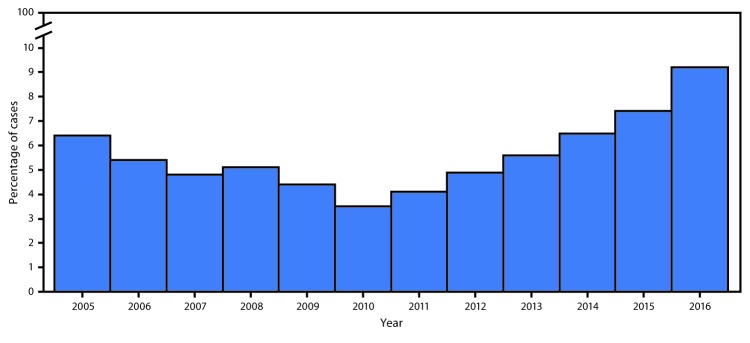
In the United States, age-adjusted opioid overdose death rates increased by >200% during 1999-2015, and heroin overdose death rates increased nearly 300% during 2011-2015 (1). During 2011-2013, the rate of heroin use within the past year among U.S. residents aged ≥12 years increased 62.5% overall and 114.3% among non-Hispanic whites, compared with 2002-2004 (2). Increases in human immunodeficiency virus (HIV) and hepatitis C virus (HCV) infections related to increases in injection drug use have been recently highlighted (3,4); likewise, invasive bacterial infections, including endocarditis, osteomyelitis, and skin and soft tissue infections, have increased in areas where the opioid epidemic is expanding (5-7). To assess the effects of the opioid epidemic on invasive methicillin-resistant Staphylococcus aureus (MRSA) infections during 2005-2016, surveillance data from CDC's Emerging Infections Program (EIP) were analyzed (8). Persons who inject drugs were estimated to be 16.3 times more likely to develop invasive MRSA infections than others. The proportion of invasive MRSA cases that occurred among persons who inject drugs increased from 4.1% in 2011 to 9.2% in 2016. Infection types were frequently those associated with nonsterile injection drug use. Continued increases in nonsterile injection drug use are likely to result in increases in invasive MRSA infections, underscoring the importance of public health measures to curb the opioid epidemic.
Overview
The claims and statistics of this paper haven’t been checked yet.
Free: it reads the open-access text and checks the first 5 claims that cite a source we can check. Create a free account to check every claim.
Integrity signals
Registry
Cites
Statistics
Figures
Verification
Claims the paper makes
The claims and statistics of this paper haven’t been checked yet.
Free: it reads the open-access text and checks the first 5 claims that cite a source we can check. Create a free account to check every claim.
Claims other papers make about this one
Each is checked against this paper’s own text: does it say what the citing paper says it does?
The cited source says what the claim attributes to it.
In the citing paper
“The growing opioid crisis in the United States (57,58) might be contributing to increased rates of IDU and their infectious disease sequelae (59).”
From Population-Based Active Surveillance for Culture-Confirmed Candidemia — Four Sites, United States, 2012–2016 (2019) · cites this paper as [59]
Self-check
Percentages, sums and reported differences re-computed from the paper’s own numbers.
The self-check needs the paper’s full text.
Citations
Cites
Klevens, R. M. (2007) · JAMA · doi:10.1001/jama.298.15.1763 · Cited by 3,726
Zibbell, J. E., Iqbal, K., Patel, R. C., Suryaprasad, A. G., Sanders, K. J., Moore-Moravian, L., Serrecchia, J., Blankenship, S., Ward, J. W., & Holtzman, D. J. (2015) · PubMed Central · Cited by 612
HIV Infection Linked to Injection Use of Oxymorphone in Indiana, 2014–2015
Peters, P. J., Pontones, P., Hoover, K. W., Patel, M. R., Galang, R. R., Shields, J., Blosser, S. J., Spiller, M. W., Combs, B., Switzer, W. M., et al. (2016) · New England Journal of Medicine · doi:10.1056/nejmoa1515195 · Cited by 594 · cited 1×
“Increases in human immunodeficiency virus (HIV) and hepatitis C virus (HCV) infections related to increases in injection drug use have been recently highlighted (3,4); likewise, invasive bacterial infections, including endocarditis, osteomyelitis, and skin and soft tissue infections, have increased in areas where the…”
Self-citationVital Signs: Demographic and Substance Use Trends Among Heroin Users - United States, 2002-2013.
Jones, C. M., Logan, J. E., Gladden, R. M., & Bohm, M. K. (2015) · PubMed Central · Cited by 569
Self-citationDantes, R. (2013) · JAMA Internal Medicine · doi:10.1001/jamainternmed.2013.10423 · Cited by 452
Ronan, M. V., & Herzig, S. J. (2016) · Health Affairs · doi:10.1377/hlthaff.2015.1424 · Cited by 406
Lansky, A., Finlayson, T., Johnson, C., Holtzman, D., Wejnert, C., Mitsch, A., Gust, D., Chen, R., Mizuno, Y., & Crepaz, N. (2014) · PLoS ONE · doi:10.1371/journal.pone.0097596 · Cited by 235 · cited 1×
“population aged ≥13 years who injected drugs in the previous year for 2011 (9).”
Opiate Injection–Associated Skin, Soft Tissue, and Vascular Infections, England, UK, 1997–2016
Lewer, D., Harris, M., & Hope, V. (2017) · Emerging Infectious Diseases · doi:10.3201/eid2308.170439 · Cited by 60
Endocarditis as a Marker for New Epidemics of Injection Drug Use
Keeshin, S. W., & Feinberg, J. (2016) · The American Journal of the Medical Sciences · doi:10.1016/j.amjms.2016.10.002 · Cited by 58
Cited by
Items 101–139 of 139
Matsuo, T., Hayashi, K., Uehara, Y., & Mori, N. (2020) · Open Forum Infectious Diseases · doi:10.1093/ofid/ofaa504 · Cited by 2
Advances in pharmacotherapies for cytomegalovirus infection: what is the current state of play?
Monday, L., Keri, V. C., & Chandrasekar, P. H. (2024) · Expert Opinion on Pharmacotherapy · doi:10.1080/14656566.2024.2353627 · Cited by 3
Microbes Causing Spinal Epidural Infection in Patients Who Use Drugs
Pralea, A., Has, P., Auld, D. B., & Mermel, L. A. (2024) · Open Forum Infectious Diseases · doi:10.1093/ofid/ofae553 · Cited by 3
Kudrina, I., Pagé, M. G., Choinière, M., Shir, Y., Eisenberg, M. J., Ben-Sasson, M., Lebouché, B., & Puzhko, S. (2024) · BMJ Open · doi:10.1136/bmjopen-2023-083791 · Cited by 4
Staphylococcus aureus susceptibilities from wounds of patients who use illicit fentanyl
Dickinson, D. T., Saw, S., Dutcher, L. S., Maguire, C., Terico, A., Lowenstein, M., & Patel, S. (2025) · Antimicrobial Stewardship & Healthcare Epidemiology · doi:10.1017/ash.2025.12 · Cited by 2
Worden, J. C., & Warren, Y. (2025) · Open Forum Infectious Diseases · doi:10.1093/ofid/ofaf150 · Cited by 2
“PWID have a 16-fold increase in developing invasive MRSA infections compared to those who do not inject drugs [8].”
Emerging Viral and Bacterial Infections: Within an Era of Opioid Epidemic
Jones, J. F., Legaspi, J., Chen, E., Lee, K. C., & Lê, J. (2020) · Infectious Diseases and Therapy · doi:10.1007/s40121-020-00335-0 · Cited by 2
Candidemia in the Growing Opioid Epidemic: A Distinct and Emerging Entity
Andes, D. R. (2019) · Clinical Infectious Diseases · doi:10.1093/cid/ciz1065 · Cited by 2
Impact of Recent Methamphetamine Use on Vancomycin Clearance
Laguado, S. A., Vadiei, N., & Yenina, K. (2025) · Psychopharmacology Bulletin · doi:10.64719/pb.4611 · Cited by 2
Improving the availability, accessibility, and use of eye protection in patient care settings
Mitchell, A. H. (2019) · Infection Control and Hospital Epidemiology · doi:10.1017/ice.2018.346 · Cited by 2
Attieh, R., Nahal, J., Husni, R., Mokhbat, J., Barhoun, J., Kmeid, J., Youssef, M., Helou, Z., Zorkot, W., Abdallah, D., et al. (2025) · Scandinavian Journal of Infectious Diseases · doi:10.1080/23744235.2025.2527691 · Cited by 1
Gunton, A., Pavan, M., Leung, V., Murray, M. C. M., & Connors, W. J. A. (2025) · Journal of the Association of Medical Microbiology and Infectious Disease Canada · doi:10.3138/jammi-2024-0036 · Cited by 1
Kaushik, A., Fomicheva, J., Zellmer, K. A., Thieman, C., & Gupta, S. (2026) · Medicines · doi:10.3390/medicines13020018 · Cited by 2
Ladines-Lim, J. B., Nemiroff, A., Cressman, L., & David, M. Z. (2026) · Open Forum Infectious Diseases · doi:10.1093/ofid/ofag354 · Cited by 1
“These features are consistent with the increasing contribution of community-associated MRSA lineages (particularly the USA300 strain in the USA) to invasive and mirror epidemiologic trends reported in other studies during the past 20 years [10, 14, 51–54].”
Methicillin-resistant Staphylococcus aureus
Parsons, J. B., Westgeest, A. C., Conlon, B. P., Harbarth, S., Howden, B. P., Kim, Y. S., King, H. A., Lambregts, M. M. C., Miller, L. G., Patel, R., et al. (2026) · Nature Reviews Disease Primers · doi:10.1038/s41572-026-00729-3 · Cited by 3
Case Reports of Heroin Injection Site Necrosis: A Novel Antecedent of Nicolau Syndrome
Rose, B., Powell, T. G., Jones, M., CHILLAG, S. A., & Kemper, S. E. (2022) · Cureus · doi:10.7759/cureus.29235 · Cited by 1
“Furthermore, organisms cultured in patients with HISN, notably Staphylococcus species and Clostridium species, are known causes of NF [8,9].”
Endocarditis - Diagnosis and Treatment
Magnusson, P., Behzadi, P., LeQuang, J. A., & Pergolizzi, J. V. (2022) · IntechOpen eBooks · doi:10.5772/intechopen.100932 · Cited by 1
Risk of nonpulmonary infections requiring hospitalization in spondyloarthritis
Chung, H. Y., Chan, S. C. W., & Sun, F. S. K. (2022) · Immunity Inflammation and Disease · doi:10.1002/iid3.615 · Cited by 1
Commentary: The toll of complicated endocarditis and septic sequela: Old wives' tales and dogma
Ferraris, V. A. (2018) · Journal of Thoracic and Cardiovascular Surgery · doi:10.1016/j.jtcvs.2018.10.119
Springer, S. A. (2019) · Clinical Infectious Diseases · doi:10.1093/cid/ciz837
“this analysis is underscored by dramatic increases in IDU-related infections [1] in the setting of ever-worsening epidemics”
Intersection of Hiv and community-associated methicillin-resistant Staphylococcus aureus
Popovich, K. J. (2020) · Future Virology · doi:10.2217/fvl-2019-0093 · Cited by 1
Anand, R. K. (2020) · Springer eBooks · doi:10.1007/978-981-15-4039-4_22
The Clinical Microbiology Laboratory and the Opioid Epidemic
Kimmel, S. D., & Miller, N. S. (2020) · Infectious Disease Clinics of North America · doi:10.1016/j.idc.2020.06.005
The Opioid Epidemic: Associated Infections and Diagnostic Methods
Lloyd, M., & Farnsworth, C. W. (2020) · Clinical Microbiology Newsletter · doi:10.1016/j.clinmicnews.2020.08.003
Larem, A., & Aljariri, A. A. (2020) · Springer eBooks · doi:10.1007/978-3-030-54088-3_50
Chapter 31. The U.S. Opioid Crisis
Compton, W. M., & Jones, C. (2021) · American Psychiatric Association Publishing eBooks · doi:10.1176/appi.books.9781615373970.kb31 · Cited by 1
Holubar, M. K. (2021) · Faculty Opinions – Post-Publication Peer Review of the Biomedical Literature · doi:10.3410/f.735244398.793587613
Fatima, M., Roach, W. E., Reddy, A. D., & Olloqui, J. (2022) · Cureus · doi:10.7759/cureus.25729
Facial and Deep Cervical Infections During Pregnancy and the Postpartum Period
Cebeci, D., Akcan, F. A., & Karpischenko, S. A. (2022) · Springer eBooks · doi:10.1007/978-3-031-05303-0_22
Injection Drug Use-Associated Infective Endocarditis
Barnes, E. W., & Cook, J. (2023) · IntechOpen eBooks · doi:10.5772/intechopen.108171
Smoking, Alcoholism, and Use of Illicit Drugs
Bonamigo, R. R., Brutti, C. S., Cappelletti, T., Duquia, R. P., & Keiserman, M. W. (2023) · Springer eBooks · doi:10.1007/978-3-031-13505-7_47
Antuña, V. L., Lobo-Antuña, M., Soro, A. F., & Climent, B. P. (2024) · Infectious Diseases in Clinical Practice · doi:10.1097/ipc.0000000000001337
Strong, S. J., Charles, N. E., Bullerjahn, M. R., Tennity, C. L., O’Dell, C. C., & Cordova, E. A. (2024) · Psychological Reports · doi:10.1177/00332941241226901
“Opioid use also puts individuals at greater risk of infectious disease, sleep disorders, mood disorders, and neonatal opioid withdrawals (Cranston et al., 2019; Jackson et al., 2018; Ko et al., 2016; Peters et al., 2016; Zibbell et al., 2018).”
Telavancin and Cardiac Surgery: Balancing Antimicrobial Efficacy With Coagulation Challenges
Muñoz-Acuña, R., Wai, M., Coopee, Z., Asuquo, R., Rady, A., & Montealegre-Gallegos, M. (2024) · Journal of Cardiothoracic and Vascular Anesthesia · doi:10.1053/j.jvca.2024.09.147
Balhan, L., Aubert, M., Lacoux, C., Grau, N., Levy, J., Stefanowski, M.-L., Perreaut, L., Sagaon‐Teyssier, L., Deuffic‐Burban, S., Cousien, A., et al. (2024) · BMC Public Health · doi:10.1186/s12889-024-20299-x
Attieh, R., Nahal, J., Husni, R., Mokhbat, J., Barhoun, J., Kmeid, J., Youssef, M., Helou, Z., Zorkot, W., Fakhreddine, N., et al. (2025) · Journal of Global Antimicrobial Resistance · doi:10.1016/j.jgar.2025.11.005
Mezaache, S., Briand-Madrid, L., Rahni, L., Poireau, J., Branchu, F., Moudachirou, K., Wendzinski, Y., Carrieri, P., & Roux, P. (2021) · Figshare · doi:10.6084/m9.figshare.14121870
Optimizing Treatment of Infective Endocarditis in Patients Who Inject Drugs
Worden, J. C., Baumeister, T., & Eaton, E. (2026) · Antibiotics · doi:10.3390/antibiotics15090881
“Compared to patients who do not inject drugs, PWID have a 16-times greater risk of developing invasive methicillin-resistant Staphylococcus aureus (MRSA) infections [7].”
Metadata
- Authors
- Jackson, K. A., Bohm, M. K., Brooks, J. T., Asher, A., Nadle, J., Bamberg, W. M., Petit, S., Ray, S. M., Harrison, L. H., Lynfield, R., Dumyati, G., Schaffner, W., Townes, J. M., & See, I.
- Affiliations
- Colorado Department of Public Health and Environment (US)
- Corresponding author
- Jackson, Kelly A.
- ORCID
- Venue
- MMWR. Morbidity and Mortality Weekly Report
- Published
- 2018-06-08
- Volume
- 67
- Issue
- 22
- Pages
- 625-628
- ISSN
- 0149-2195 (ISSN-L)
- 1545-861X
- PMC
- PMC5991809
- OpenAlex
- W2806691332
- Cited by
- 139
- References
- 11
- Citations by year
- 2026: 4 · 2025: 12 · 2024: 10 · 2023: 6 · 2022: 18 · 2021: 24 · 2020: 37 · 2019: 25 · 2018: 3
- FWCI
- 16.80
- Type
- journal article
- Language
- en
- Open access
- bronze
- doi.org
- Locations
- MMWR Morbidity and Mortality Weekly Report (publishedVersion)
- Europe PMC (PubMed Central) (publishedVersion, cc-by)
- PubMed Central (publishedVersion, cc-by)
- PubMed (publishedVersion)
- Funders
- Centers for Disease Control and Prevention
- Topics
- Health Sciences › Medicine › Infectious Diseases › Antimicrobial Resistance in Staphylococcus
- Health Sciences › Medicine › Epidemiology › HIV, Drug Use, Sexual Risk
- Health Sciences › Medicine › Cardiology and Cardiovascular Medicine › Infective Endocarditis Diagnosis and Management
- Keywords
- methicillin-resistant Staphylococcus aureus, invasive MRSA infections, people who inject drugs, opioid epidemic, endocarditis, osteomyelitis, skin and soft tissue infections, heroin use, opioid overdose deaths
- MeSH terms
- Adolescent, Adult, Female, Humans, Male, Middle Aged, Population Surveillance, Staphylococcal Infections, United States, Substance Abuse, Intravenous, Methicillin-Resistant Staphylococcus aureus, Young Adult
About these checks
Registry, retraction, Cites and statistics results are computed, not judged, with one exception: a printed reference that no index lists is read once by a model before it counts as a citation error. Claims are extracted by a model and kept only when their quote appears verbatim in the text; each cited source is then checked, with a model’s help, for whether it says what the claim relies on. Those verdicts can be wrong — read the claim’s quote and the cited source before relying on one.
Statistics and arithmetic are recomputed, not judged.
Confidence bands are shown only for fields calibrated on our annotated test set. None is calibrated yet, so no band is shown.
What counts as a claim ›How we measure confidence ›How we check this ›
Are you an author, or do you see a problem with this page? Request a review
Data sources
Bibliographic data: Semantic Scholar, OpenAlex, Crossref.
Contains information from the Semantic Scholar Academic Graph Datasets, made available under the ODC Attribution License (ODC-BY 1.0).
Semantic Scholar’s data is described in: Kinney, R., et al. (2023). The Semantic Scholar Open Data Platform. arXiv:2301.10140.
