

Update on Immunodeficiency-Associated Vaccine-Derived Polioviruses-Worldwide, July 2018–December 2019
Open accessThe DOI matches its Crossref record; 10 of the 10 references it cites were found in a registry or an index.
Abstract
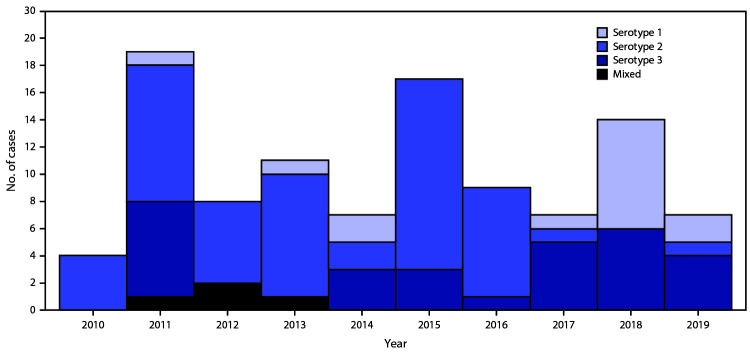
Since establishment of the Global Polio Eradication Initiative* in 1988, polio cases have declined >99.9% worldwide; extensive use of live, attenuated oral poliovirus vaccine (OPV) in routine childhood immunization programs and mass campaigns has led to eradication of two of the three wild poliovirus (WPV) serotypes (types 2 and 3) (1). Despite its safety record, OPV can lead to rare emergence of vaccine-derived polioviruses (VDPVs) when there is prolonged circulation or replication of the vaccine virus. In areas with inadequate OPV coverage, circulating VDPVs (cVDPVs) that have reverted to neurovirulence can cause outbreaks of paralytic polio (2). Immunodeficiency-associated VDPVs (iVDPVs) are isolated from persons with primary immunodeficiency (PID). Infection with iVDPV can progress to paralysis or death of patients with PID, and excretion risks seeding cVDPV outbreaks; both risks might be reduced through antiviral treatment, which is currently under development. This report updates previous reports and includes details of iVDPV cases detected during July 2018-December 2019 (3). During this time, 16 new iVDPV cases were reported from five countries (Argentina, Egypt, Iran, Philippines, and Tunisia). Alongside acute flaccid paralysis (AFP) surveillance (4), surveillance for poliovirus infections among patients with PID has identified an increased number of persons excreting iVDPVs (5). Expansion of PID surveillance will facilitate early detection and follow-up of iVDPV excretion among patients with PID to mitigate the risk for iVDPV spread. This will be critical to help identify all poliovirus excretors and thus achieve and maintain eradication of all polioviruses.
Overview
The claims and statistics of this paper haven’t been checked yet.
Free: it reads the open-access text and checks the first 5 claims that cite a source we can check. Create a free account to check every claim.
Integrity signals
Registry
Cites
Statistics
Figures
Verification
Claims the paper makes
The claims and statistics of this paper haven’t been checked yet.
Free: it reads the open-access text and checks the first 5 claims that cite a source we can check. Create a free account to check every claim.
Claims other papers make about this one
Each is checked against this paper’s own text: does it say what the citing paper says it does?
The cited source says what the claim attributes to it.
In the citing paper
“From July 2018 to December 2019, 16 new iVDPV cases were reported in Argentina, Egypt, Iran, Philippines and Tunisia, including 8 iVDPV1, 7 iVDPV3 and 1 iVDPV2 [86] (Table 2).”
From The Fight against Poliovirus Is Not Over (2023) · cites this paper as [86]
Self-check
Percentages, sums and reported differences re-computed from the paper’s own numbers.
The self-check needs the paper’s full text.
Citations
Cites
Global polio eradication initiative
Koenig‐Archibugi, M. (2011) · London School of Economics and Political Science Research Online (London School of Economics and Political Science) · Cited by 523
Update on Vaccine-Derived Polioviruses-Worldwide, January 2017–June 2018
Jorba, J., Diop, O. M., Iber, J., Henderson, E., Zhao, K., Sutter, R. W., Wassilak, S. G. F., & Burns, C. C. (2018) · MMWR. Morbidity and Mortality Weekly Report · doi:10.15585/mmwr.mm6742a5 · Cited by 197 · cited 3×
“Poliovirus isolates are grouped into three categories: WPV, Sabin-related poliovirus, and VDPV (3).”
BackgroundResultSelf-citationHampton, L. M., Farrell, M., Ramirez-Gonzalez, A., Menning, L., Shendale, S., Lewis, I., Rubin, J., Garon, J., Harris, J., Hyde, T., et al. (2016) · MMWR Morbidity and Mortality Weekly Report · doi:10.15585/mmwr.mm6535a3 · Cited by 193
Al‐Mousa, H., & Al‐Saud, B. (2017) · Frontiers in Immunology · doi:10.3389/fimmu.2017.00678 · Cited by 93 · cited 1×
“One half of the detected cases were from the WHO Eastern Mediterranean Region, likely related to more recent focus on PID surveillance in that region as well as higher rates of consanguineous marriages, which lead to higher prevalence rates of PID (8).”
BackgroundUpdate on Vaccine-Derived Poliovirus Outbreaks — Worldwide, July 2019–February 2020
Alleman, M. M., Jorba, J., Greene, S. A., Diop, O. M., Iber, J., Tallis, G., Goel, A., Wiesen, E., Wassilak, S. G. F., & Burns, C. C. (2020) · MMWR. Morbidity and Mortality Weekly Report · doi:10.15585/mmwr.mm6916a1 · Cited by 93 · cited 8×
“Surveillance for iVDPV infections among patients with PID needs to be strengthened, and development of poliovirus antivirals needs to be accelerated to treat iVDPV infections to achieve and maintain eradication of all polioviruses. detection of the iVDPV2, a cVDPV2 outbreak was detected in the Philippines (2).”
BackgroundSelf-citationProgress toward polio eradication—worldwide, January 2018–March 2020.
Chard, A. N., Datta, S. D., Tallis, G., Burns, C. C., Wassilak, S. G. F., Vertefeuille, J. F., & Zaffran, M. (2020) · MMWR. Morbidity and Mortality Weekly Report · doi:10.15585/mmwr.mm6925a4 · Cited by 83 · cited 1×
“9% worldwide; extensive use of live, attenuated oral poliovirus vaccine (OPV) in routine childhood immunization programs and mass campaigns has led to eradication of two of the three wild poliovirus (WPV) serotypes (types 2 and 3) (1).”
BackgroundLi, L., Ivanova, O., Driss, N., Tiongco-Recto, M., da Silva, R., Shahmahmoodi, S., Sazzad, H. M. S., Mach, O., Kahn, A.-L., & Sutter, R. W. (2014) · The Journal of Infectious Diseases · doi:10.1093/infdis/jiu065 · Cited by 63 · cited 2×
“However, in persons with PIDs, an inability to mount an adequate humoral immune response can result in persistence of intestinal infection with poliovirus and prolonged viral shedding (5,6).”
BackgroundSelf-citationMacklin, G., Liao, Y., Takane, M., Dooling, K., Gilmour, S., Mach, O., Kew, O. M., Sutter, R. W., & The iVDPV Working Group (2017) · Frontiers in Immunology · doi:10.3389/fimmu.2017.01103 · Cited by 47 · cited 4×
“The iVDPV case definition is a laboratoryconfirmed VDPV infection in a person of any age who has a primary humoral (B-cell) or combined humoral and cellular (B- and T-cell) immunodeficiency disorder (6).”
BackgroundSelf-citationSurveillance to Track Progress Toward Polio Eradication — Worldwide, 2018–2019
Lickness, J. S., Gardner, T., Diop, O. M., Chavan, S., Jorba, J., Ahmed, J., Gumede, N., Johnson, T., Butt, O., Asghar, H., et al. (2020) · MMWR. Morbidity and Mortality Weekly Report · doi:10.15585/mmwr.mm6920a3 · Cited by 36 · cited 1×
“Alongside acute flaccid paralysis (AFP) surveillance (4), surveillance for poliovirus infections among patients with PID has identified an increased number of persons excreting iVDPVs (5).”
BackgroundSelf-citationClearance of Immunodeficiency-associated Vaccine-derived Poliovirus Infection With Pocapavir
Copelyn, J., Hincks, J. R., Wilmshurst, J. M., Petersen, W., Howard, W., Jallow, S., Moonsamy, S., Seakamela, L., Suchard, M. S., Collett, M. S., et al. (2020) · The Pediatric Infectious Disease Journal · doi:10.1097/inf.0000000000002584 · Cited by 23 · cited 2×
“Pocapavir (a capsid inhibitor) has been administered on compassionate use basis for several patients excreting iVDPV, with mixed results (10).”
Background
Cited by
The Fight against Poliovirus Is Not Over
Mbani, C. J., Nekoua, M. P., Moukassa, D., & Hober, D. (2023) · Microorganisms · doi:10.3390/microorganisms11051323 · Cited by 34
“From July 2018 to December 2019, 16 new iVDPV cases were reported in Argentina, Egypt, Iran, Philippines and Tunisia, including 8 iVDPV1, 7 iVDPV3 and 1 iVDPV2 [86] (Table 2).”
BackgroundMohanty, A., Rohilla, R., Zaman, K., Hada, V., Dhakal, S., Shah, A., Padhi, B. K., Al‐qaim, Z. H., Altawfiq, K. J. A., Tirupathi, R., et al. (2023) · Infezioni in Medicina · doi:10.53854/liim-3102-5 · Cited by 27
Estado actual de la poliomielitis en Latinoamérica
Falleiros-Arlant, L. H., Ayala, S. E. G., Domingues, C. M. A. S., Brea, J. A. F., & Colsa-Ranero, A. D. (2020) · Revista chilena de infectología · doi:10.4067/s0716-10182020000600701 · Cited by 24
Yao, N., Liu, Y., Xu, J.-W., Wang, Q., Yin, Z.-D., Wen, N., Yang, H., Rodewald, L. E., & Zhang, Z.-Y. (2022) · MMWR. Morbidity and Mortality Weekly Report · doi:10.15585/mmwr.mm7136a2 · Cited by 16
Polio Epidemiology: Strategies and Challenges for Polio Eradication Post the COVID-19 Pandemic
Bricks, L. F., Macina, D., & Vargas-Zambrano, J. C. (2024) · Vaccines · doi:10.3390/vaccines12121323 · Cited by 16
Bermingham, W. H., Canning, B., Wilton, T., Kidd, M., Klapsa, D., Majumdar, M., Sooriyakumar, K., Martin, J., & Huissoon, A. P. (2023) · Frontiers in Immunology · doi:10.3389/fimmu.2023.1135834 · Cited by 15
“Patients with iVDPV are predominantly reported in those with severe combined immune deficiency or hypogammaglobulinaemia (3).”
BackgroundMonogenic susceptibility to live viral vaccines
Gothe, F., Howarth, S., Duncan, C. J. A., & Hambleton, S. (2021) · Current Opinion in Immunology · doi:10.1016/j.coi.2021.05.006 · Cited by 18
Kitamura, K., & Shimizu, H. (2021) · Viruses · doi:10.3390/v13071407 · Cited by 14
Virus Evolution in Prolonged Infections of Immunocompromised Individuals
Raglow, Z., & Lauring, A. S. (2024) · Clinical Chemistry · doi:10.1093/clinchem/hvae150 · Cited by 13
Anno 2021: Which antivirals for the coming decade?
Groaz, E., Clercq, E. D., & Herdewijn, P. A. (2021) · Annual reports in medicinal chemistry · doi:10.1016/bs.armc.2021.09.004 · Cited by 19
“In addition, individuals with a primary immunodeficiency disorder (PID) exposed to OPV may excrete immunodeficiency-related vaccinederived polioviruses (iVDPVs) for prolonged periods of time, which are likely to constitute a reservoir of virus after eradication.(171) The development”
Belgasmi, H., Miles, S. J., Sayyad, L., Wong, K., Harrington, C., Gerloff, N. A., Coulliette-Salmond, A. D., Guntapong, R., Tacharoenmuang, R., Ayutthaya, A. I. N., et al. (2022) · Frontiers in Environmental Science · doi:10.3389/fenvs.2022.914387 · Cited by 13
Asymptomatic immunodeficiency-associated vaccine-derived poliovirus infections in two UK children
Singanayagam, A., Klapsa, D., Burton-Fanning, S., Hand, J. F., Wilton, T., Stephens, L., Mate, R., Shillitoe, B. M. J., Celma, C., Slatter, M. A., et al. (2023) · Nature Communications · doi:10.1038/s41467-023-39094-0 · Cited by 12
“Globally, iVDPVs are rarely reported (only 149 cases formally reported between 1961 and 2019) 7 , yet their burden is not fully understood, because current poliovirus surveillance systems are not well designed to identify iVDPV-infected PID patients who do not have neurological symptoms or…”
Antiviral Development for the Polio Endgame: Current Progress and Future Directions
Xie, H., Rhoden, E. E., Liu, H., Ogunsemowo, F., Mainou, B. A., Burke, R. M., & Burns, C. C. (2024) · Pathogens · doi:10.3390/pathogens13110969 · Cited by 9
Estívariz, C. F., Krow‐Lucal, E., & Mach, O. (2024) · Pathogens · doi:10.3390/pathogens13121128 · Cited by 10
Self-citationPolio Eradication: Status, Struggles and Strategies
Bandyopadhyay, A. S., Burke, R. M., & Hawes, K. M. (2024) · The Pediatric Infectious Disease Journal · doi:10.1097/inf.0000000000004330 · Cited by 8
Salem, I. B., Khemiri, H., Drechsel, O., Arbi, M., Böttcher, S., Mekki, N., Fraj, I. B., Souiaï, O., Yahyaoui, M., Farhat, E. B., et al. (2024) · Journal of Medical Virology · doi:10.1002/jmv.29918 · Cited by 8
“12,13 The factors contributing to chronic PV infections are not known.”
Self-citationKITAMURA, K., & Shimizu, H. (2022) · Japanese Journal of Infectious Diseases · doi:10.7883/yoken.jjid.2022.312 · Cited by 7
Travel-Associated Infections & Diseases
Nemhauser, J. B. (2023) · Oxford University Press eBooks · doi:10.1093/oso/9780197570944.003.0005 · Cited by 7
Inborn errors of immunity in mainland China: the past, present and future
Deng, M., & Mao, H. (2023) · BMJ Paediatrics Open · doi:10.1136/bmjpo-2023-002002 · Cited by 6
Threat of resurgence or hope for global eradication of poliovirus?
Kim, C. Y., Piamonte, B. L. C., Allen, R., & Thakur, K. T. (2023) · Current Opinion in Neurology · doi:10.1097/wco.0000000000001156 · Cited by 5
“the live, attenuated vaccine leaving the individual unable to clear the virus from their intestinal tract [10,11].”
BackgroundHealth Economic Analysis of Antiviral Drugs in the Global Polio Eradication Endgame
Badizadegan, K., Kalkowska, D. A., & Thompson, K. M. (2023) · Medical Decision Making · doi:10.1177/0272989x231191127 · Cited by 5
“6 14 The pathophysiology of VAPP is somewhat uncertain, with VAPP largely considered an adverse individual reaction.”
BackgroundOptimizing the Live Attenuated Influenza A Vaccine Backbone for High-Risk Patient Groups
Bonifacio, J. P. P., Williams, N., Garnier, L., Hugues, S., Schmolke, M., & Mazel‐Sanchez, B. (2022) · Journal of Virology · doi:10.1128/jvi.00871-22 · Cited by 4
Mohanty, M. C., Desai, M. M., Ahmad, M. A., Aggarwal, A., Govindaraj, G. M., Bhattad, S., Lashkari, H. P., Rajasekhar, L., Verma, H., Kumar, A., et al. (2023) · Vaccines · doi:10.3390/vaccines11071211 · Cited by 5
Zhang, M., Yang, J., Bai, Y., Zhu, H., Wang, C., Zhang, L., Xu, J. H., Lu, M., Zhang, X., ZhanPei, X., et al. (2022) · Infectious Diseases of Poverty · doi:10.1186/s40249-022-01028-1 · Cited by 5
“After vaccination with OPV or infection with OPV-related virus in immunodeficient patients, especially patients with B-lymphocyte immunodeficiency, immunodeficient VDPV (iVDPV) is produced due to the long-term existence of vaccine in the body, continuous replication of the virus, and viral excretion from the body [13,…”
BackgroundZhang, H., Wang, W., Zhou, Q., Hou, J., Ying, W., Hui, X., Sun, J., Liu, L., Liu, L., Wang, C., et al. (2025) · Virology Journal · doi:10.1186/s12985-025-02697-8 · Cited by 3
“Although the WHO maintains a registry of known vaccine-derived poliovirus cases (detected mainly via acute flaccid paralysis (AFP) surveillance), the global prevalence of asymptomatic vaccine-derived poliovirus excretions remains uncertain [21].”
Xiao, T., Leng, H., Zhang, Q., Chen, Q., Guo, H., & Qi, Y. (2021) · Virus Research · doi:10.1016/j.virusres.2021.198633 · Cited by 3
Fan, Q., Ma, J., Li, X., Jorba, J. C., Yuan, F., Zhu, H., Hu, L., Song, Y., Wang, D., Zhu, S., et al. (2022) · Journal of Medical Virology · doi:10.1002/jmv.28215 · Cited by 3
“Between 1961 and 2019, approximately 149 iVDPV cases were reported to the World Health Organization (WHO) through the registration of known iVDPV cases and promotion of global iVDPV surveillance.(15) Several reported iVDPV patients spontaneously ceased excreting PVs, some were lost to follow‐up soon after the first PV…”
BackgroundSelf-citationGuo, Q., Zhu, S., Wang, D., Li, X., Zhu, H., Song, Y., Liu, X., Xiao, F., Zhao, H., Lu, H., et al. (2023) · Virus Research · doi:10.1016/j.virusres.2023.199177 · Cited by 3
“VP1-105 mutation was not infrequently found in other iVDPV evolutionary lineages (Korotkova et al., 2020), Q. Guo et al. Virus Research 334 (2023) 199177 which was the region of the VP1 protein that interacts with the poliovirus receptor (Belnap et al., 2000).”
BackgroundMethodInfluentialMohanty, M. C., Govindaraj, G. M., Ahmad, M. A., Varose, S. Y., Tatkare, M., Shete, A., Yadav, S., Joshi, Y., Yadav, P. D., Sharma, D., et al. (2024) · Vaccines · doi:10.3390/vaccines12070759 · Cited by 3
“Expansion of IEI surveillance will facilitate early detection and the follow-up of iVDPV excretion to mitigate the risk of iVDPV spread.”
BackgroundNejati, A., Tabatabaei, S. M., Mahmoudi, S., Zahraei, S. M., Tabatabaie, H., Razaghi, M., Khodakhah, F., Yousefi, M., Mollaei‐Kandelous, Y., Keyvanlou, M., et al. (2024) · Food and Environmental Virology · doi:10.1007/s12560-024-09600-8 · Cited by 2
“Circulating VDPV2 (cVDPV2) appears in areas where vaccination coverage is insufficient (Minor, 2009, Burns et al., 2014, Macklin et al., 2020, Mohanty et al., 2023).”
Self-citationEstívariz, C. F., Burns, C. C., & Macklin, G. (2023) · Elsevier eBooks · doi:10.1016/b978-0-323-79058-1.00050-5 · Cited by 7
Self-citationLiu, Y., Zhang, Y., Ning, Y., Zhang, Z., Wang, Q., Xie, W., Yang, H., Chen, L., Zhao, H., & Xu, J. (2025) · Medicine · doi:10.1097/md.0000000000044935 · Cited by 1
“[6] In 2005, VDPV was first detected in feces of PID patients through the case surveillance of acute flaccid paralysis in China, [7] and 12 cases have been found up to now.”
Current infectious disease management challenges in inborn errors of immunity
Zheng, S., & Lowe, D. M. (2025) · Annals of Clinical Microbiology and Antimicrobials · doi:10.1186/s12941-025-00830-7 · Cited by 3
“Other rare IEIs described to associate with development of iVDPV include centromere instability [29].”
Insights on vaccine-derived poliovirus type 2 outbreaks and novel oral polio vaccine candidates
Aboshanab, K. M., Alshahrani, M. Y., Enshasy, H. A. E., Shabana, M. R., & Majeed, A. B. A. (2025) · Diagnostic Microbiology and Infectious Disease · doi:10.1016/j.diagmicrobio.2025.117221 · Cited by 1
Andrus, J. K., Patel, K. B., Raghavan, P., Seper, S., Ismail, N., & Bahl, S. K. (2025) · Oxford University Press eBooks · doi:10.1093/oso/9780197687420.003.0003 · Cited by 1
Yasmon, A., Normasari, N., Fithriyah, F., & Fadilah, F. (2021) · Journal of the Medical Sciences (Berkala Ilmu Kedokteran) · doi:10.19106/jmedsci005304202106
Kew, O. M. (2023) · Springer eBooks · doi:10.1007/978-1-4939-9544-8_13-1
Gothe, F. (2023) · Kinder- und Jugendmedizin · doi:10.1055/a-2060-3412
Mach, O., Cavestany, R. L., Jeyaseelan, V., & Macklin, G. (2023) · Elsevier eBooks · doi:10.1016/b978-0-323-99967-0.00048-x
Self-citationGothe, F. (2024) · Diabetes aktuell · doi:10.1055/a-2437-3844
Yao, N., Liu, Y., Zhang, Z.-Y., Tian, M., Xie, W., Zhao, H., Yang, H., Rodewald, L. E., Wen, N., Yin, Z., et al. (2025) · Human Vaccines & Immunotherapeutics · doi:10.1080/21645515.2025.2484882
“14 The ability to identify and prevent iVDPV circulation by clearing virus excretion is an important part of the polio eradication strategy.”
Boloko, B. K., Nkanga, M. N., Kwessena, C., Kilolo, A., Lukusa, G., Salaboni, A., Beia, A., Katoka, T., Apalata, R., & Longo‐Mbenza, B. (2025) · Research Square · doi:10.21203/rs.3.rs-6439441/v1
Co, K. J. A., Tarnate, P. S., Castor, M. A. R., & Ong‐Lim, A. L. (2025) · IJID Regions · doi:10.1016/j.ijregi.2025.100722
“Shedding is considered prolonged if it persists for > 6 months and chronic if > 5 years [ 2 ]. iVDPV excretors may serve as silent reservoirs that threaten the Global Polio Eradication Initiative.”
InfluentialZhang, M. Y., Yang, J., Bai, Y., Zhu, H., Wang, C., Zhang, L., Xu, J., Lu, M., Zhang, X., ZhanPei, X., et al. (2024) · Figshare · doi:10.6084/m9.figshare.26554238
Αναζήτηση του ιού της Πολιομυελίτιδας σε λύματα από αστικές περιοχές και δομές φιλοξενίας προσφύγων
Kola, K. (2023) · University of Thessaly Institutional Repository (University of Thessaly) · doi:10.26253/heal.uth.39221
Optimization of a Human Anti-polio Monoclonal Antibody as a Potential Therapeutic ModalityPreprint
Lee, S., Siska, C. C., D’Angelo, I., Kouiavskaia, D. V., & Mahmood, K. (2026) · bioRxiv (Cold Spring Harbor Laboratory) · doi:10.64898/2026.09.20.753044
Neutralizing Activity of Vaccine-Induced Antibodies Against Vaccine-Derived Polioviruses Type 2
Karpova, E. V., Yakovchuk, E. V., Salichkin, N. V., Korotkova, E. A., Baikova, O. Y., Соцкова, С. Е., Ivanov, A. P., Ivanova, O. E., & Kozlovskaya, L. I. (2026) · Vaccines · doi:10.3390/vaccines14100899
Ermakova, M. Y., Ivanov, S., Shmeleva, O., Borisenko, N., Zyrina, A. N., Levin, I., Chumakov, S. P., Shishova, А. A., Ivin, Y. Y., Piniaeva, A. N., et al. (2026) · Viruses · doi:10.3390/v18101147
“Furthermore, there is a risk of immunodeficiency-associated vaccine-derived polioviruses (iVDPVs) in individuals with B-cell immunodeficiency [6].”
Metadata
- Authors
- Macklin, G., Diop, O. M., Humayun, A., Shahmahmoodi, S., El-Sayed, Z. A., Triki, H., Rey, G., Avagyan, T., Grabovac, V., Jorba, J., Farag, N., & Mach, O.
- Affiliations
- Ain Shams University (EG)
- Corresponding author
- Macklin, Grace
- ORCID
- Venue
- MMWR. Morbidity and Mortality Weekly Report
- Published
- 2020-07-17
- Volume
- 69
- Issue
- 28
- Pages
- 913-917
- ISSN
- 0149-2195 (ISSN-L)
- 1545-861X
- PMC
- PMC7366852
- OpenAlex
- W3043678511
- Cited by
- 46
- References
- 10
- Citations by year
- 2026: 2 · 2025: 8 · 2024: 10 · 2023: 14 · 2022: 5 · 2021: 5 · 2020: 2
- FWCI
- 4.02
- Type
- journal article
- Language
- en
- Open access
- diamond
- doi.org
- Locations
- MMWR Morbidity and Mortality Weekly Report (publishedVersion)
- PubMed Central (publishedVersion, cc-by)
- PubMed (publishedVersion)
- LSHTM Research Online (London School of Hygiene and Tropical Medicine) (acceptedVersion)
- Funders
- World Health Organization
- Centers for Disease Control and Prevention
- Topics
- Health Sciences › Medicine › Infectious Diseases › Viral Infections and Immunology Research
- Health Sciences › Medicine › Epidemiology › Virology and Viral Diseases
- Social Sciences › Health › Vaccine Coverage and Hesitancy
- Keywords
- primary immunodeficiency, oral polio vaccine, acute flaccid paralysis surveillance, polio eradication, antiviral therapy, Argentina, Egypt, Iran, Philippines, Tunisia
- MeSH terms
- Child, Child, Preschool, Female, Humans, Immunologic Deficiency Syndromes, Infant, Male, Poliomyelitis, Poliovirus Vaccine, Oral, Global Health, Poliovirus, Serogroup
About these checks
Registry, retraction, Cites and statistics results are computed, not judged, with one exception: a printed reference that no index lists is read once by a model before it counts as a citation error. Claims are extracted by a model and kept only when their quote appears verbatim in the text; each cited source is then checked, with a model’s help, for whether it says what the claim relies on. Those verdicts can be wrong — read the claim’s quote and the cited source before relying on one.
Statistics and arithmetic are recomputed, not judged.
Confidence bands are shown only for fields calibrated on our annotated test set. None is calibrated yet, so no band is shown.
What counts as a claim ›How we measure confidence ›How we check this ›
Are you an author, or do you see a problem with this page? Request a review
Data sources
Bibliographic data: Semantic Scholar, OpenAlex, Crossref.
Contains information from the Semantic Scholar Academic Graph Datasets, made available under the ODC Attribution License (ODC-BY 1.0).
Semantic Scholar’s data is described in: Kinney, R., et al. (2023). The Semantic Scholar Open Data Platform. arXiv:2301.10140.
