

Tobacco product use among adults—United States, 2019.
Open accessThe DOI matches its Crossref record; 4 of the 4 references it cites were found in a registry or an index.
Abstract
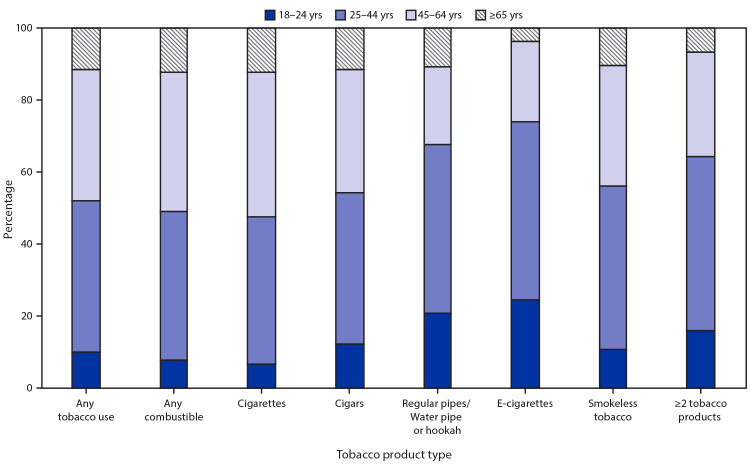
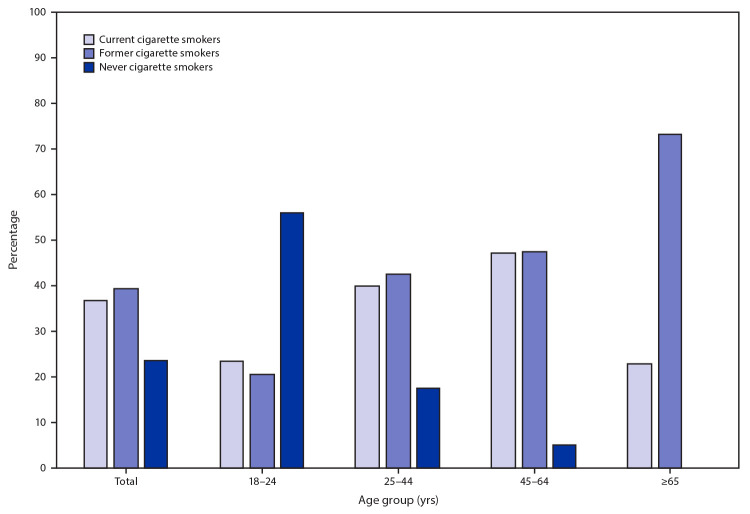
The prevalence of any current tobacco product use was higher among males; adults aged ≤65 years; non-Hispanic American Indian/Alaska Native (AI/AN) adults; those whose highest level of educational attainment was a General Educational Development (GED) certificate; those with an annual household income <$35,000; lesbian, gay, or bisexual (LGB) adults; uninsured adults and those with Medicaid; those with a disability; or those with mild, moderate, or severe generalized anxiety disorder. E-cigarette use was highest among adults aged 18-24 years (9.3%), with over half (56.0%) of these young adults reporting that they had never smoked cigarettes. Implementing comprehensive, evidence-based, population level interventions (e.g., tobacco price increases, comprehensive smoke-free policies, high-impact antitobacco media campaigns, and barrier-free cessation coverage), in coordination with regulation of the manufacturing, marketing, and sale of all tobacco products, can reduce tobacco-related disease and death in the United States (1,4). As part of a comprehensive approach, targeted interventions are also warranted to reach subpopulations with the highest prevalence of use, which might vary by tobacco product type.
Overview
The claims and statistics of this paper haven’t been checked yet.
Free: it reads the open-access text and checks the first 5 claims that cite a source we can check. Create a free account to check every claim.
Integrity signals
Registry
Cites
Statistics
Figures
Verification
Claims the paper makes
The claims and statistics of this paper haven’t been checked yet.
Free: it reads the open-access text and checks the first 5 claims that cite a source we can check. Create a free account to check every claim.
Self-check
Percentages, sums and reported differences re-computed from the paper’s own numbers.
The self-check needs the paper’s full text.
Citations
Cites
The Health consequences of smoking—50 years of progress : a report of the Surgeon General
Lushniak, B. D., Samet, J. M., Pechacek, T. F., Norman, L., & Taylor, P. A. (2014) · Cited by 4,990
Tobacco Product Use and Cessation Indicators Among Adults — United States, 2018
Creamer, M. R., Wang, T. W., Babb, S., Cullen, K. A., Day, H., Willis, G., Jamal, A., & Neff, L. (2019) · MMWR. Morbidity and Mortality Weekly Report · doi:10.15585/mmwr.mm6845a2 · Cited by 892
Self-citationBinnie, V, McHugh, S., Macpherson, L., Borland, B., Moir, K., & Malik, K. (2004) · Oral Diseases · doi:10.1111/j.1601-0825.2004.01018.x · Cited by 134
Agaku, I. T., & King, B. A. (2014) · American Journal of Epidemiology · doi:10.1093/aje/kwu182 · Cited by 45
Research works printed but not linked: 1
- US Department of Health and Human Services. Smoking cessation. A report of the Surgeon General. Atlanta, GA: US Department of Health and Human Services, CDC; 2020. https://www.hhs.gov/sites/default/files/2020-cessation-sgr-full-report.pdf 32255575
Cited by
Items 701–800 of 983
Simmons, H. L., Grits, D., Orr, M. N., Murray, T. G., Klika, A. K., & Piuzzi, N. S. (2022) · The Journal of Knee Surgery · doi:10.1055/s-0042-1748819 · Cited by 3
Development of a panel of U.S. adult tobacco users to inform tobacco regulatory science
Liu, S. T., Loomis, B. R., Kinsey, S. H., Nagler, C. F., Chen, P. M., Sukasih, A. S., Engstrom, M. C., & Choinière, C. J. (2022) · Preventive Medicine Reports · doi:10.1016/j.pmedr.2022.101898 · Cited by 3
“Users of hookah and pipe tobacco were not specifically recruited because their prevalence of use is low (Cornelius et al., 2020) and identifying sufficient numbers would have been cost prohibitive.”
BackgroundJung, B., Lee, J. A., Kim, Y., & Cho, H. (2022) · Tobacco Control · doi:10.1136/tc-2022-057332 · Cited by 3
Circumstances Around Cigarette Use after Enforced Abstinence From Smoking in an American Prison
Martin, R. A., Stein, L. A. R., Kang, A. W. C., Rohsenow, D. J., Bock, B. C., Martin, S. A., & Clarke, J. G. (2022) · Journal of Addiction Medicine · doi:10.1097/adm.0000000000001005 · Cited by 5
Wakim, K., Freedman, E. G., Tivarus, M. E., Christensen, Z. P., Molholm, S., & Foxe, J. J. (2022) · Neuroscience · doi:10.1016/j.neuroscience.2022.08.008 · Cited by 3
Fox, K. R., Vannatta, K. A., & Jackson, J. L. (2022) · The Journal of Cardiovascular Nursing · doi:10.1097/jcn.0000000000000941 · Cited by 3
Westergaard, S. A., Rupji, M., Franklin, L. E., Behera, M., Ramalingam, S. S., & Higgins, K. A. (2022) · Cancer Medicine · doi:10.1002/cam4.5423 · Cited by 3
Histopathological Findings of Oral Mucosa in Smokeless Tobacco Users: Case Report
Miļuna-Meldere, S., Melderis, R., Sperga, M., Skadiņš, I., Kroiča, J., & Rostoka, D. (2022) · The Open Dentistry Journal · doi:10.2174/18742106-v16-e221226-2022-96 · Cited by 3
Maurer, J. M., Edwards, B. G., Harenski, C. L., & Kiehl, K. A. (2023) · Substance Use & Misuse · doi:10.1080/10826084.2023.2167495 · Cited by 3
Adzrago, D., Harrell, M. B., Fujimoto, K., Jones, A., & Wilkerson, J. M. (2023) · International Journal of Environmental Research and Public Health · doi:10.3390/ijerph20032078 · Cited by 3
Alalawi, H., Fida, H. L., Bokhary, O. A., Alhuzali, M. A., Alharbi, A. F., Alhodian, F. Y., Alsahari, M. R., & Siddiqui, A. M. (2023) · Cureus · doi:10.7759/cureus.35724 · Cited by 3
Rowland, S. A., Ramos, A. K., Maiya, S., & Carlo, G. (2023) · Workplace Health & Safety · doi:10.1177/21650799231163134 · Cited by 3
“14%) (Cornelius et al., 2020) and problematic drinking was much higher (9% vs.”
BackgroundShiffman, S. S., & Hannon, M. J. (2023) · Drug Testing and Analysis · doi:10.1002/dta.3551 · Cited by 3
Masclans, L., & Davis, J. M. (2023) · Public Health in Practice · doi:10.1016/j.puhip.2023.100427 · Cited by 4
A Safety Net Tobacco Use Cessation Resource: Quitline Service Usage, 2019
Tetlow, S. M., Zhang, L., Borowiecki, M., Kim, Y., Gentzke, A. S., Wang, T. W., Cornelius, M. E., & Hawkins, N. A. (2023) · Preventing Chronic Disease · doi:10.5888/pcd20.230033 · Cited by 4
Self-citationDigital Communication Inequalities Among U.S. Adults Reporting Current Cigarette Use
Long, S. E., Lama, Y., & D'Angelo, H. (2023) · American Journal of Preventive Medicine · doi:10.1016/j.amepre.2023.09.025 · Cited by 3
Mattingly, D. T., Mezuk, B. R., Elliott, M. R., Neighbors, H. W., & Fleischer, N. L. (2023) · Journal of Racial and Ethnic Health Disparities · doi:10.1007/s40615-023-01822-z · Cited by 7
Shruti, T., Sharma, P., Budukh, A. M., & Khanna, D. (2024) · International Journal of Adolescent Medicine and Health · doi:10.1515/ijamh-2023-0008 · Cited by 3
Potter, M. B., Tsoh, J. Y., Lugtu, K., Parra, J., Bowyer, V., & Hessler, D. (2024) · The Journal of the American Board of Family Medicine · doi:10.3122/jabfm.2023.230239r1 · Cited by 3
Eugene, A., & Borrell, L. N. (2024) · Preventive Medicine · doi:10.1016/j.ypmed.2024.108118 · Cited by 3
Jarman, K. L., Kistler, C. E., Thrasher, J. F., Kowitt, S. D., Ranney, L. M., Ross, J. C., Chrzan, K., Sheeran, P., & Goldstein, A. O. (2024) · BMJ Open · doi:10.1136/bmjopen-2024-088525 · Cited by 3
Glover, M. (2025) · Data Science Journal · doi:10.5334/dsj-2025-006 · Cited by 4
Disparities in cigarette smoking and use of other tobacco products in Minnesota, 2003–14
Boyle, R. G., D’Silva, J., Stanton, C. A., Carusi, C., & Tang, Z. (2017) · Journal of Public Health · doi:10.1093/pubmed/fdx064 · Cited by 3
Electronic cigarettes as a harm reduction concept for public health
Farsalinos, K. E. (2021) · Elsevier eBooks · doi:10.1016/b978-0-323-85215-9.00036-2 · Cited by 4
ATS Core Curriculum 2021. Adult Pulmonary Medicine: Thoracic Oncology
Garrison, G. W., Cho, J. L., Deng, J. C., Camac, E. R., Oh, S., Sundar, K. M., Baptiste, J. V., Cheng, G., Cardenas, J. D., Fitzgerald, C., et al. (2021) · ATS Scholar · doi:10.34197/ats-scholar.2021-0032re · Cited by 4
Self-citationSchechter, M. S. (2021) · Journal of Cystic Fibrosis · doi:10.1016/j.jcf.2021.04.017 · Cited by 3
Wang, T. W., Walton, K., Reyes-Guzman, C. M., Cullen, K. A., & Jamal, A. (2021) · Preventing Chronic Disease · doi:10.5888/pcd18.200547 · Cited by 2
Self-citationSoulakova, J. N., & Crockett, L. J. (2023) · Healthcare · doi:10.3390/healthcare11233014 · Cited by 2
CO2-mediated catalytic pyrolysis of cigarette filters over Co/SiO2
Kim, Y., Cho, S.-H., Lee, S., Tsang, Y. F., Kim, Y., Chen, W., Jung, S., & Kwon, E. E. (2024) · Journal of Cleaner Production · doi:10.1016/j.jclepro.2024.141039 · Cited by 3
Liu, P., Lou, X., Xie, Z., Shang, C., & Li, D. (2024) · JMIR Formative Research · doi:10.2196/51327 · Cited by 2
“Moreover, the high nicotine levels in JUUL and other e-cigarettes can increase the risk of addiction to other substances, which is especially concerning for young adults [12].”
BackgroundHenes, A., Coats, E. M., Hein, R., Nonnemaker, J. M., Cunningham-Rhoads, B., Brown, E. M., Farrelly, M. C., Fajobi, O., Anker, E., & Lee, J. L. (2024) · Health Promotion Practice · doi:10.1177/15248399241296115 · Cited by 2
“Vaping products remain the most used tobacco product among U.S. middle and high school youth (Gentzke et al., 2022) and young adults aged 18–24 years (Cornelius et al., 2020).”
Mistry, R., Bondarenko, I., Jeon, J., Brouwer, A. F., Jiménez-Mendoza, E., Levy, D. T., Elliott, M. R., Tam, J., Fleischer, N. L., & Meza, R. (2024) · Addictive Behaviors · doi:10.1016/j.addbeh.2024.108217 · Cited by 2
Allagbé, I., Servier, C., & Faou, A.-L. L. (2025) · Journal of Vascular Surgery · doi:10.1016/j.jvs.2025.03.002 · Cited by 2
Pebley, K., Nelson, J., Marshall, J. L., & Rojewski, A. M. (2025) · Substance Abuse Treatment Prevention and Policy · doi:10.1186/s13011-025-00654-w · Cited by 2
“It may also be the case that younger adults were given tobacco or nicotine use diagnostic codes because they use electronic cigarettes, as young adults have the highest rates of e-cigarette use [6] and providers may not know of another way to code use of this product or how to treat it.”
InfluentialBorsari, B. E., Delacruz, J., Saiyed, A., Layton, J. F., Llanes, K. D., Mirzadegan, I. A., Cheng, J., Hargrave, A. S., Meacham, M. C., Catley, D., et al. (2026) · JMIR Formative Research · doi:10.2196/88125 · Cited by 2
“An estimated 11.5% of American adults currently smoke [1], and more than 480,000 die annually due to smoking-related illness attributable to smoking and secondhand smoke [2,3].”
InfluentialPhan, L., Mays, D. M., Tercyak, K. P., Johnson, A. C., Rehberg, K., & Lipkus, I. M. (2019) · Translational Behavioral Medicine · doi:10.1093/tbm/ibz155 · Cited by 2
Association of Policy Interventions With Tobacco Use Behaviors
Pérez‐Stable, E. J., & Rodriquez, E. J. (2022) · JAMA Internal Medicine · doi:10.1001/jamainternmed.2021.7340 · Cited by 2
Okoli, C. T. C., Otachi, J. K., Seng, S., Abufarsakh, B., & Williams, L. B. (2022) · Frontiers in Psychiatry · doi:10.3389/fpsyt.2022.868550 · Cited by 2
“, reducing the percentage of adult smokers from about 25% in 2002 to 14% in 2019 (3, 4).”
BackgroundBordner, L. S., & Lavino, J. (2022) · INNOVATIONS in pharmacy · doi:10.24926/iip.v13i1.4643 · Cited by 2
Predictors of older adults' chronic pain in the context of opioid adverse drug events
McDonald, D. D., & Walsh, S. J. (2022) · Journal of the American Association of Nurse Practitioners · doi:10.1097/jxx.0000000000000734 · Cited by 2
Conway, M., Alba, P. R., Zhu, S., & Patterson, O. V. (2021) · PubMed Central · Cited by 2
Case 26-2022: A 48-Year-Old Woman with Cystic Lung Disease
Reddy, K. P., Price, M. C., Barnes, J. A., Rigotti, N. A., & Crotty, R. K. (2022) · New England Journal of Medicine · doi:10.1056/nejmcpc2201247 · Cited by 2
Pettey, D., Rae, J., & Aubry, T. (2022) · Community Mental Health Journal · doi:10.1007/s10597-022-01041-6 · Cited by 2
Gajos, J. M., Hawes, E. S., Chana, S. M., Mrug, S., Wolford‐Clevenger, C., Businelle, M. S., Carpenter, M. J., & Cropsey, K. L. (2022) · Addictive Behaviors · doi:10.1016/j.addbeh.2022.107543 · Cited by 2
Sterberisiko für Mundhöhlen- und Oropharynxkarzinome in Thüringen: eine bevölkerungsbasierte Analyse
Kouka, M., Landgraf, J., Büntzel, J., Kaftan, H., Böger, D., Müller, A., Schultze–Mosgau, S., Ernst, T., & Guntinas‐Lichius, O. (2023) · Laryngo-Rhino-Otologie · doi:10.1055/a-1976-9815 · Cited by 2
Correlates of smoking during COVID-19 in the LGBTQI + cancer survivor population
Maglalang, D. D., Lyerly, R., Scout, N., Avila, J. C., & Ahluwalia, J. S. (2023) · Journal of Cancer Survivorship · doi:10.1007/s11764-023-01375-4 · Cited by 2
Newell, B. J., Kells, A., Robertson, A. D., Braun, T., Ward, K., Rohling, B. J., & Melton, B. L. (2023) · Kansas Journal of Medicine · doi:10.17161/kjm.vol16.18514 · Cited by 2
Borrelli, B., Endrighi, R., DUNSIGER, S. I., Busch, A. M., Bock, B. C., Risica, P. M., Hughes, R. B., & Lasater, T. M. (2023) · Disability and health journal · doi:10.1016/j.dhjo.2023.101480 · Cited by 2
Tobacco taxes as a community protective factor against cognitive decline in later life
Kalousová, L. (2023) · Alzheimer s & Dementia · doi:10.1002/alz.13099 · Cited by 2
Osibogun, O. I., Erinoso, O. A., Li, W., Kalan, M. E., Bursac, Z., & Osibogun, A. O. (2023) · Health Education & Behavior · doi:10.1177/10901981231178696 · Cited by 3
“Globally, and in the United States, tobacco remains a major cause of disease and disability (Cornelius et al., 2020; National Center for Chronic Disease Prevention and Health Promotion [NCCDPHP] (US) Office on Smoking and Health, 2014).”
BackgroundAndrews, M., Cooper, N., Mattan, B. D., Tartak, J. C., Paul, A. M., Strasser, A. A., Henriksen, L., & Falk, E. B. (2023) · Tobacco Control · doi:10.1136/tc-2023-058069 · Cited by 2
Sumbe, A., Suchting, R., Chen, B., Wilkinson, A. V., Bataineh, B. S., Clendennen, S. L., & Harrell, M. B. (2023) · Addictive Behaviors · doi:10.1016/j.addbeh.2023.107913 · Cited by 2
Smiley, S. L., & Shin, H. (2024) · Substance Use & Misuse · doi:10.1080/10826084.2023.2294984 · Cited by 2
“Previous research (Cornelius et al., 2020) shows that having health insurance increases the odds of quitting smoking, due to more primary care visits, follow-up smoking assessments, and evidence-based cessation treatments.”
BackgroundMatthews, A. K., Inwanna, S., Oyaluade, D., Chappel, A., Akufo, J., Kim, S. J., & Jeremiah, R. D. (2024) · Journal of Men s Health · doi:10.22514/jomh.2024.005 · Cited by 2
Gu, D., Rafferty, H., & Vijayaraghavan, M. (2024) · Journal of General Internal Medicine · doi:10.1007/s11606-024-08664-3 · Cited by 3
Pan, Y., Ballard, A., & Cho, B. (2024) · Substance Use & Misuse · doi:10.1080/10826084.2024.2330919 · Cited by 3
“About 9.3% of U.S. adults aged 18–24 years reported that they currently use any EVPs every day or some days, while 8% reported cigarette smoking in 2019 (Cornelius et al., 2019).”
BackgroundInfluentialCheng, H. G., Rose, J. E., Karelitz, J. L., Botts, D. R., Botts, T. L., Willette, P. N., & Cohen, G. A. (2024) · JMIR Research Protocols · doi:10.2196/56565 · Cited by 3
Young, C. C., Papini, S., Minami, H., Morikawa, H., Otto, M. W., Roache, J. D., & Smits, J. A. J. (2024) · Neuropsychopharmacology · doi:10.1038/s41386-024-01872-9 · Cited by 3
Smith, C. E., & O'Neil, P. M. (2024) · Substance Use & Misuse · doi:10.1080/10826084.2024.2354787 · Cited by 3
Rethinking rural: Public health advocates' views on ENDS cessation for young adults in rural areas
Thongpriwan, V., Christraksa, W., Eyadat, A. M., & Gwon, S. H. (2024) · Public Health Nursing · doi:10.1111/phn.13397 · Cited by 2
Fang, W., Liu, Y., Xu, C. D., Luο, X., & Wang, K. (2024) · International Journal of Environmental Research and Public Health · doi:10.3390/ijerph21111474 · Cited by 3
Androgen Receptor and Non-Coding RNAs’ Interaction in Renal Cell Carcinoma
Hussain, M. A., Elemam, N. M., & Talaat, I. M. (2024) · Non-Coding RNA · doi:10.3390/ncrna10060056 · Cited by 3
Brown, N., Shin, H., & Smiley, S. L. (2024) · International Journal of Environmental Research and Public Health · doi:10.3390/ijerph21121618 · Cited by 2
Women’s Experiences with Nicotine and Cannabis Vaping During Pregnancy and Postpartum
Brabete, A. C., Greaves, L., Poole, N., Huber, E., & Stinson, J. (2025) · Healthcare · doi:10.3390/healthcare13030223 · Cited by 3
Nicotine–Cannabis Transitions and Nicotine Abstinence Among United States Adults
Han, D., Leventhal, A. M., Stokes, A., Audrain-McGovern, J. E., Eckel, S. P., Liu, J., & Harlow, A. F. (2025) · Epidemiology · doi:10.1097/ede.0000000000001855 · Cited by 3
McQuoid, J., Blackwell, M., Bradley, D., Durazo, A., Frank-Pearce, S. G., Heffner, J. L., Islam, S. N., Le, M., Ling, P. M., Pan, S. C., et al. (2025) · Nicotine & Tobacco Research · doi:10.1093/ntr/ntaf080 · Cited by 2
Clifford, J. S., Williams, R., Hall, C., Quezada, F. M., & Blondino, C. (2025) · Substance Use & Misuse · doi:10.1080/10826084.2025.2491769 · Cited by 2
“Other combustible products have remained stable with about 3.5% of individuals using cigars, 1.0% using pipes or hookah, and 2.5% using smokeless tobacco (Cornelius et al., 2020, 2023).”
InfluentialAjayi, O. C., Esangbedo, A. E., Lawal, A. A., Ojo, T. I., Gbadegesin, A. O., Olusegun, J. O., & Talabi, O. (2025) · Nigerian Journal of Medicine · doi:10.4103/njm.njm_92_24 · Cited by 2
A Systematic Review of the Use of St. John’s Wort for Smoking Cessation in Adults
Walia, N., González, S., & Zoorob, R. (2021) · Cureus · doi:10.7759/cureus.18769 · Cited by 2
“Out of the four eligible studies, two were conducted in the United States, and the other two were conducted in the United Kingdom and Australia.”
BackgroundInfluentialBerry, C., & Burton, S. (2022) · Nicotine & Tobacco Research · doi:10.1093/ntr/ntac047 · Cited by 2
Harvanko, A. M., Koester, K. A., Helen, G. S., Olson, S., Kim, H. C., & Ling, P. M. (2022) · International Journal of Environmental Research and Public Health · doi:10.3390/ijerph19095563 · Cited by 2
Fahey, M. C., Talcott, W. G., Robinson, L. A., Mallawaarachchi, I. V., Klesges, R. C., & Little, M. A. (2022) · Journal of Aging and Health · doi:10.1177/08982643221097679 · Cited by 2
“Compared to civilians, military and veteran populations have historically had higher rates of tobacco use (Agaku et al., 2014; Creamer et al., 2019; Department of Defense, 2013; Little et al., 2015a; Meadows et al., 2021), including a higher prevalence of e-cigarette use (Cooper et al.”
BackgroundExposure to Electronic Media, Smoking and Alcohol Drinking Among Guyanese Adults
Shao, L., Zhang, T., Chen, Y., Bishwajit, G., & Ji, L. (2022) · Frontiers in Public Health · doi:10.3389/fpubh.2022.862975 · Cited by 2
Colato, E. G., Rosenberg, M. S., Ludema, C., Kianersi, S., Luetke, M. C., & Macy, J. T. (2022) · Journal of American College Health · doi:10.1080/07448481.2022.2086010 · Cited by 2
Enhancing Provider Delivery of Tobacco Treatment Within the Inpatient Psychiatric Setting
Otachi, J. K., Otis, M. D., Flaherty, C., & Okoli, C. T. C. (2022) · Social Work in Public Health · doi:10.1080/19371918.2022.2093303 · Cited by 2
Mahabee‐Gittens, E. M., King, K. A., Vidourek, R. A., & Merianos, A. L. (2022) · International Journal of Environmental Research and Public Health · doi:10.3390/ijerph19159480 · Cited by 3
“Despite recent declines in cigarette smoking rates [1], the prevalence of smoking remains disproportionately higher at 27%, in adults who live in poverty, compared to 14% in adults who have higher incomes [1].”
BackgroundZvolensky, M. J., Shepherd, J. M., Clausen, B. K., Garey, L., Redmond, B. Y., Heggeness, L. F., & Bizier, A. (2023) · Substance Use & Misuse · doi:10.1080/10826084.2023.2177114 · Cited by 3
Current Patterns of Tobacco Use and Health Disparities
Kher, S., & Vera, E. (2023) · Respiratory medicine · doi:10.1007/978-3-031-24914-3_1 · Cited by 2
Arthur, K. M., Fields, S. A., & Smallman, R. (2023) · Journal of Health Psychology · doi:10.1177/13591053231157218 · Cited by 2
Sharma, E., Gautam, P., Jao, N. C., & Stroud, L. R. (2023) · Nicotine & Tobacco Research · doi:10.1093/ntr/ntad020 · Cited by 2
Weiger, C. V., Cohen, J. E., Kennedy, R. D., & Moran, M. B. (2023) · Addictive Behaviors · doi:10.1016/j.addbeh.2023.107915 · Cited by 2
Disparities in Electronic Cigarette Use: A Narrative Review
Edwards, K. A., Manoharan, A., Asfar, T., Kareff, S. A., Lopes, G. D. L., Jr., Rodríguez, E., & Olazagasti, C. (2024) · Critical Reviews™ in Oncogenesis · doi:10.1615/critrevoncog.2024051128 · Cited by 2
Lin, W., Krebs, N. M., Zhu, J., Horn, K. A., Foulds, J., Evins, A. E., & Muscat, J. E. (2024) · Journal of Racial and Ethnic Health Disparities · doi:10.1007/s40615-024-02155-1 · Cited by 2
“Tobacco use continues to be the leading cause of preventable mortality in the United States (U.S.) [1].”
Amador, I. E., Hao, K. A., Buchanan, T. R., Damrow, D. S., Hones, K. M., Simcox, T. G., Schoch, B. S., Farmer, K. W., Wright, T. W., LaMonica, T. J., et al. (2024) · The Bone & Joint Journal · doi:10.1302/0301-620x.106b11.bjj-2024-0202.r1 · Cited by 2
Su, L., Liu, J., Yue, Q.-L., Zhang, S., Zhao, C., Sun, X.-P., Xu, J., Jiang, X., Li, K.-L., Li, B., et al. (2023) · Toxicology in Vitro · doi:10.1016/j.tiv.2023.105605 · Cited by 2
RetractedATRIAL FIBRILLATION IN YOUNG PATIENTS: ANALYSIS FROM THE JORDAN ATRIAL FIBRILLATION REGISTRY
Tabbalat, R. A., Al-Muhaisen, R., Abdulelah, Z., Khader, Y., Abukhalaf, O., Saffarini, S., Al-Hiari, M., Al-Thunibat, S., & Hammoudeh, A. J. (2021) · Journal of the American College of Cardiology · doi:10.1016/s0735-1097(21)01700-9 · Cited by 1
World Trade Center Health Program: 20 years after 9/11
Calvert, G. M., Reissman, D. B., & Howard, J. (2021) · Occupational and Environmental Medicine · doi:10.1136/oemed-2021-107770 · Cited by 1
Prescription Smoking-Cessation Medication Fills and Spending, 2009–2019
Jackson, S. L., Tsipas, S., Yang, P. K., Ritchey, M. D., Loustalot, F. V., Wozniak, G., & Wang, X. (2022) · American Journal of Preventive Medicine · doi:10.1016/j.amepre.2021.11.021 · Cited by 1
Advertising Effectiveness for Recruitment and Retention in a Trial of Yoga for Smoking Cessation
DUNSIGER, S. I., Bock, B. C., Horowitz, S., Lantini, R., Jennings, E., & Thind, H. K. (2022) · American Journal of Health Education · doi:10.1080/19325037.2022.2071782 · Cited by 1
Esophagogastric microbiome—Internal and external influences effecting variance
Yoo, B. S., Elmahdi, A., Vilela, A., D’Souza, S. M., Houston, K. V., & Johnson, D. A. (2023) · Elsevier eBooks · doi:10.1016/b978-0-323-95070-1.00006-0 · Cited by 2
Klesges, R. C., Talcott, G. W., Little, M. A., Mallawaarachchi, I. V., Wang, X. Q., Aycock, C. A., Patience, M. A., Halbert, J. P., Wiseman, K. P., & Ebbert, J. O. (2023) · Nicotine & Tobacco Research · doi:10.1093/ntr/ntad085 · Cited by 1
Min, J., Park, J. E., Kim, S. Y., Kim, Y.-Y., & Park, J. H. (2023) · Scientific Reports · doi:10.1038/s41598-023-39319-8 · Cited by 1
“According to recent large nationwide surveys conducted in the United States 17 and United Kingdom 18 , adults with disabilities are more likely to smoke compared to those without disabilities.”
BackgroundOpportunities to Improve Tobacco Control for State Agency Employees
Kava, C. M., Strait, M., Treend, K., Vu, T. T., Hannon, P. A., & Harris, J. R. (2023) · Journal of Occupational and Environmental Medicine · doi:10.1097/jom.0000000000002955 · Cited by 1
Streck, J. M., Potter, K. W., Pachas, G. N., Cather, C., Nielsen, L., & Evins, A. E. (2023) · Addictive Behaviors · doi:10.1016/j.addbeh.2023.107844 · Cited by 1
Cigarette Butts; A Little Leaven That Leaveneth the Whole Lump
Williams, E. A., WODU, D. P., & Puanoni, N. I. (2023) · Applied Research and Innovation · doi:10.54536/ari.v1i2.1961 · Cited by 1
Mojtabai, R., Susukida, R., Nejat, K., & Amin‐Esmaeili, M. (2023) · Journal of Public Health Policy · doi:10.1057/s41271-023-00458-x · Cited by 1
Bontemps, A. P., Piper, M. E., & Cropsey, K. L. (2024) · Nicotine & Tobacco Research · doi:10.1093/ntr/ntae013 · Cited by 1
Minlikeeva, A. N., & Przybyla, S. (2024) · Pedagogy in Health Promotion · doi:10.1177/23733799241263021 · Cited by 1
“They experience a high prevalence of health-related behaviors such as smoking (Cornelius et al., 2020), not meeting dietary intake recommendations (An et al., 2015), and no aerobic physical activity (Centers for Disease Control and Prevention, 2019).”
Duong, C., Rodriquez, E. J., Hinerman, A. S., Hooshmand, S., Claudel, S. E., Benowitz, N. L., & Pérez‐Stable, E. J. (2024) · Cancer Epidemiology Biomarkers & Prevention · doi:10.1158/1055-9965.epi-24-0744 · Cited by 1
Intrauterine alcohol and drug exposure: preventable causes of intellectual and behavioral disorders
López‐Arvizu, C., Hutchison, S. R., Atkinson, K. D., & Belcher, H. M. E. (2024) · Elsevier eBooks · doi:10.1016/b978-0-12-824060-1.00021-3 · Cited by 1
Metadata
- Authors
- Cornelius, M. E., Wang, T. W., Jamal, A., Loretan, C. G., & Neff, L. J.
- Affiliations
- Centers for Disease Control and Prevention (US)
- Corresponding author
- Cornelius, Monica E.
- Venue
- MMWR. Morbidity and Mortality Weekly Report
- Published
- 2020-11-20
- Volume
- 69
- Issue
- 46
- Pages
- 1736-1742
- ISSN
- 0149-2195 (ISSN-L)
- 1545-861X
- PMC
- PMC7676638
- OpenAlex
- W3103711573
- Cited by
- 975
- References
- 4
- Citations by year
- 2026: 30 · 2025: 68 · 2024: 127 · 2023: 199 · 2022: 331 · 2021: 181 · 2020: 9
- FWCI
- 108.29
- Type
- journal article
- Language
- en
- Open access
- diamond
- doi.org
- Locations
- MMWR Morbidity and Mortality Weekly Report (publishedVersion)
- PubMed Central (publishedVersion, cc-by)
- PubMed (publishedVersion)
- Topics
- Health Sciences › Medicine › Public Health, Environmental and Occupational Health › Smoking Behavior and Cessation
- Health Sciences › Medicine › Oncology › Global Cancer Incidence and Screening
- Health Sciences › Medicine › Epidemiology › Substance Abuse Treatment and Outcomes
- Keywords
- tobacco product use, vaping, cigarette smoking, tobacco use prevalence, sociodemographic disparities, young adults, uninsured adults, Medicaid, disability, anxiety disorders, tobacco control interventions, tobacco product regulation, tobacco price increases, smoke-free policies
- MeSH terms
- Adolescent, Adult, Aged, Female, Humans, Male, Middle Aged, Tobacco Use Disorder, United States, Young Adult, Tobacco Products
About these checks
Registry, retraction, Cites and statistics results are computed, not judged, with one exception: a printed reference that no index lists is read once by a model before it counts as a citation error. Claims are extracted by a model and kept only when their quote appears verbatim in the text; each cited source is then checked, with a model’s help, for whether it says what the claim relies on. Those verdicts can be wrong — read the claim’s quote and the cited source before relying on one.
Statistics and arithmetic are recomputed, not judged.
Confidence bands are shown only for fields calibrated on our annotated test set. None is calibrated yet, so no band is shown.
What counts as a claim ›How we measure confidence ›How we check this ›
Are you an author, or do you see a problem with this page? Request a review
Data sources
Bibliographic data: Semantic Scholar, OpenAlex, Crossref.
Contains information from the Semantic Scholar Academic Graph Datasets, made available under the ODC Attribution License (ODC-BY 1.0).
Semantic Scholar’s data is described in: Kinney, R., et al. (2023). The Semantic Scholar Open Data Platform. arXiv:2301.10140.
