

Regional Analysis of Coccidioidomycosis Incidence—California, 2000-2018
Open accessThe DOI matches its Crossref record; 9 of the 9 references it cites were found in a registry or an index.
Abstract
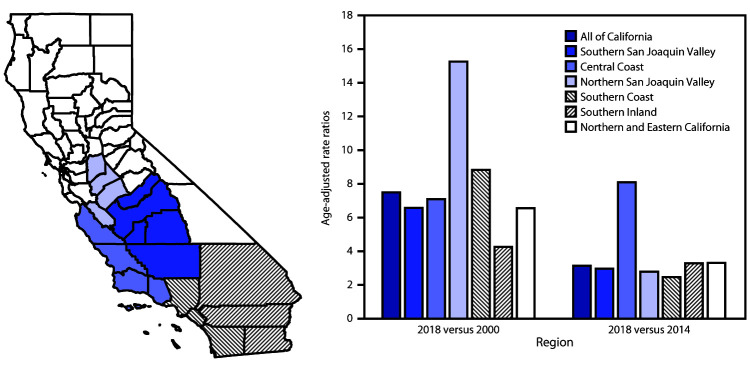
Coccidioidomycosis (Valley fever) is an infection caused by the soil-dwelling fungus Coccidioides spp., which usually manifests as a mild self-limited respiratory illness or pneumonia but can result in severe disseminated disease and, rarely, death (1,2). In California, coccidioidomycosis incidence increased nearly 800% from 2000 (2.4 cases per 100,000 population) to 2018 (18.8) (2-4). The California Department of Public Health (CDPH) reports statewide and county-level coccidioidomycosis incidence annually; however, a comprehensive regional analysis has not been conducted. Using California coccidioidomycosis surveillance data during 2000-2018, age-adjusted incidence rates were calculated, and coccidioidomycosis epidemiology was described in six regions. During 2000-2018, a total of 65,438 coccidioidomycosis cases were reported in California; median statewide annual incidence was 7.9 per 100,000 population and varied by region from 1.1 in Northern and Eastern California to 90.6 in the Southern San Joaquin Valley, with the largest increase (15-fold) occurring in the Northern San Joaquin Valley. When analyzing demographic data, which was available for >99% of cases for sex and age and 59% of cases for race/ethnicity, median annual incidence was high among males (10.2) and Black persons (9.0) consistently across all regions; however, incidence varied among Hispanics and adults aged 40-59 years by region. Tracking these surveillance data at the regional level reinforced understanding of where and among what demographic groups coccidioidomycosis rates have been highest and revealed where rates are increasing most dramatically. The results of this analysis influenced the planning of a statewide coccidioidomycosis awareness campaign so that the messaging, including social media and TV and radio segments, focused not only on the general population in the areas with the highest rates, but also in areas where coccidioidomycosis is increasing at the fastest rates and with messaging targeted to groups at highest risk in those areas.
Overview
The claims and statistics of this paper haven’t been checked yet.
Free: it reads the open-access text and checks the first 5 claims that cite a source we can check. Create a free account to check every claim.
Integrity signals
Registry
Cites
Statistics
Figures
Verification
Claims the paper makes
The claims and statistics of this paper haven’t been checked yet.
Free: it reads the open-access text and checks the first 5 claims that cite a source we can check. Create a free account to check every claim.
Claims other papers make about this one
Each is checked against this paper’s own text: does it say what the citing paper says it does?
The source backs part of the claim, not all of it — or backs it for a different population, condition or comparison.
In the citing paper
“Such geographically related trends can vary based on regional analysis, as the Hispanic population had a much higher incidence than white populations in areas such as San Joaquin Valley [140]”
From Race and ethnicity: Risk factors for fungal infections? (2023) · cites this paper as [140]
Experimental — accuracy not yet measuredThe source backs part of the claim, not all of it — or backs it for a different population, condition or comparison.
In the citing paper
“The arthroconidia (Table 1) of soil-dwelling coccidioides represent a non-human-emitted, infectious fungal aerosol that is primarily transmitted naturally via wind and wildfires, and during active soil disturbance [40,41,42].”
From Comparative Mask Protection against Inhaling Wildfire Smoke, Allergenic Bioaerosols, and Infectious Particles (2022) · cites this paper as [42]
Experimental — accuracy not yet measuredThe check wasn’t confident either way, so it gives no verdict — never disputed.
In the citing paper
“Previous authors have noted that the viral load of human-emitted infectious aerosols may depend on sputum volume [31,42].”
From Comparative Mask Protection against Inhaling Wildfire Smoke, Allergenic Bioaerosols, and Infectious Particles (2022) · cites this paper as [42]
Experimental — accuracy not yet measured
Self-check
Percentages, sums and reported differences re-computed from the paper’s own numbers.
The self-check needs the paper’s full text.
Citations
Cites
Galgiani, J. N., Ampel, N. M., Blair, J. E., Catanzaro, A., Johnson, R. H., Stevens, D. A., & Williams, P. L. (2005) · Clinical Infectious Diseases · doi:10.1086/496991 · Cited by 603
Rosenstein, N. E., Emery, K. W., Werner, S. B., Kao, A., Johnson, R., Rogers, D., Vugia, D., Reingold, A., Talbot, R., Plikaytis, B. D., et al. (2001) · Clinical Infectious Diseases · doi:10.1086/319203 · Cited by 232 · cited 2×
“, access to care and socioeconomic status) (8,9).”
BackgroundSelf-citationMalik, U., Cheema, H., Kandikatla, R., Ahmed, Y., & Chakrala, K. (2017) · Case Reports in Gastroenterology · doi:10.1159/000456655 · Cited by 213
Increase in Reported Coccidioidomycosis—United States, 1998 to 2011
Leggiadro, R. J. (2013) · Pediatric Infectious Disease Journal · doi:10.1097/inf.0b013e3182a08dc2 · Cited by 167
Coccidioides Niches and Habitat Parameters in the Southwestern United States: A Matter of Scale
FISHER, F. S., BULTMAN, M. W., JOHNSON, S. M., PAPPAGIANIS, D., & ZABORSKY, E. (2007) · Annals of the New York Academy of Sciences · doi:10.1196/annals.1406.031 · Cited by 116 · cited 1×
“48 1819 US Department of Health and Human Services/Centers for Disease Control and Prevention these regions is known to be suitable for Coccidioides proliferation; predictive ecological niche modeling has indicated that Coccidioides could expand to other areas (6).”
BackgroundInfluence of host genetics on the severity of coccidioidomycosis
Louie, L., Ng, S., Hajjeh, R., Johnson, R., Vugia, D., Werner, S. B., Talbot, R., & Klitz, W. (1999) · Emerging Infectious Diseases · doi:10.3201/eid0505.990508 · Cited by 99 · cited 1×
“, access to care and socioeconomic status) (8,9).”
BackgroundSelf-citationGriffith, G. E., Omernik, J. M., Smith, D. W., Cook, T. D., Tallyn, E., Moseley, K., & Johnson, C. B. (2016) · Antarctica A Keystone in a Changing World · doi:10.3133/ofr20161021 · Cited by 85
Surveillance for Coccidioidomycosis—United States, 2011–2017.
Benedict, K., McCotter, O. Z., Brady, S., Komatsu, K., Sondermeyer, G. L., Cooksey, Nguyen, A., Jain, S., Vugia, D. J., & Jackson, B. R. (2019) · MMWR. Surveillance Summaries · doi:10.15585/mmwr.ss6807a1 · Cited by 82 · cited 1×
“Outside of California, coccidioidomycosis incidence also increased during 2000–2011 in Arizona, which reports approximately 65% of national cases, and in other states, which report approximately 3% of national cases, after which incidence either decreased or remained stable in those areas (2,7).”
BackgroundSelf-citationPearson, D., Ebisu, K., Wu, X., & Basu, R. (2019) · Epidemiologic Reviews · doi:10.1093/epirev/mxz004 · Cited by 57 · cited 1×
“48 US Department of Health and Human Services/Centers for Disease Control and Prevention healthy populations (10).”
Background
Cited by
Coccidioidomycosis: A Contemporary Review
Crum, N. F. (2022) · Infectious Diseases and Therapy · doi:10.1007/s40121-022-00606-y · Cited by 189
“Filipinos also have a higher risk [5, 30, 32, 76].”
BackgroundInfluentialHealth and Safety Effects of Airborne Soil Dust in the Americas and Beyond
Tong, D. Q., Gill, T. E., Sprigg, W. A., Van Pelt, R. S., Baklanov, A. A., Barker, B. M., Bell, J. E., Castillo, J., Gassó, S., Gaston, C. J., et al. (2023) · Reviews of Geophysics · doi:10.1029/2021rg000763 · Cited by 131
Head, J. R., Sondermeyer-Cooksey, G., Heaney, A. K., Yu, A. T., Jones, I. J., Bhattachan, A., Camponuri, S. K., Wagner, R., Mgbara, W., Phillips, S., et al. (2022) · The Lancet Planetary Health · doi:10.1016/s2542-5196(22)00202-9 · Cited by 111
Self-citationUpdate on the Epidemiology, Diagnosis, and Treatment of Coccidioidomycosis
Williams, S., & Chiller, T. M. (2022) · Journal of Fungi · doi:10.3390/jof8070666 · Cited by 105
Climate Change and Children’s Health: Building a Healthy Future for Every Child
Ahdoot, S., Baum, C. R., Cataletto, M. B., Hogan, P., Wu, C. B., Bernstein, A. S., Bole, A., Balk, S. J., Byron, L. G., Huerta-Montañez, G. M., et al. (2024) · PEDIATRICS · doi:10.1542/peds.2023-065505 · Cited by 121
Immunogenetics associated with severe coccidioidomycosis
Hsu, A. P., Korzeniowska, A., Aguilar, C. C., Gu, J., Karlins, E., Oler, A. J., Chen, G., Reynoso, G. V., Davis, J., Chaput, A., et al. (2022) · JCI Insight · doi:10.1172/jci.insight.159491 · Cited by 70
Race and ethnicity: Risk factors for fungal infections?
Jenks, J. D., Aneke, C. I., Al-Obaidi, M. M., Egger, M., Garcia, L., Gaines, T., Hoenigl, M., & Thompson, G. R. (2023) · PLOS Pathogens · doi:10.1371/journal.ppat.1011025 · Cited by 55
Mulliken, J. S., Hampshire, K. N., Rappold, A. G., Fung, M., Babik, J. M., & Doernberg, S. B. (2023) · The Lancet Planetary Health · doi:10.1016/s2542-5196(23)00046-3 · Cited by 50
Coccidioidomycosis Osteoarticular Dissemination
Moni, B. M., Wise, B. L., Loots, G. G., & Weilhammer, D. R. (2023) · Journal of Fungi · doi:10.3390/jof9101002 · Cited by 20
Jerrett, M., Connolly, R. E., Garcia-Gonzales, D. A., Bekker, C., Nguyen, J. T., Su, J. G., Li, Y., & Marlier, M. E. (2024) · Proceedings of the National Academy of Sciences · doi:10.1073/pnas.2310081121 · Cited by 32
Chapter 15 : Human Health. Fifth National Climate Assessment
Hayden, M. H., Schramm, P. J., Beard, C. B., Bell, J. E., Bernstein, A. S., Bieniek-Tobasco, A., Cooley, N., Diuk‐Wasser, M. A., Dorsey, M. K., Ebi, K. L., et al. (2023) · doi:10.7930/nca5.2023.ch15 · Cited by 55
Phillips, S., Jones, I. J., Sondermyer-Cooksey, G., Yu, A. T., Heaney, A. K., Zhou, B., Bhattachan, A., Weaver, A., Camponuri, S. K., Mgbara, W., et al. (2023) · Environmental Epidemiology · doi:10.1097/ee9.0000000000000254 · Cited by 21
Self-citationCamponuri, S. K., Heaney, A. K., Sondermeyer-Cooksey, G., Vugia, D. J., Jain, S., Swain, D. L., Balmes, J. R., Remais, J. V., & Head, J. R. (2025) · Emerging infectious diseases · doi:10.3201/eid3105.241338 · Cited by 24
Self-citationWeaver, A., Keeney, N., Head, J. R., Heaney, A. K., Camponuri, S. K., Collender, P. A., Bhattachan, A., Okin, G. S., Eisen, E. A., Sondermeyer-Cooksey, G., et al. (2025) · Environmental Health Perspectives · doi:10.1289/ehp13875 · Cited by 19
Self-citationFallowed agricultural lands dominate anthropogenic dust sources in California
Adebiyi, A. A., Kibria, M. M., Abatzoglou, J. T., Ginoux, P. A., Pandey, S. K., Heaney, A. K., Chen, S., & Akinsanola, A. A. (2025) · Communications Earth & Environment · doi:10.1038/s43247-025-02306-0 · Cited by 23
“The Central Valley is a hotspot for cocci-dioidomycosis in California, where incidences have increased by 800% between 2000 and 2018 11 , and dust exposures have been linked to increased infection risk 12 – 17 .”
Wagner, J., Macher, J. M., Chen, W., & Kumagai, K. (2022) · International Journal of Environmental Research and Public Health · doi:10.3390/ijerph192315555 · Cited by 14
Heaney, A. K., Camponuri, S. K., Head, J. R., Collender, P. A., Weaver, A., Sondermeyer-Cooksey, G., Yu, A. T., Vugia, D. J., Jain, S., Bhattachan, A., et al. (2024) · The Lancet Regional Health - Americas · doi:10.1016/j.lana.2024.100864 · Cited by 13
Self-citationMolecular Diagnosis of Endemic Mycoses
Valero, C., Martín-Gómez, M. T., & Buitrago, M. J. (2022) · Journal of Fungi · doi:10.3390/jof9010059 · Cited by 16
Notes From the Field: Coccidioidomycosis Outbreak Among Wildland Firefighters — California, 2021
Donnelly, M. A. P., Maffei, D., Cooksey, G. L. S., Ferguson, T. J., Jain, S., Vugia, D. J., Materna, B. L., & Kamali, A. (2022) · MMWR Morbidity and Mortality Weekly Report · doi:10.15585/mmwr.mm7134a4 · Cited by 14
Self-citationPeterson, M. W., Jain, R., Hildebrandt, K., Carson, W. K., & Fayed, M. A. (2023) · Journal of Fungi · doi:10.3390/jof9060641 · Cited by 12
“In addition, the disease is increasing in this endemic region [22], and appears to be geographically expanding beyond its former boundaries [23,24].”
BackgroundOverview of the Current Challenges in Pulmonary Coccidioidomycosis
Fayed, M. A., Evans, T. M., Almasri, E., Bilello, K. L., Libke, R. D., & Peterson, M. W. (2024) · Journal of Fungi · doi:10.3390/jof10100724 · Cited by 9
“Coccidioidomy-cosis affects all age groups, where the highest rate was documented among adults aged between 40 and 49 [13].”
BackgroundAl‐Obaidi, M. M., Ostrosky-Zeichner, L. L., & Nix, D. E. (2023) · Open Forum Infectious Diseases · doi:10.1093/ofid/ofad345 · Cited by 6
“demic to the southern part of California and the at-risk population is much smaller than in Arizona [26].”
BackgroundEmerging Fungal Infections and Cutaneous Manifestations in Immunosuppressed Patients
Varghese, J. A., Guhan, S. M., & Zheng, L. (2023) · Current Dermatology Reports · doi:10.1007/s13671-023-00386-9 · Cited by 8
Regional Increases in Incidence of Coccidioidomycosis (Valley Fever) — Arizona, 2005–2022
Kruger, S. E., Ruberto, I., Williamson, T., Remais, J. V., Heaney, A. K., & Head, J. R. (2026) · MMWR Morbidity and Mortality Weekly Report · doi:10.15585/mmwr.mm7506a3 · Cited by 5
“…cause and is in part supported by a regional analysis in California that documented disproportionate increases in coccidioidomycosis incidence within cooler, wetter regions that were outside the hyperendemic hot and dry Southern San Joaquin Valley ( 9 ), similar to the findings in this study.”
The Known and Unknown “Knowns” of Human Susceptibility to Coccidioidomycosis
Hsu, A. P. (2024) · Journal of Fungi · doi:10.3390/jof10040256 · Cited by 5
Radosevich, M., Dobson, S., Weaver, A., Lampman, P., Kollath, D. R., Couper, L., Campbell, G., Taylor, J. W., Remais, J. V., Kobziar, L. N., et al. (2025) · Environmental Science & Technology Letters · doi:10.1021/acs.estlett.4c01089 · Cited by 7
Sharifi, S., Sharma, R., Heidari, A., & Johnson, R. H. (2022) · Journal of Investigative Medicine High Impact Case Reports · doi:10.1177/23247096221075906 · Cited by 4
Emerging mycoses: a neglected area of concern for global health
Barac, A. M., Cornely, O. A., Paño-Pardo, Gupta, N. D., Jokelainen, P., Mora-Rillo, M., Tsiodras, S., Gkrania‐Klotsas, E., Bulescu, C., Pellejero-Sagastizábal, G., et al. (2026) · Clinical Microbiology and Infection · doi:10.1016/j.cmi.2026.03.013 · Cited by 4
Sivasubramanian, G., Fox, K., Huynh, N., Woodley, J., Chan‐Golston, A. M., & Policepatil, S. (2025) · Medical Mycology · doi:10.1093/mmy/myaf039 · Cited by 3
Hamm, P. S., Davis, S. S., Catalan‐Dibene, J., Romero‐Olivares, A. L., Edge, K., Bartlow, A. W., Natvig, D. O., & Gorris, M. E. (2025) · Pathogens · doi:10.3390/pathogens14060607 · Cited by 4
Epidemiology of Coccidioidomycosis in the Veterans Health Administration, 2013–2022
Lucero-Obusan, C. A., Deka, R., Schirmer, P., Oda, G., & Holodniy, M. (2023) · Journal of Fungi · doi:10.3390/jof9070731 · Cited by 7
Camponuri, S. K., Heaney, A. K., Sondermeyer-Cooksey, G., Vugia, D. J., Jain, S., Swain, D. L., Balmes, J. R., Remais, J. V., & Head, J. R. (2024) · medRxiv · doi:10.1101/2024.08.30.24312858 · Cited by 3
Self-citationFan, H., Donovan, F., Lovelace, B., & Coleman, C. I. (2025) · Journal of Fungi · doi:10.3390/jof11110766 · Cited by 2
Bhardwaj, S., Tewari, A., Tewari, R., & Kogan, S. (2026) · Cureus · doi:10.7759/cureus.107243 · Cited by 2
“Incidence in Arizona peaked at 260.5 per 100,000 in 2011 before stabilizing, while California’s incidence increased steadily through 2017, with the highest rates reported in Kern, Tulare, Kings, and Fresno Counties [20-21].”
InfluentialPericardial computed tomography imaging findings in the setting of coccidioidomycosis
Madani, M. H., Ghasemiesfe, A., Abdelhafez, Y. G., & Nardo, L. (2022) · BMC Infectious Diseases · doi:10.1186/s12879-022-07601-1 · Cited by 2
Cai, H., Zhang, H., Guo, D. H., Wang, Y., & Gu, J. (2022) · Journal of Fungi · doi:10.3390/jof8101064 · Cited by 3
“Incidence was reported to increase by almost 800% from 2000 to 2018 in California, and in 2018 over 15,000 cases were reported to the Centers for Disease Control and Prevention of the United States [3,4]; (2) The increase in the area of endemicity.”
BackgroundAnalysis and Forecast of the Spread of Particularly Dangerous Mycoses around the World
Lipnitsky, A. V., Polovets, N. V., MURUGOVA, A. A., & Toporkov, A. V. (2024) · Problems of Particularly Dangerous Infections · doi:10.21055/0370-1069-2023-4-16-23 · Cited by 2
Saucier, C. J., Ma, Z., Montoya, J. A., Plant, A., Suresh, S., Robbins, C. L., & Fraser, R. (2024) · Health Communication · doi:10.1080/10410236.2023.2288380 · Cited by 3
“Between 2000 to 2018 in California, case rates rose from 2.4 to 18.8 cases per 100,000—an 800% increase (Cooksey et al., 2020).”
InfluentialType-2 immune skewing in patients with disseminated coccidioidomycosisPreprint
Thauland, T. J., Nagarajan, S. S., Stephens, A. V., Jensen, S. L., Srivastava, A., Lastre, M. A. M., Ahn, T. S., Bun, C., Trump, M. T. T., Johnson, R. H., et al. (2025) · medRxiv · doi:10.1101/2025.09.26.25336729 · Cited by 2
“California (29).”
Miliary coccidioidomycosis mimicking tuberculosis: Case report and review of literature
Gallardo-Huizar, O. E., Lee, J., Kim, K., & Jeng, A. (2024) · Medical Mycology Case Reports · doi:10.1016/j.mmcr.2024.100668 · Cited by 1
“During 2000 – 2018, a total of 65,438 coccidioidomycosis cases were reported in California, with a median age-adjusted annual incidence of 7.9 per 100,000 population [11].”
BackgroundInfluentialSivasubramanian, G., Shepard, R. E., Chauhan, U., Christman, J., & Burke, N. J. (2026) · The Lancet Regional Health - Americas · doi:10.1016/j.lana.2026.101513 · Cited by 1
Coccidioidomycosis Update and Review
Schneider, D. (2023) · Current Emergency and Hospital Medicine Reports · doi:10.1007/s40138-023-00274-3 · Cited by 5
Shehab, K. W., & Shehab, Z. M. (2025) · Elsevier eBooks · doi:10.1016/b978-0-323-82763-8.00218-1 · Cited by 1
Coccidioides immitis and Coccidioides posadasii (Coccidioidomycosis)
Thompson, G. R. (2022) · Elsevier eBooks · doi:10.1016/b978-0-323-75608-2.00253-6
A Rare Case of Disseminated Coccidioidomycosis Presenting as an Intracardiac Mass
Jamali, A., Nguyen, H. D., Tran, P., Chen, C., Devine, T., & Ahmad, S. (2024) · Annals of Internal Medicine Clinical Cases · doi:10.7326/aimcc.2022.0859
The Role of California Fires in Predicting Valley Fever
Valenzuela, N., & Bañuelos, M. (2024) · Lecture notes in computer science · doi:10.1007/978-3-031-62836-8_22
Manifestations and Treatment of Ocular Coccidioidomycosis: A Review of Literature
Shusko, A. R. (2025) · Journal of Ophthalmology and Advance Research · doi:10.46889/joar.2025.6102
Estimating Valley Fever Endemicity with Environmental Parameters
Caraccilo, J., Garner, S., & Bañuelos, M. (2024) · Asilomar Conference on Signals, Systems and Computers (ACSSC) · doi:10.1109/ieeeconf60004.2024.10943058
Maran, K., Adams, R., Khan, A., & Chen, S. F. (2025) · Journal of the Pediatric Infectious Diseases Society · doi:10.1093/jpids/piaf103
A Case of Systemic Fungal Infection Diagnosed After Tongue Mass Biopsy
Tynes, B. E., Makker, J., Chambers, T., & Martinez-Monedero, R. (2025) · SKIN The Journal of Cutaneous Medicine · doi:10.25251/skin.9.3.18
Sivasubramanian, G. (2025) · Clinical Infectious Diseases · doi:10.1093/cid/ciaf728
“Between 2000 and 2018, median annual incidence in the Southern San Joaquin Valley was 90.6 per 100 000, with Kern County frequently exceeding 250 per 100 000 during peak years, nearly tenfold higher than the statewide median of 7.9 per 100 000 [15].”
InfluentialDhillon, H., Pescaru, H. T., Dujari, S., Ding, V. Y., Desai, M., & Galetta, K. M. (2026) · The Neurohospitalist · doi:10.1177/19418744261424934
Intrapartum Fever—Coccidioidomycosis Diagnosed During Induction of Labor: A Case Report
Varella, A. P. D. C., Vo, M., & Nguyen, K. P. (2026) · Case Reports in Obstetrics and Gynecology · doi:10.1155/crog/4234610
Head, J. R., Brouwer, A. F., Rajan, A., Scherer, M., Williams, M., Balmes, J. R., Thompson, G. R., Ampel, N. M., & Lucas, K. D. (2026) · The Lancet Regional Health - Americas · doi:10.1016/j.lana.2026.101461
“23 Furthermore, since the 1950s, surveillance records indicate rising incidence and geographic expansion of the disease, 3 even as surveillance is believed to vastly undercount infections.”
Neonatal management and outcomes in the setting of disseminated coccidioidomycosis in pregnancy
Darmawan, D. O., Mathew, R., Pașca, A. M., Aziz, N., Zhang, X., Kappagoda, S., Waldrop, A. R., Markwei, M. T., & Kushner, L. E. (2026) · Journal of Perinatology · doi:10.1038/s41372-026-02659-0
Alanzi, A. R., Alharbi, H. A., Mothana, R. A., Parvez, M. K., & Shahat, A. A. (2026) · Medicine · doi:10.1097/md.0000000000049169
“[22] As evidenced by the outbreak at Dinosaur National Park, [23,24] as well as on solar power farms, [25,26] archaeology, construction, and firefighting especially when using hand tools and working in dusty conditions have all been connected to infection.”
Evaluation and Management of Exposure to Infectious Agents
Cruz, P., Kyle, J. L., Gold, D., Armour, P., & Durrani, T. S. (2026) · Wiley eBooks · doi:10.1002/9781394319947.ch7
Heaney, A. K., Jones, I. J., Camponuri, S. K., Head, J. R., Weaver, A., Collender, P. A., Sondermeyer-Cooksey, G., Jain, S., Vugia, D. J., Balmes, J. R., et al. (2026) · Science Advances · doi:10.1126/sciadv.aec0156
Self-citationAccelerating research to keep pace with the rising incidence of coccidioidomycosis
Homer, C. M. (2026) · mSphere · doi:10.1128/msphere.00082-26
Kasturi, K., Burke, N., & Sivasubramanian, G. (2026) · Frontiers in Public Health · doi:10.3389/fpubh.2026.1972841
Metadata
- Authors
- Sondermeyer Cooksey, G. L., Nguyen, A., Vugia, D., & Jain, S.
- Affiliations
- Infectious Diseases Branch, Center for Infectious Diseases, California Department of Public Health.
- California Department of Public Health (US)
- Venue
- MMWR. Morbidity and Mortality Weekly Report
- Published
- 2020-12-04
- Volume
- 69
- Issue
- 48
- Pages
- 1817-1821
- ISSN
- 0149-2195 (ISSN-L)
- 1545-861X
- PMC
- PMC7714029
- OpenAlex
- W3109191613
- Cited by
- 60
- References
- 9
- Citations by year
- 2026: 13 · 2025: 13 · 2024: 12 · 2023: 11 · 2022: 11
- FWCI
- 3.94
- Type
- journal article
- Language
- en
- Open access
- diamond
- doi.org
- Locations
- MMWR Morbidity and Mortality Weekly Report (publishedVersion)
- PubMed Central (publishedVersion, cc-by)
- PubMed (publishedVersion)
- Funders
- Centers for Disease Control and Prevention
- Topics
- Health Sciences › Medicine › Infectious Diseases › Fungal Infections and Studies
- Health Sciences › Medicine › Microbiology (medical) › Actinomycetales infections and treatment
- Health Sciences › Medicine › Infectious Diseases › Antifungal resistance and susceptibility
- Keywords
- coccidioidomycosis, Coccidioides, incidence trends, regional variation, San Joaquin Valley, California, demographic disparities, Black population, sex differences, age differences, race and ethnicity, health information campaigns, fungal infection surveillance
- MeSH terms
- Adolescent, Adult, California, Child, Child, Preschool, Coccidioidomycosis, Female, Humans, Infant, Infant, Newborn, Male, Middle Aged, Risk Factors, Incidence, Young Adult
About these checks
Registry, retraction, Cites and statistics results are computed, not judged, with one exception: a printed reference that no index lists is read once by a model before it counts as a citation error. Claims are extracted by a model and kept only when their quote appears verbatim in the text; each cited source is then checked, with a model’s help, for whether it says what the claim relies on. Those verdicts can be wrong — read the claim’s quote and the cited source before relying on one.
Statistics and arithmetic are recomputed, not judged.
Confidence bands are shown only for fields calibrated on our annotated test set. None is calibrated yet, so no band is shown.
What counts as a claim ›How we measure confidence ›How we check this ›
Are you an author, or do you see a problem with this page? Request a review
Data sources
Bibliographic data: Semantic Scholar, OpenAlex, Crossref.
Contains information from the Semantic Scholar Academic Graph Datasets, made available under the ODC Attribution License (ODC-BY 1.0).
Semantic Scholar’s data is described in: Kinney, R., et al. (2023). The Semantic Scholar Open Data Platform. arXiv:2301.10140.
