

The DOI matches its Crossref record; 4 of the 4 references it cites were found in a registry or an index.
Outbreak Associated with SARS-CoV-2 B.1.617.2 (Delta) Variant in an Elementary School — Marin County, California, May–June 2021
Open accessAbstract
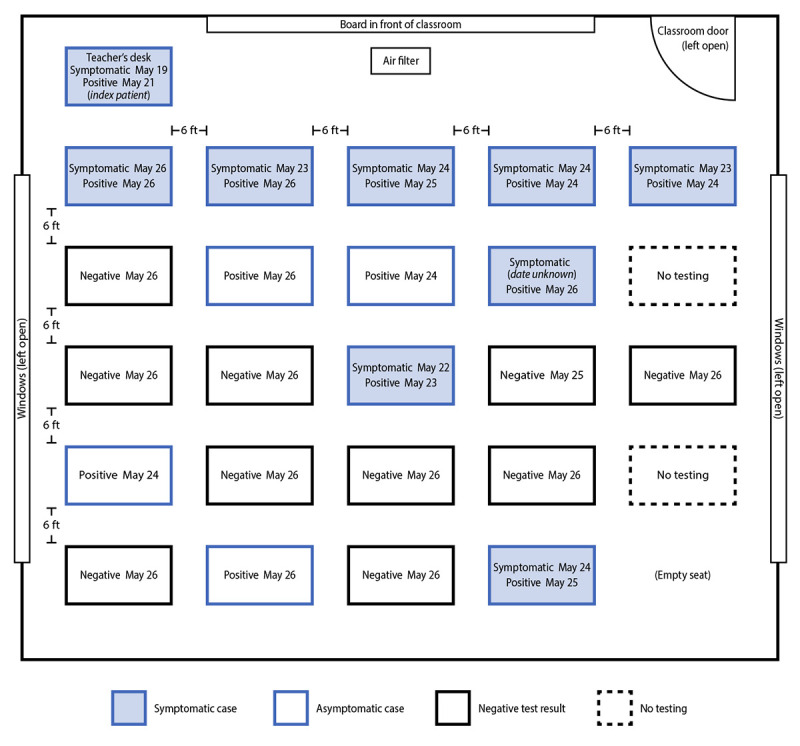
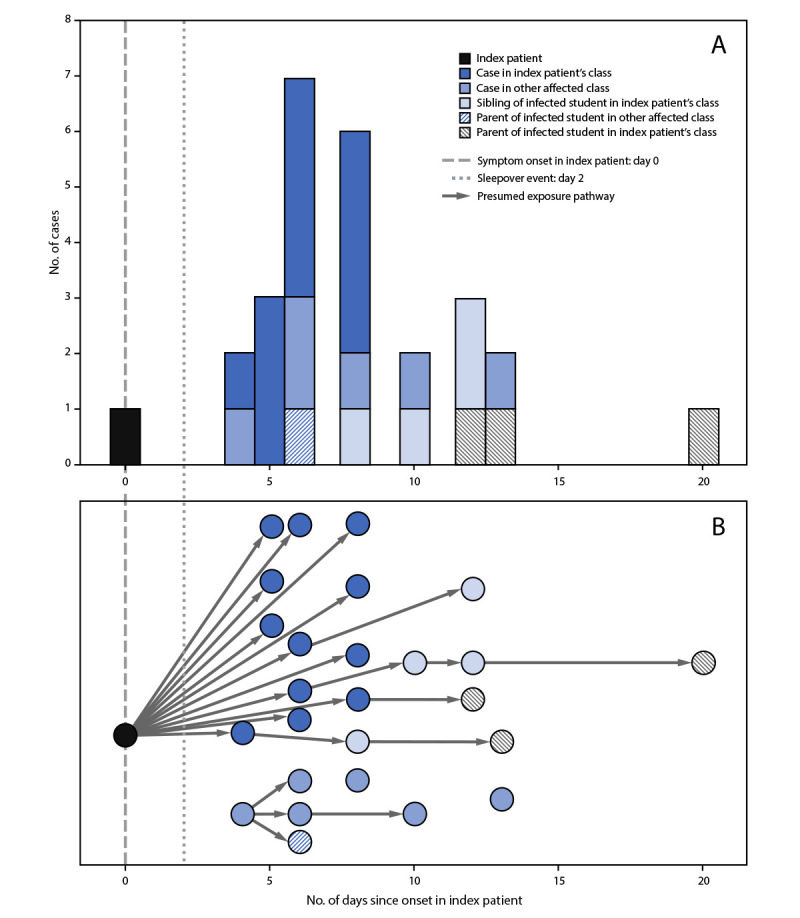
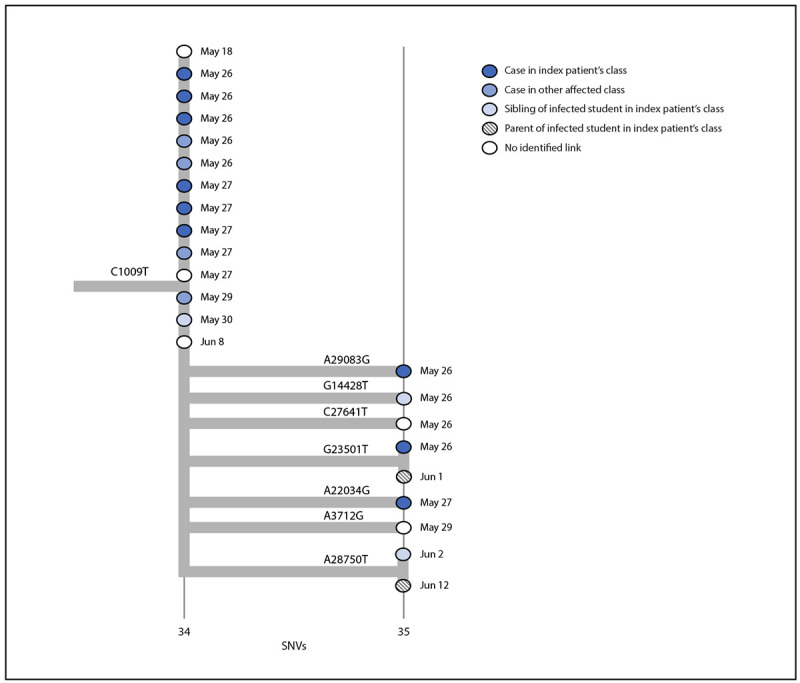
On May 25, 2021, the Marin County Department of Public Health (MCPH) was notified by an elementary school that on May 23, an unvaccinated teacher had reported receiving a positive test result for SARS-CoV-2, the virus that causes COVID-19. The teacher reported becoming symptomatic on May 19, but continued to work for 2 days before receiving a test on May 21. On occasion during this time, the teacher read aloud unmasked to the class despite school requirements to mask while indoors. Beginning May 23, additional cases of COVID-19 were reported among other staff members, students, parents, and siblings connected to the school. To characterize the outbreak, on May 26, MCPH initiated case investigation and contact tracing that included whole genome sequencing (WGS) of available specimens. A total of 27 cases were identified, including that of the teacher. During May 23-26, among the teacher's 24 students, 22 students, all ineligible for vaccination because of age, received testing for SARS-CoV-2; 12 received positive test results. The attack rate in the two rows seated closest to the teacher's desk was 80% (eight of 10) and was 28% (four of 14) in the three back rows (Fisher's exact test; p = 0.036). During May 24-June 1, six of 18 students in a separate grade at the school, all also too young for vaccination, received positive SARS-CoV-2 test results. Eight additional cases were also identified, all in parents and siblings of students in these two grades. Among these additional cases, three were in persons fully vaccinated in accordance with CDC recommendations (1). Among the 27 total cases, 22 (81%) persons reported symptoms; the most frequently reported symptoms were fever (41%), cough (33%), headache (26%), and sore throat (26%). WGS of all 18 available specimens identified the B.1.617.2 (Delta) variant. Vaccines are effective against the Delta variant (2), but risk of transmission remains elevated among unvaccinated persons in schools without strict adherence to prevention strategies. In addition to vaccination for eligible persons, strict adherence to nonpharmaceutical prevention strategies, including masking, routine testing, facility ventilation, and staying home when symptomatic, are important to ensure safe in-person learning in schools (3).
Overview
The claims and statistics of this paper haven’t been checked yet.
Run the check — free, no account needed. It reads the open-access text and checks the sources it cites.
Integrity signals
Registry
Cites
Statistics
Figures
Verification
Claims the paper makes
The claims and statistics of this paper haven’t been checked yet.
Run the check — free, no account needed. It reads the open-access text and checks the sources it cites.
Claims other papers make about this one
Each is checked against this paper’s own text: does it say what the citing paper says it does?
In the citing paper
“School-age children represent a high proportion of Covid-19 cases,10 and they may play an important role in the transmission of SARS-CoV-2,11,12 including spread of the highly transmissible B.1.617.2 (or delta) variant.13,14”
From Evaluation of the BNT162b2 Covid-19 Vaccine in Children 5 to 11 Years of Age (2022) · cites this paper as [14]
In the citing paper
“With the prioritization of older age groups for vaccination, school-age children now account for an increasing proportion of cases and hospitalizations as compared with their proportion early in the pandemic,10,22,23,24 and school outbreaks are occurring.14,25”
From Evaluation of the BNT162b2 Covid-19 Vaccine in Children 5 to 11 Years of Age (2022) · cites this paper as [14]
Self-check
Percentages, sums and reported differences re-computed from the paper’s own numbers.
The self-check needs the paper’s full text.
Citations
Cites
Effectiveness of Covid-19 Vaccines against the B.1.617.2 (Delta) Variant
Lopez Bernal, J., Andrews, N., Gower, C., Gallagher, E., Simmons, R., Thelwall, S., Stowe, J., Tessier, E., Groves, N., Dabrera, G., et al. (2021) · New England Journal of Medicine · doi:10.1056/nejmoa2108891 · Cited by 2,889
Brown, C., Vostok, J., Johnson, H., Burns, M., Gharpure, R. V., Sami, S., Sabo, R. T., Hall, N. B., Foreman, A., Schubert, P. L., et al. (2021) · MMWR Morbidity and Mortality Weekly Report · doi:10.15585/mmwr.mm7031e2 · Cited by 491
Turakhia, Y., Thornlow, B. P., Hinrichs, A. S., Maio, N. D., Gozashti, L., Lanfear, R., Haussler, D. H., & Corbett-Detig, R. B. (2021) · Nature Genetics · doi:10.1038/s41588-021-00862-7 · Cited by 414
Self-citationDougherty, K., Mannell, M., Naqvi, O. H., Matson, D., & Stone, J. (2021) · MMWR Morbidity and Mortality Weekly Report · doi:10.15585/mmwr.mm7028e2 · Cited by 145
Cited by
Sorted by citations
Items 101–120 of 120
Children and COVID-19 Vaccine: A Public Health Ethics Perspective
Nurunnabi, A. S. M., Ashique, S. S., Jahan, A., Sweety, A. A., & Sharmin, S. (2022) · Bangladesh Medical Journal · doi:10.3329/bmj.v50i3.62934 · Cited by 1
COVID-19 in Children and Adolescents
Banerjee, R. (2023) · Elsevier eBooks · doi:10.1016/b978-0-323-87539-4.00014-2 · Cited by 1
MITIGATING THE 4 th WAVE OF THE COVID-19 PANDEMIC IN ONTARIOPreprint
Cipriano, L. E., Haddara, W. M. R., & Sander, B. (2021) · medRxiv · doi:10.1101/2021.09.02.21263000 · Cited by 1
Stange, M., Wuerfel, E., Peter, J. K., Seth-Smith, H. M. B., Roloff, T. C., Gsponer, S., Mari, A., Gil, B. C., Lebrand, A., Wegner, F., et al. (2022) · medRxiv · doi:10.1101/2022.01.26.22269824 · Cited by 1
Loima, J. (2022) · International Journal of Education and Literacy Studies · doi:10.7575/aiac.ijels.v.10n.1p.2
Schreiber, J., Adnani, S., Stücker, U., Weidlich, A., & Rieger‐Ndakorerwa, G. (2022) · Das Gesundheitswesen · doi:10.1055/s-0042-1745548
Stutman, D. R., Tergliafera, J. K., Black, M. E., Chen, A. L.-T., Karnes, L. L., Turner, N. A., Wagner, G. R., & Thompson, J. M. (2022) · American Journal of Public Health · doi:10.2105/ajph.2022.306875
Kutty, P. K., Stuckey, M. J., & Koumans, E. H. A. (2022) · Clinical Infectious Diseases · doi:10.1093/cid/ciac522
Dynamic characteristics of COVID-19 infection in Chinese children.
Zhang, Y., Li, H., Xiang, B., Du, J., Huang, Y., Lin, G., & Wu, D. (2022) · PubMed Central
SARS-CoV-2 Delta variant: a systematic review of transmissibility and severity in children
Honeyman, D. A., Buisson, E., Hutchinson, D., Kunasekaran, M. P., Aagerup, J., Chen, X., Moa, A., & Hyde, Z. (2022) · Global Biosecurity · doi:10.31646/gbio.169
Epidemiology and Control: From Principles to Pandemics
Kaslow, R. A., & Bell, D. M. (2023) · Springer eBooks · doi:10.1007/978-1-4939-9544-8_1-2
Sustainable Green Doped Nanomaterials for Emerging Contaminants Removal
Rani, M., Ankit, Yadav, J., & Shanker, U. (2023) · Springer eBooks · doi:10.1007/978-3-031-16101-8_88
Kakeshpour, T., & Bax, A. (2024) · Atmosphere · doi:10.3390/atmos15050570
COVID-19 Incidence and Age Eligibility for Elementary School
Lin, E., Bilinski, A., Collender, P. A., Lee, V., Sud, S. R., León, T. M., White, L. A., Remais, J. V., & Head, J. R. (2024) · JAMA Network Open · doi:10.1001/jamanetworkopen.2024.44836
Public Health Aspects of Infectious Disease Control
Harriman, K. H. (2025) · Elsevier eBooks · doi:10.1016/b978-0-323-82763-8.00264-8
Mikszewski, A., Stabile, L., Buonanno, G., & Morawska, L. (2021) · Figshare · doi:10.6084/m9.figshare.17086938
Bhavnani, D., James, E. R., Johnson, K. E., Beaudenon‐Huibregtse, S., Chang, P., Rathouz, P. J., Weldon, M., Matouschek, A. T., & Young, A. E. (2022) · Figshare · doi:10.6084/m9.figshare.20444226
Merckx, J., Crèvecoeur, J., Proesmans, K., Hammami, N., Denys, H., & Hens, N. (2022) · Figshare · doi:10.6084/m9.figshare.21341586
Carranza, C., Ortiz, L., Castellanos, M. E., Gonzalez-Reiche, A. S., Mendizábal-Cabrera, R., Khalil, Z., van DeGuchte, A., Farrugia, K., Herrera, M., Mena, E., et al. (2026) · Access Microbiology · doi:10.1099/acmi.0.000939.v3
Tang, W., Chen, T., Slocum, Z., Lan, Y., Delmelle, E. M., Bolanos, J., Chen, D., Mittal, N., Rice, J., Shukla, T., et al. (2026) · Cartography and Geographic Information Science · doi:10.1080/15230406.2026.2629334
Metadata
- Authors
- Lam-Hine, T., McCurdy, S. A., Santora, L., Duncan, L., Corbett-Detig, R., Kapusinszky, B., & Willis, M.
- Corresponding author
- Lam-Hine, Tracy
- Venue
- MMWR. Morbidity and Mortality Weekly Report
- Published
- 2021-09-03
- Volume
- 70
- Issue
- 35
- Pages
- 1214-1219
- ISSN
- 0149-2195 (ISSN-L)
- 1545-861X
- PMC
- PMC8422870
- OpenAlex
- W3198028366
- Cited by
- 124
- References
- 4
- Citations by year
- 2026: 4 · 2025: 7 · 2024: 8 · 2023: 20 · 2022: 65 · 2021: 20
- FWCI
- 8.94
- Type
- journal article
- Language
- en
- Open access
- diamond
- doi.org
- Locations
- MMWR Morbidity and Mortality Weekly Report (publishedVersion)
- Europe PMC (PubMed Central) (publishedVersion, cc-by)
- PubMed Central (publishedVersion, cc-by)
- PubMed (publishedVersion)
- eScholarship (California Digital Library) (submittedVersion, cc-by)
- Funders
- Pfizer
- California Department of Public Health
- Moderna
- Centers for Disease Control and Prevention
- Topics
- Health Sciences › Medicine › Infectious Diseases › SARS-CoV-2 and COVID-19 Research
- Physical Sciences › Mathematics › Modeling and Simulation › COVID-19 epidemiological studies
- Health Sciences › Medicine › Pulmonary and Respiratory Medicine › Infection Control and Ventilation
- Keywords
- COVID-19 outbreak, Delta variant, elementary school, attack rate, whole genome sequencing, contact tracing, non-pharmaceutical interventions, Marin County, children and adolescents, vaccine effectiveness, asymptomatic transmission, household transmission
- MeSH terms
- School Teachers, COVID-19, SARS-CoV-2, COVID-19 Vaccines, Adult, California, Child, Disease Outbreaks, Humans, Masks, Schools, Contact Tracing
About these checks
Registry, retraction, Cites and statistics results are computed, not judged, with one exception: a printed reference that no index lists is read once by a model before it counts as a citation error. Claims are extracted by a model and kept only when their quote appears verbatim in the text; each cited source is then checked, with a model’s help, for whether it says what the claim relies on. Those verdicts can be wrong — read the claim’s quote and the cited source before relying on one.
Statistics and arithmetic are recomputed, not judged.
Confidence bands are shown only for fields calibrated on our annotated test set. None is calibrated yet, so no band is shown.
What counts as a claim ›How we measure confidence ›How we check this ›
Are you an author, or do you see a problem with this page? Request a review
