

The DOI matches its Crossref record; 8 of the 8 references it cites were found in a registry or an index.
Chronic Pain Among Adults — United States, 2019–2021
Open accessAbstract
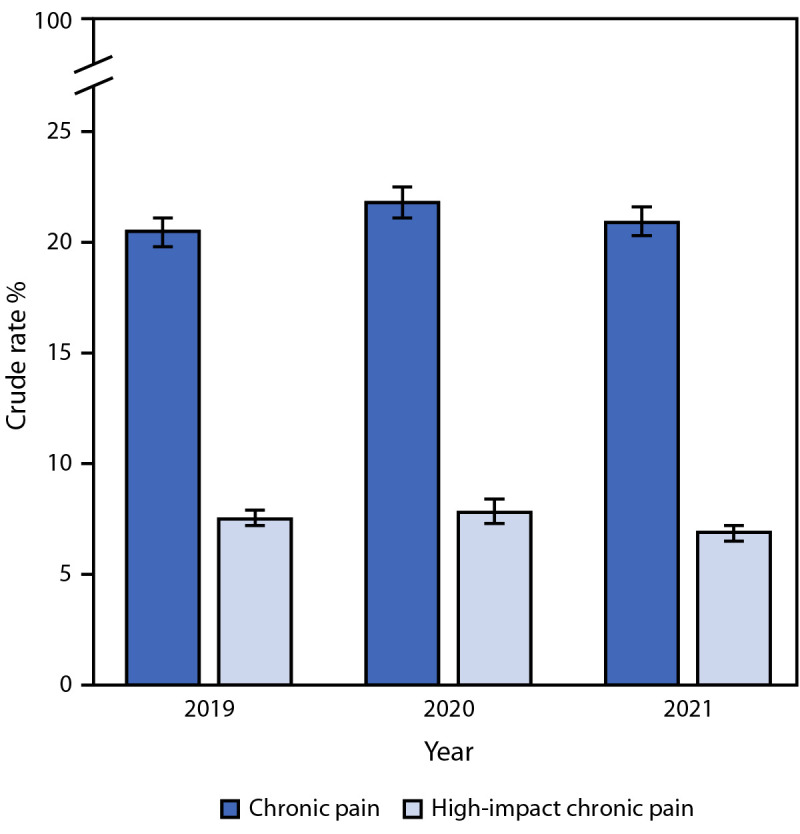
Chronic pain (i.e., pain lasting ≥3 months) is a debilitating condition that affects daily work and life activities for many adults in the United States and has been linked with depression (1), Alzheimer disease and related dementias (2), higher suicide risk (3), and substance use and misuse (4).During 2016, an estimated 50 million adults in the United States experienced chronic pain, resulting in substantial health care costs and lost productivity (5,6).Addressing chronic pain and improving the lives of persons living with pain is a public health imperative.Population research objectives in the National Pain Strategy, which was released in 2016 by the Interagency Pain Research Coordinating Committee, call for more precise estimates of the prevalence of chronic pain and high-impact chronic pain (i.e., chronic pain that results in substantial restriction to daily activities) in the general population and within various population groups to guide efforts to reduce the impact of chronic pain (3).Further, a 2022 review of U.S. chronic pain surveillance systems identified the National Health Interview Survey (NHIS) as the best source for pain surveillance data (7).CDC analyzed data from the 2019-2021 NHIS to provide updated estimates of the prevalence of chronic pain and highimpact chronic pain among adults in the United States and within population groups defined by demographic, geographic, socioeconomic, and health status characteristics.During 2021, an estimated 20.9% of U.S. adults (51.6 million persons) experienced chronic pain, and 6.9% (17.1 million persons) experienced high-impact chronic pain.New findings from this analysis include that non-Hispanic American Indian or Alaska Native (AI/AN) adults, adults identifying as bisexual, and adults who are divorced or separated are among the populations experiencing a higher prevalence of chronic pain and highimpact chronic pain.Clinicians, practices, health systems, and payers should vigilantly attend to health inequities and ensure access to appropriate, affordable, diversified, coordinated, and effective pain management care for all persons (8).NHIS is a cross-sectional, household survey of the civilian, noninstitutionalized population conducted annually by the National Center for Health Statistics (NCHS).*Data were analyzed using the 2019-2021 Sample Adult Interviews.† Survey questions used to estimate the prevalence of pain included, "In the past three months, how often did you have pain?Would you say never, some days, most days, or every day?" and "Over the past three months, how often did your pain limit your life or work activities?Would you say never, some days, most days, INSIDE 386 Secondary Cases of Invasive Disease Caused by Encapsulated and Nontypeable Haemophilus influenzae -10 U.S. Jurisdictions, 2011-2018 391 Update on Wild Poliovirus Type 1 Outbreak -Southeastern Africa, 2021-2022 398 Racial and Ethnic Disparities in Mpox Cases and Vaccination Among Adult Males -United States, May-December 2022 404 Epidemiologic and Clinical Features of Mpox-Associated Deaths -United States, May 10, 2022-March 7, 2023 411 Notes From the Field: Campylobacteriosis Outbreak Associated with Consumption of Raw Water -Montana, 2022 414 QuickStats
Overview
The claims and statistics of this paper haven’t been checked yet.
Run the check — free, no account needed. It reads the open-access text and checks the sources it cites.
Integrity signals
Registry
Cites
Statistics
Figures
Verification
Claims the paper makes
The claims and statistics of this paper haven’t been checked yet.
Run the check — free, no account needed. It reads the open-access text and checks the sources it cites.
Claims other papers make about this one
Each is checked against this paper’s own text: does it say what the citing paper says it does?
The source backs part of the claim, not all of it — or backs it for a different population, condition or comparison.
In the citing paper
“In the US, 30.1% of those with HICP are employed 2”
From Overview and Feasibility of a Novel Transdisciplinary Integrative Approach to High Impact Chronic Pain in Vermont (2024) · cites this paper as [2]
Experimental — accuracy not yet measuredThe source backs part of the claim, not all of it — or backs it for a different population, condition or comparison.
In the citing paper
“The mean age of the PATH participants (49.8 years) is also typical of the HICP population in the US (low 50s). 2”
From Overview and Feasibility of a Novel Transdisciplinary Integrative Approach to High Impact Chronic Pain in Vermont (2024) · cites this paper as [2]
Experimental — accuracy not yet measuredThe cited source says what the claim attributes to it.
In the citing paper
“Chronic pain is one of the most common chronic conditions in the United States based on multiple prevalence studies 1 with the most recent national estimate at 20.9% of US adults. 2”
From Overview and Feasibility of a Novel Transdisciplinary Integrative Approach to High Impact Chronic Pain in Vermont (2024) · cites this paper as [2]
The cited source says what the claim attributes to it.
In the citing paper
“The employment status, however, is not typical. In the US, 30.1% of those with HICP are employed 2 while 50% of the PATH participants are employed full-time, and 17% are employed part-time.”
From Overview and Feasibility of a Novel Transdisciplinary Integrative Approach to High Impact Chronic Pain in Vermont (2024) · cites this paper as [2]
The cited source says what the claim attributes to it.
In the citing paper
“67% of the participants were employed at least part-time vs only 30.1% of those with HICP in the US are employed. 2”
From Overview and Feasibility of a Novel Transdisciplinary Integrative Approach to High Impact Chronic Pain in Vermont (2024) · cites this paper as [2]
Self-check
Percentages, sums and reported differences re-computed from the paper’s own numbers.
The self-check needs the paper’s full text.
Citations
Cites
Prevalence of Chronic Pain and High-Impact Chronic Pain Among Adults — United States, 2016
Dahlhamer, J., Lucas, J., Zelaya, Nahin, R., Mackey, S., DeBar, L., Kerns, R., Von Korff, M., Porter, L., & Helmick, C. (2018) · MMWR. Morbidity and Mortality Weekly Report · doi:10.15585/mmwr.mm6736a2 · Cited by 2,598
The Economic Costs of Pain in the United States
Gaskin, D. J., & Richard, P. (2012) · The Journal of Pain · doi:10.1016/j.jpain.2012.03.009 · Cited by 2,359
CDC Clinical Practice Guideline for Prescribing Opioids for Pain — United States, 2022
Dowell, D., Ragan, K. R., Jones, C. M., Baldwin, G. T., & Chou, R. (2022) · MMWR. Recommendations and Reports · doi:10.15585/mmwr.rr7103a1 · Cited by 1,886
Depression and chronic pain in the elderly: links and management challenges
Zis, P., Daskalaki, A., Bountouni, I., Sykioti, P., Varrassi, G., & Paladini, A. (2017) · Clinical Interventions in Aging · doi:10.2147/cia.s113576 · Cited by 458
Ditre, J. W., Zale, E. L., & LaRowe, L. R. (2018) · Annual Review of Clinical Psychology · doi:10.1146/annurev-clinpsy-050718-095440 · Cited by 247
Racial and Ethnic Disparities in the Treatment of Chronic Pain
Morales, M. E., & Yong, R. J. (2020) · Pain Medicine · doi:10.1093/pm/pnaa427 · Cited by 224
A Review of Potential National Chronic Pain Surveillance Systems in the United States
Duca, L. M., Helmick, C. G., Barbour, K. E., Nahin, R. L., Korff, M. V., Murphy, L. B., Theis, K. A., Guglielmo, D., Dahlhamer, J. M., Porter, L. L., et al. (2022) · Journal of Pain · doi:10.1016/j.jpain.2022.02.013 · Cited by 45
Khalid, S., Sambamoorthi, U., Umer, A., Lilly, C. L., Gross, D. K., & Innes, K. E. (2021) · Journal of Aging and Health · doi:10.1177/08982643211036219 · Cited by 42
Cited by
Sorted by citations
Prevalence of Depression and Anxiety Among Adults With Chronic Pain
Aaron, R. V., Ravyts, S. G., Carnahan, N. D., Bhattiprolu, K., Harte, N., McCaulley, C. C., Vitalicia, L., Rogers, A. B., Wegener, S. T., & Dudeney, J. E. (2025) · JAMA Network Open · doi:10.1001/jamanetworkopen.2025.0268 · Cited by 293
İçer, M. A., Sarıkaya, B., Koçyiğit, E., Atabılen, B., Çelik, M. N., Capasso, R., Ağagündüz, D., & Budán, F. (2024) · Foods · doi:10.3390/foods13152437 · Cited by 108
Janus effect of the anterior cingulate cortex: Pain and emotion
Journée, S. H., Mathis, V., Fillinger, C., Veinante, P., & Yalçın, İ. (2023) · Neuroscience & Biobehavioral Reviews · doi:10.1016/j.neubiorev.2023.105362 · Cited by 85
Baker, M. B., Liu, E., Bully, M. A., Hsieh, A., Nozari, A., Tuler, M., & Binda, D. D. (2024) · Healthcare · doi:10.3390/healthcare12171765 · Cited by 72
“Thus, the consequences of chronic pain grow increasingly dire with an aging population and necessitate improved strategies for management [1,9].”
BackgroundMethodInfluentialYarns, B. C., JACKSON, N. J., Alas, A., Melrose, R. J., Lumley, M. A., & Sultzer, D. L. (2024) · JAMA Network Open · doi:10.1001/jamanetworkopen.2024.15842 · Cited by 60
Metadata
- Authors
- Rikard, S. M., Strahan, A. E., Schmit, K. M., & Guy, G. P.
- Affiliations
- National Center for Injury Prevention and Control (US)
- Corresponding author
- Rikard, S. Michaela
- Venue
- MMWR. Morbidity and Mortality Weekly Report
- Published
- 2023-04-14
- Volume
- 72
- Issue
- 15
- Pages
- 379-385
- ISSN
- 0149-2195 (ISSN-L)
- 1545-861X
- PMC
- PMC10121254
- OpenAlex
- W4365442769
- Cited by
- 588
- References
- 8
- Citations by year
- 2026: 144 · 2025: 265 · 2024: 143 · 2023: 35
- FWCI
- 91.10
- Type
- journal article
- Language
- en
- Open access
- diamond
- doi.org
- Locations
- MMWR Morbidity and Mortality Weekly Report (publishedVersion)
- PubMed Central (publishedVersion, public-domain)
- PubMed (publishedVersion)
- Topics
- Health Sciences › Health Professions › Physical Therapy, Sports Therapy and Rehabilitation › Musculoskeletal pain and rehabilitation
- Health Sciences › Medicine › Public Health, Environmental and Occupational Health › Opioid Use Disorder Treatment
- Health Sciences › Medicine › Anesthesiology and Pain Medicine › Pain Management and Opioid Use
- Keywords
- chronic pain, high-impact chronic pain, prevalence, adults, health disparities, American Indian and Alaska Native adults, bisexuals, marital status, socioeconomic status, pain management, National Health Interview Survey, health equity
- MeSH terms
- Adult, Health Status, Humans, Population Surveillance, United States, Prevalence, American Indian or Alaska Native, Chronic Pain, Pain Management
About these checks
Registry, retraction, Cites and statistics results are computed, not judged, with one exception: a printed reference that no index lists is read once by a model before it counts as a citation error. Claims are extracted by a model and kept only when their quote appears verbatim in the text; each cited source is then checked, with a model’s help, for whether it says what the claim relies on. Those verdicts can be wrong — read the claim’s quote and the cited source before relying on one.
Statistics and arithmetic are recomputed, not judged.
Confidence bands are shown only for fields calibrated on our annotated test set. None is calibrated yet, so no band is shown.
What counts as a claim ›How we measure confidence ›How we check this ›
Are you an author, or do you see a problem with this page? Request a review
