

The DOI matches its Crossref record; 22 of the 22 references it cites were found in a registry or an index.
Early identification of autism spectrum disorder among children aged 4 years—Early Autism and Developmental Disabilities Monitoring Network, six sites, United States, 2016.
Open accessAbstract
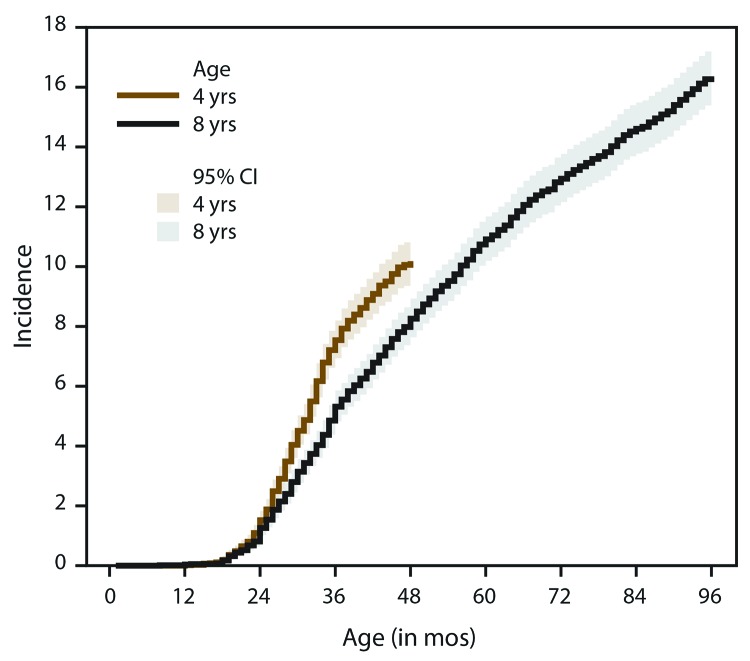
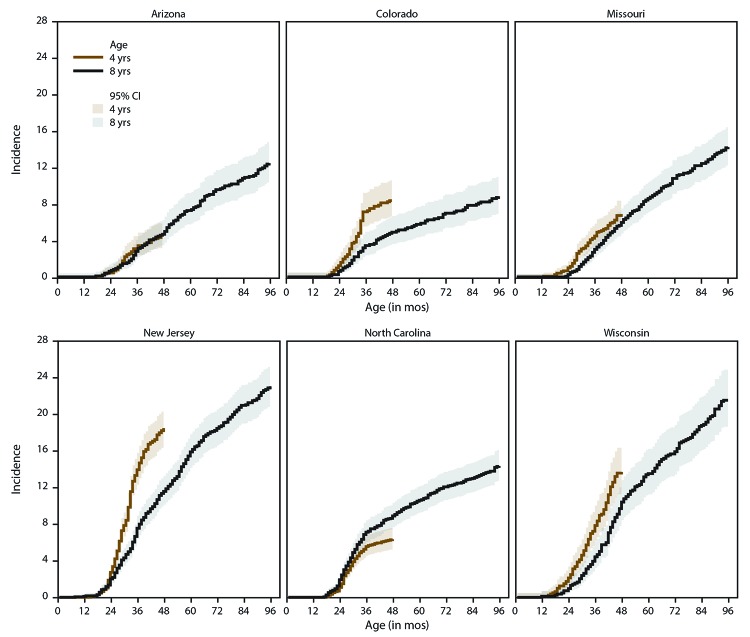
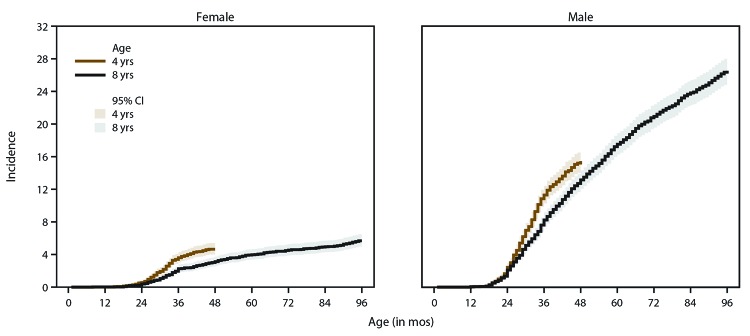
PROBLEM/CONDITION: Autism spectrum disorder (ASD). PERIOD COVERED: 2016. DESCRIPTION OF SYSTEM: The Early Autism and Developmental Disabilities Monitoring (Early ADDM) Network, a subset of the overall ADDM Network, is an active surveillance program that estimates ASD prevalence and monitors early identification of ASD among children aged 4 years. Children included in surveillance year 2016 were born in 2012 and had a parent or guardian who lived in the surveillance area in Arizona, Colorado, Missouri, New Jersey, North Carolina, or Wisconsin, at any time during 2016. Children were identified from records of community sources including general pediatric health clinics, special education programs, and early intervention programs. Data from comprehensive evaluations performed by community professionals were abstracted and reviewed by trained clinicians using a standardized ASD surveillance case definition with criteria from the Diagnostic and Statistical Manual of Mental Disorders, Fifth Edition (DSM-5). RESULTS: In 2016, the overall ASD prevalence was 15.6 per 1,000 (one in 64) children aged 4 years for Early ADDM Network sites. Prevalence varied from 8.8 per 1,000 in Missouri to 25.3 per 1,000 in New Jersey. At every site, prevalence was higher among boys than among girls, with an overall male-to-female prevalence ratio of 3.5 (95% confidence interval [CI] = 3.1-4.1). Prevalence of ASD between non-Hispanic white (white) and non-Hispanic black (black) children was similar at each site (overall prevalence ratio: 0.9; 95% CI = 0.8-1.1). The prevalence of ASD using DSM-5 criteria was lower than the prevalence using Diagnostic and Statistical Manual of Mental Disorders, Fourth Edition, Text Revision (DSM-IV-TR) criteria at one of four sites that used criteria from both editions. Among sites where ≥60% of children aged 4 years had information about intellectual disability (intelligence quotient ≤70 or examiner's statement of intellectual disability documented in an evaluation), 53% of children with ASD had co-occurring intellectual disability. Of all children aged 4 years with ASD, 84% had a first evaluation at age ≤36 months and 71% of children who met the surveillance case definition had a previous ASD diagnosis from a community provider. Median age at first evaluation and diagnosis for this age group was 26 months and 33 months, respectively. Cumulative incidence of autism diagnoses received by age 48 months was higher for children aged 4 years than for those aged 8 years identified in Early ADDM Network surveillance areas in 2016. INTERPRETATION: In 2016, the overall prevalence of ASD in the Early ADDM Network using DSM-5 criteria (15.6 per 1,000 children aged 4 years) was higher than the 2014 estimate using DSM-5 criteria (14.1 per 1,000). Children born in 2012 had a higher cumulative incidence of ASD diagnoses by age 48 months compared with children born in 2008, which indicates more early identification of ASD in the younger group. The disparity in ASD prevalence has decreased between white and black children. Prevalence of co-occurring intellectual disability was higher than in 2014, suggesting children with intellectual disability continue to be identified at younger ages. More children received evaluations by age 36 months in 2016 than in 2014, which is consistent with Healthy People 2020 goals. Median age at earliest ASD diagnosis has not changed considerably since 2014. PUBLIC HEALTH ACTION: More children aged 4 years with ASD are being evaluated by age 36 months and diagnosed by age 48 months, but there is still room for improvement in early identification. Timely evaluation of children by community providers as soon as developmental concerns have been identified might result in earlier ASD diagnoses, earlier receipt of evidence-based interventions, and improved developmental outcomes.
Overview
The claims and statistics of this paper haven’t been checked yet.
Run the check — free, no account needed. It reads the open-access text and checks the sources it cites.
Integrity signals
Registry
Cites
Statistics
Figures
Verification
Claims the paper makes
The claims and statistics of this paper haven’t been checked yet.
Run the check — free, no account needed. It reads the open-access text and checks the sources it cites.
Claims other papers make about this one
Each is checked against this paper’s own text: does it say what the citing paper says it does?
The source backs part of the claim, not all of it — or backs it for a different population, condition or comparison.
In the citing paper
“Surveillance among children aged 4 years in 2016 (8) indicated similar prevalence among children of different racial and ethnic groups, consistent with trends among children aged 8 years (9).”
From Early Identification of Autism Spectrum Disorder Among Children Aged 4 Years — Autism and Developmental Disabilities Monitoring Network, 11 Sites, United States, 2018 (2021) · cites this paper as [8]
Experimental — accuracy not yet measuredIn the citing paper
“Although prevalence has been lower among children aged 4 years than aged 8 years in each reporting year, comparing cumulative incidence of identification by age 48 months has consistently indicated higher rates of ASD identification in younger cohorts (i.e., children born more recently) (9–11).”
In the citing paper
“In addition, ASD identification measured by cumulative incidence of diagnosis by age 48 months was higher among children aged 4 years (born in 2012) compared with children aged 8 years (born in 2008), suggesting increased early identification of ASD among the younger cohort (8).”
In the citing paper
“The 2018 estimate for children aged 4 years was lower than the 23.0 per 1,000 ASD prevalence among children aged 8 years (11), a finding consistent with previous reports (8,13).”
In the citing paper
“The ASD prevalence of 17.0 per 1,000 children aged 4 years for 2018 was higher than for 2016, when prevalence was 15.6 per 1,000 (8).”
In the citing paper
“In 2016, prevalence was higher among Hispanic compared with White children aged 4 years higher at one site (New Jersey) and overall (8).”
In the citing paper
“The sex ratio is one example of how differences in identification of children without intellectual disability can affect patterns observed at older ages, with a higher ratio of boys to girls at age 8 years than at age 4 years, consistent with previous reports (8,9).”
In the citing paper
“Children with co-occurring intellectual disability are more likely to be identified earlier than children without intellectual disability, as indicated by an earlier median age at identification among this group (11) as well as the consistently higher proportion of children with intellectual disability at age 4 years (8,13) than at age 8 years (9,11,17).”
Self-check
Percentages, sums and reported differences re-computed from the paper’s own numbers.
The self-check needs the paper’s full text.
Citations
Cites
Diagnostic and Statistical Manual of Mental Disorders
American Psychiatric Association (2013) · doi:10.1176/appi.books.9780890425596 · Cited by 116,369
Baio, J., Wiggins, L., Christensen, D. L., Maenner, M. J., Daniels, J., Warren, Z., Kurzius-Spencer, M., Zahorodny, W., Robinson, C., Rosenberg, et al. (2018) · MMWR. Surveillance Summaries · doi:10.15585/mmwr.ss6706a1 · Cited by 6,078
Self-citationMaenner, M. J., Shaw, K. A., Baio, J., EdS1, Washington, A., Patrick, M., DiRienzo, M., Christensen, D. L., Wiggins, L. D., Pettygrove, S., et al. (2020) · MMWR. Surveillance Summaries · doi:10.15585/mmwr.ss6904a1 · Cited by 3,780 · cited 4×
“In contrast, children aged 8 years with ASD and intellectual disability were more likely to be evaluated and receive an ASD diagnosis at a younger age (8).”
BackgroundInfluentialSelf-citationWhat Is the Male-to-Female Ratio in Autism Spectrum Disorder? A Systematic Review and Meta-Analysis
Loomes, R., Hull, L., & Mandy, W. P. L. (2017) · Journal of the American Academy of Child & Adolescent Psychiatry · doi:10.1016/j.jaac.2017.03.013 · Cited by 2,804
Identification and Evaluation of Children With Autism Spectrum Disorders
Johnson, C. P., Myers, S. M., & and the Council on Children With Disabilities (2007) · Pediatrics · doi:10.1542/peds.2007-2361 · Cited by 2,011
Christensen, D. L., Baio, J., Braun, K. V. N., Bilder, D., Charles, J., Constantino, J. N., Daniels, J., Durkin, M. S., Fitzgerald, R. T., Kurzius-Spencer, M., et al. (2016) · MMWR. Surveillance Summaries · doi:10.15585/mmwr.ss6503a1 · Cited by 1,964
Self-citationRice, C. E. (2009) · PsycEXTRA Dataset · doi:10.1037/e562722010-001 · Cited by 762
Cited by
Sorted by citations
Items 201–286 of 286
Prevalence of autism in children with epilepsy: A population‐based study
Saify, M., Katusic, M. Z., Myers, S. M., Voigt, R. G., Nickels, K. C., & Wirrell, E. C. (2026) · Developmental Medicine & Child Neurology · doi:10.1111/dmcn.70288 · Cited by 1
Obstacles to diagnostic investigation of a child with comorbid psychiatric conditions
Salem, J., & Kennedy, C. (2021) · Scandinavian Journal of Child and Adolescent Psychiatry and Psychology · doi:10.21307/sjcapp-2021-012 · Cited by 1
Early Indicators of Autism in Infants: Development of the IMES Screening Tool
Demchick, B. B., Flanagan, J. E., Li, C., Cassidy, R., & Golding, J. (2022) · OTJR Occupational Therapy Journal of Research · doi:10.1177/15394492221134910 · Cited by 1
Elsabbagh, M. (2023) · Springer eBooks · doi:10.1007/978-3-031-20792-1_13 · Cited by 1
Comment les nouvelles technologies peuvent-elles faciliter le dépistage de l’autisme ?
Kojovic, N., & Schaer, M. (2023) · Revue suisse de pédagogie spécialisée · doi:10.57161/r2023-01-02 · Cited by 1
Evaluating screening for autism spectrum disorder using cluster randomization
Jonsdottir, S. L., Sæmundsen, E., Þórarinsdóttir, E. Á., & Rafnsson, V. (2024) · Scientific Reports · doi:10.1038/s41598-024-57656-0 · Cited by 1
de Souza, C. B., & Moreno, G. H. M. (2024) · Cuadernos de Educación y Desarrollo · doi:10.55905/cuadv16n10-104 · Cited by 1
Grzadzinski, R., Carpenter, R. S., Rutsohn, J., Jatkar, A., Mata, K., Bhatt, A., Ortiz-Juza, M. M., Dennehey, M. R., Gilleskie, D., Elison, J. T., et al. (2025) · Journal of Neurodevelopmental Disorders · doi:10.1186/s11689-025-09628-2 · Cited by 1
Recognizing the overlooked: rethinking autism spectrum disorder symptom presentation in girls
Yeşil, A. M., İskender, H. C., Çam, E. C., Ömercioğlu, E., Kılınç, Ş., & Özmert, E. N. (2025) · The Turkish Journal of Pediatrics · doi:10.24953/turkjpediatr.2025.5636 · Cited by 1
Stavropoulos, K. K. M., & Baker, E. J. (2021) · IntechOpen eBooks · doi:10.5772/intechopen.96859 · Cited by 2
TÜRKÇE KONUŞAN OTİZM SPEKTRUM BOZUKLUĞU OLAN ÇOCUKLARDA BİÇİMBİRİMBİLGİSİ
Servi, C., & Acarlar, F. (2021) · İnönü Üniversitesi Eğitim Fakültesi Dergisi · doi:10.17679/inuefd.899556 · Cited by 1
The association between sleeping position and symptom severity of Autism Spectrum Disorder
Bisson, J. B., Keramati, C., Colwell, C., Bott, E., Shealy, K., & Shiffer, M. (2022) · Medical Hypotheses · doi:10.1016/j.mehy.2022.110773 · Cited by 1
Al-Salihy, A. A.-R. S. (2022) · Kufa Medical Journal · doi:10.36330/kmj.v18i2.3639 · Cited by 2
Daily oscillation of the excitation/inhibition ratio is disrupted in two mouse models of autismPreprint
Bridi, M., Luo, N., Kim, G., O’Ferrall, C., Patel, R. V., Bertrand, S. J., Kannan, S., & Kirkwood, A. (2021) · bioRxiv (Cold Spring Harbor Laboratory) · doi:10.1101/2021.07.05.451213 · Cited by 1
Mosquera, M. L., Zubizarreta, S. C.-P., Tubío-Fungueiriño, M., Navarro, M. A., Hull, L., Álvarez, A. C., Gándara-Gafo, B., & Fernández‐Prieto, M. (2022) · Research Square · doi:10.21203/rs.3.rs-2048328/v1 · Cited by 1
Sobieski, M., Kopszak, A., Wrona, S., & Bujnowska–Fedak, M. M. (2024) · medRxiv · doi:10.1101/2024.02.15.24302869 · Cited by 1
Antenatal antioxidants to avert autism?
Quaas, A. M., & Kearns, W. G. (2020) · Journal of Assisted Reproduction and Genetics · doi:10.1007/s10815-020-01982-5
Kamaşak, T., Direk, M. Ç., Kurt, T., & Karaman, S. (2020) · Kırıkkale Üniversitesi Tıp Fakültesi Dergisi · doi:10.24938/kutfd.793771
Care under general anesthesia of patients with autistic spectrum
da, C. B. P., de, J. P. D., Lage, D. C. M., & de Andrade, C. D. P. V. (2021) · Journal of Dental Problems and Solutions · doi:10.17352/2394-8418.000096
A Comprehensive Meta-analysis of the Prevalence of Autism Spectrum Disorders
Guo, H., Ma, Y., Aizhu, W., & Xiang, Z. (2021) · Psychology and Behavioral Sciences · doi:10.11648/j.pbs.20211003.11
Montrenes, J. J. (2021) · Louisiana State University · doi:10.31390/gradschool_theses.5336
Franchini, M., Schaer, M., & D, S. E. M. (2021) · Enfance · doi:10.3917/enf2.213.0263
Genetic determinants of autism spectrum disorders - a review
Stanicki, P., Goliszek, K., Kasprzak, K., & Makarewicz, A. (2021) · Current Problems of Psychiatry · doi:10.2478/cpp-2021-0011
両側唇顎口蓋裂および臼後部にポリープ状の粘膜隆起を伴った Treacher-Collins 症候群の1例
引地, 尚., 高戸, 毅., 須佐美, 隆., 森, 良., 米原, 啓., & 松本, 重. (1999) · 日本口腔外科学会雑誌
Akmanoğlu, N., Şükran, A. L. A. N., Karabekir, E. P., Şahin, Ş., Alagözoğlu, E., & Topuz, Ç. (2021) · Ege Eğitim Dergisi · doi:10.12984/egeefd.937865
Being autistic during the COVID-19 process: from a public health nurse’s perspective
Yildirim, N., & Elmas, S. (2022) · International Journal of Community Medicine and Public Health · doi:10.18203/2394-6040.ijcmph20220264
Hong, E. S., Issarraras, A., Matson, J. L., Montrenes, J. J., & Weir, P. A. (2022) · Developmental Neurorehabilitation · doi:10.1080/17518423.2022.2047120
Davis, A. S., Bernat, D. J., & Shetter, M. D. (2022) · Springer eBooks · doi:10.1007/978-3-030-93947-2_3
Researching African American Autistics
Bennett, M., & Goodall, E. (2022) · Emerald Group Publishing Limited eBooks · doi:10.1108/978-1-80382-463-520221008
Examining the Needs of Autistics With Intellectual Disabilities
Bennett, M., & Goodall, E. (2022) · Emerald Group Publishing Limited eBooks · doi:10.1108/978-1-80382-463-520221007
Screening of ASD in At-Risk Young Children and Initiation of the Diagnostic Process
Weir, P. A., Tevis, C. M., & Matson, J. L. (2022) · Journal of Developmental and Physical Disabilities · doi:10.1007/s10882-022-09850-z
Rockwell, D., Sterling, D., & Mello, M. (2022) · Advances in higher education and professional development book series · doi:10.4018/978-1-6684-5103-8.ch009
Percepção de famílias quanto à escolarização de indivíduos com transtorno do espectro autista
Ferreira, B. R. (2022) · Digital Library of Theses and Dissertations (Universidade de São Paulo) · doi:10.11606/d.5.2022.tde-23092022-123652
Recent Trends in Automatic Autism Spectrum Disorder Detection Using Brain MRI
Dhamale, T. D., & Bhandari, S. U. (2023) · Lecture notes in networks and systems · doi:10.1007/978-981-19-7874-6_27
10.18081/2333-5106/2022.10/136
(2022) · American Journal of BioMedicine · doi:10.18081/2333-5106/2022.10/136
USE OF HUMANIZED OFF-LABEL MONOCLONAL ANTIBODIES IN PEDIATRIC PRACTICE
Shnaider, K. O., Maksimov, M. L., Romanov, B. K., Gusarova, O. A., & Baranova, V. A. (2023) · Bulletin Biomedicine and sociology · doi:10.26787/nydha-2618-8783-2023-8-1-17-32
Characteristics of play interaction in twins with autism spectrum disorder
Djordjević, M., Vukotic, T., Glumbić, N., Teovanović, P., & Golubović, Š. (2023) · Zbornik Instituta za pedagoska istrazivanja · doi:10.2298/zipi2301211d · Cited by 1
Alfaro-Sandoval, D. S., Vergara-Drago, C. L., Cortés-Jofré, M., & Ortiz-Muñoz, L. E. (2023) · doi:10.31219/osf.io/8xuzj
Mothers Maintaining Stable Parenting after Participation in Parent Training: A Qualitative Study
SUZUKI, M., Tsujino, K., Toyama, N., Uehara, M., & Kobayashi, J. (2023) · Japanese Journal of Health and Human Ecology · doi:10.3861/kenko.89.4_121
Haas, J. S., Steyaert, J. G., & Danckaerts, M. (2024) · Tijdschrift voor Geneeskunde · doi:10.47671/tvg.79.23.108
AUTISMO E PSICOSE: UMA INTERSECÇÃO PSICOPATOLÓGICA
Alves, L. M., & Ribeiro, L. M. (2024) · Revista Contemporânea · doi:10.56083/rcv4n3-130
Cepstral Space Projection on the Evaluation of Autistic Speech: A Pilot Study
Gómez-Rodellar, A., Jodra, M., Vicente, J. M. F., & Gómez‐Vilda, P. (2024) · Lecture notes in computer science · doi:10.1007/978-3-031-61140-7_32
Možná, T., & Válková, H. (2024) · Listy klinické logopedie · doi:10.36833/lkl.2024.013
To study the impact of m-chat in developing social interaction among children with special need
Mandeep, & Kansal, D. R. (2024) · Global International Research Thoughts · doi:10.36676/girt.v12.i1.106
Early Diagnosis of Mild Autism Spectrum Disorder and Its Relationship With Self-efficacy BeliefsPreprint
Cerqueira, H. F., Santana, S. M., & Cerqueira, C. A. (2024) · Research Square · doi:10.21203/rs.3.rs-4759501/v1
USO DA CANNABIS MEDICINAL NO TRATAMENTO DO AUTISMO: UMA REVISÃO INTEGRATIVA
Morais, A. B., de Souza, E. D. G., Raddi, Q. H. D. M., de Castro, D. N. A., & Oliveira, D. S. (2024) · Revista Omnia Saúde · doi:10.69719/ros.v7iesp..798
Autism and Medical Comorbidities
Megerian, J. T., Golla, S., Pionk, M. J., Amin, H., & Kim, A. (2024) · Autism and child psychopathology series · doi:10.1007/978-3-031-64499-3_25
Screening for creatine transporter deficiency in autism spectrum disorder: a pilot study
Arslan, M., Yıldız, Y., Olgaç, A., HEKİM, Ö., Yücel, Ç., & Sertoğlu, E. (2024) · Turkish Journal of Biochemistry · doi:10.1515/tjb-2024-0114
Mgaieth, F., Palmer, M. L., Charman, T., & Simonoff, E. A. (2024) · Journal of Autism and Developmental Disorders · doi:10.1007/s10803-024-06656-0
Богуш, А., Чекан, О. І., Ivanova, V., Попович, Н. Ф., & Palahnyuk, O. (2025) · WSEAS TRANSACTIONS ON COMPUTER RESEARCH · doi:10.37394/232018.2025.13.17
Al-Motrif, A., Omar, S. A., Alfayez, A. A., Almalhy, K. M., & Alruwaili, T. (2025) · International Journal of Human-Computer Interaction · doi:10.1080/10447318.2024.2443240
Amato, H. N., Monteiro, R. C., Almeida, A. R., Mantovani, H. B., & Rocha, A. N. D. C. (2025) · Caderno Pedagógico · doi:10.54033/cadpedv22n4-259
Diógenes, B. D. S., Freire, R. M. A. D. C., Rocha, D. D. S., Chagas, H. M. D. A., & Lago, R. R. (2025) · Caderno Pedagógico · doi:10.54033/cadpedv22n6-124
Wang, X., Cui, Y., Wang, M., & Fan, X. (2025) · International Journal of Disability Development and Education · doi:10.1080/1034912x.2025.2500325
Smith, J. L., Wamsley, F., Gile, A. C., Weber, S., Adams, R. E., Esbensen, A. J., Shaffer, R. C., & Ayers, K. (2025) · Advances in Neurodevelopmental Disorders · doi:10.1007/s41252-025-00445-1
Grzadzinski, R., Carpenter, R. S., Rutsohn, J., Jatkar, A., Mata, K., Bhatt, A., Ortiz-Juza, M. M., Dennehey, M. R., Gilleskie, D., Elison, J. T., et al. (2025) · bioRxiv (Cold Spring Harbor Laboratory) · doi:10.1101/2025.05.30.656675
Cerqueira, H. F., Santana, S. D. M., & Cerqueira, C. A. (2025) · Jornal Brasileiro de Psiquiatria · doi:10.1590/0047-2085-2025-0002 · Cited by 2
Chuang, P.-C., Hou, Y., Iao, L., & Wu, C. (2025) · Research in Autism · doi:10.1016/j.reia.2025.202645
Campoverde, P. A. A., LLulluna, V. E. C., Falcón, W. R. S., Tayo, I. M. C., & Cañizares, V. P. B. (2025) · Revista Ciencias de la Educación y el Deporte · doi:10.70262/rced.v3i2.2025.124
Gallardo, C. P. J., Bruna, S. I. P., & Sánchez, P. (2024) · Neurodivergences · doi:10.56294/neuro2024130
Chintalapally, S., Rajanala, K., & Upadhyay, A. K. (2025) · Frontiers in Neuroscience · doi:10.3389/fnins.2025.1655348
de Sena, L. P., Fortunato, J. J., Koch, K. D. S., Lin, J. H. X., Pinotti, S. F., Pallaoro, Y. L. D. R., Damasceno, G. V. B., Soratto, A. P. C., Tomasi, G., & Ritterbusch, A. A. C. (2025) · STUDIES IN HEALTH SCIENCES · doi:10.54022/shsv6n4-029
Cunha, F. M. S. D., Araújo, M. M., de Melo, A. C. S., Lira, M. E. D. R., de Oliveira, A. S., Fonseca, F. S., Seixas, J. L., Cordeiro, C., Lins, C., de Santana, M. A., et al. (2025) · IEEE Latin American Conference on Computational Intelligence (LA-CCI) · doi:10.1109/la-cci66231.2025.11270443
Mekayten, H., & Pearlman-Avnion, S. (2026) · Autism and child psychopathology series · doi:10.1007/978-3-032-07009-8_11
Chen, R., Chen, W., & Pan, Y. (2025) · IEEE International Conference on Bioinformatics and Biomedicine (BIBM) · doi:10.1109/bibm66473.2025.11356490
Biological Pathways and Biomarker Patterns in Autism Spectrum Disorder
Ahmed, T. H. (2026) · Academia Open · doi:10.21070/acopen.11.2026.13560
Roussin, L. (2023) · theses.fr (ABES) · doi:10.70675/998d3bd1z4618z400dz998cz89e524b35aef · Cited by 1
Les troubles du spectre autistique au Liban : une étude épidémiologique et génétique
Gerges, P. (2022) · theses.fr (ABES) · doi:10.70675/f14fade5z5081z4718za5b2zd91f27aa6992
Fournier, J. (2024) · theses.fr (ABES) · doi:10.70675/b66eb7d5z757dz4ffaz9272z37070604de9f
Autism Spectrum Disorder: Supporting Families Through Evaluation, Diagnosis, and Beyond
Hopkins, K. M. (2026) · American Academy of PediatricsItasca, IL eBooks · doi:10.1542/9781610028493-ch12
Eye Gaze Tracking System for Behavioural Analysis in Autism Support
Kavitha, R. K., Uma Barathi, U., Thuriya, M., Raj, S., V, & Thamizhselvan, I. (2026) · International Conference on Intelligent Computing and Control Systems (ICICCS) · doi:10.1109/iciccs67901.2026.11502910
Identification of Serum Proteome in Children with Autism Spectrum Disorder
Popov, T. N., Minchev, S. D., & Vachev, I. T. (2025) · Balkan Journal of Medical Genetics · doi:10.2478/bjmg-2025-00023
Strosberg, D. B., Moura, M., Ferreira, J., Oliveira, M., Fonseca, E., & Oliveira, M. (2026) · Residência Pediátrica · doi:10.25060/residpediatr-2026-1453
Modern vıews on features of clınıc, dıagnosıs of autısm spectrum dısorders ın chıldren
Dzhanbakhyshova, E. C., & Asadov, B. (2026) · Azərbaycan Psixiatriya Jurnalı · doi:10.66642/jxhi7630
Balcı, M. A., & Akgüller, Ö. (2026) · Mammalian Genome · doi:10.1007/s00335-026-10259-8
Pini, N., Shuffrey, L. C., Sparks, K. C. O., Marin, A., D'Amato, C., Dambreville, R., Hu, Y., Siegel, R. N., Brown, H. R., Azad, G. F., et al. (2026) · Pediatric Research · doi:10.1038/s41390-026-05204-z
DESIGUALDADES SOCIAIS E ESPACIAIS NO DIAGNÓSTICO DO TRANSTORNO DO ESPECTRO AUTISTA NO BRASIL
Rodrigues, G. F. F. D. C., Ramos, E. M., Dias, J. M. A., & Konkiewitz, E. C. (2026) · Psicologia e Saúde em Debate · doi:10.22289/2446-922x.v12a1a91
Banerjee, T., & Nayak, A. (2026) · Frontiers in Public Health · doi:10.3389/fpubh.2026.1886106
Supporting Autistic Students in Music Education: A Systematic Literature Review
Mason, B., & Witt, K. M. (2026) · Update Applications of Research in Music Education · doi:10.1177/87551233261476702
Bučanović, M., Hojsak, M., & Krampač-Grljušić, A. (2026) · Specijalna edukacija i rehabilitacija · doi:10.5937/specedreh25-65164
Ayamba, E. V. E. (2025) · Nursing & Care Open Access Journal · doi:10.15406/ncoaj.2025.11.00324
Metadata
- Authors
- Shaw, K. A., Maenner, M. J., Baio, J., EdS1, Washington, A., Christensen, D. L., Wiggins, L. D., Pettygrove, S., Andrews, J. G., White, T., Rosenberg, C. R., Constantino, J. N., Fitzgerald, R. T., Zahorodny, W., Shenouda, J., Daniels, J. L., Salinas, A., Durkin, M. S., & Dietz, P. M.
- Affiliations
- University of North Carolina at Chapel Hill (US)
- Rutgers, The State University of New Jersey (US)
- Corresponding author
- Shaw, Kelly A.
- ORCID
- Venue
- MMWR. Surveillance Summaries
- Published
- 2020-03-27
- Volume
- 69
- Issue
- 3
- Pages
- 1-11
- ISSN
- 1545-8636 (ISSN-L)
- 1546-0738
- PMC
- PMC7119643
- OpenAlex
- W3013358449
- Cited by
- 286
- References
- 22
- Citations by year
- 2026: 17 · 2025: 36 · 2024: 30 · 2023: 50 · 2022: 65 · 2021: 67 · 2020: 19
- FWCI
- 26.99
- Type
- journal article
- Language
- en
- Open access
- diamond
- doi.org
- Locations
- MMWR Surveillance Summaries (publishedVersion)
- PubMed Central (publishedVersion, cc-by)
- PubMed (publishedVersion)
- UA Campus Repository (The University of Arizona) (acceptedVersion, public-domain)
- Carolina Digital Repository (University of North Carolina at Chapel Hill) (submittedVersion)
- UNC Libraries
- Funders
- National Institute of Environmental Health Sciences (P30ES010126)
- Topics
- Life Sciences › Neuroscience › Cognitive Neuroscience › Autism Spectrum Disorder Research
- Health Sciences › Medicine › Psychiatry and Mental health › Child Nutrition and Feeding Issues
- Social Sciences › Psychology › Clinical Psychology › Family and Disability Support Research
- Keywords
- autism spectrum disorder, autism prevalence, early detection, DSM-5 diagnostic criteria, DSM-IV-TR diagnostic criteria, sex differences in prevalence, racial and ethnic differences, early intervention programs, special education programs
- MeSH terms
- Autism Spectrum Disorder, Child, Preschool, Female, Humans, Male, Population Surveillance, United States, Prevalence, Diagnostic and Statistical Manual of Mental Disorders, Early Diagnosis
About these checks
Registry, retraction, Cites and statistics results are computed, not judged, with one exception: a printed reference that no index lists is read once by a model before it counts as a citation error. Claims are extracted by a model and kept only when their quote appears verbatim in the text; each cited source is then checked, with a model’s help, for whether it says what the claim relies on. Those verdicts can be wrong — read the claim’s quote and the cited source before relying on one.
Statistics and arithmetic are recomputed, not judged.
Confidence bands are shown only for fields calibrated on our annotated test set. None is calibrated yet, so no band is shown.
What counts as a claim ›How we measure confidence ›How we check this ›
Are you an author, or do you see a problem with this page? Request a review
