

The DOI matches its Crossref record; 6 of the 6 references it cites were found in a registry or an index.
Data Brief 399: Dietary Supplement Use Among Adults: United States, 2017–2018
Abstract
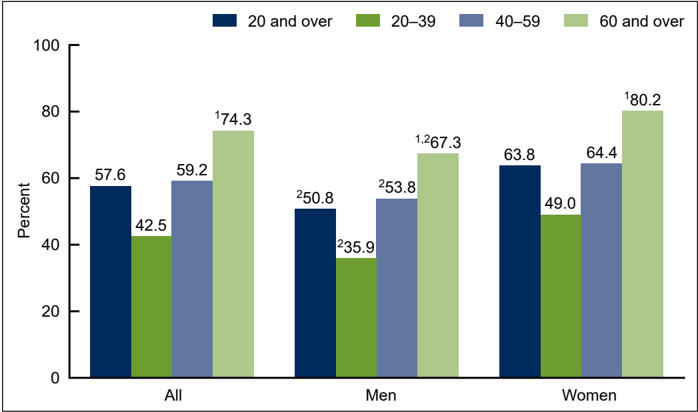
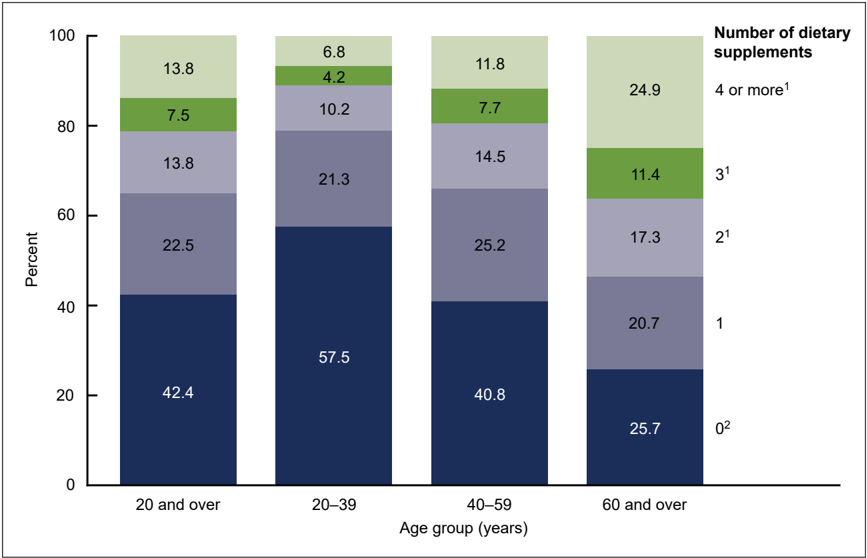
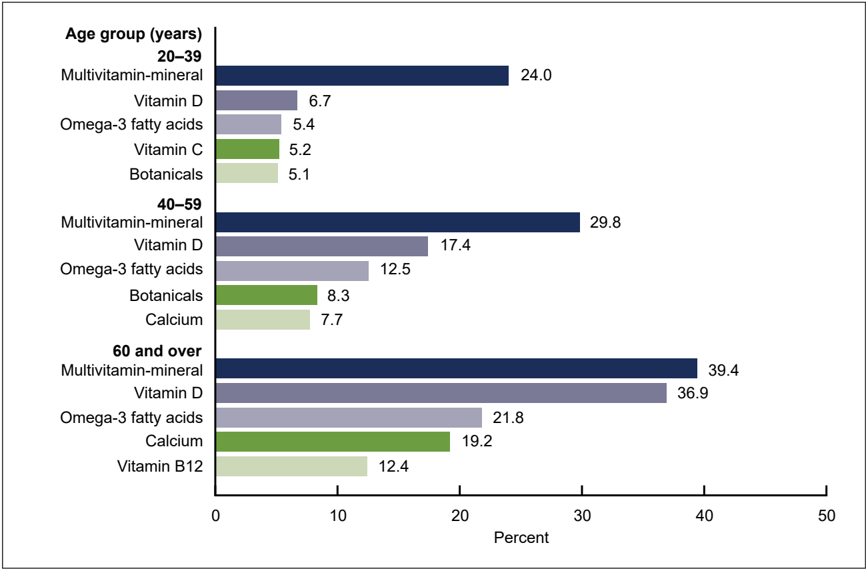
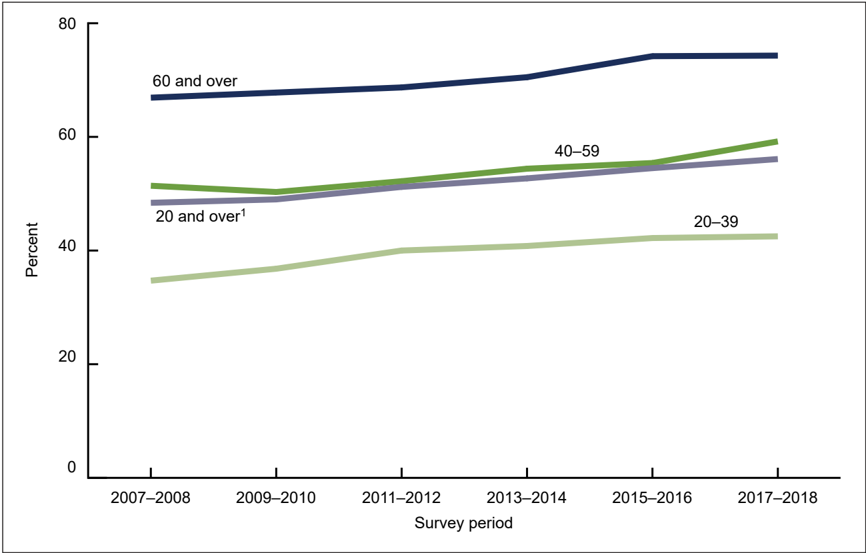
This report describes recent prevalence estimates for dietary supplement use among U.S. adults, the distribution of the number of dietary supplements used, and the most common types of dietary supplements used.
Overview
The claims and statistics of this paper haven’t been checked yet.
Run the check — free, no account needed. It reads the open-access text and checks the sources it cites.
Integrity signals
Registry
Cites
Statistics
Figures

Verification
Claims the paper makes
The claims and statistics of this paper haven’t been checked yet.
Run the check — free, no account needed. It reads the open-access text and checks the sources it cites.
Claims other papers make about this one
Each is checked against this paper’s own text: does it say what the citing paper says it does?
In the citing paper
“Nearly 60% of adult Americans reported taking an HDS product in the last 30 days between 2017 and 2018, with the frequency of HDS use greatest in older adults. 14”
From The contemporary epidemiology, causes, and management of drug-induced liver injury (2026) · cites this paper as [14]
In the citing paper
“more than 50% of adults over the age of 20 used dietary supplements in the preceding 30 days in a 2017–2018 study.123”
From AASLD practice guidance on drug, herbal, and dietary supplement–induced liver injury (2023) · cites this paper as [123]
Self-check
Percentages, sums and reported differences re-computed from the paper’s own numbers.
The self-check needs the paper’s full text.
Citations
Cites
(2017) · PubMed · Cited by 960
survey: Analysis of Complex Survey Samples
Gao, P., Schneider, B., & Kolenkikov, S. (2003) · doi:10.32614/cran.package.survey · Cited by 523
Dietary supplement use among U.S. adults has increased since NHANES III (1988-1994).
Gahche, J. J., Bailey, R. L., Burt, V. L., Hughes, J. P., Yetley, E. A. D., Dwyer, J. T., Picciano, M. F., McDowell, M., & Sempos, C. T. (2011) · PubMed · Cited by 336
Cowan, A., Jun, S., Gahche, J. J., Tooze, J. A., Dwyer, J. T., Eicher‐Miller, H. A., Bhadra, A., Guenther, P. M., Potischman, N. A., Dodd, K. W., et al. (2018) · Nutrients · doi:10.3390/nu10081114 · Cited by 201
Wallace, T. C., Frankenfeld, C. L., Frei, B. B., Shah, A., Yu, C., van Klinken, B. J., & Adeleke, M. (2019) · Journal of Nutrition in Gerontology and Geriatrics · doi:10.1080/21551197.2019.1656135 · Cited by 40
Dietary Supplement Health and Education Act
Scott, G. N. (2002) · Informa Healthcare eBooks · doi:10.3109/9780824706081.047 · Cited by 30
Cited by
AASLD practice guidance on drug, herbal, and dietary supplement–induced liver injury
Fontana, R. J., Liou, I., Reuben, A., Suzuki, A., Fiel, M. I., Lee, W., & Navarro, V. (2023) · Hepatology · doi:10.1002/hep.32689 · Cited by 340
Estimated Exposure to 6 Potentially Hepatotoxic Botanicals in US Adults
Likhitsup, A., Chen, V. L., & Fontana, R. J. (2024) · JAMA Network Open · doi:10.1001/jamanetworkopen.2024.25822 · Cited by 30
Kamat, D., Al-Ajlouni, Y. A., & Hall, R. C. W. (2023) · International Journal of Environmental Research and Public Health · doi:10.3390/ijerph20065171 · Cited by 10
Bogataj Jontez, N., Šik Novak, K., Jenko Pražnikar, Z., Petelin, A., Kenig, S., & Mohorko, N. (2024) · Nutrients · doi:10.3390/nu16121832 · Cited by 5
The contemporary epidemiology, causes, and management of drug-induced liver injury
Swanson, L., & Fontana, R. J. (2026) · Hepatology Communications · doi:10.1097/hc9.0000000000001011
Metadata
- Published
- 2021-02-26
- Cited by
- 27
- References
- 6
About these checks
Registry, retraction, Cites and statistics results are computed, not judged, with one exception: a printed reference that no index lists is read once by a model before it counts as a citation error. Claims are extracted by a model and kept only when their quote appears verbatim in the text; each cited source is then checked, with a model’s help, for whether it says what the claim relies on. Those verdicts can be wrong — read the claim’s quote and the cited source before relying on one.
Statistics and arithmetic are recomputed, not judged.
Confidence bands are shown only for fields calibrated on our annotated test set. None is calibrated yet, so no band is shown.
What counts as a claim ›How we measure confidence ›How we check this ›
Are you an author, or do you see a problem with this page? Request a review
Data sources
Bibliographic data: Semantic Scholar, OpenAlex, Crossref.
Contains information from the Semantic Scholar Academic Graph Datasets, made available under the ODC Attribution License (ODC-BY 1.0).
Semantic Scholar’s data is described in: Kinney, R., et al. (2023). The Semantic Scholar Open Data Platform. arXiv:2301.10140.
