

Counteracting the contemporaneous proliferation of digital forgeries and fake news
Open accessThe DOI matches its Crossref record; 60 of the 60 references it cites were found in a registry or an index.
Abstract
Fake news has been certainly the expression of the moment: from political round table discussions to newspapers to social and mainstream media. It is everywhere. With such an intense discussion and yet few effective ways to combat it, what can be done? Providing methods to fight back even the least harming hoax is a social responsibility. To look for authenticity in a wide sea of fake news, every detail is a lead. Image appearance and semantic content of text and images are some of the main properties, which can be analyzed to reveal even the slightest lie. In this vein, this work overviews some recent methods applicable to the verification of dubious content in text and images, and discusses how we can put them together as an option to curb away the proliferation of unverified and phony "facts". We briefly present the main idea behind each method, highlighting real situations where they can be applied and discussing expected results. Ultimately, we show how new research areas are working to seamlessly stitch together all these methods so as to provide a unified analysis and to establish the synchronization in space and time - the X-Coherence of heterogeneous sources of information documenting real-world events.
Overview
The claims and statistics of this paper haven’t been checked yet.
Free: it reads the open-access text and checks the first 5 claims that cite a source we can check. Create a free account to check every claim.
Integrity signals
Registry
Cites
Statistics
Figures
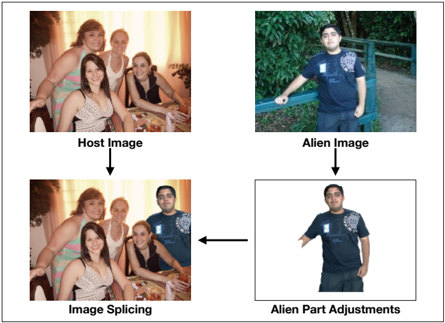
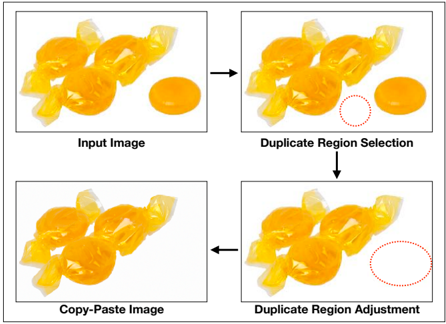
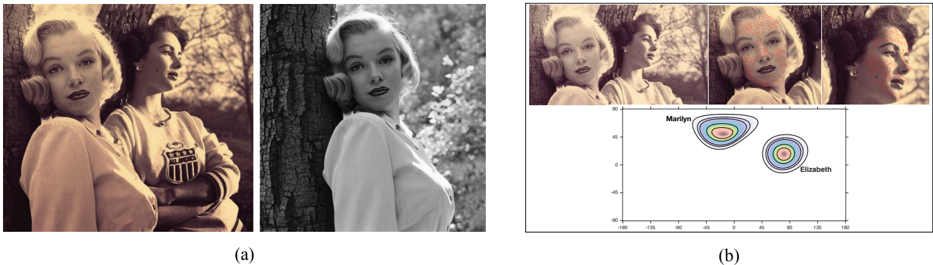
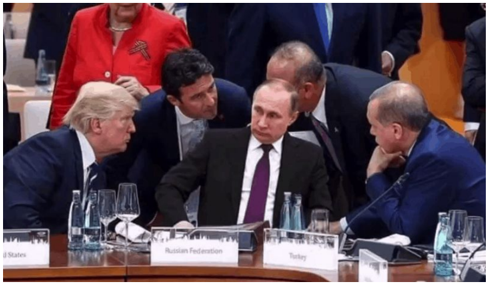
Verification
Claims the paper makes
The claims and statistics of this paper haven’t been checked yet.
Free: it reads the open-access text and checks the first 5 claims that cite a source we can check. Create a free account to check every claim.
Claims other papers make about this one
Each is checked against this paper’s own text: does it say what the citing paper says it does?
The source backs part of the claim, not all of it — or backs it for a different population, condition or comparison.
In the citing paper
“For example, a convincing video deepfake may be accompanied by a synthetically generated voice-over, making it more challenging to detect the manipulation (Ferreira et al., 2019).”
From Deepfake forensics: a survey of digital forensic methods for multimodal deepfake identification on social media (2024) · cites this paper as Ferreira et al., 2019
Experimental — accuracy not yet measured
Self-check
Percentages, sums and reported differences re-computed from the paper’s own numbers.
The self-check needs the paper’s full text.
Citations
Cites
Deep Residual Learning for Image Recognition
He, K., Zhang, X., Ren, S., & Sun, J. (2016) · 2016 IEEE Conference on Computer Vision and Pattern Recognition (CVPR) · doi:10.1109/cvpr.2016.90 · Cited by 235,474 · cited 2×
“The Siamese network uses shared ResNet-50 (He et al. 2016) sub-networks, each one producing feature vectors with 4096 dimensions.”
MethodFaster R-CNN: Towards Real-Time Object Detection with Region Proposal Networks
Ren, S., He, K., Girshick, R., & Sun, J. (2017) · IEEE Transactions on Pattern Analysis and Machine Intelligence · doi:10.1109/tpami.2016.2577031 · Cited by 73,472 · cited 3×
“(2018) proposed a method based on a two-stream Faster R-CNN (Ren et al. 2017) network, which is independent of the forgery process creation (splicing, copy-paste, etc.”
MethodInfluentialBreiman, L. (1996) · Machine Learning · doi:10.1007/bf00058655 · Cited by 16,325
Speeded-Up Robust Features (SURF)
Bay, H., Ess, A., Tuytelaars, T., & Van Gool, L. (2008) · Computer Vision and Image Understanding · doi:10.1016/j.cviu.2007.09.014 · Cited by 13,557
Social Media and Fake News in the 2016 Election
Allcott, H., & Gentzkow, M. (2017) · Journal of Economic Perspectives · doi:10.1257/jep.31.2.211 · Cited by 6,767
A performance evaluation of local descriptors
Mikolajczyk, K., & Schmid, C. (2005) · IEEE Transactions on Pattern Analysis and Machine Intelligence · doi:10.1109/tpami.2005.188 · Cited by 6,723 · cited 1×
“The method always associates keypoints in pairs by using the Nearest Neighbor Distance Ratio (NNDR) policy (Mikolajczyk and Schmid 2005).”
MethodIntroduction to modern information retrieval
Dillon, M. (1983) · Information Processing & Management · doi:10.1016/0306-4573(83)90062-6 · Cited by 5,909
Fischler, M. A., & Bolles, R. C. (1987) · Readings in Computer Vision · doi:10.1016/b978-0-08-051581-6.50070-2 · Cited by 2,122
Face2Face: Real-Time Face Capture and Reenactment of RGB Videos
Thies, J., Zollhofer, M., Stamminger, M., Theobalt, C., & Niessner, M. (2016) · 2016 IEEE Conference on Computer Vision and Pattern Recognition (CVPR) · doi:10.1109/cvpr.2016.262 · Cited by 1,747
A survey of modern authorship attribution methods
Stamatatos, E. (2009) · Journal of the American Society for Information Science and Technology · doi:10.1002/asi.21001 · Cited by 1,176
Synthesizing Obama: learning lip sync from audio
Suwajanakorn, S., Seitz, S. M., & Kemelmacher-Shlizerman, I. (2017) · ACM Transactions on Graphics · doi:10.1145/3072959.3073640 · Cited by 1,057 · cited 1×
“2016), by learning lip-sync from audio (Suwajanakorn et al. 2017), or by animating static images (Averbuch-Elor et al.”
Backgroundvan de Weijer, J., Gevers, T., & Gijsenij, A. (2007) · IEEE Transactions on Image Processing · doi:10.1109/tip.2007.901808 · Cited by 928 · cited 1×
“There are different color constancy methods able to estimate scene illuminants and this work relied upon two of them: a statistical one (van de Weijer et al. 2007) used to estimate the illuminant from pixels; and a physics-based one (Riess and Angelopoulou 2010), which is a variant of the original…”
MethodLearning Rich Features for Image Manipulation Detection
Zhou, P., Han, X., Morariu, V. I., & Davis, L. S. (2018) · 2018 IEEE/CVF Conference on Computer Vision and Pattern Recognition · doi:10.1109/cvpr.2018.00116 · Cited by 778
Social media definition and the governance challenge: An introduction to the special issue
Obar, J. A., & Wildman, S. (2015) · Telecommunications Policy · doi:10.1016/j.telpol.2015.07.014 · Cited by 650
Probability Models for Open Set Recognition
Scheirer, W. J., Jain, L. P., & Boult, T. E. (2014) · IEEE Transactions on Pattern Analysis and Machine Intelligence · doi:10.1109/tpami.2014.2321392 · Cited by 630
Fighting Fake News: Image Splice Detection via Learned Self-Consistency
Huh, M., Liu, A., Owens, A., & Efros, A. A. (2018) · Lecture Notes in Computer Science · doi:10.1007/978-3-030-01252-6_7 · Cited by 442
FaceForensics: A Large-scale Video Dataset for Forgery Detection in Human Faces
Rössler, A., Cozzolino, D., Verdoliva, L., Riess, C., Thies, J., & Nießner, M. (2018) · arXiv · doi:10.48550/arxiv.1803.09179 · Cited by 339 · cited 2×
“Mainly due to the lack of d ta (Rössler et al. 2018), which is a requirement for training modern mac ine le rning me hods, rese rch in vid o manipulation detectio is rath r limited, in opposi ion to the r search scenario discus ed for images.”
BackgroundVision of the unseen: Current trends and challenges in digital image and video forensics
Rocha, A., Scheirer, W., Boult, T., & Goldenstein, S. (2011) · ACM Computing Surveys · doi:10.1145/1978802.1978805 · Cited by 231
Self-citationForensis: The Architecture of Public Truth
Weizman, E. (2014) · Cited by 226
Silva, E., Carvalho, T., Ferreira, A., & Rocha, A. (2015) · Journal of Visual Communication and Image Representation · doi:10.1016/j.jvcir.2015.01.016 · Cited by 222 · cited 1×
“Silva et al. (2015) proposed a method tailored for copy-move image forgery detection based on a multi-scale analysis of the input image.”
MethodSelf-citationAuthorship Attribution for Social Media Forensics
Rocha, A., Scheirer, W. J., Forstall, C. W., Cavalcante, T., Theophilo, A., Shen, B., Carvalho, A. R. B., & Stamatatos, E. (2017) · IEEE Transactions on Information Forensics and Security · doi:10.1109/tifs.2016.2603960 · Cited by 222 · cited 6×
“The recently launched DéjàVu project (Rocha 2017) focuses on synchronizing, in space and ti e, all multimedia information collected from a target event, enabling fact-checking and mining persons, objects, and contents of interest.”
BackgroundInfluentialSelf-citationAverbuch-Elor, H., Cohen-Or, D., Kopf, J., & Cohen, M. F. (2017) · ACM Transactions on Graphics · doi:10.1145/3130800.3130818 · Cited by 187 · cited 1×
“2017), or by animating static images (Averbuch-Elor et al. 2017).”
Color constancy through inverse-intensity chromaticity space
Tan, R. T., Nishino, K., & Ikeuchi, K. (2004) · Journal of the Optical Society of America A · doi:10.1364/josaa.21.000321 · Cited by 169
Video pornography detection through deep learning techniques and motion information
Pérez, M., Avila, S., Moreira, D., Moraes, D., Testoni, V., Junior, E. A. D. V., Goldenstein, S. K., & Rocha, A. D. R. (2016) · Neurocomputing · doi:10.1016/j.neucom.2016.12.017 · Cited by 159
Self-citationUsing Compression-Based Language Models for Text Categorization
Teahan, W. J., & Harper, D. J. (2003) · Springer eBooks · doi:10.1007/978-94-017-0171-6_7 · Cited by 156
Local tampering detection in video sequences
Bestagini, P., Milani, S., Tagliasacchi, M., & Tubaro, S. (2013) · 2013 IEEE 15th International Workshop on Multimedia Signal Processing (MMSP) · doi:10.1109/mmsp.2013.6659337 · Cited by 145
Authorship Attribution for Twitter in 140 Characters or Less
Layton, R., Watters, P., & Dazeley, R. (2010) · 2010 Second Cybercrime and Trustworthy Computing Workshop · doi:10.1109/ctc.2010.17 · Cited by 138 · cited 3×
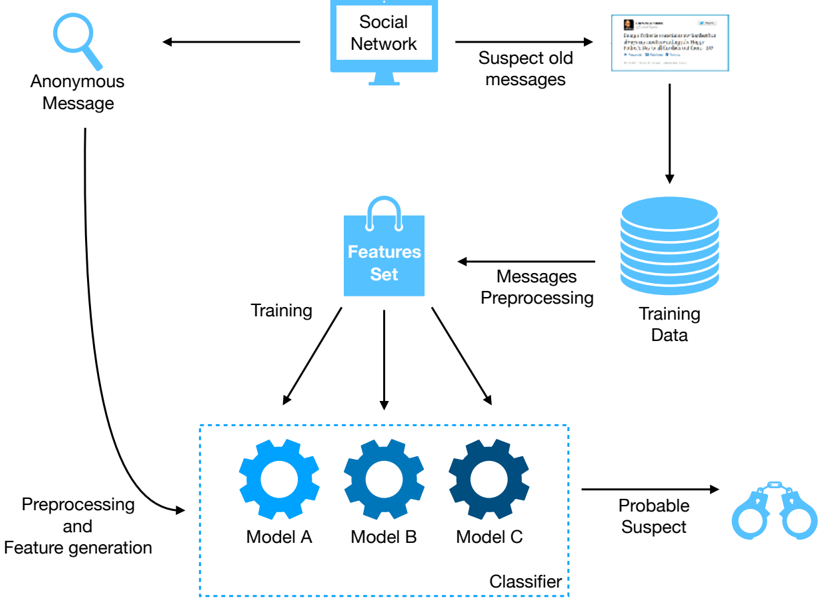
“1) e20180149 10 | 19 ALEXANDRE FERREIRA et al. COUNTERACTING THE PROLIFERATION OF FAKE NEWS Focusing on cybercrime identification from short texts shared on Twitter, Layton et al. (2010) adopted the Source-Code Author Profile (SCAP) methodology, introducing new preprocessing methods for text of 140 characters or less.”
MethodCan people identify original and manipulated photos of real-world scenes?
Nightingale, S. J., Wade, K. A., & Watson, D. G. (2017) · Cognitive Research: Principles and Implications · doi:10.1186/s41235-017-0067-2 · Cited by 135
Mahmood, T., Mehmood, Z., Shah, M., & Saba, T. (2018) · Journal of Visual Communication and Image Representation · doi:10.1016/j.jvcir.2018.03.015 · Cited by 127
Identifying Authorship by Byte-Level N-Grams: The Source Code Author Profile (SCAP) Method.
Frantzeskou, G., Stamatatos, E., Gritzalis, S., Chaski, C. E., & Howald, B. S. (2007) · International journal of digital evidence · Cited by 118
Illuminant-Based Transformed Spaces for Image Forensics
Carvalho, T., Faria, F. A., Pedrini, H., da S. Torres, R., & Rocha, A. (2016) · IEEE Transactions on Information Forensics and Security · doi:10.1109/tifs.2015.2506548 · Cited by 110
Self-citationExposing digital forgeries from 3-D lighting environments
Kee, E., & Farid, H. (2010) · 2010 IEEE International Workshop on Information Forensics and Security · doi:10.1109/wifs.2010.5711437 · Cited by 110
Leveraging deep neural networks to fight child pornography in the age of social media
Vitorino, P. R. R., Avila, S., Pérez, M., & Rocha, A. D. R. (2017) · Journal of Visual Communication and Image Representation · doi:10.1016/j.jvcir.2017.12.005 · Cited by 104 · cited 1×
“Automatically distinguishing child pornography from adult pornography and regular everyday images/videos is the main goal of a work conducted by our research group in collaboration with the Brazilian Federal Police and several universities (Vitorino et al. 2018).”
BackgroundSelf-citationA video forensic technique for detecting frame deletion and insertion
Gironi, A., Fontani, M., Bianchi, T., Piva, A., & Barni, M. (2014) · 2014 IEEE International Conference on Acoustics, Speech and Signal Processing (ICASSP) · doi:10.1109/icassp.2014.6854801 · Cited by 98 · cited 1×
“The literature focus s n some simple clue , often f nd in c l ssly gener ted videos, such as insertion and deleti of fram s (Gironi et al. 2014, Smith t al.”
BackgroundPornography classification: The hidden clues in video space–time
Moreira, D., Avila, S., Pérez, M., Moraes, D., Testoni, V., Junior, E. A. D. V., Goldenstein, S. K., & Rocha, A. D. R. (2016) · Forensic Science International · doi:10.1016/j.forsciint.2016.09.010 · Cited by 95
Self-citationStylometric Analysis for Authorship Attribution on Twitter
Bhargava, M., Mehndiratta, P., & Asawa, K. (2013) · Lecture notes in computer science · doi:10.1007/978-3-319-03689-2_3 · Cited by 85
Image Phylogeny by Minimal Spanning Trees
Dias, Z., Rocha, A., & Goldenstein, S. (2012) · IEEE Transactions on Information Forensics and Security · doi:10.1109/tifs.2011.2169959 · Cited by 79
Self-citationScene Illumination as an Indicator of Image Manipulation
Rieß, C., & Angelopoulou, E. (2010) · Lecture notes in computer science · doi:10.1007/978-3-642-16435-4_6 · Cited by 73 · cited 2×
“To aid the fight against this lack of accountability in social networks, Rocha et al. (2017) discussed a general framework, which has the advantage of being scalable to a high number of suspects.”
BackgroundMethodLaser printer attribution: Exploring new features and beyond
Ferreira, A., Navarro, L. C., Pinheiro, G., dos Santos, J. A., & Rocha, A. D. R. (2014) · Forensic Science International · doi:10.1016/j.forsciint.2014.11.030 · Cited by 68 · cited 1×
“Similar approaches can be seen in (Joshi and Khanna 2018, Ferreira et al. 2015, Bertrand et al. 2013, Tsai and Liu 2013), where hand-crafted features from characters are extracted and combined for single classification.”
Self-citationA System Based on Intrinsic Features for Fraudulent Document Detection
Bertrand, R., Gomez‐Krämer, P., Terrades, O. R., Franco, P., & Ogier, J.-M. (2013) · IAPR International Conference on Document Analysis and Recognition (ICDAR) · doi:10.1109/icdar.2013.29 · Cited by 66 · cited 1×
“Similar approaches can be seen in (Joshi and Khanna 2018, Ferreira et al. 2015, Bertrand et al. 2013, Tsai and Liu 2013), where hand-crafted features from characters are extracted and combined for single classification.”
Detecting documents forged by printing and copying
Shang, S., Memon, N. D., & Kong, X. (2014) · EURASIP Journal on Advances in Signal Processing · doi:10.1186/1687-6180-2014-140 · Cited by 63
Humans are easily fooled by digital images
Schetinger, V., Oliveira, M. M., da Silva, R., & Carvalho, T. J. (2017) · Computers & Graphics · doi:10.1016/j.cag.2017.08.010 · Cited by 62
Self-citationBlogs, Twitter Feeds, and Reddit Comments: Cross-domain Authorship Attribution
Overdorf, R., & Greenstadt, R. (2016) · Proceedings on Privacy Enhancing Technologies · doi:10.1515/popets-2016-0021 · Cited by 58
Data-Driven Feature Characterization Techniques for Laser Printer Attribution
Ferreira, A., Bondi, L., Baroffio, L., Bestagini, P., Huang, J.-W., dos Santos, J. D., Tubaro, S., & Rocha, A. (2017) · IEEE Transactions on Information Forensics and Security · doi:10.1109/tifs.2017.2692722 · Cited by 55
Self-citationPower mean SVM for large scale visual classification
Wu, J. (2012) · 2012 IEEE Conference on Computer Vision and Pattern Recognition · doi:10.1109/cvpr.2012.6247946 · Cited by 54 · cited 9×
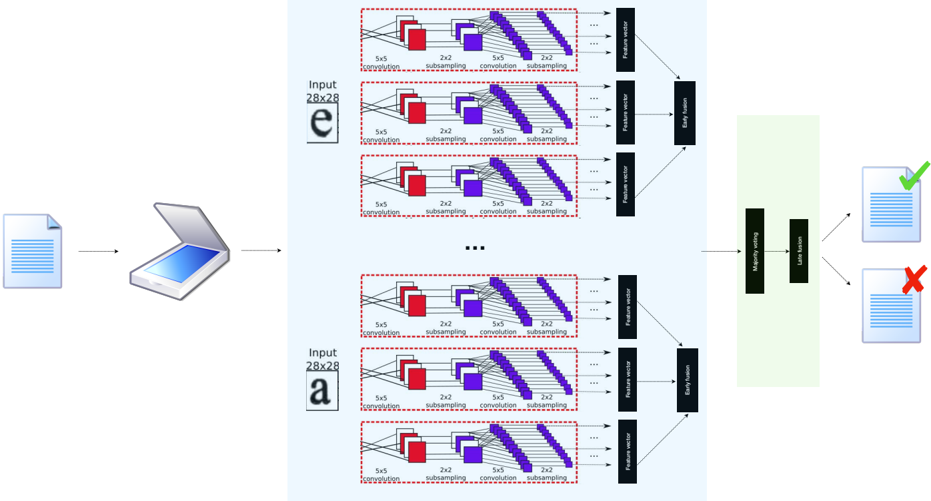
“A SVM classifier is applied for each character and a voting mechanism provides the final result, with a reported 90% accuracy.”
MethodInfluentialJoshi, S., & Khanna, N. (2017) · IEEE Transactions on Information Forensics and Security · doi:10.1109/tifs.2017.2779441 · Cited by 48
A C3D-Based Convolutional Neural Network for Frame Dropping Detection in a Single Video Shot
Long, C., Smith, E., Basharat, A., & Hoogs, A. (2017) · 2017 IEEE Conference on Computer Vision and Pattern Recognition Workshops (CVPRW) · doi:10.1109/cvprw.2017.237 · Cited by 46
Toward image phylogeny forests: Automatically recovering semantically similar image relationships
Dias, Z., Goldenstein, S. K., & Rocha, A. D. R. (2013) · Forensic Science International · doi:10.1016/j.forsciint.2013.05.002 · Cited by 44
Self-citationAuthorship attribution on micro-messages
Cavalcante, T. (2021) · doi:10.47749/t/unicamp.2014.945944 · Cited by 42
Large-Scale Image Phylogeny: Tracing Image Ancestral Relationships
Dias, Z., Goldenstein, S., & Rocha, A. (2013) · IEEE MultiMedia · doi:10.1109/mmul.2013.17 · Cited by 41
Self-citationManifold Learning and Spectral Clustering for Image Phylogeny Forests
Oikawa, M. A., Dias, Z., Rocha, A. D. R., & Goldenstein, S. K. (2015) · IEEE Transactions on Information Forensics and Security · doi:10.1109/tifs.2015.2442527 · Cited by 41 · cited 1×
“Such extensions are called multiple parenting phylogeny (Oikawa et al. 2016).”
BackgroundSelf-citationFighting Fake News: Image Splice Detection via Learned Self-ConsistencyPreprint
Huh, M., Liu, A., Owens, A., & Efros, A. A. (2018) · arXiv (Cornell University) · doi:10.48550/arxiv.1805.04096 · Cited by 38 · cited 1×
“The method proposed by Huh et al. (2018) takes advantage of the automatically recorded photo EXIF metadata as supervisory signal for training a model to determine whether an image is, or not, produced by image splicing.”
MethodA new keypoint-based copy-move forgery detection for color image
Wang, X., Jiao, L.-X., Yang, H., Yang, H., & Niu, P. (2018) · Applied Intelligence · doi:10.1007/s10489-018-1168-4 · Cited by 37
Digital forensics for printed source identification
Tsai, M.-J., & Liu, J. (2013) · IEEE International Symposium on Circuits and Systems proceedings · doi:10.1109/iscas.2013.6572349 · Cited by 30 · cited 1×
“Similar approaches can be seen in (Joshi and Khanna 2018, Ferreira et al. 2015, Bertrand et al. 2013, Tsai and Liu 2013), where hand-crafted features from characters are extracted and combined for single classification.”
Exposing photo manipulation from user-guided 3D lighting analysis
Carvalho, T., Farid, H., & Kee, E. (2015) · SPIE Proceedings · doi:10.1117/12.2075544 · Cited by 28
Self-citationWho is my parent? Reconstructing video sequences from partially matching shots
Lameri, S., Bestagini, P., Mellon, A., Milani, S., Rocha, A. D. R., Tagliasacchi, M., & Tubaro, S. (2014) · Proceedings - International Conference on Image Processing · doi:10.1109/icip.2014.7026081 · Cited by 24 · cited 1×
“In order to hint at the X-coherence strength, Lameri et al. (2014) analyzed a pool of videos related to specific events, first focusing on the reconstruction of longer parent sequences describing the event itself.”
BackgroundSelf-citationImage phylogeny through dissimilarity metrics fusion
Melloni, A. I., Bestagini, P., Milani, S., Tagliasacchi, M., Rocha, A. D. R., & Tubaro, S. (2014) · European Workshop on Visual Information Processing · doi:10.1109/euvip.2014.7018370 · Cited by 23
Self-citationResidual-based forensic comparison of video sequences
Mullan, P., Cozzolino, D., Verdoliva, L., & Rieß, C. (2017) · Proceedings - International Conference on Image Processing · doi:10.1109/icip.2017.8296533 · Cited by 20
Hash-based frame selection for video phylogeny
Costa, F., Lameri, S., Bestagini, P., Dias, Z., Tubaro, S., & Rocha, A. D. R. (2016) · IEEE International Workshop on Information Forensics and Security · doi:10.1109/wifs.2016.7823906 · Cited by 14
Self-citationTowards Forensic Exploitation of 3-D Lighting Environments in Practice
Seuffert, J., Stamminger, M., & Rieß, C. (2018) · Gesellschaft für Informatik (GI) · doi:10.18420/sicherheit2018_12 · Cited by 3 · cited 1×
“1) e20180149 3 | 19 ALEXANDRE FERREIRA et al. COUNTERACTING THE PROLIFERATION OF FAKE NEWS In a similar line of research, Seuffert et al. (2018) also explored 3D light in the fake image detection context.”
Method
Research works printed but not linked: 2
- 4. BAY H, TUYTELAARS T AND VAN GOOL L. 2006. SURF: Speeded Up Robust Features. In: Leonardis A, Bischof H and Pinz A (Eds), Computer Vision -ECCV 2006, p. 404-417. Berlin, Heidelberg: Springer Berlin Heidelberg.
- 59. SANDERSON C AND GUENTER S. 2006. Short text authorship attribution via sequence kernels, Markov chains and author unmasking: An investigation. In: Conference on Empirical Methods in Natural Language Processing, p. 482-491.
Cited by
Qureshi, S. M., Saeed, A., Almotiri, S. H., Ahmad, F., & Al Ghamdi, M. A. (2024) · PeerJ Computer Science · doi:10.7717/peerj-cs.2037 · Cited by 71
Causas e consequências da redução da cobertura vacinal no Brasil
Milani, L. R. N., & Busato, I. M. S. (2021) · Revista de Saúde Pública do Paraná · doi:10.32811/25954482-2021v4n2p157 · Cited by 95
Lima, S. D. C., & Mendes, E. D. S. S. (2020) · Texto Livre Linguagem e Tecnologia · doi:10.35699/1983-3652.2020.24889 · Cited by 7
Galvão, T., Noll, P. R. E. S., Silveira, É. A., & Noll, M. A. (2023) · Journal of Human Growth and Development · doi:10.36311/jhgd.v33.14938 · Cited by 7
“Nowadays, the combination of political polarization, increasing use of social media, and low scientific knowledge from the population offers a fertile ground for fake news 14 .”
Background
Metadata
- Authors
- FERREIRA, A., CARVALHO, T., ANDALÓ, F., & ROCHA, A.
- Affiliations
- Universidade Estadual de Campinas (UNICAMP) (BR)
- Federal Institute of São Paulo (BR)
- Venue
- Anais da Academia Brasileira de Ciências
- Publisher
- FapUNIFESP (SciELO)
- Published
- 2019
- Volume
- 91
- Issue
- suppl 1
- Pages
- e20180149-e20180149
- ISSN
- 0001-3765 (ISSN-L)
- 1678-2690
- OpenAlex
- W2913187042
- Cited by
- 11
- References
- 60
- Citations by year
- 2024: 1 · 2023: 1 · 2022: 1 · 2021: 4 · 2020: 4
- FWCI
- 4.53
- Type
- journal article
- Language
- en
- Open access
- diamond
- doi.org
- Licence
- cc-by
- creativecommons.org/licenses/by/4.0/ (vor)
- creativecommons.org/licenses/by/4.0/ (am)
- creativecommons.org/licenses/by/4.0/ (tdm)
- Locations
- Anais da Academia Brasileira de Ciências (publishedVersion, cc-by)
- PubMed (publishedVersion)
- LA Referencia (Red Federada de Repositorios Institucionales de Publicaciones Científicas) (publishedVersion, other-oa)
- Americanae (AECID Library) (submittedVersion, cc-by-nc)
- Americanae (AECID Library) (submittedVersion, other-oa)
- DOAJ (DOAJ: Directory of Open Access Journals) (submittedVersion, cc-by-sa)
- Funders
- Fundação de Amparo à Pesquisa do Estado de São Paulo (17/12631-6, 17/12646-3)
- Coordenação de Aperfeiçoamento de Pessoal de Nível Superior
- Conselho Nacional de Desenvolvimento Científico e Tecnológico (304472/2015-8, -8 and, 423797/2016-6)
- Academia Brasileira de Ciências
- Topics
- Social Sciences › Sociology and Political Science › Misinformation and Its Impacts
- Physical Sciences › Computer Science › Computer Vision and Pattern Recognition › Digital Media Forensic Detection
- Physical Sciences › Mathematics › Statistics and Probability › Benford’s Law and Fraud Detection
- Keywords
- fake news, digital forgery, misinformation detection, image verification, text verification, authenticity, heterogeneous data sources, social media, fact-checking
About these checks
Registry, retraction, Cites and statistics results are computed, not judged, with one exception: a printed reference that no index lists is read once by a model before it counts as a citation error. Claims are extracted by a model and kept only when their quote appears verbatim in the text; each cited source is then checked, with a model’s help, for whether it says what the claim relies on. Those verdicts can be wrong — read the claim’s quote and the cited source before relying on one.
Statistics and arithmetic are recomputed, not judged.
Confidence bands are shown only for fields calibrated on our annotated test set. None is calibrated yet, so no band is shown.
What counts as a claim ›How we measure confidence ›How we check this ›
Are you an author, or do you see a problem with this page? Request a review
Data sources
Bibliographic data: Semantic Scholar, OpenAlex, Crossref.
Contains information from the Semantic Scholar Academic Graph Datasets, made available under the ODC Attribution License (ODC-BY 1.0).
Semantic Scholar’s data is described in: Kinney, R., et al. (2023). The Semantic Scholar Open Data Platform. arXiv:2301.10140.
