

The DOI matches its Crossref record.
Comparative study: TQ and Lean Production ownership models in health services
Open accessAbstract
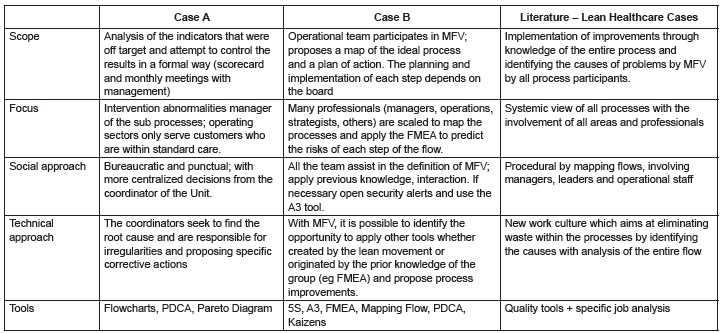
Objective: compare the application of Total Quality (TQ) models used in processes of a health service, cases of lean healthcare and literature from another institution that has also applied this model.Method: this is a qualitative research that was conducted through a descriptive case study.Results:through critical analysis of the institutions studied it was possible to make a comparison between the traditional quality approach checked in one case and the theoretical and practice lean production approach used in another case and the specifications are described below.Conclusion: the research identified that the lean model was better suited for people that work systemically and generate the flow. It also pointed towards some potential challenges in the introduction and implementation of lean methods in health.
Overview
The claims and statistics of this paper haven’t been checked yet.
Run the check — free, no account needed. It reads the open-access text and checks the sources it cites.
Integrity signals
Registry
Cites
Statistics
Figures

Verification
Claims the paper makes
The claims and statistics of this paper haven’t been checked yet.
Run the check — free, no account needed. It reads the open-access text and checks the sources it cites.
Claims other papers make about this one
Each is checked against this paper’s own text: does it say what the citing paper says it does?
The source backs part of the claim, not all of it — or backs it for a different population, condition or comparison.
In the citing paper
“From an organizational point of view, tools help to change healthcare service flows and, as an effect of this, for example, one can obtain a “decrease in length of stay and lead time”, “increased productivity”, “reduction of errors” and time “increased in the time allocated for assistance” [20,21,32,50,51,56].”
From Lean Healthcare Tools for Processes Evaluation: An Integrative Review. (2021) · cites this paper as [50]
Experimental — accuracy not yet measuredThe check wasn’t confident either way, so it gives no verdict — never disputed.
In the citing paper
“development and standardization of documents [29,50,51,52,53]”
From Lean Healthcare Tools for Processes Evaluation: An Integrative Review. (2021) · cites this paper as [50]
Experimental — accuracy not yet measured
Self-check
Percentages, sums and reported differences re-computed from the paper’s own numbers.
The self-check needs the paper’s full text.
Citations
Cites
No references could be resolved yet.
Research works printed but not linked: 11
- Pedroso MC, 2011, As Quatro Dimensões Competitivas da Saúde, Harvard Business Rev, 89, 59
- Fonseca PC, 2009, Investigação dos níveis de eficiência na utilização de recursos no setor de saúde: uma análise das microrregiões de Minas Gerais, Saúde Soc, 18, 199
- Gurgel GD Junior, 2002, Qualidade total e administração hospitalar: explorando disjunções conceituais, Ci Saúde Coletiva, 7, 325, 10.1590/S1413-81232002000200012 · DOI
- Manzo BF, 2012, Nursing in the hospital accreditation process: practice and implications in the work quotidian, Rev. Latino-Am. Enfermagem, 20, 151, 10.1590/S0104-11692012000100020 · DOI
- Womack JP, 1996, Beyond Toyota: how to root out waste and pursue perfection, Harvard Business Rev, 74, 140
- Shah R, 2003, Lean manufacturing: context, practice bundles, and performance, J Operations Manage, 21, 129, 10.1016/S0272-6963(02)00108-0 · DOI · Paper page
- Joosten T, 2009, Application of lean thinking to health care: issues and observations, Int J Quality in Health Care, 21, 341, 10.1093/intqhc/mzp036 · DOI · Paper page
- Ventura MMO, 2007, Estudo de caso como modalidade de pesquisa, Rev SOCERJ, 20, 383
- Harari O, 1993, Ten reasons why Total Quality Management (TQM) doesn't work, Manage Rev, 82, 33
- Vieira KF, 2011, A utilidade dos indicadores da qualidade no gerenciamento de laboratórios clínicos, J Bras Patol Med Lab, 47, 201, 10.1590/S1676-24442011000300002 · DOI
- Coelho SMA, 2012, Integration of value stream map (VSM) and FMEA in the handling and chemotherapeutic infusion process in the clinical oncology service: case study of regional hospital vele do Paraíba, Eng Res, 3, 1
Cited by
Lean Healthcare Tools for Processes Evaluation: An Integrative Review.
de Barros, L. B., Bassi, L. D. C., Caldas, L. P., Sarantopoulos, A., Zeferino, E. B. B., Minatogawa, V., & Gasparino, R. C. (2021) · International Journal of Environmental Research and Public Health · doi:10.3390/ijerph18147389 · Cited by 90
“From an organizational point of view, tools help to change healthcare service flows and, as an effect of this, for example, one can obtain a “decrease in length of stay and lead time”, “increased productivity”, “reduction of errors” and time “increased in the time allocated for assistance” [20,21,32,50,51,56].”
Background
Metadata
- Authors
- Eiro, N. Y., & Torres-Junior, A. S.
- Affiliations
- Universidade de São Paulo (BR)
- Universidade de São Paulo, Brazil
- Venue
- Revista Latino-Americana de Enfermagem
- Publisher
- FapUNIFESP (SciELO)
- Published
- 2015-10
- Volume
- 23
- Issue
- 5
- Pages
- 846-854
- ISSN
- 0104-1169 (ISSN-L)
- PMC
- PMC4660406
- OpenAlex
- W2301263571
- Cited by
- 19
- References
- 0
- Citations by year
- 2024: 3 · 2023: 3 · 2022: 3 · 2021: 2 · 2020: 4 · 2019: 2 · 2018: 1 · 2016: 1
- FWCI
- 1.28
- Type
- journal article
- Language
- en
- Open access
- diamond
- doi.org
- Licence
- cc-by-nc
- Locations
- Revista Latino-Americana de Enfermagem (publishedVersion, cc-by-nc)
- PubMed Central (publishedVersion, cc-by-nc)
- PubMed (publishedVersion)
- LA Referencia (Red Federada de Repositorios Institucionales de Publicaciones Científicas) (publishedVersion, other-oa)
- Americanae (AECID Library) (submittedVersion, other-oa)
- DOAJ (DOAJ: Directory of Open Access Journals) (submittedVersion, cc-by-sa)
- Topics
- Health Sciences › Medicine › Public Health, Environmental and Occupational Health › Healthcare Quality and Management
- Social Sciences › Business, Management and Accounting › Management Information Systems › Quality and Supply Management
- Social Sciences › Decision Sciences › Management Science and Operations Research › Healthcare Operations and Scheduling Optimization
- Keywords
- total quality management, lean healthcare, lean manufacturing, health services, quality management model, implementation barriers
- MeSH terms
- Brazil, Health Services Administration, Models, Theoretical, Total Quality Management, Quality Improvement
About these checks
Registry, retraction, Cites and statistics results are computed, not judged, with one exception: a printed reference that no index lists is read once by a model before it counts as a citation error. Claims are extracted by a model and kept only when their quote appears verbatim in the text; each cited source is then checked, with a model’s help, for whether it says what the claim relies on. Those verdicts can be wrong — read the claim’s quote and the cited source before relying on one.
Statistics and arithmetic are recomputed, not judged.
Confidence bands are shown only for fields calibrated on our annotated test set. None is calibrated yet, so no band is shown.
What counts as a claim ›How we measure confidence ›How we check this ›
Are you an author, or do you see a problem with this page? Request a review
Data sources
Bibliographic data: Semantic Scholar, OpenAlex, Crossref.
Contains information from the Semantic Scholar Academic Graph Datasets, made available under the ODC Attribution License (ODC-BY 1.0).
Semantic Scholar’s data is described in: Kinney, R., et al. (2023). The Semantic Scholar Open Data Platform. arXiv:2301.10140.
