

Evaluation of waist-to-height ratio as a predictor of insulin resistance in non-diabetic obese individuals. A cross-sectional study
Open accessThe DOI matches its Crossref record; 40 of the 41 references it cites were found in a registry or an index.
Abstract
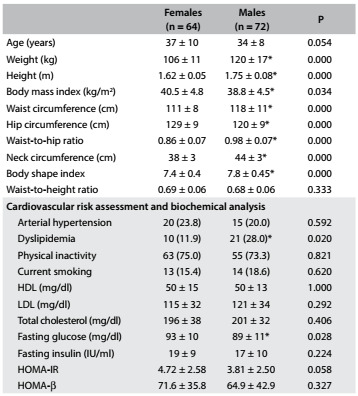
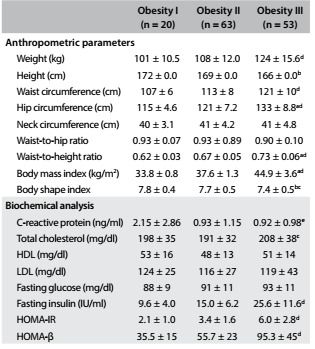
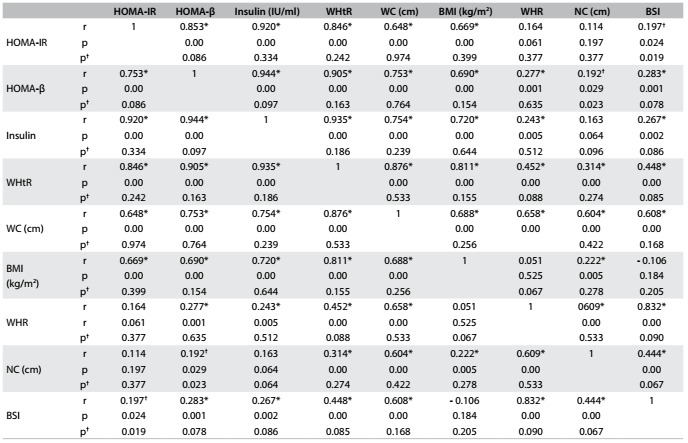
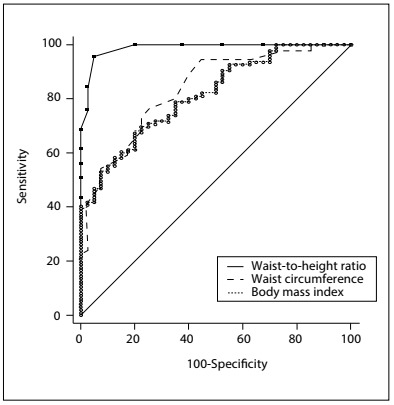
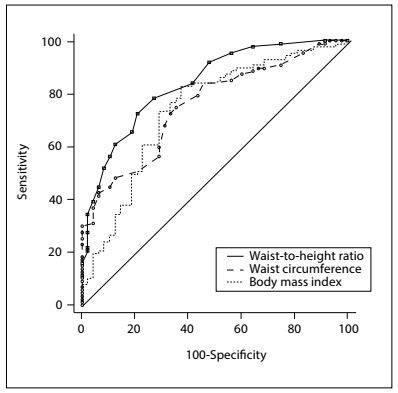
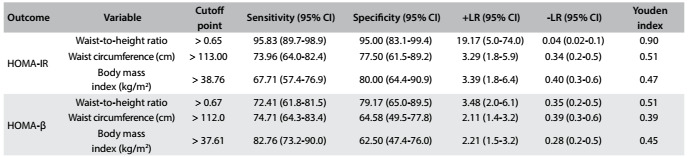
BACKGROUND: Insulin resistance (IR) and progressive pancreatic β-cell dysfunction have been identified as the two fundamental features in the pathogenesis of obesity and non-insulin-dependent diabetes mellitus. We aimed to investigate correlations between anthropometric indices of obesity and IR in non-diabetic obese individuals, and the cutoff value from receiver operating characteristic (ROC) curve analysis. DESIGN AND SETTING: Cross-sectional study conducted in a private clinic. METHODS: We included obese individuals (body mass index, BMI ≥ 30 kg/m2) with no diabetes mellitus (fasting glucose levels ≤ 126 mg/dl). The participants were evaluated for the presence of cardiovascular risk factors and through anthropometric measurements and biochemical tests. Furthermore, IR was assessed indirectly using the homeostatic model assessment (HOMA)-IR and HOMA-β indexes. The area underthe curve (AUC) of the variables was compared.The sensitivity, specificity and cutoff of each variable for diagnosing IR were calculated. RESULTS: The most promising anthropometric parameters for indicating IR in non-diabetic obese individuals were waist-to-height ratio (WHtR), waist circumference (WC) and BMI. WHtR proved to be an independent predictor of IR, with risk increased by 0.53% in HOMA-IR, 5.3% in HOMA-β and 1.14% in insulin. For HOMA-IR, WHtR had the highest AUC value (0.98), followed by WC (0.93) and BMI (0.81). For HOMA-β, WHtR also had the highest AUC value (0.83), followed by WC (0.75) and BMI (0.73).The optimal WHtR cutoff was 0.65 for HOMA-IR and 0.67 for HOMA-β. CONCLUSION: Among anthropometric obesity indicators, WHtR was most closely associated with occurrences of IR and predicted the onset of diabetes in obese individuals.
Overview
The claims and statistics of this paper haven’t been checked yet.
Free: it reads the open-access text and checks the first 5 claims that cite a source we can check. Create a free account to check every claim.
Integrity signals
Registry
Cites
Statistics
Figures

Verification
Claims the paper makes
The claims and statistics of this paper haven’t been checked yet.
Free: it reads the open-access text and checks the first 5 claims that cite a source we can check. Create a free account to check every claim.
Claims other papers make about this one
Each is checked against this paper’s own text: does it say what the citing paper says it does?
The cited source says what the claim attributes to it.
In the citing paper
“Additionally, the WHtR was significantly associated with IR among anthropometric indicators in obese individuals (43).”
From The waist-to-height ratio is a good predictor for insulin resistance in women with polycystic ovary syndrome (2024) · cites this paper as [43]
Self-check
Percentages, sums and reported differences re-computed from the paper’s own numbers.
The self-check needs the paper’s full text.
Citations
Cites
Matthews, D. R., Hosker, J. P., Rudenski, A. S., Naylor, B. A., Treacher, D. F., & Turner, R. C. (1985) · Diabetologia · doi:10.1007/bf00280883 · Cited by 31,502
Toprak, O., Kurt, H., Sarı, Y., Şarkış, C., Us, H., & Kırık, A. (2017) · Kidney and Blood Pressure Research · doi:10.1159/000468530 · Cited by 29,627
(2014) · Medical Entomology and Zoology · Cited by 9,400
The metabolic phenotype in obesity: Fat mass, body fat distribution, and adipose tissue function
Goossens, G. H. (2017) · Obesity Facts · doi:10.1159/000471488 · Cited by 8,481
Diagnosis and classification of diabetes mellitus
American Diabetes Association (2014) · Diabetes Care · doi:10.2337/dc14-s081 · Cited by 5,974
Use and Abuse of HOMA Modeling
Wallace, T. M., Levy, J. C., & Matthews, D. R. (2004) · Diabetes Care · doi:10.2337/diacare.27.6.1487 · Cited by 5,114
Mechanisms of fatty acid-induced inhibition of glucose uptake.
Boden, G., Chen, X., Ruiz, J., White, J. V., & Rossetti, L. (1994) · Journal of Clinical Investigation · doi:10.1172/jci117252 · Cited by 3,705
Anthropometric Standardization Reference Manual
Lohman, T. J., Roache, A. F., & Martorell, R. (1992) · Medicine & Science in Sports & Exercise · doi:10.1249/00005768-199208000-00020 · Cited by 2,764
Ashwell, M., Gunn, P., & Gibson, S. (2012) · Obesity Reviews · doi:10.1111/j.1467-789x.2011.00952.x · Cited by 2,130
A New Body Shape Index Predicts Mortality Hazard Independently of Body Mass Index
Krakauer, N. Y., & Krakauer, J. C. (2012) · PLoS ONE · doi:10.1371/journal.pone.0039504 · Cited by 1,310
Cited by
Novel anthropometric indices for predicting type 2 diabetes mellitus
Sadeghi, E., Khodadadiyan, A., Hosseini, S. A., Hosseini, S. M., Aminorroaya, A., Amini, M., & Javadi, S. (2024) · BMC Public Health · doi:10.1186/s12889-024-18541-7 · Cited by 53
“According to the study by Jamar et al., WHtR predicts insulin resistance more precisely than WC or BMI [10].”
ResultWerida, R. H., El-Gharbawy, N. M., & Mostafa, T. M. (2021) · Archives of Endocrinology and Metabolism · doi:10.20945/2359-3997000000336 · Cited by 26
“Furthermore, male group showed significantly higher WC than female group, a result seems in accordanace with some former findings (41,42).”
ResultWaist-to-height ratio associated cardiometabolic risk phenotype in children with overweight/obesity
Ukegbu, T. E., Wylie‐Rosett, J., Groisman-Perelstein, A. E., Diamantis, P. M., Rieder, J., Ginsberg, M. S., Lichtenstein, A. H., Matthan, N. R., & Shankar, V. (2023) · BMC Public Health · doi:10.1186/s12889-023-16418-9 · Cited by 25
Gagnon, É., Mitchell, P. L., & Arsenault, B. J. (2022) · The Journal of Clinical Endocrinology & Metabolism · doi:10.1210/clinem/dgac758 · Cited by 23
Prediction of gestational diabetes mellitus by different obesity indices
Song, Z.-M., Cheng, Y., Li, T., Fan, Y., Zhang, Q., & Cheng, H. (2022) · BMC Pregnancy and Childbirth · doi:10.1186/s12884-022-04615-0 · Cited by 24
“Different obesity indicators are differentially effective in measuring and predicting gestational diabetes [11, 12].”
BackgroundBedros, J. R., Jermendy, G., Gaál, Z., Gerő, L., Hídvégi, T., Kempler, P., Lengyel, C., Várkonyi, T. T., Winkler, G., & Wittmann, I. (2023) · Diabetologia Hungarica · doi:10.24121/dh.2023.20 · Cited by 21
Scovronec, A., Provencher, A., Iceta, S., Pelletier, M., Leblanc, V., Nadeau, M., Simard, S., Biertho, L. D., Richard, D., Tchernof, A., et al. (2022) · Obesity Research & Clinical Practice · doi:10.1016/j.orcp.2022.07.005 · Cited by 18
Malagón-Soriano, V. A., Ledezma, A. J., Espinel-Pachón, C. F., Burgos-Cárdenas, Á. J., Garcés, M. F., Ramirez, G. E. O., Vega, R. F., Franco, J. J. P., Maldonado‐Acosta, L. M., Rubio-Romero, J. A., et al. (2024) · Frontiers in Endocrinology · doi:10.3389/fendo.2024.1343641 · Cited by 18
Sotiropoulos, C., Giormezis, N., Pertsas, V., & Tsirkas, T. (2024) · Life · doi:10.3390/life14091197 · Cited by 16
Zhu, M., Wang, K., Feng, J., Liu, Y., Guan, M., Wang, Y., & Wu, X. (2024) · Frontiers in Endocrinology · doi:10.3389/fendo.2024.1502321 · Cited by 14
Carvalho, W. R. C., França, A. K. T. D. C., dos Santos, A. M., Padilha, L. L., & Bogéa, E. G. (2023) · Revista de Saúde Pública · doi:10.11606/s1518-8787.2023057004349 · Cited by 13
Yang, Q., Liu, Y., Jin, Z., Liu, L., Yuan, Z., Xu, D., & Hong, F. (2022) · PLoS ONE · doi:10.1371/journal.pone.0265228 · Cited by 10
Kolivas, D., Fraser, L., Schweitzer, R., Brukner, P. D., & Moschonis, G. (2025) · Nutrients · doi:10.3390/nu17060937 · Cited by 10
“In addition, the waist to height ratio is a simple and predictive indicator of health risks associated with obesity and insulin resistance [33,49].”
Wu, W., Diao, J., Yang, J., Sun, D., Wang, Y., Ni, Z., Yang, F., Tan, X., Li, L., & Li, L. (2021) · International Journal of Hypertension · doi:10.1155/2021/4514871 · Cited by 10
“We also measured WC and the actual height and weight of all respondents using an ultrasonic height sensor, from which BMI and WHtR were computed.”
ResultInfluentialAbnormal Glucose Metabolism and Associated Risk Factors Among Adults in Mekelle City, Ethiopia
Gebreegziabiher, G., Belachew, T., & Tamiru, D. (2020) · Diabetes Metabolic Syndrome and Obesity · doi:10.2147/dmso.s280215 · Cited by 9
Rai, N., Sharma, H. B., Kumari, R., & Kailashiya, J. (2021) · Indian Journal of Physiology and Pharmacology · doi:10.25259/ijpp_378_2020 · Cited by 7
Vera-Ponce, V. J., Valencia, J. G., Poma, M. Á., Loayza-Castro, J. A., Zeñas-Trujillo, G. Z., Zuzunaga-Montoya, F. E., Torres-Malca, J. R., & Cruz-Vargas, J. A. D. L. (2023) · Medicina Clínica y Social · doi:10.52379/mcs.v7i3.292 · Cited by 7
Lins, P. R. M., Neta, A. D. C. P. D. A., & Vianna, R. P. D. T. (2022) · British Journal Of Nutrition · doi:10.1017/s0007114522000769 · Cited by 5
“In addition, methodological aspects may also be of influence, such as the different methods of measuring the WC that were used in the studies(35,37,38).”
BackgroundMethodSoliman, H. M. A. L., Ahmed, S., & Ibrahim, A. (2021) · Egyptian Pediatric Association Gazette · doi:10.1186/s43054-021-00085-9 · Cited by 5
“[35] found that among anthropometric obesity indicators, WHtR was most closely associated with occurrences of IR and predicted the onset of diabetes in obese individuals as compared with other parameters (BMI, WC, WHR, neck circumference, and body shape index).”
BackgroundBahçebaşı, S., Açmaz, B., Aydın, E., Biçer, İ., & Yıldız, Ş. (2025) · Current Medical Research and Opinion · doi:10.1080/03007995.2025.2545489 · Cited by 3
Indicadores de obesidade e resistência à insulina: uma revisão sistemática
dos Santos, H. C., Ferriani, L. O., & Mill, J. G. (2021) · Saúde e Pesquisa · doi:10.17765/2176-9206.2021v14supl.1.e9602 · Cited by 5
Anthropometric profile and its correlation to insulin resistance in female students with obesity
Dieny, F. F., Fitranti, D. Y., Jauharany, F. F., Tsani, A. F. A., Faradila, U. N., & Rose, S. (2022) · Food Research · doi:10.26656/fr.2017.6(2).129 · Cited by 2
Dahlmann, N., & Klingmüller, D. (2023) · Archives of Internal Medicine Research · doi:10.26502/aimr.0147 · Cited by 2
Bockarie, A. S., Derkyi‐Kwarteng, L., Obeng, J. A., Adatsi, R. K., Aniakwaa-Bonsu, E., Apprey, C., Ampofo‐Asiama, J., & Acquah, S. (2025) · PLOS Global Public Health · doi:10.1371/journal.pgph.0004506 · Cited by 2
“However, the observation of insulin resistance across the various weight groups corroborates a number of previous studies [20–27] and implies that the development of insulin resistance probably precedes weight gain.”
Arfianti, A., Deyana, F., Rosdiana, D., Ardin, N. Y., Armi, W., & Kesumah, D. I. S. (2018) · Majalah kedokteran Bandung/Majalah Kedokteran Bandung · doi:10.15395/mkb.v50n3.1361 · Cited by 2
The Role of Waist-to-Height Ratio in Screening for Hyperinsulinemia in Normoglycemic Individuals
Akhlaq, S., Khaliq, S., Salam, A., & Usman, H. (2025) · Journal of Postgraduate Medical Institute · doi:10.54079/jpmi.39.1.3495 · Cited by 1
Larsson, J., Auscher, S., Madsen, F. S., Overgaard, K. S., Pararajasingam, G., Heinsen, L. J., Andersen, T. R., Lindholt, J. S., Lambrechtsen, J., & Egstrup, K. (2025) · Journal of Cardiovascular Development and Disease · doi:10.3390/jcdd12050180 · Cited by 1
“Insulin resistance and obesity, especially central obesity, are closely related [49].”
Chen, H., Liu, Z., Du, H., Wan, Z., Bai, X., & Mi, J. (2025) · Human Genomics · doi:10.1186/s40246-025-00832-8 · Cited by 1
“In non-diabetic obese individuals, WHtR is an independent predictor of IR, with a higher area under the curve (AUC) than other body measurements like waist circumference (WC) and body mass index (BMI) in predicting IR [47].”
Berceanu, M., Cheng, C. W., Viswambharan, H., & Kain, K. (2022) · Scientific Reports · doi:10.1038/s41598-022-13372-1 · Cited by 1
Vera-Ponce, V. J., Torres-Malca, J. R., Ramirez-Ortega, A. P., Lara, R., Loayza-Castro, J. A., Zuzunaga-Montoya, F. E., Valladares-Garrido, M. J., Orihuela-Manrique, E. J., Paucar, C. R. I., & Cruz-Vargas, J. A. D. L. (2024) · Journal of Endocrinology and Metabolism · doi:10.14740/jem891 · Cited by 1
Obeng, J. A., Adatsi, R. K., Derkyi‐Kwarteng, L., Bockarie, A. S., Nuvor, S. V., Aniakwaa-Bonsu, E., Nsiah, P., & Acquah, S. (2024) · Scientific African · doi:10.1016/j.sciaf.2024.e02179
Stoffwechselflexibilität – eine wichtige Grundlage des Behandlungserfolgs
Zweedijk, F., & Smidts, Y. (2024) · Osteopathische Medizin · doi:10.1016/s1615-9071(24)00046-7
Predictive modeling and risk assessment of pancreatic β-cell dysfunction in type 2 diabetes
Wu, N., & Sun, Y. (2025) · Medicine · doi:10.1097/md.0000000000044462
“…attenuating the body’s sensitivity to insulin and further impairing pancreatic β cell function, [23] consistent with related research conclusions [24,25] ; sedentary behavior: the specific mechanism by which a sedentary lifestyle affects insulin resistance and pancreatic β cell dysfunction is…”
Anthropometric predictors of insulin resistance in Iraqi healthy adults
Fahad, E. H., Hamdan, F. B., & AL-MAYAH, Q. S. (2025) · Chirurgia · doi:10.23736/s0394-9508.25.05863-2
Cai, Y., Ye, E., Liu, W., Zhou, S., Chen, X., Li, H., Chen, G., Zhou, Y., Liu, H., Yi, M., et al. (2025) · BMC Cardiovascular Disorders · doi:10.1186/s12872-025-05286-3
“Compared with BMI, WHtR is more sensitive to reflecting visceral fat accumulation, which has been confirmed to be closely related to atherosclerosis, insulin resistance, and chronic inflammation [5].”
Soto‐Sánchez, J., Garza-Treviño, G., Arreguín, A., Fuentes-Salazar, G. S., Ríos-Lugo, M. J., & Hernández‐Mendoza, H. (2025) · Journal of Trace Elements in Medicine and Biology · doi:10.1016/j.jtemb.2025.127803
Mahmood, T., Arkawazi, L., Salih, M., & Abdulateef, D. S. (2025) · Medicine · doi:10.1097/md.0000000000046498
“[28] –31] Other studies associated VAT, SAT and HbA1c, and higher VAT, and VAT/SAT were found in pre-diabetic patients than in normal subjects.”
Evaluation of Obesity Indices for Hyperglycemia Prediction in the Adult Population of Gaya, Bihar
Anisha, & Panwar, D. (2023) · International Journal of Pharmaceutical and Clinical Research · doi:10.5281/zenodo.12689418
Liu, Y., Gong, Y., Feng, J., Ge, H., Zhu, M., Yu, H., Gao, J., & Wu, X. (2026) · Research Square · doi:10.21203/rs.3.rs-8643615/v1
Chambergo‐Michilot, D. (2025) · Universidad Peruana Cayetano Heredia Institutional Repository
Davids, S. F. G., Raghubeer, S., Davison, G. M., & Matsha, T. E. (2026) · Advances in Public Health · doi:10.1155/adph/8823096
Digital biomarkers for insulin resistance screening in daily lifePreprint
Jovanova, M., Brügger, V., Švihrová, R., Fuchs, M., Jin, Q., Wortmann, F., Mitter, M., & Bechný, M. (2026) · medRxiv · doi:10.64898/2026.05.20.26353669
Zam, W., Farkoh, H., Makhoul, J., & Youssef, J. (2026) · Journal of International Medical Research · doi:10.1177/03000605261455139
“42 A recent meta-analysis showed that WHtR was a better predictor of hyper-insulinemia and metabolic syndrome than BMI and WHR in both men and women.”
Waist-to-height ratio reveals hidden metabolic risk in lean individuals with MASLD
Wang, Z.-G., Tan, W., Luo, J., Wei, H., An, W., Li, M., Gao, Q., Sun, L., He, L., Ma, J., et al. (2026) · Clinical Nutrition ESPEN · doi:10.1016/j.clnesp.2026.105064
García, A. H., Sanctis, J. B. D., & Kubler, G. A. C. (2026) · Frontiers in Endocrinology · doi:10.3389/fendo.2026.1966524
Malagón-Soriano, V. A., Ledezma-Forero, A. J., Espinel-Pachon, C. F., Burgos-Cárdenas, Á. J., Garces, M. F., Ortega-Ramírez, G. E., Franco-Vega, R., Peralta-Franco, J. J., Maldonado-Acosta, L. M., Rubio-Romero, J. A., et al. (2024) · doi:10.3389/fendo.2024.1343641.s001
Metadata
- Authors
- Jamar, G., Almeida, F. R. D., Gagliardi, A., Sobral, M. R., Ping, C. T., Sperandio, E., Romiti, M., Arantes, R., & Dourado, V. Z.
- Affiliations
- Universidade Federal de São Paulo (BR)
- Angiocorpore Instituto de Medicina Cardiovascular, Brazil
- Corresponding author
- Almeida, Flávio Rossi de
- Venue
- Sao Paulo Medical Journal
- Publisher
- FapUNIFESP (SciELO)
- Published
- 2017-11-06
- Volume
- 135
- Issue
- 5
- Pages
- 462-468
- ISSN
- 0035-0362 (ISSN-L)
- 1806-9460
- 1516-3180
- PMC
- PMC10027251
- OpenAlex
- W2766297598
- Cited by
- 38
- References
- 41
- Citations by year
- 2026: 4 · 2025: 10 · 2024: 7 · 2023: 4 · 2022: 7 · 2021: 4 · 2020: 1 · 2018: 1
- FWCI
- 0.43
- Type
- journal article
- Language
- en
- Open access
- diamond
- doi.org
- Licence
- cc-by
- Locations
- Sao Paulo Medical Journal (publishedVersion, cc-by)
- PubMed Central (publishedVersion, cc-by)
- PubMed (publishedVersion)
- LA Referencia (Red Federada de Repositorios Institucionales de Publicaciones Científicas) (publishedVersion, cc-by)
- LA Referencia (Red Federada de Repositorios Institucionales de Publicaciones Científicas) (publishedVersion, other-oa)
- Americanae (AECID Library) (submittedVersion, cc-by)
- DOAJ (DOAJ: Directory of Open Access Journals) (submittedVersion, cc-by-sa)
- LA Referencia (Red Federada de Repositorios Institucionales de Publicaciones Científicas) (submittedVersion, other-oa)
- Topics
- Health Sciences › Medicine › Endocrinology, Diabetes and Metabolism › Diabetes, Cardiovascular Risks, and Lipoproteins
- Health Sciences › Medicine › Physiology (medical) › Body Composition Measurement Techniques
- Health Sciences › Medicine › Endocrinology, Diabetes and Metabolism › Adipokines, Inflammation, and Metabolic Diseases
- Keywords
- waist-to-height ratio, insulin resistance, obesity, anthropometric indices, waist circumference, body mass index, HOMA-IR, HOMA-β, beta-cell function, diabetes risk prediction, cut-off values
- MeSH terms
- Adult, Body Height, Cardiovascular Diseases, Cross-Sectional Studies, Female, Humans, Insulin Resistance, Male, Middle Aged, Obesity, Predictive Value of Tests, Risk Factors, ROC Curve, Body Mass Index, Waist-Hip Ratio, Waist Circumference
About these checks
Registry, retraction, Cites and statistics results are computed, not judged, with one exception: a printed reference that no index lists is read once by a model before it counts as a citation error. Claims are extracted by a model and kept only when their quote appears verbatim in the text; each cited source is then checked, with a model’s help, for whether it says what the claim relies on. Those verdicts can be wrong — read the claim’s quote and the cited source before relying on one.
Statistics and arithmetic are recomputed, not judged.
Confidence bands are shown only for fields calibrated on our annotated test set. None is calibrated yet, so no band is shown.
What counts as a claim ›How we measure confidence ›How we check this ›
Are you an author, or do you see a problem with this page? Request a review
Data sources
Bibliographic data: Semantic Scholar, OpenAlex, Crossref.
Contains information from the Semantic Scholar Academic Graph Datasets, made available under the ODC Attribution License (ODC-BY 1.0).
Semantic Scholar’s data is described in: Kinney, R., et al. (2023). The Semantic Scholar Open Data Platform. arXiv:2301.10140.
