

Art therapy as an adjuvant treatment for depression in elderly women: a randomized controlled trial
Open accessThe DOI matches its Crossref record; 41 of the 44 references it cites were found in a registry or an index.
Abstract
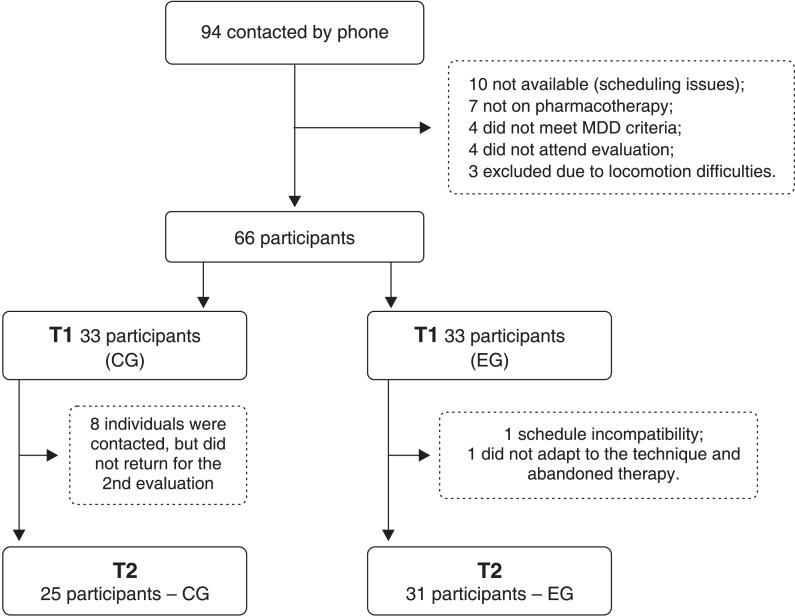
OBJECTIVE: There are few quantitative studies on art therapy for the treatment of depression. The objective of this study was to evaluate if art therapy is beneficial as an adjuvant treatment for depression in the elderly. METHODS: A randomized, controlled, single-blind study was carried out in a sample of elderly women with major depressive disorder (MDD) stable on pharmacotherapy. The experimental group (EG) was assigned to 20 weekly art therapy sessions (90 min/session). The control group (CG) was not subjected to any adjuvant intervention. Patients were evaluated at baseline and after 20 weeks, using the Geriatric Depression Scale (GDS), Beck Depression Inventory (BDI), Beck Anxiety Inventory (BAI), and cognitive measures. RESULTS: Logistic regression analysis adjusted for age revealed that women in EG (n=31) had significant improvement in GDS (p = 0.007), BDI (p = 0.025), and BAI (p = 0.032) scores as compared with controls (n=25). No difference was found in the cognitive measures. CONCLUSION: Art therapy as an adjunctive treatment for MDD in the elderly can improve depressive and anxiety symptoms. CLINICAL TRIAL REGISTRATION: RBR-2YXY7Z.
Overview
The claims and statistics of this paper haven’t been checked yet.
Free: it reads the open-access text and checks the first 5 claims that cite a source we can check. Create a free account to check every claim.
Integrity signals
Registry
Cites
Statistics
Figures
Verification
Claims the paper makes
The claims and statistics of this paper haven’t been checked yet.
Free: it reads the open-access text and checks the first 5 claims that cite a source we can check. Create a free account to check every claim.
Claims other papers make about this one
Each is checked against this paper’s own text: does it say what the citing paper says it does?
The source backs part of the claim, not all of it — or backs it for a different population, condition or comparison.
In the citing paper
“Active visual art therapy (AVAT) is often used as a complementary therapy method, both in acute medicine and in rehabilitation.”
From The effect of active visual art therapy on health outcomes: protocol of a systematic review of randomised controlled trials (2022) · cites this paper as [3]
Experimental — accuracy not yet measuredThe cited source says what the claim attributes to it.
In the citing paper
“The use of AVAT is frequently associated with the treatment of psychiatric, psychosomatic, psychological, or neurological disorders, such as anxiety [2], depression [3], eating disorders [4], trauma [5, 6], cognitive impairment, or dementia [7].”
From The effect of active visual art therapy on health outcomes: protocol of a systematic review of randomised controlled trials (2022) · cites this paper as [3]
The cited source says what the claim attributes to it.
In the citing paper
“The existing literature examining the effectiveness of art therapy has shown some positive results across a wide variety of treatment indications, such as the treatment of depression [3, 18], anxiety [19, 20], psychosis [21], the enhancement of mental wellbeing [22], and the complementary treatment of cancer [15, 23].”
From The effect of active visual art therapy on health outcomes: protocol of a systematic review of randomised controlled trials (2022) · cites this paper as [3]
The cited source says what the claim attributes to it.
In the citing paper
“However, the existing evidence is characterised by conflicting results.”
From The effect of active visual art therapy on health outcomes: protocol of a systematic review of randomised controlled trials (2022) · cites this paper as [3]
Self-check
Percentages, sums and reported differences re-computed from the paper’s own numbers.
The self-check needs the paper’s full text.
Citations
Cites
Folstein, M. F., Folstein, S. E., & McHugh, P. R. (1975) · Journal of Psychiatric Research · doi:10.1016/0022-3956(75)90026-6 · Cited by 88,282
Hirono, N., Mori, E., Ikejiri, Y., Imamura, T., Shimomura, T., Hashimoto, M., Yamashita, H., & Ikeda, M. (1997) · Brain and nerve · Cited by 21,030
Kok, J. S., Berg, I. J., & Scherder, E. J. A. (2013) · Dementia and Geriatric Cognitive Disorders Extra · doi:10.1159/000353441 · Cited by 20,589
Older Adults' Reasons for Using Technology while Aging in Place
Peek, S. T. M., Luijkx, K. G., Rijnaard, M. D., Nieboer, M. E., van der Voort, C. S., Aarts, S., van Hoof, J., Vrijhoef, H. J. M., & Wouters, E. J. M. (2016) · Gerontology · doi:10.1159/000430949 · Cited by 19,690
Sensitivity and False Alarm Rate of a Fall Sensor in Long-Term Fall Detection in the Elderly
Kangas, M., Korpelainen, R., Vikman, I., Nyberg, L., & Jämsä, T. (2015) · Gerontology · doi:10.1159/000362720 · Cited by 18,909
Development and validation of a geriatric depression screening scale: a preliminary report
Yesavage, J. A., Brink, T. L., Rose, T. L., Lum, O., Huang, V., Adey, M., & Leirer, V. O. (1982) · Journal of Psychiatric Research · doi:10.1016/0022-3956(82)90033-4 · Cited by 15,025
Cognitive Stimulation in Patients with Dementia: Randomized Controlled Trial
Mapelli, D., Di Rosa, E., Nocita, R., & Sava, D. (2013) · Dementia and Geriatric Cognitive Disorders Extra · doi:10.1159/000353457 · Cited by 3,453
L’examen Clinique en Psychologie
Rubé, P. (1959) · American Journal of Psychotherapy · doi:10.1176/appi.psychotherapy.1959.13.4.989 · Cited by 3,302
Sugestões para o uso do mini-exame do estado mental no Brasil
Brucki, S. M. D., Nitrini, R., Caramelli, P., Bertolucci, P. H. F., & Okamoto, I. H. (2003) · Arquivos de Neuro-Psiquiatria · doi:10.1590/s0004-282x2003000500014 · Cited by 2,228
Mental imagery in emotion and emotional disorders
Holmes, E. A., & Mathews, A. (2010) · Clinical Psychology Review · doi:10.1016/j.cpr.2010.01.001 · Cited by 976
Research works printed but not linked: 1
- Gameiro GR Minguini IP Alves TCTF The role of stress and life events in the onset of depression in the elderly Rev Med (São Paulo). 2014 93 31 40
Cited by
Art Therapy: A Complementary Treatment for Mental Disorders
Hu, J., Zhang, J., Hu, L., Yu, H., & Xu, J. (2021) · Frontiers in Psychology · doi:10.3389/fpsyg.2021.686005 · Cited by 185
Dunphy, K., Baker, F. A., Dumaresq, E., Carroll-Haskins, K., Eickholt, J., Ercole, M., Kaimal, G., Meyer, K., Sajnani, N., Shamir, O. Y., et al. (2019) · Frontiers in Psychology · doi:10.3389/fpsyg.2018.02655 · Cited by 224
“, 2014); and distraction from ruminative thoughts (Goldblatt et al., 2010; Ciasca et al., 2018) • Interpersonal: group work (with or without therapist’s involvement) was seen to encourage socialization and sharing (Canuto et al.”
BackgroundInfluentialRole of Art Therapy in the Promotion of Mental Health: A Critical Review
Shukla, A., Choudhari, S. G., Gaidhane, A. M., & Zahiruddin, Q. S. (2022) · Cureus · doi:10.7759/cureus.28026 · Cited by 186
Art making and expressive art therapy in adult health and nursing care: A scoping review
Vaartio‐Rajalin, H., Fischer, R. S., Jokisalo, P., & Lisbeth, F. (2020) · International Journal of Nursing Sciences · doi:10.1016/j.ijnss.2020.09.011 · Cited by 177
“Connection with others such as family members and staff [67,78] Individual therapy: Connection with others such as family members and staff [77,78] Individual therapy: Quality of life [72] Painting Improved self-expression [78] Improved cognitive skills [65] Improved self-esteem [78] Self-empowerment [76] Decrease in…”
BackgroundInfluentialMasika, G. M., Yu, D. S. F., & Li, P. W. C. (2020) · Journal of Advanced Nursing · doi:10.1111/jan.14362 · Cited by 134
Active Visual Art Therapy and Health Outcomes: A Systematic Review and Meta-Analysis
Joschko, R., Klatte, C., Grabowska, W. A., Roll, S., Berghöfer, A., & Willich, S. N. (2024) · JAMA Network Open · doi:10.1001/jamanetworkopen.2024.28709 · Cited by 96
Quinn, E. A., Millard, E., & Jones, J. M. (2025) · Nature Mental Health · doi:10.1038/s44220-024-00368-1 · Cited by 75
“…99 Masika et al. (2021) 87 Wang et al. (2020) 95 Matto et al. (2015) 90 Ilali et al. (2018) 82 Masika et al (2022) 88 Mastel-Smith et al. (2007) 89 Ciasca et al. (2018) 73 Wang et al. (2023) 96 Johnson et al. (2018) 83 Chippendale & Bear-Lehman (2012) 72 Lazarou et al. (2017) 85 Liu et al. (2013)…”
Masika, G. M., Yu, D. S. F., & Li, P. W. C. (2020) · Journal of Geriatric Psychiatry and Neurology · doi:10.1177/0891988720901789 · Cited by 62
“This finding was also evident in the previous studies where VAT using similar approach demonstrated improvement in participants’ psychological well-being.(15,47,48) The effects of VAT as identified in the quantitative evaluation, indeed, are coherent with the qualitative findings.”
ResultChen, Y., Li, X., Pan, B., Wang, B., Jing, G., Liu, Q., Li, Y., Bing, Z., Yang, K., Han, X., et al. (2019) · Aging & Mental Health · doi:10.1080/13607863.2019.1704219 · Cited by 62
A Systematic Review of the Effects of Aromatherapy with Lavender Essential Oil on Depression
Jafari-Koulaee, A., Elyasi, F., Taraghi, Z., Ilali, E. S., & Moosazadeh, M. (2020) · Central Asian Journal of Global Health · doi:10.5195/cajgh.2020.442 · Cited by 67
Crafting Life Stories in Photocollage: An Online Creative Art-Based Intervention for Older Adults
Keisari, S., Piol, S., Elkarif, T., Mola, G., & Testoni, I. (2021) · Behavioral Sciences · doi:10.3390/bs12010001 · Cited by 52
Keisari, S., Gesser‐Edelsburg, A., Yaniv, D., & Palgi, Y. (2020) · PLoS ONE · doi:10.1371/journal.pone.0239812 · Cited by 55
Aydın, M., & Kutlu, Y. (2021) · Florence Nightingale Journal of Nursing · doi:10.5152/fnjn.2021.20224 · Cited by 77
“…(Kimport & Hartzell, 2015; Morais et al., 2014), enhances personal power, helps release suppressed emotions such as feelings of abandonment or depression, and contributes to physical and mental well-being while guiding reality (Ciasca et al., 2018; Jang & Choi, 2012; Kimport & Robins, 2012).”
BackgroundJenabi, E., Bashirian, S., Ayubi, E., Rafiee, M., & Bashirian, M. (2022) · Journal of Geriatric Psychiatry and Neurology · doi:10.1177/08919887221130264 · Cited by 41
Savazzi, F. A., Isernia, S., Farina, E., Fioravanti, R., D’Amico, A., Saibene, F. L., Rabuffetti, M., Gilli, G., Alberoni, M., Nemni, R., et al. (2020) · Frontiers in Psychology · doi:10.3389/fpsyg.2020.01467 · Cited by 50
Masika, G. M., Yu, D. S. F., Li, P. W. C., Lee, D., & Nyundo, A. (2021) · The Journals of Gerontology Series B · doi:10.1093/geronb/gbab168 · Cited by 44
Wang, C., & Xiao, R. (2021) · PubMed · Cited by 41
Lee, M., Choi, H. N., Shin, J., & Suh, H.-S. (2022) · International Journal of Environmental Research and Public Health · doi:10.3390/ijerph20010091 · Cited by 46
“Art psychotherapy was constructed and rationalized with the following evidence and recommendations: The largest open-label and RCT of ADs with MDD, the sequenced treatment alternatives to relieve depression (STAR*D) study [41], recommends a minimum of 8 weeks of medication adherence before switching ADs.”
BackgroundResultInfluentialHuang, W. M., Luan, T., Li, L., Zhang, A., Mu, Y., Sun, Y., Huang, K., Qin, R., Liu, W., & Guo, H. (2025) · Journal of Psychiatric and Mental Health Nursing · doi:10.1111/jpm.70003 · Cited by 27
Liu, T., Chan, R., Yeung, C., Lee, L. C. B., Chan, N. C. T., Welton, K., Lum, T. Y. S., & Wong, G. H. Y. (2023) · Innovation in Aging · doi:10.1093/geroni/igad041 · Cited by 25
“Creating arts may provide valuable distance from the emotional process and enables externalization and visual communication of inner subjective experiences for interpretation (Ciasca et al., 2018; Im & Lee, 2014).”
BackgroundJoschko, R., Roll, S., Willich, S. N., & Berghöfer, A. (2022) · Systematic Reviews · doi:10.1186/s13643-022-01976-7 · Cited by 19
Choi, H. N., Jung, D.-J., Jeon, Y.-H., & Kim, M. J. (2020) · The Arts in Psychotherapy · doi:10.1016/j.aip.2020.101689 · Cited by 19
Barnish, M. S., & Nelson-Horne, R. V. (2023) · BMJ Open · doi:10.1136/bmjopen-2022-069310 · Cited by 19
Kowalski, M. O., Smith, C., Cole, D. A., Bersick, E., Keleekai-Brapoh, N., Panfile, P., & Abate, S. V. (2021) · Applied Nursing Research · doi:10.1016/j.apnr.2021.151447 · Cited by 16
Eficácia da Arteterapia como tratamento complementar a depressão em idosos
da Silva, K. A., Dallecrode, V. D. C. F., Galdino, K. C. S., Sá, L. D. O., & Lemos, A. C. M. (2021) · Research Society and Development · doi:10.33448/rsd-v10i7.16411 · Cited by 15
Impacts of Game-based psychotherapy intervention to elderly with memory disorder
ChePa, N., Sie-Yi, L. L., Yusof, N., Yahaya, W. A. J. W., & Ishak, R. (2022) · Entertainment Computing · doi:10.1016/j.entcom.2022.100532 · Cited by 15
Keisari, S., Piol, S., Orkibi, H., Elkarif, T., Mola, G., & Testoni, I. (2022) · Frontiers in Psychology · doi:10.3389/fpsyg.2022.897158 · Cited by 15
“A growing body of research points to the value of creative art interventions for older adults, and their ability to improve various facets of mental health such as meaning in life, self-acceptance, wellbeing, positive relationships with others, and the reduction of symptoms of depression (Beard, 2012; Ciasca et al., 2…”
BackgroundMishra, K., Misra, N., & Chaube, N. (2021) · Asia Pacific Journal of Counselling and Psychotherapy · doi:10.1080/21507686.2021.1876116 · Cited by 15
Mental Health Recovery Through "Art Therapy": A Pilot Study in Portuguese Acute Inpatient Setting
Laranjeira, C., Campos, C., Bessa, A., Neves, G., & Marques, M. I. (2019) · Issues in Mental Health Nursing · doi:10.1080/01612840.2018.1563255 · Cited by 12
Zuo, X., Lou, P., Zhu, Y., Chen, B., Zhu, X., Chen, P., Dong, Z., Zhu, X., Li, T., & Zhang, P. (2022) · Therapeutic Advances in Respiratory Disease · doi:10.1177/17534666221111876 · Cited by 12
Analysis of mental health status and related factors in patients with acute cerebral infarction
Chen, Q. X., Lin, F.-M., Chen, D.-H., Ye, Y.-M., Gong, G.-M., Chen, F.-F., Huang, S.-F., & Peng, S.-L. (2023) · World Journal of Psychiatry · doi:10.5498/wjp.v13.i10.793 · Cited by 13
Sun, W., Lu, H., Huang, F., Shiu, C. A., Zhang, L., & Chen, W. (2021) · AIDS Care · doi:10.1080/09540121.2021.1991879 · Cited by 11
Zahmatkesh, M., Siahkal, S. F., Alahverdi, F., Tahmasebi, G., & Ebrahimi, E. (2024) · PLoS ONE · doi:10.1371/journal.pone.0305403 · Cited by 13
Pandya, S. P. (2025) · Art Therapy · doi:10.1080/07421656.2024.2424042 · Cited by 9
“In general, art therapy is seen as promoting health and quality of life of older adults (da Silva Jardim et al., 2020), though most studies focus on art therapy with -older adults having preexisting illnesses (Ciasca et al., 2018).”
Safien, A. M., Ibrahim, N., Subramaniam, P., Shahar, S., Din, N. C., Ismail, A., Singh, D. K. A., & Ludin, A. F. M. (2021) · Gerontology and Geriatric Medicine · doi:10.1177/23337214211025167 · Cited by 11
“It is interesting to note that in Ciasca et al.’s (2018) study, formal education received determined the MMSE score for the inclusion criteria. Only those participants who scored above 25 and having between 1 and 4 years of formal schooling or scoring above 27 for people with 5 years or more of schooling in MMSE testi…”
BackgroundMethodResultInfluentialEffect of an Integrated Healthcare Program for Korean Rural Older Adults: A Quasi-Experimental Study
Kim, H. J., Kim, H. J., Yang, Y., & Ko, E. (2020) · Healthcare · doi:10.3390/healthcare8030244 · Cited by 8
“Although prior studies on health management programs for rural older adults focused on disease, loneliness, and poverty [2], they did not examine the multifaceted nature of the older adults and focused instead on single programs such as exercise [21–23], music [24,25], art [26], horticultural therapy [27], and laughte…”
BackgroundHavsteen-Franklin, D., Oley, M., Sellors, S. J., & Eagles, D. (2021) · Frontiers in Psychology · doi:10.3389/fpsyg.2021.588661 · Cited by 8
“Most of these studies were brief group-based therapies, utilising group theoretical practices (Ponteri, 2001; Chandraiah et al., 2012; Zubala et al., 2017; Blomdahl et al., 2018; Ciasca et al., 2018; Ilali et al., 2018; Haslam et al., 2019).”
BackgroundResultArt Making as a Health Intervention: Concept Analysis and Implications for Nursing Interventions.
Kim, K. S., & Lor, M. (2022) · PubMed · doi:10.1097/ans.0000000000000412 · Cited by 7
Exploring Art Hives: Implications of virtual art studio communities on positive and negative affect
Moore, A., Goebl-Parker, S., & Ro, E. (2023) · The Arts in Psychotherapy · doi:10.1016/j.aip.2023.102059 · Cited by 7
Exploring of Expressive Art Therapy in Counselling: A Recent Systematic Review
Rahman, S. N. A., Mahmud, M. I., & Johari, K. S. K. (2024) · Qubahan Academic Journal · doi:10.48161/qaj.v4n2a479 · Cited by 7
“There is evidence that expressive arts therapy is helpful for disorders such as depression [28].”
BackgroundTratamento medicamentoso para depressão e prevenção quaternária
Pereira, M. T. C. G., de Souza, F. A. M., & Cardoso, F. M. (2021) · Revista Brasileira de Medicina de Família e Comunidade · doi:10.5712/rbmfc16(43)2568 · Cited by 16
Yue, W., Chen, Y., & Ma, X. (2025) · Geriatric Nursing · doi:10.1016/j.gerinurse.2025.103392 · Cited by 9
Asadi, L., Seirafi, M., & Ahadi, M. (2023) · Applied Family Therapy Journal · doi:10.61838/kman.aftj.4.2.25 · Cited by 6
The Effect of Art on Premenstrual Syndrome Symptoms: A Randomized Controlled Study
Çitil, E. T., & Canbay, F. Ç. (2024) · Holistic Nursing Practice · doi:10.1097/hnp.0000000000000659 · Cited by 6
“22 , 33 In a study, it was determined that art therapy reduced anxiety in gynecological cancer patients.”
InfluentialIndirect evidence of travel therapy for anxiety and depression: A network meta-analysis
Huang, M., Xiong, W., Okumuş, B., Wen, J., & Fan, F. (2025) · Journal of Hospitality and Tourism Management · doi:10.1016/j.jhtm.2025.101360 · Cited by 4
Art-based emotion regulation in major depression: Framework for intervention
Lee, M., & Choi, H. N. (2023) · The Arts in Psychotherapy · doi:10.1016/j.aip.2023.102018 · Cited by 6
Digitally Enhanced Art Therapy and Mindfulness in Older Adults
Hawkes, E., Heintz, H., & Vahia, I. V. (2019) · American Journal of Geriatric Psychiatry · doi:10.1016/j.jagp.2019.10.002 · Cited by 4
A guide to what works for depression: An evidence-based review
Morgan, A. J., Reavley, N. J., Jorm, A. F., Bassilios, B., Hopwood, M., Allen, N. B., & Purcell, R. (2019) · Cited by 5
Visual Art Therapy in Psychiatry Rehabilitation
Viganò, C. A., & Magnotti, R. (2021) · Springer eBooks · doi:10.1007/978-3-030-76208-7_1 · Cited by 5
Psycho-social Intervention for Managing Depression among Older Adults – A Meta-Analysis
SABEENA, P. K., & KUMAR, V. S. (2022) · Journal of Evidence-Based Psychotherapies · doi:10.24193/jebp.2022.2.10 · Cited by 5
The Effectiveness of the Intervention Depression in the Elderly: A Systematic Review
Sinaga, M. R. E. (2020) · Jurnal Keperawatan Jiwa · doi:10.26714/jkj.8.4.2020.529-540 · Cited by 13
The Effectiveness of Art Therapy on Adults With Depression: A Systematic Review and Meta‐Analysis
Qiao, L., Zhu, B., Liu, P., & Chen, X. (2026) · Journal of Psychiatric and Mental Health Nursing · doi:10.1111/jpm.70127 · Cited by 3
Effekte von Kunsttherapie bei geriatrischen Patient:innen: Ergebnisse der PAINT II-Studie
Masuch, J., Brons, S., Habboub, B., Antwerpen, L., Lorenzo, A. D. P., Gosch, M., & Singler, K. (2023) · Die Psychotherapie · doi:10.1007/s00278-023-00674-6 · Cited by 3
“Angststörung (Ciasca et al. 2018).”
BackgroundBettin, B. P. C., Nogueira, L. U., de Araújo, P. A. B., & Antunes, L. D. C. (2023) · Arts & Health · doi:10.1080/17533015.2023.2218408 · Cited by 4
“…measured their symptoms found no significant results for them (obsessive compulsive, anxiety and depressive symptoms) when using visual art-based intervention in AN outpatients (Lock et al., 2018), differently from studies with other clinical populations (Abbing et al., 2018; Ciasca et al., 2018).”
ResultUno, A., Browne, R., Shinada, T., Takahashi, M., Soga, K., Du, Y., Abiko, F., & Taki, Y. (2025) · Frontiers in Aging · doi:10.3389/fragi.2025.1635789 · Cited by 3
Morbach, A. C. B., & Pedroso, J. D. S. (2020) · Aging & Mental Health · doi:10.1080/13607863.2020.1849024 · Cited by 3
“Other recent approaches such as life review therapy and reminiscence therapy (Ciasca et al., 2018; Nyman & Szymczynska, 2016) have been shown to be effective with older patients, including in the treatment of depressive symptoms (Amy et al.”
BackgroundMethodKaantan, A. D. A. R. (2023) · JOURNAL OF SOCIAL HUMANITIES AND ADMINISTRATIVE SCIENCES · doi:10.29228/joshas.72072 · Cited by 3
The Effectiveness of Art Therapy for Depression and Relevant Factors
Wu, Y. (2024) · Transactions on Materials Biotechnology and Life Sciences · doi:10.62051/4yxjcw03 · Cited by 6
“Overall, the study discovered that using art therapy for MDD in older women can alleviate depression symptoms [4].”
BackgroundMegasari, A. L., Wulandari, I. S., & Maula, S. N. (2024) · Journal of Applied Nursing and Health · doi:10.55018/janh.v6i2.234 · Cited by 3
“Research conducted by (Ciasca et al., 2018) stated that art therapy had a significant effect anxiety scores, both somatic and general cognitive.”
Viganò, C. A. (2019) · Journal of Complementary Medicine & Alternative Healthcare · doi:10.19080/jcmah.2019.10.555796 · Cited by 3
“systematic review on the use of artistic techniques for elderly depressed patients, selecting those conducted by specialized professionals came out to confirm the use of artistic techniques in the improvement not only of mood and of physical state of the people, more connected to the techniques like dance movement-the…”
BackgroundMarco, P., Corella, M., & Redolat, R. (2024) · Arteterapia Papeles de arteterapia y educación artística para la inclusión social · doi:10.5209/arte.88560 · Cited by 2
Guo, Z., Liu, Y., Zhu, S., & He, Y. (2026) · Frontiers in Psychiatry · doi:10.3389/fpsyt.2026.1877502 · Cited by 2
“Randomized controlled trials have shown that VAT can signi fi cantly improve depressive symptoms in older women with depression (17).”
Flores, S., Ramirez-Meneses, D., Carbonel, A., Sanchez, H., Vilela-Estrada, A. L., Toyama, M., Hidalgo-Padilla, L., Tangoa, C., Castañeda, J., Fung, C., et al. (2025) · Arts & Health · doi:10.1080/17533015.2025.2471414 · Cited by 2
Valladares-Torres, A. C. A., & Silva, J. M. D. (2025) · Aracê. · doi:10.56238/arev7n3-076 · Cited by 2
Selfie: Tecnología del Yo en el Capitalismo tardío y nuevo malestar en la cultura
González, V. F. (2019) · Revista Inclusiones · Cited by 8
Intervensi Teknik Relaksasi pada Caregiver Cancer yang Mengalami Fatigue
Hendriyeni, P., & Allenidekania, A. (2022) · Jurnal Keperawatan Silampari · doi:10.31539/jks.v5i2.3482 · Cited by 2
Amanai, A. B. A., Faria, S. M., Bigatto, K. R. S., & de Azevedo, O. A. (2022) · Research Society and Development · doi:10.33448/rsd-v11i11.33651 · Cited by 2
Rafiq, S. (2023) · Annals of Human and Social Sciences · doi:10.35484/ahss.2023(4-ii)21 · Cited by 3
Hong, S., Jung, J. Y., & Ahn, J. (2022) · Asian Oncology Nursing · doi:10.5388/aon.2022.22.2.74 · Cited by 1
Exploring the Therapeutic Role of Art in Enhancing Mental Health and Quality of Life in Older Adults
Park, Z., & Maks, N. (2024) · Journal of Student Research · doi:10.47611/jsrhs.v13i2.6701 · Cited by 1
Trkulja, V., & Barić, H. (2024) · Advances in experimental medicine and biology · doi:10.1007/978-981-97-4402-2_6 · Cited by 1
Ma, D., & Ma, T. (2024) · Applied Mathematics and Nonlinear Sciences · doi:10.2478/amns-2024-3065 · Cited by 1
Çevık, O., Şimşek, O. M., VUÇİNAS, O., Yıldırım, M., Koçak, O., & ÖZMEN, N. (2025) · Social Work With Groups · doi:10.1080/01609513.2025.2539420 · Cited by 1
“Moreover, it contributes to healing in mental health issues like depression (Ciasca et al., 2018).”
Shalev, O., Livni, T., Toaff, A., & Berger, M. (2025) · The Arts in Psychotherapy · doi:10.1016/j.aip.2025.102339 · Cited by 1
Kellerwessel, K., Kovács, A., & Ujhelyi, A. (2026) · Exploration of Digital Health Technologies · doi:10.37349/edht.2026.101180 · Cited by 1
King, J. L., Koch, U., van der Wees, P. J., & Gerber, N. E. (2026) · The Arts in Psychotherapy · doi:10.1016/j.aip.2026.102414 · Cited by 1
Azhdarloo, M., Ataei, R., Alamdarloo, S. M. M., Mirzakhani, A., & Nazari, A. (2026) · BMC Medicine · doi:10.1186/s12916-026-04728-9 · Cited by 1
“Meta-analysis with the random-effects approach was conducted on 37 reports from 23 RCTs [15, 16, 18, 19, 21–25, 28–39, 41–47, 49–54] and found significant, strongly [56], that depression symptoms decrease after art intervention.”
Yoo, D., Lopez, D. E. M., Hu, X., Yip, J., & Davis, K. (2026) · International Conference on Human Factors in Computing Systems · doi:10.1145/3772318.3790909 · Cited by 3
Munusamy, K. B., Rahman, M. N. B. A., Yahya, A. N. B., & Khazaei, H. (2026) · Frontiers in Psychology · doi:10.3389/fpsyg.2026.1750496 · Cited by 1
“As articulated by Ciasca et al. (2018), the sensory engagement offered by various art forms not only serves as an emotional release but also plays a crucial role in alleviating the physical tension that accumulates in response to prolonged periods of stress and anxiety.”
Art Therapy in TikTok-Based Classical Guidance: An Expressive Islamic Counseling Review
Alimin, U. A., Kadarsih, S., & Syarifudin, M. (2026) · International Journal of Islamicate Social Studies · doi:10.62039/ijiss.v4i1.141 · Cited by 1
“Empirical studies have shown that art therapy can provide a safe and indirect channel for expressing difficult emotions, especially when direct verbal communication is limited (Abbing et al., 2018; Ciasca et al., 2018; Hu et al., 2021; Regev & Cohen-Yatziv, 2018).”
Art therapy for depression: a systematic review and meta-analysis
Joschko, R., Roll, S., Grabowska, W. A., Willich, S. N., & Berghöfer, A. (2026) · Frontiers in Psychiatry · doi:10.3389/fpsyt.2026.1789633 · Cited by 1
Komplementärmedizinische Verfahren bei therapieresistenten Depressionen
Juckel, G., Berghöfer, A., & Hoffmann, K. (2022) · Springer eBooks · doi:10.1007/978-3-662-65734-8_20 · Cited by 1
A Psychosocial Touch on Elderly Individuals: Art Therapy
Düzgün, N., & Demir, S. (2023) · Journal of Gazi University Health Sciences Institute · doi:10.59124/guhes.1254046 · Cited by 3
Effect of Art Therapy on Changes in Psycho-Emotional State for Women Who Have Attempted Suicide
Mostauskis, S., Sebeikaitė, A., & Rapolienė, J. (2023) · Reabilitacijos mokslai slauga kineziterapija ergoterapija · doi:10.33607/rmske.v1i28.1358 · Cited by 1
New Art Therapy Technology – Quilling
Iskakova, Z., Kassymova, R., Zhamalova, T., Chalimbayeva, A., & Utegenova, K. (2023) · Harmonia Journal of Arts Research and Education · doi:10.15294/harmonia.v23i2.43676 · Cited by 1
“…particular art therapy technique, as a therapy for poorly developed fine motor skills in a child can be explained by the fact that quilling includes fine bimanual fin - ger dexterity, gross motor skills, strength, trunk stability, hand-eye coordination and creative abilities (Ciasca et al., 2018).”
BackgroundShuhaimi, S., & Azizan, A. (2024) · Journal of Clinical and Health Sciences · doi:10.24191/jchs.v9i2.22772 · Cited by 1
Liu, L., Hu, H., Xu, J., & Liu, Y. (2026) · Frontiers in Psychology · doi:10.3389/fpsyg.2026.1877910 · Cited by 1
“…value of accessible arts-based interventions is supported by broader arts-and-health evidence and by recent findings that group arts interventions can reduce depression and anxiety in older adults, especially in care-home contexts (Fancourt and Finn, 2019; Ciasca et al., 2018; Quinn et al., 2025).”
Uno, A., Browne, R., Shinada, T., Soga, K., Du, Y., Takahashi, M., Abiko, F., & Taki, Y. (2024) · Research Square · doi:10.21203/rs.3.rs-4836281/v1 · Cited by 1
Uno, A., Browne, R., Shinada, T., Takahashi, M., Soga, K., Du, Y., Abiko, F., & Taki, Y. (2025) · Research Square · doi:10.21203/rs.3.rs-4836281/v2 · Cited by 1
Depression in the elderly as a significant clinical problem
Niewiadomska, E., Husejko, J., Kujaciński, M., Wijata, A., Falkowski, M., & Kędziora–Kornatowska, K. (2019) · Nicolaus Copernicus University Repository (Nicolaus Copernicus University) · doi:10.5281/zenodo.3459107
Art therapy with meditation for children diagnosed with ADHD and their caretakers
Potirala, D. (2020) · Spectrum Research Repository (Concordia University)
Ucun, Y., & Küçük, L. (2021) · Perspectives In Psychiatric Care · doi:10.1111/ppc.12844
The advantages of art therapy with autistic adult populations
Francileudo, F. A., & Pereira, P. V. D. M. C. (2021) · Cited by 1
PSICHINĘ NEGALIĄ TURINČIŲ ASMENŲ LAISVALAIKIO POVEIKIS PSICHOEMOCINEI BŪKLEI
Rolienė, A., & Jonaitienė, R. (2022) · Health Sciences · doi:10.35988/sm-hs.2022.062
A PHILOSOPHICAL PERSPECTIVE ON NURSING INTERVENTION IN ELDERLY WITH DEPRESSIONPreprint
Suhariyanti, E. (2022) · medRxiv · doi:10.1101/2022.08.08.22278530
CATÁLOGO DE REMÉDIOS NATURAIS, UM LEVANTAMENTO DE PLANTAS MEDICINAIS NO CE
Linhares, G. S., Aguiar, L. P., & Medeiros, J. (2023) · doi:10.22533/at.ed.5642316033
Contado, B. A., Silva, L. B. C., & Silva, J. E. D. S. (2023) · doi:10.22533/at.ed.5642316037
O PAPEL DO FARMACÊUTICO NO CONTEXTO DA SAÚDE ESTÉTICA
da Silva, D. W. M., Lobo, D. G., de Matos, K. C. T., & Santos, J. D. S. (2023) · doi:10.22533/at.ed.5642316032
Blandes, A. I. D. S., Silva, L. N. R., Silva, Y. R. B., Almeida, I. D. A. P., da Silva, J. G., de Miranda, L. G. S., Lemos, G. W. C., Picanço, T. D. A., & de Oliveira, E. C. P. (2023) · doi:10.22533/at.ed.5642316036
da Silva, I. O., Santos, G. R., Mendes, J. M. T. D. N., Assis, S. Y. A., da Silva, I. I., Pereira, R. L. D. S., da Silva, S. S., Rola, M. G., Gomes, B. H. D., Affonso, R. D. S., et al. (2023) · doi:10.22533/at.ed.5642316039
Metadata
- Authors
- Ciasca, E. C., Ferreira, R. C., Santana, C. L. A., Forlenza, O. V., dos Santos, G. D., Brum, P. S., & Nunes, P. V.
- Affiliations
- Universidade de São Paulo (BR)
- Universidade Federal de São Paulo (BR)
- Universidade de São Paulo, Brazil
- Corresponding author
- Ciasca, Eliana C.
- Venue
- Revista Brasileira de Psiquiatria
- Publisher
- EDITORA SCIENTIFIC
- Published
- 2018-02-01
- Volume
- 40
- Issue
- 3
- Pages
- 256-263
- ISSN
- 1516-4446 (ISSN-L)
- 1809-452X
- PMC
- PMC6899401
- OpenAlex
- W2792552493
- Semantic Scholar
- 7c408642e62f85d8c0dc188542638afb77b9c6d1
- Cited by
- 123
- References
- 44
- Citations by year
- 2026: 20 · 2025: 18 · 2024: 11 · 2023: 24 · 2022: 18 · 2021: 15 · 2020: 10 · 2019: 7
- FWCI
- 96.97
- Type
- journal article
- Language
- en
- Open access
- diamond
- doi.org
- Licence
- cc-by-nc
- Locations
- Brazilian Journal of Psychiatry (publishedVersion, cc-by-nc)
- Europe PMC (PubMed Central) (publishedVersion, cc-by-nc)
- PubMed Central (publishedVersion, cc-by-nc)
- PubMed (publishedVersion)
- LA Referencia (Red Federada de Repositorios Institucionales de Publicaciones Científicas) (publishedVersion, other-oa)
- Americanae (AECID Library) (submittedVersion, cc-by-nc)
- DOAJ (DOAJ: Directory of Open Access Journals) (submittedVersion, cc-by-sa)
- Topics
- Social Sciences › Psychology › Clinical Psychology › Art Therapy and Mental Health
- Social Sciences › Psychology › Clinical Psychology › Psychotherapy Techniques and Applications
- Health Sciences › Medicine › Pharmacology (medical) › Treatment of Major Depression
- Keywords
- art therapy, major depressive disorder, older women, adjuvant therapy, geriatric depression, anxiety symptoms, cognitive function, Geriatric Depression Scale, Beck Depression Inventory, Beck Anxiety Inventory
- MeSH terms
- Aged, Anxiety Disorders, Art Therapy, Combined Modality Therapy, Depressive Disorder, Major, Major Depressive Disorder, Female, Humans, Middle Aged, Neuropsychological Tests, Psychiatric Status Rating Scales, Psychotherapy, Socioeconomic Factors, Time Factors, Geriatric Assessment, Single-Blind Method, Treatment Outcome
About these checks
Registry, retraction, Cites and statistics results are computed, not judged, with one exception: a printed reference that no index lists is read once by a model before it counts as a citation error. Claims are extracted by a model and kept only when their quote appears verbatim in the text; each cited source is then checked, with a model’s help, for whether it says what the claim relies on. Those verdicts can be wrong — read the claim’s quote and the cited source before relying on one.
Statistics and arithmetic are recomputed, not judged.
Confidence bands are shown only for fields calibrated on our annotated test set. None is calibrated yet, so no band is shown.
What counts as a claim ›How we measure confidence ›How we check this ›
Are you an author, or do you see a problem with this page? Request a review
Data sources
Bibliographic data: Semantic Scholar, OpenAlex, Crossref.
Contains information from the Semantic Scholar Academic Graph Datasets, made available under the ODC Attribution License (ODC-BY 1.0).
Semantic Scholar’s data is described in: Kinney, R., et al. (2023). The Semantic Scholar Open Data Platform. arXiv:2301.10140.
