

Art therapy as an adjuvant treatment for depression in elderly women: a randomized controlled trial
Open accessThe DOI matches its Crossref record; 41 of the 44 references it cites were found in a registry or an index.
Abstract
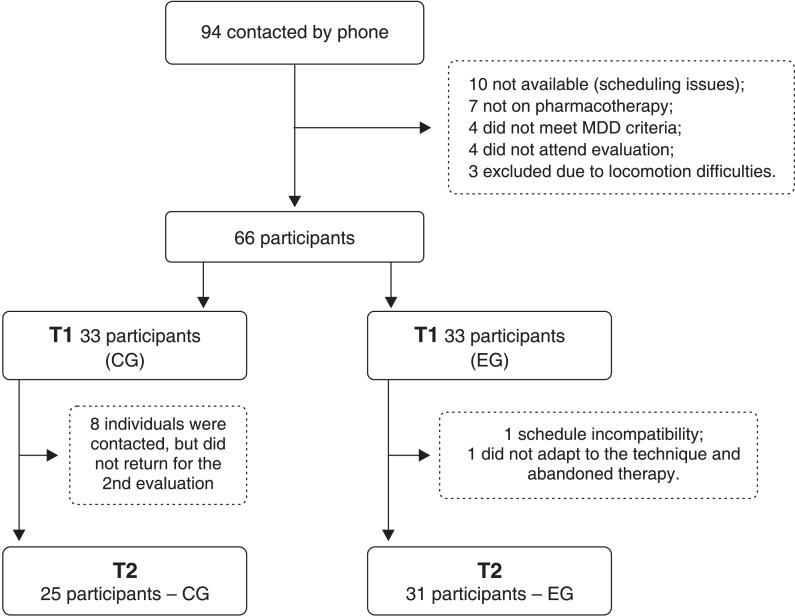
OBJECTIVE: There are few quantitative studies on art therapy for the treatment of depression. The objective of this study was to evaluate if art therapy is beneficial as an adjuvant treatment for depression in the elderly. METHODS: A randomized, controlled, single-blind study was carried out in a sample of elderly women with major depressive disorder (MDD) stable on pharmacotherapy. The experimental group (EG) was assigned to 20 weekly art therapy sessions (90 min/session). The control group (CG) was not subjected to any adjuvant intervention. Patients were evaluated at baseline and after 20 weeks, using the Geriatric Depression Scale (GDS), Beck Depression Inventory (BDI), Beck Anxiety Inventory (BAI), and cognitive measures. RESULTS: Logistic regression analysis adjusted for age revealed that women in EG (n=31) had significant improvement in GDS (p = 0.007), BDI (p = 0.025), and BAI (p = 0.032) scores as compared with controls (n=25). No difference was found in the cognitive measures. CONCLUSION: Art therapy as an adjunctive treatment for MDD in the elderly can improve depressive and anxiety symptoms. CLINICAL TRIAL REGISTRATION: RBR-2YXY7Z.
Overview
The claims and statistics of this paper haven’t been checked yet.
Free: it reads the open-access text and checks the first 5 claims that cite a source we can check. Create a free account to check every claim.
Integrity signals
Registry
Cites
Statistics
Figures
Verification
Claims the paper makes
The claims and statistics of this paper haven’t been checked yet.
Free: it reads the open-access text and checks the first 5 claims that cite a source we can check. Create a free account to check every claim.
Claims other papers make about this one
Each is checked against this paper’s own text: does it say what the citing paper says it does?
The source backs part of the claim, not all of it — or backs it for a different population, condition or comparison.
In the citing paper
“Active visual art therapy (AVAT) is often used as a complementary therapy method, both in acute medicine and in rehabilitation.”
From The effect of active visual art therapy on health outcomes: protocol of a systematic review of randomised controlled trials (2022) · cites this paper as [3]
Experimental — accuracy not yet measuredThe cited source says what the claim attributes to it.
In the citing paper
“The use of AVAT is frequently associated with the treatment of psychiatric, psychosomatic, psychological, or neurological disorders, such as anxiety [2], depression [3], eating disorders [4], trauma [5, 6], cognitive impairment, or dementia [7].”
From The effect of active visual art therapy on health outcomes: protocol of a systematic review of randomised controlled trials (2022) · cites this paper as [3]
The cited source says what the claim attributes to it.
In the citing paper
“The existing literature examining the effectiveness of art therapy has shown some positive results across a wide variety of treatment indications, such as the treatment of depression [3, 18], anxiety [19, 20], psychosis [21], the enhancement of mental wellbeing [22], and the complementary treatment of cancer [15, 23].”
From The effect of active visual art therapy on health outcomes: protocol of a systematic review of randomised controlled trials (2022) · cites this paper as [3]
The cited source says what the claim attributes to it.
In the citing paper
“However, the existing evidence is characterised by conflicting results.”
From The effect of active visual art therapy on health outcomes: protocol of a systematic review of randomised controlled trials (2022) · cites this paper as [3]
Self-check
Percentages, sums and reported differences re-computed from the paper’s own numbers.
The self-check needs the paper’s full text.
Citations
Cites
Folstein, M. F., Folstein, S. E., & McHugh, P. R. (1975) · Journal of Psychiatric Research · doi:10.1016/0022-3956(75)90026-6 · Cited by 88,282
Hirono, N., Mori, E., Ikejiri, Y., Imamura, T., Shimomura, T., Hashimoto, M., Yamashita, H., & Ikeda, M. (1997) · Brain and nerve · Cited by 21,030
Kok, J. S., Berg, I. J., & Scherder, E. J. A. (2013) · Dementia and Geriatric Cognitive Disorders Extra · doi:10.1159/000353441 · Cited by 20,589
Older Adults' Reasons for Using Technology while Aging in Place
Peek, S. T. M., Luijkx, K. G., Rijnaard, M. D., Nieboer, M. E., van der Voort, C. S., Aarts, S., van Hoof, J., Vrijhoef, H. J. M., & Wouters, E. J. M. (2016) · Gerontology · doi:10.1159/000430949 · Cited by 19,690
Sensitivity and False Alarm Rate of a Fall Sensor in Long-Term Fall Detection in the Elderly
Kangas, M., Korpelainen, R., Vikman, I., Nyberg, L., & Jämsä, T. (2015) · Gerontology · doi:10.1159/000362720 · Cited by 18,909
Development and validation of a geriatric depression screening scale: a preliminary report
Yesavage, J. A., Brink, T. L., Rose, T. L., Lum, O., Huang, V., Adey, M., & Leirer, V. O. (1982) · Journal of Psychiatric Research · doi:10.1016/0022-3956(82)90033-4 · Cited by 15,025
Cognitive Stimulation in Patients with Dementia: Randomized Controlled Trial
Mapelli, D., Di Rosa, E., Nocita, R., & Sava, D. (2013) · Dementia and Geriatric Cognitive Disorders Extra · doi:10.1159/000353457 · Cited by 3,453
L’examen Clinique en Psychologie
Rubé, P. (1959) · American Journal of Psychotherapy · doi:10.1176/appi.psychotherapy.1959.13.4.989 · Cited by 3,302
Sugestões para o uso do mini-exame do estado mental no Brasil
Brucki, S. M. D., Nitrini, R., Caramelli, P., Bertolucci, P. H. F., & Okamoto, I. H. (2003) · Arquivos de Neuro-Psiquiatria · doi:10.1590/s0004-282x2003000500014 · Cited by 2,228
Mental imagery in emotion and emotional disorders
Holmes, E. A., & Mathews, A. (2010) · Clinical Psychology Review · doi:10.1016/j.cpr.2010.01.001 · Cited by 976
Research works printed but not linked: 1
- Gameiro GR Minguini IP Alves TCTF The role of stress and life events in the onset of depression in the elderly Rev Med (São Paulo). 2014 93 31 40
Cited by
Items 101–143 of 143
de Araújo, K. U. B., de Oliveira, L. B., Affonso, R. D. S., Mendes, V. S., Martins, N. P. D. L., Lima, M. P., da Silva, I. I., Rola, M. G., Pereira, R. L. D. S., de Melo, D. A., et al. (2023) · doi:10.22533/at.ed.5642316035
Art in Memory: The Positive Effects of Art Therapy on Dementia and Alzheimer's Disease
Biron, Z. (2023) · Advances in psychology, mental health, and behavioral studies (APMHBS) book series · doi:10.4018/978-1-6684-7856-1.ch001
Temas Selectos en Salud Mental Tomo 2
Andrade, J. E. G., Enriquez, J. F. F., Fray, D. X. Á., Gaibor, A. S. G., & Campoverde, J. A. P. (2023) · Juan Cuevas eBooks · doi:10.56470/978-9942-627-88-9
ChePa, N., Lim, S.-Y. L., Yusoff, N. B., Yahaya, W. A. J. W., & Ishak, R. (2023) · Journal of Information and Communication Technology · doi:10.32890/jict2023.22.4.4
Emotion in Art Therapy as Creative Thinking in the Psychological Aspect
Velayutham, V., & Kannuswamy, R. (2023) · Praxis International Journal of Social Science and Literature · doi:10.51879/pijssl/060803
Lopes, I. F., Tertuliano, M. L., & Coelho, T. (2023) · Advances in medical technologies and clinical practice book series · doi:10.4018/978-1-6684-9251-2.ch012
Demir, V. (2024) · Anemon Muş Alparslan Üniversitesi Sosyal Bilimler Dergisi · doi:10.18506/anemon.1428758
Sanatın İyileştirici Gücü 4 Farklı Bakış Açılarıyla Sanat ve İyi Oluş
Ördem, Ö. A., Ördem, E., Demirel, İ. N., Caca, G., Girgin, İ. T., DİNÇ, N. D., ÇEKEN, K. Ş., & Polat, P. O. (2025) · Akademisyen Kitabevi eBooks · doi:10.37609/akya.3431
REDUCING DEPRESSION THROUGH ART THERAPY TECHNIQUES: A SYSTEMATIC LITERATURE REVIEW
Constantin, C.-N., Niță, E., & Popa, C. (2025) · Anthropological Researches and Studies · doi:10.26758/15.1.17
“Ciasca et al. (2018) pointed out that the art therapy may be particularly beneficial for patients who do not adapt to the exclusively verbal psychotherapeutic approaches.”
ÇIRLAK, A., Şener, B. B., & Gökdemir, D. (2025) · Türk hemşireler derneği dergisi. · doi:10.70479/thdd.1646901
Muthahharah, F., & Iswinarti (2025) · International Journal of Educational and Psychological Sciences · doi:10.59890/ijeps.v3i3.22 · Cited by 1
Pretty, D., Norwood, M. F., Ownsworth, T., Dungey, K., Jones, S., Gomes, Z., Clanchy, K., & Kendall, E. A. (2025) · JMIR Research Protocols · doi:10.2196/69452
“Although verbal psychotherapy relies on dialogue as the primary mode of communication [14], creative arts instead provide a low-verbal alternative for emotional expression [15,16].”
Ethical consideration in non-pharmacological treatments for neuropsychiatric disorders
Hazime, Z., Ghraizi, S., Shhaytli, A., Serhal, A., Takesh, Z., & Fliti, T. (2025) · Progress in brain research · doi:10.1016/bs.pbr.2025.08.016
Dovizio, M., Rossi, C., Pesce, M., Candeloro, G., Pica, V., Bruno, A., Laurenzi, V. D., Ballerini, P., Sommer, D., & Sacco, P. L. (2025) · The Arts in Psychotherapy · doi:10.1016/j.aip.2025.102367
Music and art therapy in age-related neuropsychiatric disorders: Creative approaches to healing
Hajizadeh, E., Salatin, S., Sarailoo, M., Amirazad, H., Azarfarin, M., & Dadkhah, M. (2025) · Progress in brain research · doi:10.1016/bs.pbr.2025.08.023
Joschko, R., Roll, S., Willich, S. N., & Berghöfer, A. (2022) · Figshare · doi:10.6084/m9.figshare.19776362
Joschko, R., Roll, S., Willich, S. N., & Berghöfer, A. (2022) · Figshare · doi:10.6084/m9.figshare.19776359
Relationship Between Social Support and Childhood Trauma on Resilience
Krieger, C. (2021) · ScholarWorks (Walden University) · Cited by 2
El uso del arte en intervenciones de Trabajo Social con personas con depresión
Cebader Gregorio, M., & Muñoz Marco, M. T. (2025) · Zaguan (University of Zaragoza Repository)
Azizan, A., Mohamad, A., Shuhaimi, S., Omar, A., & Nordin, E. (2025) · Malaysian Journal of Medicine and Health Sciences · doi:10.47836/mjmhs.21.3.35
Kumar, G. M., Kathale, K., Rajratan, & Gupta, S. (2025) · Indian Journal of Psychiatric Nursing · doi:10.4103/iopn.iopn_64_25
O desenho como ferramenta de cuidado na promoção de saúde mental
da Silva, L. G. B., & Trinchão, G. M. C. (2026) · Caderno Pedagógico · doi:10.54033/cadpedv23n3-043
Pu, L., & Songwathana, P. (2026) · JMIR Research Protocols · doi:10.2196/85612
Nurdaş, A. (2026) · Scandinavian Journal of Caring Sciences · doi:10.1111/scs.70235
Experiences of people with mood disorders in clay workshops during art therapy
Stončiūtė, E. (2019) · Lithuanian University of Health Sciences
Vázquez, F. H. (2026) · El Repositorio Academico Digital de la UANL (Universidad Autónoma de Nuevo León)
Yang, J., Chang, S., Zhang, Y., Sirui, C., Zhao, J., Li, N., Cai, L., Xian, C., Wang, X., & Wang, G. (2026) · Trials · doi:10.1186/s13063-026-09684-6
Ruan, J., Wei, Q., Lu, S., & Qian, J. (2025) · Journal of Craniofacial Surgery · doi:10.1097/scs.0000000000012218
Klasan, D., & Degmečić, D. (2025) · Transfer · doi:10.63614/t.3.3.7
Klasan, D., & Degmečić, D. (2025) · Transfer · doi:10.63614/t.3.3.9
Lakshmanan, A., Balasundaram, S., Gopalakrishnan, D., Raju, T., Muralikrishnan, N., & Krishnamoorthy, P. (2026) · Journal of Education and Health Promotion · doi:10.4103/jehp.jehp_2477_25
“[36] In contrast, mindfulness requires sustained attention and self‑regulation, which can be challenging for some older adults.”
Envelhecendo com arte e saúde: relato de prática extensionista
Brum, J. L. A., dos Santos, A. O., Tier, C. G., Caiçara, A. B. L., Severo, S. M. A., & Messa, N. D. (2026) · Experiência Revista Científica de Extensão · doi:10.5902/2447115189412
Tong, C., Zhang, X., Zhang, X., & Xiong, J. (2026) · International Conference on Intelligent Engineering and Next-Gen Healthcare Systems (IEHNS) · doi:10.1109/iehns68708.2026.11606866
“Numerous studies, including randomized controlled trials (RCTs) and meta-analyses, have demonstrated their effectiveness in reducing symptoms of anxiety and depression across various populations [4, 5].”
Guo, Z., Liu, Y., Zhu, S., & He, Y. (2026) · Frontiers in Psychiatry · doi:10.3389/fpsyt.2026.1828257
“Eight studies (22 – 29) explicitly reported appropriate randomization methods (e.g., random number tables, computer-generated sequences); two studies (20, 21) did not provide suf fi cient information on sequence generation and were rated unclear risk.”
Art therapy and mental health outcomes: an updated systematic review and meta-analysis
Dang, Z., Feng, Y., Mo, Y., & Jiang, L. (2026) · Arts & Health · doi:10.1080/17533015.2026.2720128
Salihu, D., Suleiman, S. K., Alasqah, I., Hussien, R. M., Almutairi, S., Ngo, A. L., Abdullahi, N. M., Alqarawi, N., Alsunitan, R., Bello, U. M., et al. (2026) · Geriatric Nursing · doi:10.1016/j.gerinurse.2026.104290
Kankshi vetkar, P. M. S., Sublok, P. M., Mukkannavar, P., & Bembalgi, V. (2023) · Journal for ReAttach Therapy and Developmental Diversities
Ponce, V. (2026) · Depositum (Université du Québec en Abitibi-Témiscamingue)
Tang, Y., 叶, 福., & Feng, Y. (2026) · Social Work With Groups · doi:10.1080/01609513.2026.2739321
Tsang, W. H. W. (2026) · Journal of Social Work and Social Welfare Policy · doi:10.33790/jswwp1100216
Painting Therapy as an Adjunctive Treatment for Depression in Older Adults: a Systematic Review
Utari, M. D., DEWI, O. O., Amalia, F., & Putera, M. A. (2026) · Jurnal Psikiatri Surabaya · doi:10.20473/jps.v15i2.56673
Metadata
- Authors
- Ciasca, E. C., Ferreira, R. C., Santana, C. L. A., Forlenza, O. V., dos Santos, G. D., Brum, P. S., & Nunes, P. V.
- Affiliations
- Universidade de São Paulo (BR)
- Universidade Federal de São Paulo (BR)
- Universidade de São Paulo, Brazil
- Corresponding author
- Ciasca, Eliana C.
- Venue
- Revista Brasileira de Psiquiatria
- Publisher
- EDITORA SCIENTIFIC
- Published
- 2018-02-01
- Volume
- 40
- Issue
- 3
- Pages
- 256-263
- ISSN
- 1516-4446 (ISSN-L)
- 1809-452X
- PMC
- PMC6899401
- OpenAlex
- W2792552493
- Semantic Scholar
- 7c408642e62f85d8c0dc188542638afb77b9c6d1
- Cited by
- 123
- References
- 44
- Citations by year
- 2026: 20 · 2025: 18 · 2024: 11 · 2023: 24 · 2022: 18 · 2021: 15 · 2020: 10 · 2019: 7
- FWCI
- 96.97
- Type
- journal article
- Language
- en
- Open access
- diamond
- doi.org
- Licence
- cc-by-nc
- Locations
- Brazilian Journal of Psychiatry (publishedVersion, cc-by-nc)
- Europe PMC (PubMed Central) (publishedVersion, cc-by-nc)
- PubMed Central (publishedVersion, cc-by-nc)
- PubMed (publishedVersion)
- LA Referencia (Red Federada de Repositorios Institucionales de Publicaciones Científicas) (publishedVersion, other-oa)
- Americanae (AECID Library) (submittedVersion, cc-by-nc)
- DOAJ (DOAJ: Directory of Open Access Journals) (submittedVersion, cc-by-sa)
- Topics
- Social Sciences › Psychology › Clinical Psychology › Art Therapy and Mental Health
- Social Sciences › Psychology › Clinical Psychology › Psychotherapy Techniques and Applications
- Health Sciences › Medicine › Pharmacology (medical) › Treatment of Major Depression
- Keywords
- art therapy, major depressive disorder, older women, adjuvant therapy, geriatric depression, anxiety symptoms, cognitive function, Geriatric Depression Scale, Beck Depression Inventory, Beck Anxiety Inventory
- MeSH terms
- Aged, Anxiety Disorders, Art Therapy, Combined Modality Therapy, Depressive Disorder, Major, Major Depressive Disorder, Female, Humans, Middle Aged, Neuropsychological Tests, Psychiatric Status Rating Scales, Psychotherapy, Socioeconomic Factors, Time Factors, Geriatric Assessment, Single-Blind Method, Treatment Outcome
About these checks
Registry, retraction, Cites and statistics results are computed, not judged, with one exception: a printed reference that no index lists is read once by a model before it counts as a citation error. Claims are extracted by a model and kept only when their quote appears verbatim in the text; each cited source is then checked, with a model’s help, for whether it says what the claim relies on. Those verdicts can be wrong — read the claim’s quote and the cited source before relying on one.
Statistics and arithmetic are recomputed, not judged.
Confidence bands are shown only for fields calibrated on our annotated test set. None is calibrated yet, so no band is shown.
What counts as a claim ›How we measure confidence ›How we check this ›
Are you an author, or do you see a problem with this page? Request a review
Data sources
Bibliographic data: Semantic Scholar, OpenAlex, Crossref.
Contains information from the Semantic Scholar Academic Graph Datasets, made available under the ODC Attribution License (ODC-BY 1.0).
Semantic Scholar’s data is described in: Kinney, R., et al. (2023). The Semantic Scholar Open Data Platform. arXiv:2301.10140.
