

Science and evolution.
Open accessThe DOI matches its Crossref record; 33 of the 33 references it cites were found in a registry or an index; 3 of the 13 sources its claims cite were checked for support.
Abstract
Evolution is both a fact and a theory. Evolution is widely observable in laboratory and natural populations as they change over time. The fact that we need annual flu vaccines is one example of observable evolution. At the same time, evolutionary theory explains more than observations, as the succession on the fossil record. Hence, evolution is also the scientific theory that embodies biology, including all organisms and their characteristics. In this paper, we emphasize why evolution is the most important theory in biology. Evolution explains every biological detail, similar to how history explains many aspects of a current political situation. Only evolution explains the patterns observed in the fossil record. Examples include the succession in the fossil record; we cannot find the easily fossilized mammals before 300 million years ago; after the extinction of the dinosaurs, the fossil record indicates that mammals and birds radiated throughout the planet. Additionally, the fact that we are able to construct fairly consistent phylogenetic trees using distinct genetic markers in the genome is only explained by evolutionary theory. Finally, we show that the processes that drive evolution, both on short and long time scales, are observable facts.
Overview
CoChat Summary
TL;DR
This is a perspective-style paper arguing that evolution is both an observable fact and the central scientific theory of biology. It uses examples from flu viruses, fossils, hybrids, and phylogenetics to claim that both microevolution and macroevolution are well supported and that creationist explanations are not scientific.
Key findings
- The paper argues that evolution is observable in present-day populations, using the annual flu vaccine as an example: resistant strains survive and the virus changes over time.
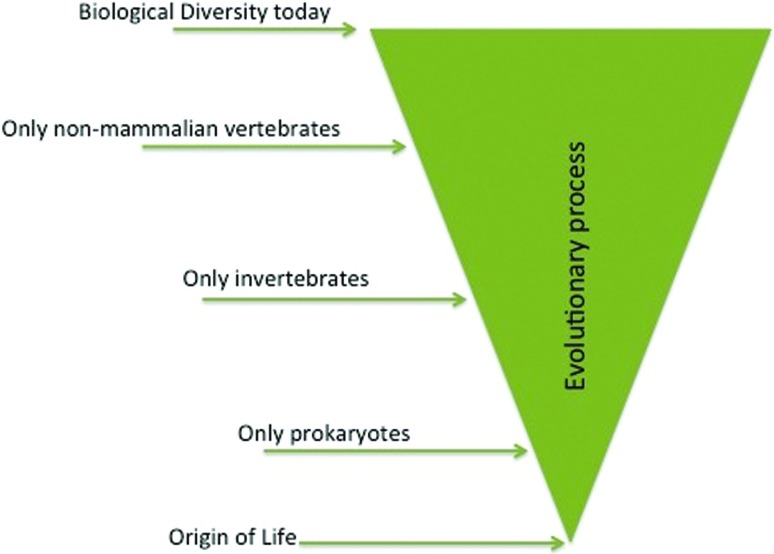
- It claims the fossil record supports macroevolution, citing the absence of mammalian fossils before 300 million years ago, vertebrate absence in 500-million-year-old strata, and the later appearance/radiation of mammals and birds after dinosaur extinction.
- It states that “more than a million species have been described,” and that the varying degrees of similarity among reproductively isolated species are best explained by common ancestry.
- It presents hybrids such as the mule, liger, and coywolf as direct evidence of ongoing speciation and common ancestry.
Methods
- Not stated in the paper.
- The text is argumentative and expository rather than an empirical study; it does not report a new sample, dataset, or experimental design.
- It relies on illustrative examples and citations to prior literature rather than a stated original analysis.
Limitations
- The paper does not state formal study limitations.
- Evident from the text: it does not present new data, statistical tests, or a reproducible empirical protocol; it is a conceptual argument.
- Evident from the text: several claims are broad philosophical assertions about science and creationism rather than results from direct analysis.
Model-written summary. Check it against the paper before relying on it.
Integrity signals
Registry
Cites
Statistics
Figures
Verification
Claims the paper makes
3 Valid · 5 Not valid · 8 Not checked · 30 Own results and interpretations
Every source the paper cites for this claim was checked and supports it.
In the paper
“One example is the understanding that, at the molecular level, random evolution, rather than natural selection, plays the most important role (Kimura, 1991).”
§ Science and evolution > Evolution as a fact and theory
What the sources say
- Supportedcites Kimura, 1991 source
The Abstract (p. 1) and Section 3 'The Neutral Theory' (pp. 3-4) state the claim directly: in sharp contrast to the Darwinian theory of evolution by natural selection, the overwhelming majority of evolutionary changes at the molecular level are caused by random fixation of selectively neutral mutants through sampling drift rather than by natural selection. The Discussion (p. 15) repeats that the great majority of molecular evolutionary changes are controlled by random genetic drift. The citing paraphrase accurately captures this, and the paper's own qualification (positive selection still governs a small adaptive fraction, p. 4) does not conflict with 'most important role at the molecular level'. (LLM, conf=0.92)
plainstates a cause- Asserted: passes — The authors put it forward as true.
- Checkable: passes — It can be checked against evidence.
- Load-bearing: unclear — It is unclear whether the paper’s conclusions depend on it.
- Based: passes — The paper gives a reason why it holds.
- Supported
The cited sources support only part of this claim — read each source’s verdict below.
In the paper
“Smaller local successions are also observable in the fossil record; such as the beautiful strings of intermediate fossils that include amphibians (Kustchera and Elliot, 2013), birds, whales (Thewissen, 2009), horses, and humans.”
§ Science and evolution > The cornerstone of biology
What the sources say
- Not matchedcites Kustchera and Elliot, 2013
Couldn’t be matched to a paper in Crossref, so it can’t be checked.
- Supportedcites Thewissen, 2009 source
The Abstract (p. 1) states that 'the transition from land to water is documented by a series of intermediate fossils, many of which are known from India and Pakistan,' reviewing pakicetids, ambulocetids, remingtonocetids, protocetids, and basilosaurids. The Conclusion reinforces this: whale origins have become 'one of the best-documented examples of macroevolution.' The citation is offered only as the source identifying the whale intermediate-fossil succession, which our copy plainly provides; the surrounding list (amphibians, birds, horses, humans) and the 'smaller local successions' framing belong to the citing authors and are not attributed here. (LLM, conf=0.90)
plain- Asserted: passes — The authors put it forward as true.
- Checkable: passes — It can be checked against evidence.
- Load-bearing: passes — The paper’s conclusions depend on it.
- Based: passes — The paper gives a reason why it holds.
- Not matched
A statement the paper makes itself — it cites no source for it, so there is none to check. The quote shows it is in the paper.
In the paper
“Each newly sequenced genome tests some aspects of Darwin’s theory, and, on each case, the sequence has been consistent with Darwin’s prediction of the shared evolutionary history of life.”
§ Science and evolution > Evolution as a fact and theory
plainstates an association- Asserted: passes — The authors put it forward as true.
- Checkable: passes — It can be checked against evidence.
- Load-bearing: passes — The paper’s conclusions depend on it.
- Based: passes — The paper gives a reason why it holds.
The paper states this without a source or data behind it here, so there is nothing to check it against. The quote shows it is in the paper.
In the paper
“In one billion years old strata, we find only single-celled organisms.”
§ Science and evolution > The cornerstone of biology
plain- Asserted: passes — The authors put it forward as true.
- Checkable: passes — It can be checked against evidence.
- Load-bearing: passes — The paper’s conclusions depend on it.
- Based: unclear — It is unclear why the paper says it holds.
In the paper
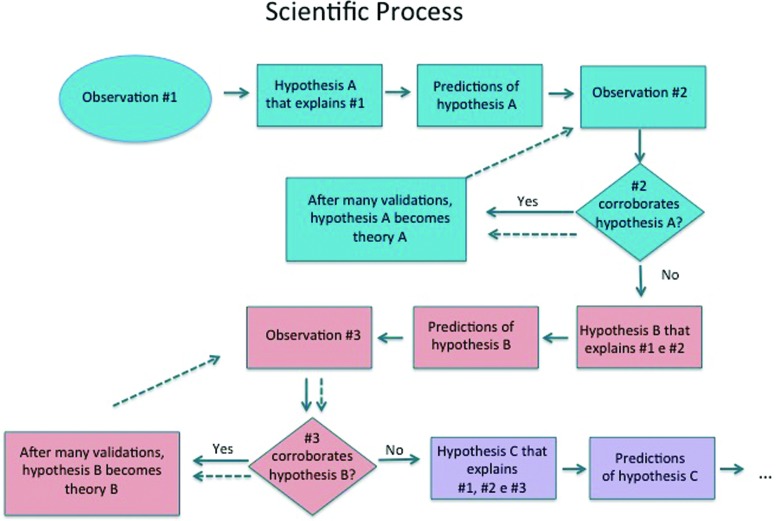
“A valid scientific theory can never become a fact (Gould, 1981), as there is always the possibility that a future explanation will better match newly discovered facts.”
§ Science and evolution > Abstract
What the sources say
- Not matchedcites Gould, 1981
Couldn’t be matched to a paper in Crossref, so it can’t be checked.
plain- Asserted: passes — The authors put it forward as true.
- Checkable: unclear — It is unclear whether it could be checked against evidence.
- Load-bearing: passes — The paper’s conclusions depend on it.
- Based: passes — The paper gives a reason why it holds.
- Not matched
12 more claims
Create a free account to see all 46 claims and to verify the 1 reference still open.
- Probably not a substantial claim. 14
- It may state two separate claims as one. 17
- The quote only partly states this claim. 2
Citations
Cites
The descent of man and selection in relation to sex
(1907) · The Journal of the Anthropological Society of Tokyo · doi:10.1537/ase1887.22.495 · Cited by 10,892
Darwin, C., Burndy Library, Darwin, C., Edmonds & Remnants, & Henry Sotheran Ltd. (1859) · J. Murray eBooks · doi:10.5962/bhl.title.59991 · Cited by 6,984
Darwin, C., Murray, J., Sons, W. C. A., & Evans., B. &. (1859) · doi:10.5962/bhl.title.82303 · Cited by 5,608
Handbook of Research on Science Education
Abell, S. K. (2013) · Routledge eBooks · doi:10.4324/9780203824696 · Cited by 4,447
Nothing in Biology Makes Sense except in the Light of Evolution
Dobzhansky, T. (1973) · The American Biology Teacher · doi:10.2307/4444260 · Cited by 3,219
How Many Species Are There on Earth and in the Ocean?
Mora, C., Tittensor, D. P., Adl, S., Simpson, A. G. B., & Worm, B. (2011) · PLoS Biology · doi:10.1371/journal.pbio.1001127 · Cited by 3,045
The descent of man, and selection in relation to sex
Darwin, C. (1872) · D. Appleton and company eBooks · doi:10.5962/bhl.title.2112 · Cited by 2,404
(2021) · Encyclopedia of Evolutionary Psychological Science · doi:10.1007/978-3-319-19650-3_303511 · Cited by 863
Public Acceptance of Evolution
Miller, J. D., Scott, E. C., & Okamoto, S. (2006) · Science · doi:10.1126/science.1126746 · Cited by 817
Essays upon heredity and kindred biological problems,
Weismann, A., Shipley, A. E., Schönland, S., & Poulton, E. B. (1889) · University of Michigan Library Repository · Cited by 496
Cited by
Differentiated impacts of human interventions on nature
Heinemann, J. A., Paull, D. J., Walker, S., & Kurenbach, B. (2021) · Elementa Science of the Anthropocene · doi:10.1525/elementa.2021.00086 · Cited by 14
Biological evolution requires an emergent, self-organizing principle
Brown, O. R., & Hullender, D. A. (2023) · Progress in Biophysics and Molecular Biology · doi:10.1016/j.pbiomolbio.2023.06.001 · Cited by 20
A Cost-benefit Analysis of Basic Income Support during the Initial Stage of the AI Revolution.Preprint
Jozaghi, E. (2024) · Research Square · doi:10.21203/rs.3.rs-5505317/v1 · Cited by 10
Demétrio, G. R., Jacobina, U. P., & Barão, K. R. (2021) · Science & Education · doi:10.1007/s11191-021-00286-z · Cited by 7
Siani, M., Stahi-Hitin, R., & Yarden, A. (2022) · Journal of Science Teacher Education · doi:10.1080/1046560x.2021.2003934 · Cited by 10
“These outcomes show us the importance of students understanding the meaning of the word “theory” in the context of evolution, even though this is a term that sometimes decreases the value of evolution according to some students, as they regard it as “just a theory” (Russo & André, 2019).”
Background
Metadata
- Authors
- Russo, C. A. M., & André, T.
- Affiliations
- Universidade Federal do Rio de Janeiro (BR)
- Universidade Federal do Oeste do Pará (BR)
- Venue
- Genetics and Molecular Biology
- Publisher
- FapUNIFESP (SciELO)
- Published
- 2019-03
- Volume
- 42
- Issue
- 1
- Pages
- 120-124
- ISSN
- 1415-4757 (ISSN-L)
- 1678-4685
- PMC
- PMC6428117
- OpenAlex
- W2919894427
- Cited by
- 14
- References
- 33
- Citations by year
- 2026: 5 · 2024: 3 · 2023: 3 · 2022: 1 · 2021: 2
- FWCI
- 5.22
- Type
- journal article
- Language
- en
- Open access
- gold
- doi.org
- Licence
- cc-by
- creativecommons.org/licenses/by/4.0/ (vor)
- creativecommons.org/licenses/by/4.0/ (am)
- creativecommons.org/licenses/by/4.0/ (tdm)
- Locations
- Genetics and Molecular Biology (publishedVersion, cc-by)
- PubMed (publishedVersion)
- LA Referencia (Red Federada de Repositorios Institucionales de Publicaciones Científicas) (publishedVersion, other-oa)
- PubMed Central (submittedVersion, cc-by)
- Americanae (AECID Library) (submittedVersion, other-oa)
- Americanae (AECID Library) (submittedVersion, cc-by)
- DOAJ (DOAJ: Directory of Open Access Journals) (submittedVersion)
- Topics
- Social Sciences › Arts and Humanities › History and Philosophy of Science › Evolution and Science Education
- Life Sciences › Biochemistry, Genetics and Molecular Biology › Genetics › Evolution and Genetic Dynamics
- Physical Sciences › Physics and Astronomy › Astronomy and Astrophysics › Origins and Evolution of Life
- Keywords
- evolution, evolutionary theory, fossil record, phylogenetic tree, genetic markers, mammalian radiation, dinosaur extinction, evolutionary processes
About these checks
Registry, retraction, Cites and statistics results are computed, not judged, with one exception: a printed reference that no index lists is read once by a model before it counts as a citation error. Claims are extracted by a model and kept only when their quote appears verbatim in the text; each cited source is then checked, with a model’s help, for whether it says what the claim relies on. Those verdicts can be wrong — read the claim’s quote and the cited source before relying on one.
A language model drew the claims from the paper on 2026-10-10, under version 3 of the claim definition (model deepseek-v4.1-flash, prompt extract-v3).
A second model labelled each claim on 2026-10-10 (model jev-1.13-20260917, definition revision gold-guideline-v0.2).
Cited sources are checked with a language model’s help (qwen3.8-omni-flash).
Statistics and arithmetic are recomputed, not judged.
Confidence bands are shown only for fields calibrated on our annotated test set. None is calibrated yet, so no band is shown.
What counts as a claim ›How we measure confidence ›How we check this ›
Are you an author, or do you see a problem with this page? Request a review
How to cite
Cite CoChat for the checks on this page, and the paper for its own findings.
- This page
- CoChat. (2026). Citation check: Science and evolution. https://app.cochat.ai/papers/10.1590/1678-4685-gmb-2018-0086
- The paper
- Russo, C. A. M., & André, T. (2019). Science and evolution. Genetics and Molecular Biology. https://doi.org/10.1590/1678-4685-gmb-2018-0086
Data sources
Bibliographic data: Semantic Scholar, OpenAlex, Crossref.
Contains information from the Semantic Scholar Academic Graph Datasets, made available under the ODC Attribution License (ODC-BY 1.0).
Semantic Scholar’s data is described in: Kinney, R., et al. (2023). The Semantic Scholar Open Data Platform. arXiv:2301.10140.
