

Coping moderates the relationship between intolerance of uncertainty and stress in men during the Covid-19 pandemic
Open accessThe DOI matches its Crossref record; 24 of the 24 references it cites were found in a registry or an index.
Abstract
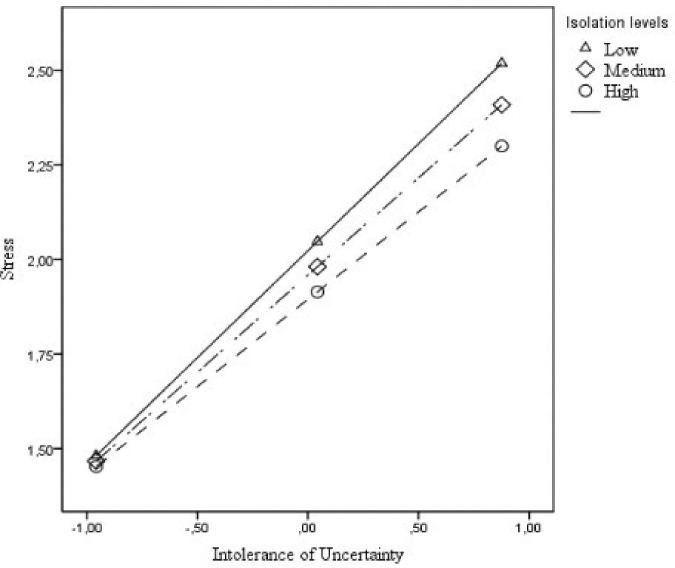
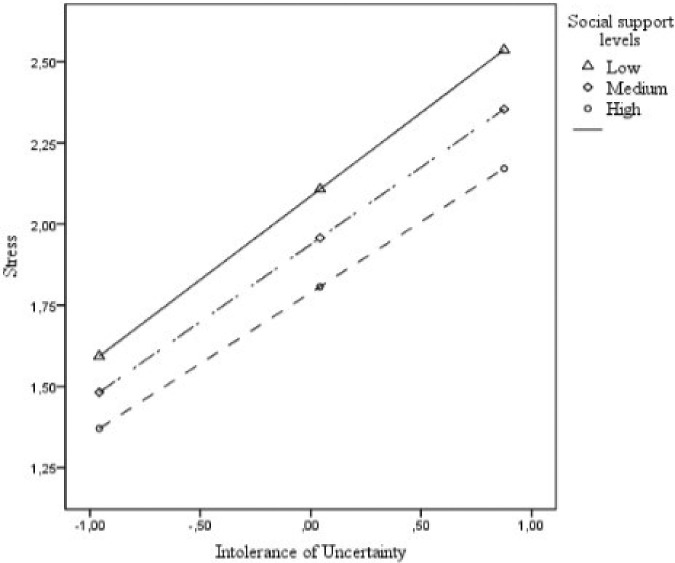
Abstract Objective: To test the explanatory power of coping strategies and intolerance of uncertainty on men’s perceived stress levels and test the moderating role of coping strategies in the relationship between intolerance of uncertainty and perceived stress during the Covid-19 pandemic. Method: This was an online cross-sectional study in which 1,006 men living in Brazil during the Covid-19 pandemic participated. Participants were recruited using a snowball sampling technique and completed a questionnaire containing measures of all study variables. Data were examined using a correlation and a regression analysis. Results: Intolerance of uncertainty (β = .51) and refusal (β = .15) positively predicted perceived stress, whereas control (β = –.31) and isolation (β = –.06) negatively predicted it. Together, these variables explained 52% of men’s perceived stress (p < .001). Isolation and social support lessened the relationship between intolerance of uncertainty and stress (p < .001). Conclusion: Men high in intolerance of uncertainty and refusal were more vulnerable to stress during the pandemic. However, coping helped mitigate the relationship between intolerance of uncertainty and perceived stress, thus being a promising psychosocial intervention in this context.
Overview
The claims and statistics of this paper haven’t been checked yet.
Free: it reads the open-access text and checks the first 5 claims that cite a source we can check. Create a free account to check every claim.
Integrity signals
Registry
Cites
Statistics
Figures
Verification
Claims the paper makes
The claims and statistics of this paper haven’t been checked yet.
Free: it reads the open-access text and checks the first 5 claims that cite a source we can check. Create a free account to check every claim.
Claims other papers make about this one
Each is checked against this paper’s own text: does it say what the citing paper says it does?
The source backs part of the claim, not all of it — or backs it for a different population, condition or comparison.
In the citing paper
“In this scenario, stress related to the pandemic was affected by both dispositional and behavioral dimensions, and namely by variables like personality factors, intolerance to uncertainty, and coping strategies [16,17,18].”
From Impact of Stress during COVID-19 Pandemic in Italy: A Study on Dispositional and Behavioral Dimensions for Supporting Evidence-Based Targeted Strategies (2024) · cites this paper as [17]
Experimental — accuracy not yet measured
Self-check
Percentages, sums and reported differences re-computed from the paper’s own numbers.
The self-check needs the paper’s full text.
Citations
Cites
A Global Measure of Perceived Stress
Cohen, S., Kamarck, T., & Mermelstein, R. (1983) · Journal of Health and Social Behavior · doi:10.2307/2136404 · Cited by 32,807 · cited 5×
“Perceived Stress Scale (PSS)(21-27): This is a 14-item instrument using a Likert-type scale ranging from 0 = never to 4 = always.”
BackgroundMethodResultInfluentialFearing the unknown: A short version of the Intolerance of Uncertainty Scale
Carleton, R. N., Norton, M. A. P. J., & Asmundson, G. J. G. (2007) · Journal of Anxiety Disorders · doi:10.1016/j.janxdis.2006.03.014 · Cited by 2,288 · cited 4×
“This finding reinforces IU’s role as a transdiagnostic factor associated with adverse mental health outcomes, as reported by other studies(12-13,22).”
BackgroundMethodResultInfluentialTaquet, M., Luciano, S., Geddes, J. R., & Harrison, P. J. (2021) · The Lancet Psychiatry · doi:10.1016/s2215-0366(20)30462-4 · Cited by 1,484 · cited 1×
“Higher rates of mental health disorders have been reported worldwide during the months following the Covid-19 pandemic(1), posing challenges to health professionals of different fields, such as psychology and nursing.”
BackgroundInfluentialMore than a feeling: A unified view of stress measurement for population science
Epel, E. S., Crosswell, A. D., Mayer, S. E., Prather, A. A., Slavich, G. M., Puterman, E., & Mendes, W. B. (2018) · Frontiers in Neuroendocrinology · doi:10.1016/j.yfrne.2018.03.001 · Cited by 1,077 · cited 1×
“Stress has traditionally been defined as an intense experience of strain involving physical, emotional, and cognitive dimensions(9).”
BackgroundThe impact of the Covid-19 pandemic on women's mental health
Almeida, M., Shrestha, A. D., Stojanac, D., & Miller, L. J. (2020) · Archives of Women s Mental Health · doi:10.1007/s00737-020-01092-2 · Cited by 583 · cited 1×
“Studies have been carried out in different populations, such as health care professionals(3-4), women(5), and adolescents(6).”
BackgroundNearchou, F., Flinn, C., Niland, R., Subramaniam, S. S., & Hennessy, E. (2020) · International Journal of Environmental Research and Public Health · doi:10.3390/ijerph17228479 · Cited by 577
Asmundson, G. J. G., Paluszek, M. M., Landry, C. A., Rachor, G. S., McKay, D., & Taylor, S. (2020) · Journal of Anxiety Disorders · doi:10.1016/j.janxdis.2020.102271 · Cited by 451
Versão brasileira da Escala de Estresse Percebido: tradução e validação para idosos
Luft, C. D. B., Sanches, S. D. O., Mazo, G. Z., & Andrade, A. (2007) · Revista de Saúde Pública · doi:10.1590/s0034-89102007000400015 · Cited by 449
Yan, L., Gan, Y., Ding, X., Wu, J., & Duan, H. (2021) · Journal of Anxiety Disorders · doi:10.1016/j.janxdis.2020.102328 · Cited by 236 · cited 3×
“For example, positive coping strategies (e.g., seeking help and active problem solving) were associated with lower emotional distress, whereas negative coping increased psychological suffering during the Covid-19 pandemic in China(17).”
BackgroundInfluentialMENTAL ILLNESS IN THE GENERAL POPULATION AND HEALTH PROFESSIONALS DURING COVID-19: A SCOPING REVIEW
Moreira, W. C., de Sousa, A. R., & Nóbrega, M. D. P. S. D. S. (2020) · Texto & Contexto - Enfermagem · doi:10.1590/1980-265x-tce-2020-0215 · Cited by 193 · cited 1×
“Studies have been carried out in different populations, such as health care professionals(3-4), women(5), and adolescents(6).”
Background
Research works printed but not linked: 2
- 10. Cooper CL, Quick JC. The handbook of stress and health: A guide to research and practice. Hoboken, New Jersey: John Wiley & Sons; 2017.
- 26. Hayes A. Introduction to Mediation, Moderation, and Conditional Process Analysis: A Regression-Based Approach. New York: Guilford Press; 2018.
Cited by
Muniz, V. D. O., Braga, L. D. C. A., de Araújo, P. O., Santana, P. P. C., Pereira, G. S., de Sousa, A. R., Pedreira, L. C., & Carvalho, E. S. D. S. (2022) · Revista Brasileira de Enfermagem · doi:10.1590/0034-7167-2021-0933 · Cited by 23
“However, there are limitations derived from the hegemonic models of masculinities that imply on their socialization and learning, which can result in health imbalance(35-37), with expanding needs to activate partially compensatory and fully compensatory care systems when they become older men(38).”
BackgroundSang, Z., Chen, H.-F., Yeung, J., & Xu, L. (2024) · Psychology Research and Behavior Management · doi:10.2147/prbm.s463399 · Cited by 11
Şirin, H. D., Şirin, E. F., & Erdoğan, A. (2023) · Gazi Beden Eğitimi ve Spor Bilimleri Dergisi · doi:10.53434/gbesbd.1190801 · Cited by 9
Palma, E. M. S., de Sousa, A. R., Aguiar, C. V. N., Nilo, N. G., & dos Santos, T. M. (2022) · Counselling and Psychotherapy Research · doi:10.1002/capr.12606 · Cited by 4
Self-citationde Paula, G. B., Martins, A. M., Soares, A. K. S., Rodrigues, L. F. F., & Baptista, C. J. (2024) · Psicologia Teoria e Pesquisa · doi:10.1590/0102.3772e40506.pt · Cited by 2
VIOLÊNCIA DOMÉSTICA: A TRISTE REALIDADE ACERCA DA VIOLÊNCIA CONTRA A MULHER
Miranda, M., Tonon, A. P., & Macedo, F. L. (2023) · doi:10.22533/at.ed.4992314049 · Cited by 2
Rosen, A. O., Montesinos, M. D. H., Mistler, C. B., Balluerka, N., Gorostiaga, A., Gómez‐Benito, J., Holmes, A. L., & Huedo-Medina, T. B. (2024) · PLOS Global Public Health · doi:10.1371/journal.pgph.0003389 · Cited by 4
Platania, G. A., Varrasi, S., Guerrera, C. S., Boccaccio, F. M., Torre, V., Vezzosi, V. F., Pirrone, C., & Castellano, S. (2024) · International Journal of Environmental Research and Public Health · doi:10.3390/ijerph21030330 · Cited by 1
COVID-19 e burnout: como estão os profissionais de terapia intensiva?
Ferreira, R. K. G., & Dias, M. L. D. C. (2022) · Research Society and Development · doi:10.33448/rsd-v11i8.31004 · Cited by 1
Migrant Men Living in Brazil during the Pandemic: A Qualitative Study
Santos, R. V. P. D. S., Neto, J. C., Bacelo, S. R., José, O. Y. F., Vergara-Escobar, O. J., Machuca‐Contreras, F., de Moraes, M. C. L., Lourenção, L. G., de Sousa, Á. F. L., de Oliveira, L. B., et al. (2024) · International Journal of Environmental Research and Public Health · doi:10.3390/ijerph21010109 · Cited by 4
“This study’s findings hold relevance for the international nursing community, offering valuable insights into Transcultural Nursing and the impact of COVID-19 on migrant populations, with the potential to inform nursing practices and global healthcare policies.”
BackgroundMedical and Psychological Distress in Male COVID-19 Survivors with Lung Damage
Guskova, O. A., Приленский, Б. Ю., Stoyanova, I. Y., Yaroslavskaya, E. I., Avdeeva, K. S., & Petelina, T. I. (2025) · SibScript · doi:10.21603/sibscript-2025-27-2-149-162 · Cited by 2
karimzadeh, F., Abdollahi, A., & Dehghanidowlatabadi, S. (2026) · Brain and Behavior · doi:10.1002/brb3.71436 · Cited by 2
de Sousa, I. M. L., Nojosa, S. D. S., da Silva, L. C. R., Gomes, T. R. L., Machado, Y. V., & Santiago, T. C. D. O. (2023) · doi:10.22533/at.ed.4992314045 · Cited by 1
I played I healed: how gaming helps quarantined people relieve stress during the COVID-19 pandemic
Zhang, Z., Jin, J., & Luo, C. (2024) · Current Psychology · doi:10.1007/s12144-024-07020-2 · Cited by 1
“…deficiency or information contradiction (Kuang & Wang, 2022), uncertainty is a typical stressor in the health risk context (Lazarus & Folkman, 1984 ; So, 2013 ), which is also considered a transdiagnostic factor that is prevalent across various psychological disorders (Palma et al., 2022).”
CAPITALISMO, TRABALHO E O PARADIGMA INCLUSÃO-EXCLUSÃO
Rogério, D. D. M., dos Santos, D. B., & Bellenzani, R. (2023) · doi:10.22533/at.ed.49923140410
PSICOLOGIA E DESASTRES: REFLEXÕES E POSSIBILIDADES DE ATUAÇÃO NO ANTROPOCENO
Campos, N. R. C., & Pedrosa, M. M. M. P. (2023) · doi:10.22533/at.ed.4992314044
ESPERANÇAR É PRECISO: AUTOAVALIAÇÃO NA EDUCAÇÃO DE JOVENS E ADULTOS (EJA) EM TEMPOS DE PANDEMIA
Silva, A. P. L. E., & Sott, A. C. L. (2023) · doi:10.22533/at.ed.49923140414
USO DO ÁLCOOL NA CONTEMPORANEIDADE: QUE LUGAR OCUPA, QUE VAZIO PREENCHE?
Pinto, A. A. D. S., & Marques, E. L. L. (2023) · doi:10.22533/at.ed.4992314041
INVESTIGAÇÃO DA ADAPTAÇÃO DE UM ADULTO ATRAVÉS DE UMA SÉRIE TELEVISIVA
Guimarães, L. P. D. M., & dos Santos, P. G. (2023) · doi:10.22533/at.ed.4992314047
EMPREGABILIDADE E SEUS DESAFIOS: UM LEVANTAMENTO REALIZADO COM PSICÓLOGOS RECÉM-FORMADOS
Mourão, B. A. F., & Scoralick-Lempke, N. N. (2023) · doi:10.22533/at.ed.49923140415
ACOMPANHAMENTO PSICOLÓGICO MATERNO PREVENINDO À DEPRESSÃO PÓS-PARTO
Wanderley, S. J. L., Rocha, A. P. T., de Souza, M. O., & Ferreira, M. M. D. C. (2023) · doi:10.22533/at.ed.4992314046
منصور, م. ا., & سلام, د. ا. (2023) · مجلة مرکز الخدمة للاستشارات البحثية واللغات · doi:10.21608/jocr.2023.241310.1157
dos Santos, F. S., Braga, L. D. C. A., Santos, R. V. P. D. S., de Santana, M. K. T. S., Pereira, G. S., Muniz, V. D. O., Almeida, É. S., & de Sousa, A. R. (2023) · Revista Brasileira de Enfermagem · doi:10.1590/0034-7167-2022-0534pt
dos Santos, F. S., Braga, L. D. C. A., Santos, R. V. P. D. S., de Santana, M. K. T. S., Pereira, G. S., Muniz, V. D. O., Almeida, É. S., & de Sousa, A. R. (2023) · Revista Brasileira de Enfermagem · doi:10.1590/0034-7167-2022-0534
de Paula, G. B., Martins, A. M., Soares, A. K. S., Rodrigues, L. F. F., & Baptista, C. J. (2024) · Psicologia Teoria e Pesquisa · doi:10.1590/0102.3772e40506.en
INTOLERANCE AND PERSEVERANCE DILEMMA IN ATHLETES: THE ROLE OF SOCIAL SUPPORT
Güleşce, M., & İlhan, E. L. (2025) · Ankara Üniversitesi Beden Eğitimi ve Spor Yüksekokulu SPORMETRE Beden Eğitimi ve Spor Bilimleri Dergisi · doi:10.33689/spormetre.1636650
Dinî Başa Çıkma ve Algılanan Sosyal Desteğin Belirsizliğe Tahammülsüzlüğü Yordayıcı Rolü
Tosun, M. (2026) · Hitit İlahiyat Dergisi · doi:10.14395/hid.1869144
Postiglione, J., Fernández‐García, O., Sommantico, M., & Parrello, S. (2026) · Personality and Individual Differences · doi:10.1016/j.paid.2026.114141
Metadata
- Authors
- Palma, E. M. S., Reis de Sousa, A., Andrade de Morais, F., Evangelista Luz, R., Freitas Neto, Á. L., & Lima, P. P. F.
- Affiliations
- Escola Bahiana de Medicina e Saúde Pública (BR)
- Universidade Federal da Bahia, Brazil
- Instituto Federal Baiano, Brazil
- Faculdade Unidas de Pesquisas, Brazil
- Escola Bahiana de Medicina e Saúde Pública, Brazil
- Centro Universitário Fundação Santo André (BR)
- ORCID
- Venue
- Revista da Escola de Enfermagem da USP
- Publisher
- FapUNIFESP (SciELO)
- Published
- 2022
- Volume
- 56
- Pages
- e20210303-e20210303
- ISSN
- 0080-6234 (ISSN-L)
- 1980-220X
- PMC
- PMC10132738
- OpenAlex
- W4205544778
- Semantic Scholar
- 9e2fd039d73d64be2d4ea282b5c9fe250f49ba4d
- Cited by
- 19
- References
- 23
- Citations by year
- 2026: 2 · 2025: 2 · 2024: 7 · 2023: 4 · 2022: 4
- FWCI
- 3.88
- Type
- journal article
- Language
- en
- Open access
- diamond
- doi.org
- Licence
- cc-by
- creativecommons.org/licenses/by/4.0/ (vor)
- creativecommons.org/licenses/by/4.0/ (am)
- creativecommons.org/licenses/by/4.0/ (tdm)
- Locations
- Revista da Escola de Enfermagem da USP (publishedVersion, cc-by)
- PubMed Central (publishedVersion, cc-by)
- PubMed (publishedVersion)
- LA Referencia (Red Federada de Repositorios Institucionales de Publicaciones Científicas) (publishedVersion, cc-by-nc)
- LA Referencia (Red Federada de Repositorios Institucionales de Publicaciones Científicas) (publishedVersion, other-oa)
- DOAJ (DOAJ: Directory of Open Access Journals) (submittedVersion)
- Topics
- Social Sciences › Psychology › Clinical Psychology › COVID-19 and Mental Health
- Social Sciences › Psychology › Developmental and Educational Psychology › Student Stress and Coping
- Social Sciences › Psychology › Clinical Psychology › Resilience and Mental Health
- Keywords
- intolerance of uncertainty, coping strategies, perceived stress, men, COVID-19 pandemic, refusal, control, isolation, social support
- MeSH terms
- COVID-19, SARS-CoV-2, Adaptation, Psychological, Cross-Sectional Studies, Humans, Male, Uncertainty, Pandemics
About these checks
Registry, retraction, Cites and statistics results are computed, not judged, with one exception: a printed reference that no index lists is read once by a model before it counts as a citation error. Claims are extracted by a model and kept only when their quote appears verbatim in the text; each cited source is then checked, with a model’s help, for whether it says what the claim relies on. Those verdicts can be wrong — read the claim’s quote and the cited source before relying on one.
Statistics and arithmetic are recomputed, not judged.
Confidence bands are shown only for fields calibrated on our annotated test set. None is calibrated yet, so no band is shown.
What counts as a claim ›How we measure confidence ›How we check this ›
Are you an author, or do you see a problem with this page? Request a review
Data sources
Bibliographic data: Semantic Scholar, OpenAlex, Crossref.
Contains information from the Semantic Scholar Academic Graph Datasets, made available under the ODC Attribution License (ODC-BY 1.0).
Semantic Scholar’s data is described in: Kinney, R., et al. (2023). The Semantic Scholar Open Data Platform. arXiv:2301.10140.
