

Measuring child maltreatment using multi-informant survey data: a higher-order confirmatory factor analysis
Open accessThe DOI matches its Crossref record; 44 of the 45 references it cites were found in a registry or an index.
Abstract
Objective To investigate the validity and reliability of a multi-informant approach to measuring child maltreatment (CM) comprising seven questions assessing CM administered to children and their parents in a large community sample. Methods Our sample comprised 2,512 children aged 6 to 12 years and their parents. Child maltreatment (CM) was assessed with three questions answered by the children and four answered by their parents, covering physical abuse, physical neglect, emotional abuse and sexual abuse. Confirmatory factor analysis was used to compare the fit indices of different models. Convergent and divergent validity were tested using parent-report and teacher-report scores on the Strengths and Difficulties Questionnaire. Discriminant validity was investigated using the Development and Well-Being Assessment to divide subjects into five diagnostic groups: typically developing controls (n = 1,880), fear disorders (n = 108), distress disorders (n = 76), attention deficit hyperactivity disorder (n = 143) and oppositional defiant disorder/conduct disorder (n = 56). Results A higher-order model with one higher-order factor (child maltreatment) encompassing two lower-order factors (child report and parent report) exhibited the best fit to the data and this model's reliability results were acceptable. As expected, child maltreatment was positively associated with measures of psychopathology and negatively associated with prosocial measures. All diagnostic category groups had higher levels of overall child maltreatment than typically developing children. Conclusions We found evidence for the validity and reliability of this brief measure of child maltreatment using data from a large survey combining information from parents and their children.
Overview
The claims and statistics of this paper haven’t been checked yet.
Free: it reads the open-access text and checks the first 5 claims that cite a source we can check. Create a free account to check every claim.
Integrity signals
Registry
Cites
Statistics
Figures
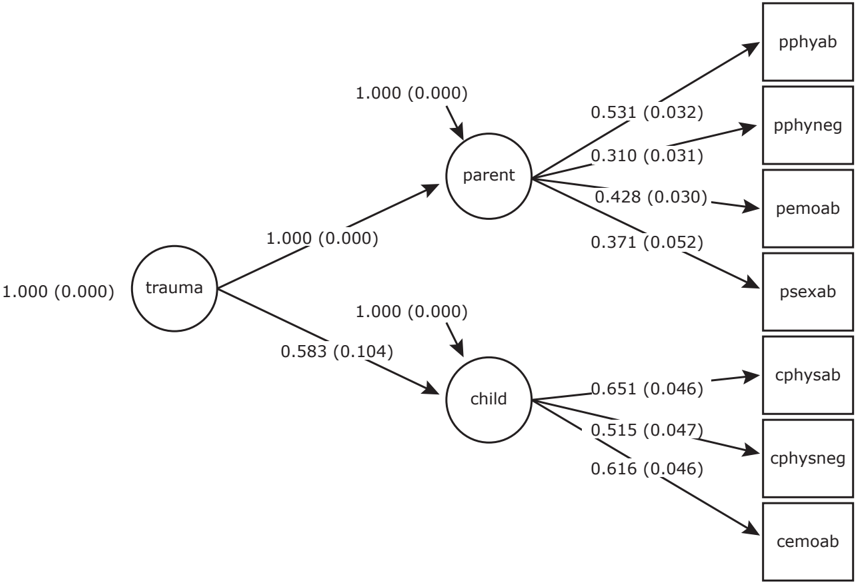
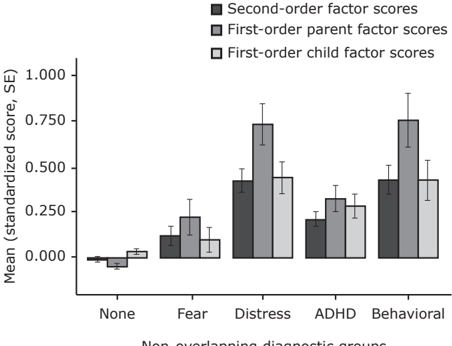
Verification
Claims the paper makes
The claims and statistics of this paper haven’t been checked yet.
Free: it reads the open-access text and checks the first 5 claims that cite a source we can check. Create a free account to check every claim.
Self-check
Percentages, sums and reported differences re-computed from the paper’s own numbers.
The self-check needs the paper’s full text.
Citations
Cites
Felitti, V. J., Anda, R. F., Nordenberg, D., Williamson, D. F., Spitz, A. M., Edwards, V., Koss, M. P., & Marks, J. S. (1998) · American Journal of Preventive Medicine · doi:10.1016/s0749-3797(98)00017-8 · Cited by 18,943
The Strengths and Difficulties Questionnaire: A research note
Goodman, R. (1997) · Journal of Child Psychology and Psychiatry · doi:10.1111/j.1469-7610.1997.tb01545.x · Cited by 14,908
Hu, L.-T., & Bentler, P. M. (1998) · Psychological Methods · doi:10.1037/1082-989x.3.4.424 · Cited by 12,298
Influence of life stress on depression: moderation by a polymorphism in the 5-HTT gene
Caspi, A., Sugden, K., Moffitt, T. E., Taylor, A., Craig, I. W., Harrington, H., McClay, J., Mill, J., Martin, J., Braithwaite, A., et al. (2003) · Science · doi:10.1126/science.1083968 · Cited by 8,120
Psychometric properties of the strengths and difficulties questionnaire
GOODMAN, R. (2001) · Journal of the American Academy of Child & Adolescent Psychiatry · doi:10.1097/00004583-200111000-00015 · Cited by 6,813
Development and validation of a brief screening version of the Childhood Trauma Questionnaire
Bernstein, D. P., Stein, J. A., Newcomb, M. D., Walker, E., Pogge, D., Ahluvalia, T., Stokes, J., Handelsman, L., Medrano, M., Desmond, D., et al. (2003) · Child Abuse & Neglect · doi:10.1016/s0145-2134(02)00541-0 · Cited by 6,419
Achenbach, T. M., McConaughy, S. H., & Howell, C. T. (1987) · Psychological Bulletin · doi:10.1037/0033-2909.101.2.213 · Cited by 5,436
Role of genotype in the cycle of violence in maltreated children
Caspi, A., McClay, J., Moffitt, T. E., Mill, J., Martin, J., Craig, I. W., Taylor, A., & Poulton, R. (2002) · Science · doi:10.1126/science.1072290 · Cited by 4,842
Simultaneous Factor Analysis in Several Populations
Jöreskog, K. G. (1971) · Psychometrika · doi:10.1007/bf02291366 · Cited by 2,051
Multivariate Analysis: Methods and Applications
Dillon, W. R., & Goldstein, M. (1984) · CERN Document Server (European Organization for Nuclear Research) · Cited by 1,905
Research works printed but not linked: 1
- 16. Grassi-Oliveira R, Stein LM, Pezzi JC. [Translation and content validation of the Childhood Trauma Questionnaire into Portuguese language]. Rev Saude Publica. 2006;40:249-55e.
Cited by
Schäfer, J., McLaughlin, K. A., Manfro, G. G., Pan, P. M., Rohde, L. A., Miguel, E. C., Simioni, A., Hoffmann, M. S., & Salum, G. A. (2022) · Developmental Science · doi:10.1111/desc.13267 · Cited by 131
“Abbreviations: DAWBA, Development andWell-being Assessment; ABEP, Brazilian Economic Classification.”
MethodInfluentialSelf-citationADHD and Exposure to Maltreatment in Children and Youth: a Systematic Review of the Past 10 Years
Craig, S. G., Bondi, B. C., O’Donnell, K. A., Pepler, D. J., & Weiss, M. D. (2020) · Current Psychiatry Reports · doi:10.1007/s11920-020-01193-w · Cited by 78
Abuso físico de crianças e adolescentes: os profissionais de saúde percebem e denunciam?
Martins‐Júnior, P. A., Ribeiro, D. C., Peruch, G. S. D. O., Paiva, S. M., Marques, L. S., & Ramos‐Jorge, M. L. (2019) · Ciência & Saúde Coletiva · doi:10.1590/1413-81232018247.19482017 · Cited by 76
Spíndola, L., Pan, P. M., Moretti, P. N. S., Ota, V., Santoro, M. L., Cogo‐Moreira, H., Gadelha, A., Salum, G. A., Manfro, G. G., Mari, J. D. J., et al. (2017) · Journal of Psychiatric Research · doi:10.1016/j.jpsychires.2017.03.015 · Cited by 33
Self-citationMoriyama, T. S., Drukker, M., Gadelha, A., Pan, P. M., Salum, G. A., Manfro, G. G., Mari, J. D. J., Miguel, E. C., Rohde, L. A., Polanczyk, G. V., et al. (2018) · Psychological Medicine · doi:10.1017/s0033291717003762 · Cited by 26
“The psychometric properties of these questions were tested and showed good validity and reliability (Salum et al. 2016).”
BackgroundSelf-citationSerum copeptin in children exposed to maltreatment
Coelho, R. P. S., Levandowski, M. L., Mansur, R. B., da Cunha, G. R., Asevedo, E. D. M., Zugman, A., Salum, G. A., Gadelha, A., Pan, P. M., Rizzo, L. B., et al. (2016) · Psychiatry and Clinical Neurosciences · doi:10.1111/pcn.12412 · Cited by 21
“The full method for investigating CM in the context of this large community survey has been described previously.(27) In brief, questions about lifetime exposure to CM were created to investigate four categories of maltreatment: (i) physical abuse (infliction of bodily injury by non-accidental means); (ii) neglect (fa…”
MethodSelf-citationPan, P. M., Gadelha, A., Argôlo, F. C., Hoffmann, M. S., Arcadepani, F. B., Miguel, E. C., Rohde, L. A., McGuire, P. K., Salum, G. A., & Bressan, R. A. (2018) · Schizophrenia Research · doi:10.1016/j.schres.2018.06.044 · Cited by 17
Self-citationDoretto, V. F., Salto, A. B. R., Schivoletto, S., Zugman, A., Oliveira, M. C., Brañas, M. J. A. A., Croci, M. S., Ito, L. T., Santoro, M. L., Jackowski, A. P., et al. (2024) · Psychological Medicine · doi:10.1017/s0033291724001636 · Cited by 15
“We utilized a higher-order model with two lower-order factors (parent-and child-report) and a higher-order factor (CM) that presented the best fit to the data, as described in detail by Salum et al. (2016) (Salum et al., 2016).”
Self-citationThe association between child maltreatment and sleep disturbances among preschoolers
Wang, Z., Li, W., Cui, N., Sun, X., Rong, T., Deng, Y., Meng, M., Shan, W., Zhang, Y., Ordway, M. R., et al. (2022) · Child Abuse & Neglect · doi:10.1016/j.chiabu.2022.105525 · Cited by 15
Ziebold, C., Evans-Lacko, S. E., Andrade, M. C. R., Hoffmann, M. S., Fonseca, L., Barbosa, M. G., Pan, P. M., Miguel, E. C., Bressan, R. A., Rohde, L. A., et al. (2022) · Scientific Reports · doi:10.1038/s41598-022-13975-8 · Cited by 15
Self-citationHenriques, C. G. P., Dutra-Thomé, L., & Rosa, E. M. (2022) · Psico · doi:10.15448/1980-8623.2022.1.39085 · Cited by 14
Cross-Sectional and Longitudinal Associations of Temperament and Mental Disorders in Youth
Hoffmann, M. S., Pan, P. M., Manfro, G. G., Mari, J. D. J., Miguel, E. C., Bressan, R. A., Rohde, L. A., & Salum, G. A. (2018) · Child Psychiatry & Human Development · doi:10.1007/s10578-018-0846-0 · Cited by 14
Self-citationBernardes, E. T., Manitto, A. M., Miguel, E. C., Pan, P. M., Batistuzzo, M. C., Rohde, L. A., & Polanczyk, G. V. (2019) · European Child & Adolescent Psychiatry · doi:10.1007/s00787-019-01408-3 · Cited by 14
Self-citationFilho, N. D. A., Mari, J. D. J., & Kieling, C. (2023) · SSM - Mental Health · doi:10.1016/j.ssmmh.2023.100212 · Cited by 10
Self-citationBorges, M. S., Hoffmann, M. S., Simioni, A., Axelrud, L. K., Teixeira, D. S., Zugman, A., Jackowski, A. P., Pan, P. M., Bressan, R. A., Parker, N., et al. (2022) · Psychological Medicine · doi:10.1017/s0033291722002926 · Cited by 9
Self-citationFontes, L. F., Mrejen, M., Rache, B., & Rocha, R. (2023) · The Economic Journal · doi:10.1093/ej/uead109 · Cited by 8
Christophe, N. K., Stein, G. L., Romero, M. Y. M., Patel, P., & Sircar, J. K. (2021) · Cultural Diversity & Ethnic Minority Psychology · doi:10.1037/cdp0000361 · Cited by 8
Shan, W., Zhang, Y., Zhao, J. H., Wu, S., Li, Z., Ip, P., Tucker, J. D., & Jiang, F. (2023) · Pediatric Research · doi:10.1038/s41390-023-02842-5 · Cited by 7
“At the same time, before we successfully change the public ’ s attitude towards the use of corporal punishment, we can encourage parents to spend more time companying with their children and increase the frequency of parent – child interactions.”
Schønning, V., Dovran, A., Hysing, M., Hafstad, G. S., Nilsen, S. A., Aaro, L. E., & Sivertsen, B. (2024) · Nordic Psychology · doi:10.1080/19012276.2024.2390428 · Cited by 6
“…results of the current study are mostly consistent with the literature on CM, where CM is associated with higher levels of mental health problems (Jonkman et al., 2013; Mills et al., 2013; Salum et al., 2016; Shan et al., 2019), supporting the validity of these fi ndings for a Norwegian population.”
Ota, V., de Oliveira, A. M., Bugiga, A., Conceição, H. B., Galante, P. A. F., Asprino, P. F., Schäfer, J., Hoffmann, M. S., Bressan, R. A., Brietzke, E. M., et al. (2025) · Frontiers in Psychiatry · doi:10.3389/fpsyt.2025.1505421 · Cited by 6
Self-citationRamires, V. R. R., Fiorini, G., Schmidt, F. M. D., Costa, C. P. D., Deon, E., & Saunders, R. (2023) · Psychotherapy Research · doi:10.1080/10503307.2023.2281549 · Cited by 6
“This result is similar to previous studies that associated maltreatment and childhood disorders (Salum et al., 2016; Weissman et al., 2019), existing some evidence that childhood maltreatment influences general factors common to multiple different types of disorders rather than those that give rise…”
Bugiga, A., Carvalho, C. M., de Oliveira, A. M., Coimbra, B. M., Chehimi, S. N., Zanardo, É. A., Kulikowski, L. D., Mello, A. F., Ota, V., Mello, M. F., et al. (2024) · Brazilian Journal of Psychiatry · doi:10.47626/1516-4446-2023-3335 · Cited by 6
Shan, W., Zhang, Y.-T., Zhao, J., Zhao, L., Hall, B. J., Tucker, J. D., & Jiang, F. (2024) · European Child and Adolescent Psychiatry · doi:10.1007/s00787-023-02355-w · Cited by 2
“The questionnaire was developed based on the definition of four categories of child maltreatment and was proven to have good validity and reliability for the measure of child maltreatment [39].”
Ribeiro, S. M., Caye, A., Fitzpatrick, C., Silva‐Jr, F. D., Haas, L. M., de Giusti, C., Salto, A. B. R., Bressan, R. A., Miguel, E. C., Rohde, L. A., et al. (2025) · Journal of Affective Disorders · doi:10.1016/j.jad.2025.120095 · Cited by 3
Self-citationZhang, C., Huang, C., Zhang, C., Wu, W., Huang, Z., Xia, X., Liu, S., Wang, C., Luo, Q., & Fan, L. (2025) · Frontiers in Psychology · doi:10.3389/fpsyg.2024.1471723 · Cited by 2
Henriques, C. G. P., Rosa, E. M., & Merçon‐Vargas, E. A. (2025) · Psicologia USP · doi:10.1590/0103-6564e230188 · Cited by 2
Damiano, R. F., Low, D. M., Ito, L. T., Santoro, M. L., Belangero, S. I., Pan, P. M., Casella, C., Schäfer, J., Uher, R., Szatmári, P., et al. (2026) · The Lancet Regional Health - Americas · doi:10.1016/j.lana.2026.101531 · Cited by 2
“27 Physical neglect was assessed via parent and child reports using the item “ Has it ever happened to your child (you) of not having anything to eat and/or having to wear dirty or torn clothes?”
Self-citationNegligência Parental Infantil: Revisão do Constructo
da Fonseca, H. R. R., & Ferreira, M. D. M. (2019) · Revista FSA · doi:10.12819/2019.16.4.12 · Cited by 2
Medidas Psicométricas da Escala Subjetiva de Felicidade em Adolescentes de Santa Maria, Brasil
Ortiz, F. R. (2016) · LA Referencia (Red Federada de Repositorios Institucionales de Publicaciones Científicas) · Cited by 2
A Cognitive Development Chart for School-age Children and AdolescentsPreprint
Simioni, A., Pine, D. S., Sato, J. R., Pan, P. M., Fonseca, R. P., Schafer, J., Miguel, E. C., Mari, J. D. J., Gadelha, A., Bressan, R. A., et al. (2019) · medRxiv · doi:10.1101/19012963 · Cited by 2
Self-citationDamiano, R. F., Bryan, C. J., Pan, P. M., Rohde, L. A., Miguel, E. C., Salum, G. A., & Hoffmann, M. S. (2026) · Suicide and Life-Threatening Behavior · doi:10.1111/sltb.70118 · Cited by 1
Self-citationMaus-tratos na infância, estresse e envelhecimento celular
Levandowski, M. L. (2018) · Americanae (AECID Library) · Cited by 1
Hoffmann, M. S. (2017) · LA Referencia (Red Federada de Repositorios Institucionales de Publicaciones Científicas)
Carvalho, C. M., Pan, P. M., Ota, V., Spíndola, L., Xavier, G., Santoro, M. L., Mazzotti, D. R., Pellegrino, R., Hakonarson, H. H., Rohde, L. A., et al. (2019) · Psychiatry Research · doi:10.1016/j.psychres.2019.01.078
Self-citationChristophe, N. K. (2021) · NC Digital Online Collection of Knowledge and Scholarship (The University of North Carolina at Greensboro)
Maus tratos e o desenvolvimento do Hipocampo ao longo da infância e adolescência
Doretto, V. F. (2024) · Digital Library of Theses and Dissertations (Universidade de São Paulo) · doi:10.11606/t.5.2024.tde-08042025-165515
Oliveira, A. M., Carvalho, C. M., Ota, V., Hoffmann, M. S., Schäfer, J., Bugiga, A., Pan, P. M., Rohde, L. A., Bressan, R. A., Miguel, E. C., et al. (2025) · Psychiatry Research · doi:10.1016/j.psychres.2025.116825
Self-citationShan, W., Wang, Y., Zhang, Y.-T., Zhao, J. H., Ip, P., Zhang, L., & Jiang, F. (2025) · Pediatric Research · doi:10.1038/s41390-025-04600-1
Metadata
- Authors
- Salum, G. A., DeSousa, D. A., Manfro, G. G., Pan, P. M., Gadelha, A., Brietzke, E., Miguel, E. C., Mari, J. J., Rosário, M. C. D., & Grassi-Oliveira, R.
- Affiliations
- Universidade Federal do Rio Grande do Sul (BR)
- Instituto Nacional de Psiquiatria do Desenvolvimento para Crianças e Adolescentes, Brazil; Universidade Federal de São Paulo, Brazil
- Instituto Nacional de Psiquiatria do Desenvolvimento para Crianças e Adolescentes (BR)
- Instituto Nacional de Psiquiatria do Desenvolvimento para Crianças e Adolescentes, Brazil; Universidade de São Paulo, Brazil
- Instituto Nacional de Psiquiatria do Desenvolvimento para Crianças e Adolescentes, Brazil; Pontifícia Universidade Católica do Rio Grande do Sul, Brazil
- ORCID
- Venue
- Trends in Psychiatry and Psychotherapy
- Publisher
- FapUNIFESP (SciELO)
- Published
- 2016-03-18
- Volume
- 38
- Issue
- 1
- Pages
- 23-32
- ISSN
- 2237-6089 (ISSN-L)
- 2238-0019
- OpenAlex
- W2324030724
- Cited by
- 33
- References
- 45
- Citations by year
- 2026: 1 · 2025: 6 · 2024: 3 · 2023: 4 · 2022: 5 · 2021: 2 · 2020: 2 · 2019: 5 · 2018: 3 · 2017: 1 · 2016: 1
- FWCI
- 4.46
- Type
- journal article
- Language
- en
- Open access
- diamond
- doi.org
- Licence
- cc-by
- Locations
- Trends in Psychiatry and Psychotherapy (publishedVersion, cc-by)
- PubMed (publishedVersion)
- LA Referencia (Red Federada de Repositorios Institucionales de Publicaciones Científicas) (publishedVersion, other-oa)
- Americanae (AECID Library) (submittedVersion, cc-by-nc-sa)
- Americanae (AECID Library) (submittedVersion, cc-by-nc)
- DOAJ (DOAJ: Directory of Open Access Journals) (submittedVersion, cc-by-sa)
- Redalyc (Universidad Autónoma del Estado de México) (submittedVersion)
- Funders
- Fundação de Amparo à Pesquisa do Estado de São Paulo (08/57896-8, 573974/2008‐0)
- Coordenação de Aperfeiçoamento de Pessoal de Nível Superior
- Conselho Nacional de Desenvolvimento Científico e Tecnológico (573974/2008, 573974/2008–0)
- Fundação de Amparo à Pesquisa do Estado do Rio Grande do Sul
- Topics
- Social Sciences › Psychology › Clinical Psychology › Child Abuse and Trauma
- Social Sciences › Sociology and Political Science › Child Welfare and Adoption
- Social Sciences › Psychology › Clinical Psychology › Child and Adolescent Psychosocial and Emotional Development
- Keywords
- child abuse, multi-informant assessment, child report, parent report, physical abuse, physical neglect, emotional abuse, sexual abuse, psychometric validity, reliability statistics, child psychopathology, attention deficit hyperactivity disorder, oppositional defiant disorder, conduct disorder, prosocial behavior
- MeSH terms
- Anxiety Disorders, Attention Deficit Disorder with Hyperactivity, Brazil, Child, Child Abuse, Data Interpretation, Statistical, Factor Analysis, Statistical, Female, Humans, Male, Parents, Surveys and Questionnaires, Schools, Reproducibility of Results, Conduct Disorder, Stress Disorders, Traumatic
About these checks
Registry, retraction, Cites and statistics results are computed, not judged, with one exception: a printed reference that no index lists is read once by a model before it counts as a citation error. Claims are extracted by a model and kept only when their quote appears verbatim in the text; each cited source is then checked, with a model’s help, for whether it says what the claim relies on. Those verdicts can be wrong — read the claim’s quote and the cited source before relying on one.
Statistics and arithmetic are recomputed, not judged.
Confidence bands are shown only for fields calibrated on our annotated test set. None is calibrated yet, so no band is shown.
What counts as a claim ›How we measure confidence ›How we check this ›
Are you an author, or do you see a problem with this page? Request a review
Data sources
Bibliographic data: Semantic Scholar, OpenAlex, Crossref.
Contains information from the Semantic Scholar Academic Graph Datasets, made available under the ODC Attribution License (ODC-BY 1.0).
Semantic Scholar’s data is described in: Kinney, R., et al. (2023). The Semantic Scholar Open Data Platform. arXiv:2301.10140.
