

Contribuição dos fatores de risco psicossociais para o transtorno de déficit de atenção/hiperatividade
Open accessThe DOI matches its Crossref record; 21 of the 21 references it cites were found in a registry or an index.
Abstract
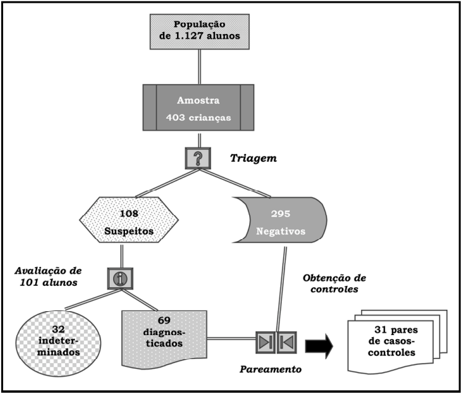
OBJETIVO: Analisar a contribuição dos fatores psicossociais para a ocorrência do transtorno de déficit de atenção/hiperatividade (TDAH). MÉTODO: Este é um estudo retrospectivo de casos-controles que analisou 403 alunos de uma escola pública primária. Preencheram-se o questionário de sintomas do DSM-IV e um questionário psicossocial específico e realizaram-se anamnese e exames físico e neurológico completos. RESULTADOS: O fator psicossocial estatisticamente significativo foi "brigas conjugais no passado" (odds ratio = 11,66, p = 0,044). Observaram-se assassinatos de 29 parentes próximos das crianças, e esta variável foi estatisticamente relevante. CONCLUSÃO: As crianças expostas a "brigas conjugais no passado" entre os pais correram risco 11,66 vezes mais alto de ter o diagnóstico de TDAH. Os autores propõem que a exposição à violência comunitária seja acrescentada aos indicadores de adversidade de Rutter, os quais predispõem à ocorrência de TDAH e outros transtornos neuropsiquiátricos na infância.
Overview
The claims and statistics of this paper haven’t been checked yet.
Free: it reads the open-access text and checks the first 5 claims that cite a source we can check. Create a free account to check every claim.
Integrity signals
Registry
Cites
Statistics
Figures
Verification
Claims the paper makes
The claims and statistics of this paper haven’t been checked yet.
Free: it reads the open-access text and checks the first 5 claims that cite a source we can check. Create a free account to check every claim.
Self-check
Percentages, sums and reported differences re-computed from the paper’s own numbers.
The self-check needs the paper’s full text.
Citations
Cites
Association of attention-deficit disorder and the dopamine transporter gene.
Cook, E. H., Stein, M. A., Krasowski, M. D., Cox, N. J., Olkon, D. M., Kieffer, J. E., & LEVENTHAL, B. L. (1995) · PubMed Central · Cited by 1,181
Committee on Quality Improvement, S. O. A.-D. D. (2000) · Pediatrics · doi:10.1542/peds.105.5.1158 · Cited by 1,076
Attainment and Adjustment in Two Geographical Areas: I—The Prevalence of Psychiatric Disorder
Rutter, M., Cox, A., Tupling, C., Berger, M., & Yule, W. (1975) · British Journal of Psychiatry · doi:10.1192/bjp.126.6.493 · Cited by 770
Ontario Child Health Study: Prevalence of Attention Deficit Disorder with Hyperactivity
Szatmari, P., Offord, D. R., & Boyle, M. H. (1989) · Journal of Child Psychology and Psychiatry · doi:10.1111/j.1469-7610.1989.tb00236.x · Cited by 551
Epidemiology of Adhd in School-Age Children
Scahill, L., & Schwab-Stone, M. (2000) · Child and Adolescent Psychiatric Clinics of North America · doi:10.1016/s1056-4993(18)30106-8 · Cited by 527
The epidemiology of attention‐deficit/hyperactivity disorder (ADHD): A public health view
Rowland, A. S., Lesesne, C. A., & Abramowitz, A. J. (2002) · Mental Retardation and Developmental Disabilities Research Reviews · doi:10.1002/mrdd.10036 · Cited by 495
MICK, E., BIEDERMAN, J., FARAONE, S. V., SAYER, J., & KLEINMAN, S. (2002) · Journal of the American Academy of Child & Adolescent Psychiatry · doi:10.1097/00004583-200204000-00009 · Cited by 482
Biederman, J. (1995) · Archives of General Psychiatry · doi:10.1001/archpsyc.1995.03950180050007 · Cited by 480
Biederman, J., Faraone, S. V., & Monuteaux, M. C. (2002) · American Journal of Psychiatry · doi:10.1176/appi.ajp.159.9.1556 · Cited by 290
Transtorno de déficit de atenção/hiperatividade: atualização
Rohde, L. A., & Halpern, R. (2004) · Jornal de Pediatria · doi:10.1590/s0021-75572004000300009 · Cited by 265
Research works printed but not linked: 4
- M e rcugliano M. O que é distúrbio de déficit de atenção/hiperatividade? In Morgan AM (org). Distúrbio de déficit de atenção/hiperatividade. Pediatr Clin N Am 1999;46:835-847.
- McGuinness D. Attention deficit disorder: the Empero r's clothes, animal 'pharm', and other fiction. In Fisher S, Greenberg R. The limits of biological treatments for psychological distress: comparisons with pys- chotherapy and placebo. Hillsdale: Lawrence Erlbaum A s s o c i a t e s , 1989:151-187.
- B reggin PR, Breggin GR. The war against children: how the drugs, programs, and theories of the psychiatric establishment are threatening A m erica's children wih a medical 'cure' for violence. New York:St. Martin's Press, 1994.
- Diagnostic and Statistical Manual of Mental Disorders, Fourth Edition - DSM-IV. Washington, DC: American Psychiatric Association, 1994.
Cited by
Violence and injuries in Brazil: the effect, progress made, and challenges ahead
Reichenheim, M. E., de Souza, E. R., Moraes, C. L., de Mello Jorge, M. H. P., da Silva, C. M. F. P., & de Souza Minayo, M. C. (2011) · The Lancet · doi:10.1016/s0140-6736(11)60053-6 · Cited by 383
Koneski, J. A. S., & Casella, E. B. (2010) · Arquivos de Neuro-Psiquiatria · doi:10.1590/s0004-282x2010000100023 · Cited by 52
Prevalência de TDAH em quatro escolas públicas brasileiras
Fontana, R. D. S., Vasconcelos, M. M., Werner, J., de Góes, F. V., & Liberal, E. F. (2007) · Arquivos de Neuro-Psiquiatria · doi:10.1590/s0004-282x2007000100027 · Cited by 117
Self-citationPires, T. D. O., da Silva, C. M. F. P., & de Assis, S. G. (2013) · BMC Psychiatry · doi:10.1186/1471-244x-13-215 · Cited by 37
Exposição à violência em adolescentes de diferentes contextos: família e instituições
Braga, L. D. L., & Dell’Aglio, D. D. (2012) · Estudos de Psicologia (Natal) · doi:10.1590/s1413-294x2012000300009 · Cited by 38
“Muitos estudos têm verificado que indivíduos expostos a diferentes formas de violência ao longo de seu desenvolvimento apresentam risco aumentado para o surgimento de sintomas ou transtornos psicológicos, como por exemplo: baixa autoestima, baixo senso de autoeficácia, comportamento agressivo, sintomas internalizantes…”
BackgroundAmbiente familiar e transtorno de déficit de atenção e \nhiperatividade
Pires, T. D. O., da Silva, C. M. F. P., & de Assis, S. G. (2012) · Redalyc (Universidad Autónoma del Estado de México) · Cited by 18
Guilherme, P. R., Mattos, P., Serra-Pinheiro, M. A., & Regalla, M. A. (2007) · Jornal Brasileiro de Psiquiatria · doi:10.1590/s0047-20852007000300008 · Cited by 35
Adolescents with attention deficit hyperactivity disorder and exposure to violence: parents' opinion
Stefanini, J. R., Scherer, Z. A. P., Scherer, E. A., Cavalin, L. A., & Guazzelli, M. S. (2015) · Revista Latino-Americana de Enfermagem · doi:10.1590/0104-1169.0249.2653 · Cited by 17
Sleep disturbances in 50 children with attention-deficit hyperactivity disorder
Neves, S., & Reimão, R. (2007) · Arquivos de Neuro-Psiquiatria · doi:10.1590/s0004-282x2007000200008 · Cited by 15
Aspectos neurobiológicos do transtorno do déficit de atenção e hiperatividade (TDAH): uma revisão
Couto, T. D. S., de Melo-Júnior, M. R., & Gomes, C. R. D. A. (2010) · Ciências & Cognição · Cited by 11
Abramovitch, S., Maia, M. C., & Cheniaux, E. (2008) · Archives of Clinical Psychiatry (São Paulo) · doi:10.1590/s0101-60832008000400006 · Cited by 37
Exigências de produtividade na escola e no trabalho e o consumo de metilfenidato
Carvalho, T. R. F., Brant, L. C., & de Melo, M. B. (2014) · Educação & Sociedade · doi:10.1590/s0101-73302014000200014 · Cited by 10
Ambiente familiar e transtorno de déficit de atenção e hiperatividade
Pires, T. D. O., da Silva, C. M. F. P., & de Assis, S. G. (2012) · Revista de Saúde Pública · doi:10.1590/s0034-89102012005000043 · Cited by 38
A Multiplicidade do TDAH nas Diferentes Versões Produzidas pelas Ciências no Brasil
Ferreira, R. R., & Moscheta, M. D. S. (2019) · Psicologia Teoria e Pesquisa · doi:10.1590/0102.3772e3539 · Cited by 5
Vinaccia, S., Barrera, L., Sánchez, M., Zuluaga, M. A., Arjona, M., Franco, S., Bernal, S., & Guerrero, C. I. (2022) · Psicología y Salud · doi:10.25009/pys.v33i1.2774 · Cited by 3
TDA/H – Análise documental sobre a produção do conceito
Benedetti, I. M. M., & Anache, A. A. (2014) · Psicologia Escolar e Educacional · doi:10.1590/2175-3539/2014/0183783 · Cited by 2
Reflexões acerca das estratégias educativas nas famílias com crianças com TDA/H
Kunrath, L. H. (2009) · doi:10.15210/caduc.v0i32.1734 · Cited by 1
Between the Frontier of Learning and School Failure in Attention Deficit Hyperactivity Disorder
(2020) · International Journal of Humanities Social Sciences and Education · doi:10.20431/2349-0381.0712001 · Cited by 1
Pedrosa, S. M. (2011) · Portuguese National Funding Agency for Science, Research and Technology (RCAAP Project by FCT)
Pires, T. D. O. (2011) · Americanae (AECID Library) · Cited by 4
Guilherme, P. R., Mattos, P., Serra-Pinheiro, M. A., & Regalla, M. A. (2007)
Perfil Neuropsicológico De Crianças Com Transtorno De Déficit De Atenção E Hiperatividade
Almeida, T. D. S., & de Souza, J. C. P. (2021) · Revista Científica Multidisciplinar Núcleo do Conhecimento · doi:10.32749/nucleodoconhecimento.com.br/psicologia/neuropsicologico-de-criancas
Pelligrini, E. F., Nesso, A. C., Berengel, D. C. C., Bolssone, V. A. M., Santos, V. A. D., Sasso, L. S. D. A., & André, J. C. (2022) · Brazilian Journal of Development · doi:10.34117/bjdv8n5-533
Reflexões sobre os efeitos da violência na saúde de alunos e professores
Avanci, J. Q., Pesce, R. P., de Albuquerque, A. P. L. C., & Ferreira, A. L. (2023) · Editora FIOCRUZ eBooks · doi:10.7476/9786557082126.0009
Souza, L. I., Seixas, C. H. A. M., Wladimirski, P. S., Júnior, C. R. D. A. M., & Rocha, F. R. (2024) · Journal Archives of Health · doi:10.46919/archv5n3espec-483
Electroencephalographic changes in children with attention deficit hyperactivity disorder
Khalaf, Z., Salah, A. O., Zaky, E. A., & Wahab, M. A. E. (2024) · The Egyptian Journal of Otolaryngology · doi:10.1186/s43163-024-00671-9 · Cited by 1
“Children with epilepsy have a better quality of life when their behavioral issues are diagnosed and treated correctly, although psychosocial factors do not contribute significantly to ADHD etiology but represent an important role in the severity and persistence of ADHD symptoms [11].”
Background
Metadata
- Authors
- Vasconcelos, M. M., Malheiros, A. F. D. A., Werner Jr., J., Brito, A. R., Barbosa, J. B., Santos, Í. S. O., & Lima, D. F. N.
- Affiliations
- Universidade Federal Fluminense (BR)
- Universidade Federal Fluminense; Universidade Federal Fluminense
- Venue
- Arquivos de Neuro-Psiquiatria
- Publisher
- FapUNIFESP (SciELO)
- Published
- 2005-03
- Volume
- 63
- Issue
- 1
- Pages
- 68-74
- ISSN
- 0004-282X (ISSN-L)
- OpenAlex
- W2149396817
- Semantic Scholar
- 8aef2f5fdbd3250153838bc56861f30bad238ece
- Cited by
- 26
- References
- 21
- Citations by year
- 2024: 2 · 2023: 1 · 2022: 2 · 2021: 1 · 2020: 1 · 2019: 1 · 2015: 1 · 2014: 2 · 2013: 1 · 2012: 3
- FWCI
- 1.00
- Type
- journal article
- Language
- pt
- Open access
- gold
- doi.org
- Licence
- cc-by-nc
- Locations
- Arquivos de Neuro-Psiquiatria (publishedVersion, cc-by-nc)
- PubMed (publishedVersion)
- LA Referencia (Red Federada de Repositorios Institucionales de Publicaciones Científicas) (publishedVersion, other-oa)
- Americanae (AECID Library) (submittedVersion, cc-by-nc)
- DOAJ (DOAJ: Directory of Open Access Journals) (submittedVersion, cc-by-sa)
- Topics
- Health Sciences › Medicine › Psychiatry and Mental health › Attention Deficit Hyperactivity Disorder
- Social Sciences › Psychology › Clinical Psychology › Child and Adolescent Psychosocial and Emotional Development
- Social Sciences › Psychology › Clinical Psychology › Child Abuse and Trauma
- Keywords
- attention deficit hyperactivity disorder, psychosocial risk factors, marital conflict, parental conflict, childhood adversity, community violence, children, ADHD diagnosis
- MeSH terms
- Adolescent, Attention Deficit Disorder with Hyperactivity, Child, Female, Humans, Male, Psychiatric Status Rating Scales, Surveys and Questionnaires, Retrospective Studies, Risk Factors, Socioeconomic Factors, Case-Control Studies, Domestic Violence
About these checks
Registry, retraction, Cites and statistics results are computed, not judged, with one exception: a printed reference that no index lists is read once by a model before it counts as a citation error. Claims are extracted by a model and kept only when their quote appears verbatim in the text; each cited source is then checked, with a model’s help, for whether it says what the claim relies on. Those verdicts can be wrong — read the claim’s quote and the cited source before relying on one.
Statistics and arithmetic are recomputed, not judged.
Confidence bands are shown only for fields calibrated on our annotated test set. None is calibrated yet, so no band is shown.
What counts as a claim ›How we measure confidence ›How we check this ›
Are you an author, or do you see a problem with this page? Request a review
Data sources
Bibliographic data: Semantic Scholar, OpenAlex, Crossref.
Contains information from the Semantic Scholar Academic Graph Datasets, made available under the ODC Attribution License (ODC-BY 1.0).
Semantic Scholar’s data is described in: Kinney, R., et al. (2023). The Semantic Scholar Open Data Platform. arXiv:2301.10140.
