

Valores de referência para o teste cardiopulmonar para homens e mulheres sedentários e ativos
Open accessThe DOI matches its Crossref record, with a small difference in title or year; 26 of the 27 references it cites were found in a registry or an index.
Abstract
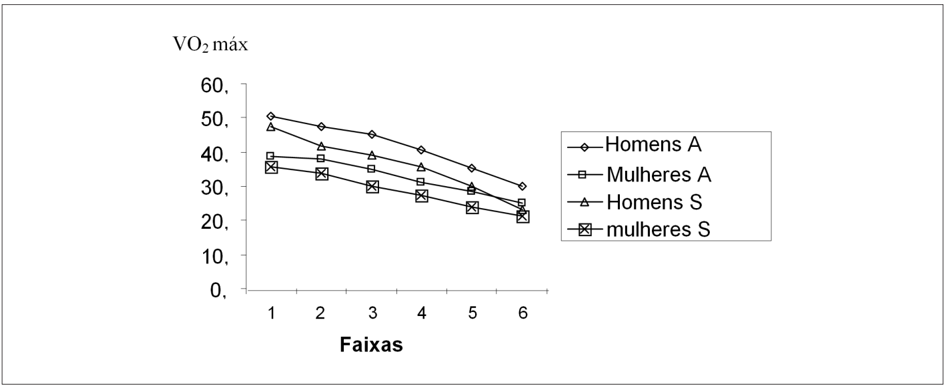
BACKGROUND: The reference values for cardiopulmonary exercise testing (CPET) available in Brazil were derived from a cycle ergometer in a sedentary and relatively small population. OBJECTIVE: Provide reference values for CPET in Brazilians of both sexes, either sedentary or active. METHODS: From 2006 to 2008, 3,992 CEPT of healthy individuals were selected from our laboratory. Athletes, smokers, patients with any known pathology, users of continuous medication and obese patients were excluded. Peak VO(2) was considered max VO(2). We also analyzed the anaerobic threshold VO(2), maximum ventilation and oxygen pulse according to sex, age, sedentary and active patients. Age groups were divided as follows: G1 (15-24), G2 (25-34), G3 (35-44), G4 (45-54), G5 (55-64) and G6 (65-74). RESULTS: According to age groups, the mean values of VO(2) in ml/kg/min with their standard deviations were: Active man: G1-50.6 ± 7.3, G2-47, 4 ± 7.4, G3-45, 4 ± 6.8, G4-40.5 ± 6.5; G5-35.3 ± 6.2; G6-30.0 ± 6.1. Active woman: G1-38.9 ± 5.7; G2-38.1 ± 6.6; G3-34.9 ± 5.9; G4-31.1 ± 5.4; G5-28.6 ± 6.1; G6-25.1 ± 4.4. Sedentary man: G1-47.4 ± 7.9; G2-41.9 ± 7.2; G3-39.0 ± 6.8; G4-35.6 ± 7.7; G5-30.0 ± 6.3; G6-23.1 ± 6.3. Sedentary woman: G1-35.6 ± 5.7; G2-34.0 ± 4.8; G3-30.0 ± 5.4; G4-27.2 ± 5.0; G5-23.9 ± 4.2; G6-21.2 ± 3.4. CONCLUSION: This article provides reference values of max VO(2), among other parameters, in the Cardiopulmonary Exercise Testing performed on the treadmill in individuals of both sexes, either active and sedentary.
Overview
The claims and statistics of this paper haven’t been checked yet.
Free: it reads the open-access text and checks the first 5 claims that cite a source we can check. Create a free account to check every claim.
Integrity signals
Registry
Cites
Statistics
Figures
Verification
Claims the paper makes
The claims and statistics of this paper haven’t been checked yet.
Free: it reads the open-access text and checks the first 5 claims that cite a source we can check. Create a free account to check every claim.
Claims other papers make about this one
Each is checked against this paper’s own text: does it say what the citing paper says it does?
The check wasn’t confident either way, so it gives no verdict — never disputed.
In the citing paper
“This division was based on the optimal VO 2 peak considered for values >43 [ 17 ].”
From Involvement of Cardiorespiratory Capacity on the Acute Effects of Caffeine on Autonomic Recovery (2019) · cites this paper as [17]
Experimental — accuracy not yet measured
Self-check
Percentages, sums and reported differences re-computed from the paper’s own numbers.
The self-check needs the paper’s full text.
Citations
Cites
ATS/ACCP statement on cardiopulmonary exercise testing
Ross, R. M. (2003) · American Journal of Respiratory and Critical Care Medicine · doi:10.1164/ajrccm.167.10.950 · Cited by 2,073
Bruce, R. A., Kusumi, F., & Hosmer, D. (1973) · American Heart Journal · doi:10.1016/0002-8703(73)90502-4 · Cited by 2,049
Mancini, D. M., Eisen, H., Kussmaul, W., Mull, R., Edmunds, L. H., & Wilson, J. R. (1991) · Circulation · doi:10.1161/01.cir.83.3.778 · Cited by 1,882
Qualitative Methods in Public Health: A Field Guide for Applied Research
Ulin, P. R., Robinson, E. T., & Tolley, E. E. (2005) · Medicine & Science in Sports & Exercise · doi:10.1249/01.mss.0000172593.20181.14 · Cited by 1,700
Predicted Values for Clinical Exercise Testing 1– 3
Hansen, J. E., Sue, D. Y., & Wasserman, K. (1984) · American Review of Respiratory Disease · doi:10.1164/arrd.1984.129.2p2.s49 · Cited by 929
Oxygen utilization and ventilation during exercise in patients with chronic cardiac failure.
Weber, K. T., Kinasewitz, G. T., Janicki, J. S., & Fishman, A. P. (1982) · Circulation · doi:10.1161/01.cir.65.6.1213 · Cited by 917
Wasserman, K. (2004) · Cited by 861
Exercise standards. A statement for health professionals from the American Heart Association.
Fletcher, G. F., Froelicher, V. F., Hartley, L. H., Haskell, W. L., & Pollock, M. L. (1990) · Circulation · doi:10.1161/01.cir.82.6.2286 · Cited by 723
Normal standards for an incremental progressive cycle ergometer test.
Jones, N. L., Makrides, L., Hitchcock, C., Chypchar, T., & McCartney, N. (1985) · PubMed · doi:10.1164/arrd.1985.131.5.700 · Cited by 717
Cardiopulmonary exercise testing and its application
Albouaini, K., Egred, M., Alahmar, A., & Wright, D. J. (2007) · Postgraduate Medical Journal · doi:10.1136/hrt.2007.121558 · Cited by 582
Research works printed but not linked: 1
- Storer TW, Davis JA, Caiozzo VJ. Accurate prediction of VO2max in cycle ergometry. Med Sci Sports Exerc. 1990; 22 (5): 704-12.
Cited by
Items 101–106 of 106
Caracterización de la función pulmonar en los sobrevivientes colombianos de la COVID-19
Américas, I. U. V. D. L., Romero, S. A., Guerrero-Salgado, L. F., Andina, F. U. D. Á., Muñoz, A. I. G., Andina, F. U. D. Á., Aedo–Muñoz, E., & de Chile, U. S. (2024) · IATREIA · doi:10.17533/udea.iatreia.265
Yu, F., Salisbury, D. L., & Lin, F. V. (2024) · Journal of Gerontological Nursing · doi:10.3928/00989134-20240809-07
Maximal oxygen uptake of master swimmers in incremental intermittent swimming test: effects of aging
Trindade, C. D. Z., Schneider, C. D., Guimard, A., & Castro, F. A. D. S. (2025) · Sport Sciences for Health · doi:10.1007/s11332-025-01401-1
Oliveira, J. G. M., de Alegria, S. G., Ferreira, I. D. N., Fonseca, I. M. P. P., da Silva, M. M., dos Santos, B. P., Alves, M. R., Monteiro, E. R., Lopes, A. J., & Mafort, T. T. (2025) · International Journal of Environmental Research and Public Health · doi:10.3390/ijerph22121839
Farrash, W. (2020) · Nottingham ePrints (University of Nottingham)
Estrés oxidativo en mujeres durante una competencia de Crossfit
Hernández, N. C., Nájera, N. H., del Castillo, L. A. E., & Jacquez, R. G. M. (2026) · MHSALUD Revista en Ciencias del Movimiento Humano y Salud · doi:10.15359/mhs.23-s1.22169
Metadata
- Authors
- Herdy, A. H., & Uhlendorf, D.
- Affiliations
- Instituto de Cardiologia de Santa Catarina (BR)
- ORCID
- Herdy, Artur Haddad
- Venue
- Arquivos Brasileiros de Cardiologia
- Publisher
- FapUNIFESP (SciELO)
- Published
- 2011-01
- Volume
- 96
- Issue
- 1
- Pages
- 54-59
- ISSN
- 0066-782X (ISSN-L)
- OpenAlex
- W1575370949
- Semantic Scholar
- 77df5b912b6af80a458f5e7d38e5019a4cac3395
- Cited by
- 98
- References
- 27
- Citations by year
- 2025: 2 · 2024: 12 · 2023: 4 · 2022: 7 · 2021: 8 · 2020: 8 · 2019: 13 · 2018: 10 · 2017: 2 · 2016: 5 · 2015: 6 · 2014: 10 · 2013: 6 · 2012: 3
- FWCI
- 9.41
- Type
- journal article
- Language
- en
- Open access
- diamond
- doi.org
- Licence
- cc-by-nc
- Locations
- Arquivos Brasileiros de Cardiologia (publishedVersion, cc-by-nc)
- PubMed (publishedVersion)
- Topics
- Health Sciences › Medicine › Physiology (medical) › Cardiovascular and exercise physiology
- Health Sciences › Medicine › Public Health, Environmental and Occupational Health › Physical Activity and Health
- Health Sciences › Medicine › Orthopedics and Sports Medicine › Sports Performance and Training
- Keywords
- cardiopulmonary exercise testing, reference values, peak oxygen uptake, VO2max, anaerobic threshold, oxygen pulse, ventilatory response, sedentary populations, physically active population, sex differences, age groups, healthy adults, Brazilian population, cycle ergometer, exercise capacity, cardiorespiratory fitness, ventilatory threshold, ventilatory efficiency, oxygen uptake efficiency
- MeSH terms
- Adolescent, Adult, Aged, Brazil, Exercise Test, Female, Humans, Life Style, Male, Middle Aged, Oxygen Consumption, Reference Values, Sedentary Behavior
About these checks
Registry, retraction, Cites and statistics results are computed, not judged, with one exception: a printed reference that no index lists is read once by a model before it counts as a citation error. Claims are extracted by a model and kept only when their quote appears verbatim in the text; each cited source is then checked, with a model’s help, for whether it says what the claim relies on. Those verdicts can be wrong — read the claim’s quote and the cited source before relying on one.
Statistics and arithmetic are recomputed, not judged.
Confidence bands are shown only for fields calibrated on our annotated test set. None is calibrated yet, so no band is shown.
What counts as a claim ›How we measure confidence ›How we check this ›
Are you an author, or do you see a problem with this page? Request a review
Data sources
Bibliographic data: Semantic Scholar, OpenAlex, Crossref.
Contains information from the Semantic Scholar Academic Graph Datasets, made available under the ODC Attribution License (ODC-BY 1.0).
Semantic Scholar’s data is described in: Kinney, R., et al. (2023). The Semantic Scholar Open Data Platform. arXiv:2301.10140.
