

Seeding density in wheat genotypes as a function of tillering potential
Open accessThe DOI matches its Crossref record; 26 of the 26 references it cites were found in a registry or an index.
Abstract
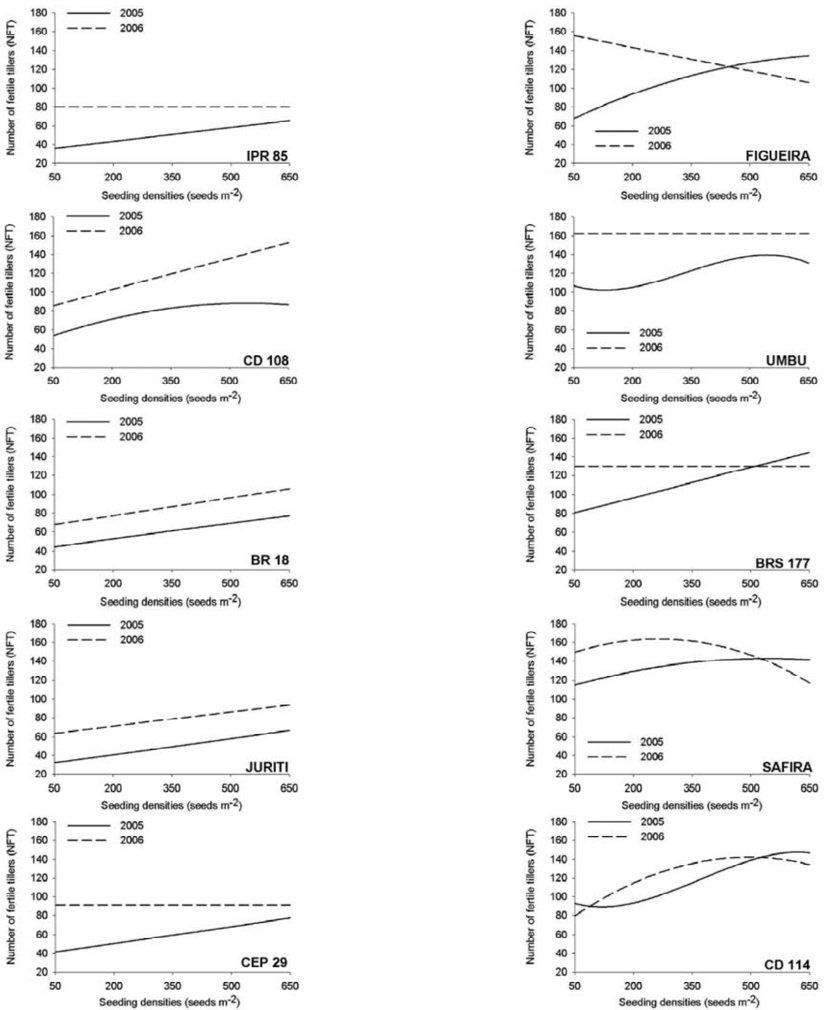
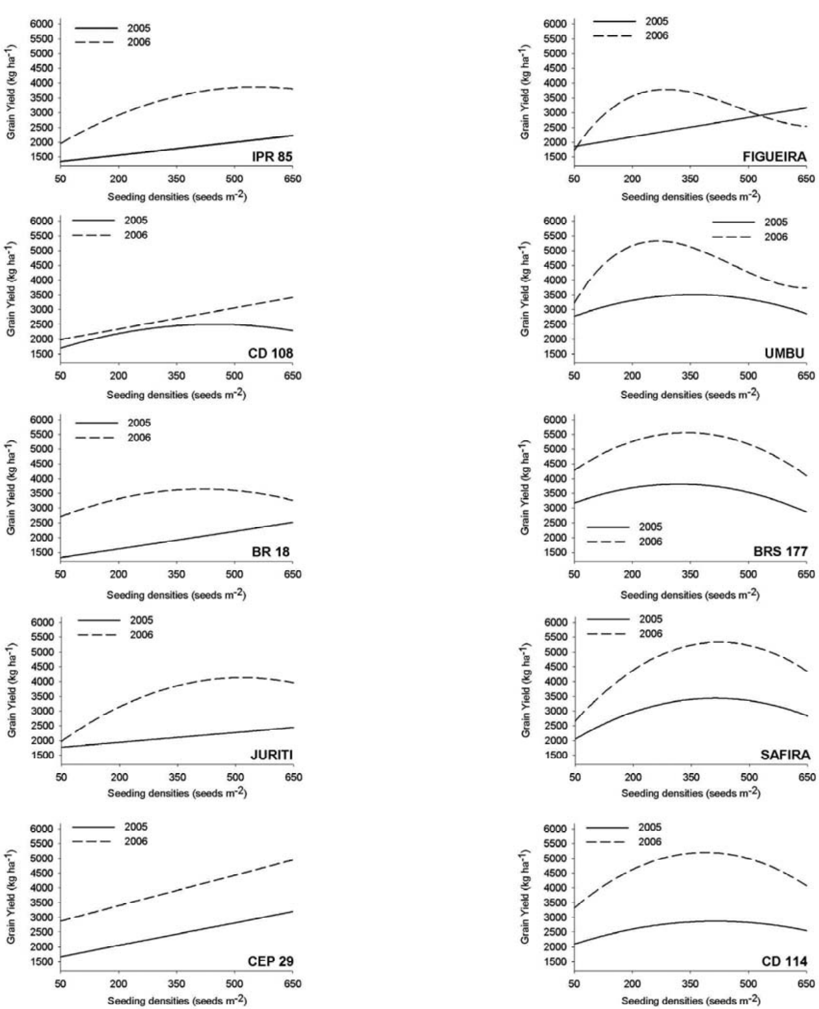
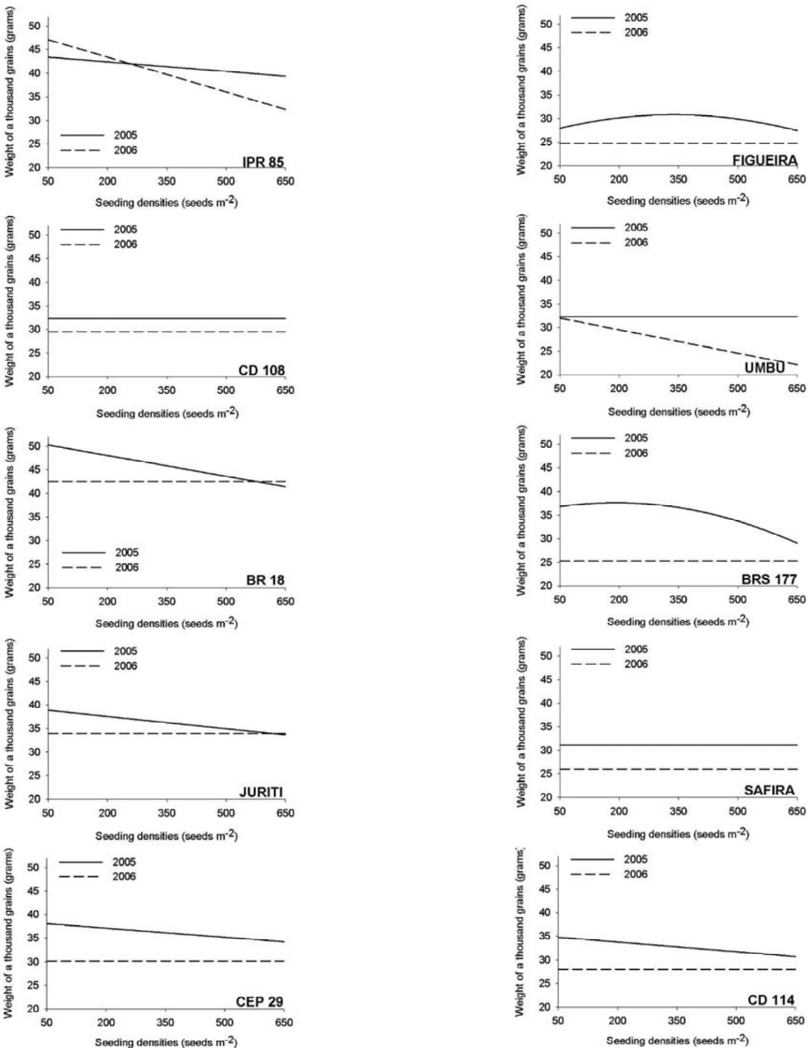
Seeding density adjustments is one of the practices that most influence grain yield, as well as other agronomic traits. Therefore, the objective of this study was to determine the ideal plant stand to achieve the maximum grain yield in genotypes showing differential tillering ability. Also, to establish the associations between the genotypes used with tillering and other agronomically important traits as weight of a thousand grains. Two experiments were conducted in 2005 and 2006 in Capão do Leão, Rio Grande do Sul state, Brazil. Five low (JURITI, BR 18, CEP 29, BR 18 and CD 108) and five high (CD 114, SAFIRA, FIGUEIRA, BRS 177 and UMBU) tillering potential wheat cultivars were tested for two years on a split-plot design. The results indicate the need for recommending cultivars based on more than one year of cultivation, especially when dealing with contrasting genotypes for the trait fertile tillers. Regarding the ideal plant stand, seeding density of low tillering ability genotypes ranges from 417 to 555 seeds m-2, in order to obtain maximum yield and grain weight. On the other hand, for high tillering ability genotypes, the ideal stand ranges from 221 to 422 seeds m-². These results were year independent. Furthermore, low tillering ability genotypes showed a closer association of number of fertile tillers with grain yield. However, an inverse association was found between number of fertile tillers and weight of a thousand grains.
Overview
The claims and statistics of this paper haven’t been checked yet.
Free: it reads the open-access text and checks the first 5 claims that cite a source we can check. Create a free account to check every claim.
Integrity signals
Registry
Cites
Statistics
Figures
Verification
Claims the paper makes
The claims and statistics of this paper haven’t been checked yet.
Free: it reads the open-access text and checks the first 5 claims that cite a source we can check. Create a free account to check every claim.
Claims other papers make about this one
Each is checked against this paper’s own text: does it say what the citing paper says it does?
The cited source says what the claim attributes to it.
In the citing paper
“Previous studies showed the optimum plant density depended on the cultivar’s tillering potential [4, 44], yield of a cultivar at very low planting density (i.e.: plant yield efficiency; [41]), and to lesser extent differences in leaf insertion angle (i.e.: planophile or erectophile; [16]).”
From A Bayesian framework to model variance of grain yield response to plant density (2025) · cites this paper as [44]
The cited source says what the claim attributes to it.
In the citing paper
“The model described in Eqs. 1–3 can be easily adapted to commonly used experimental designs of agricultural experiments, such as experiments testing the interaction of plant density and genotype (i.e. [44]:) or row spacing (i.e. [16]:).”
From A Bayesian framework to model variance of grain yield response to plant density (2025) · cites this paper as [44]
The cited source says what the claim attributes to it.
In the citing paper
“Another limitation of this study is that we evaluated a single cultivar, thus ignoring cultivar × plant density interactions that can occur in wheat [2, 15, 41, 44].”
From A Bayesian framework to model variance of grain yield response to plant density (2025) · cites this paper as [44]
Self-check
Percentages, sums and reported differences re-computed from the paper’s own numbers.
The self-check needs the paper’s full text.
Citations
Cites
Moreno, J. A. (2014) · Boletim Geográfico do Rio Grande do Sul · Cited by 829
Arduini, I., Masoni, A., Ercoli, L., & Mariotti, M. (2006) · European Journal of Agronomy · doi:10.1016/j.eja.2006.06.009 · Cited by 301 · cited 1×
“, the density in which the maximum yield was reached, a slight increase in grain nitrogen was observed, without any changes in the overall grain nutrition value (Arduini et al., 2006).”
BackgroundQuantitative Characterization of Vegetative Development in Small Cereal Grains1
Klepper, B., Rickman, R. W., & Peterson, C. M. (1982) · Agronomy Journal · doi:10.2134/agronj1982.00021962007400050005x · Cited by 253 · cited 1×
“Furthermore, the ideal should take into account environmental conditions, such as altitude, temperature, soil and seeding time (Klepper et al., 1982; Gade, 1995).”
Background(1985) · Springer eBooks · doi:10.1007/978-1-4899-3665-3 · Cited by 215
The physiological response of winter wheat to reductions in plant density
WHALEY, J. M., SPARKES, D. L., FOULKES, M. J., SPINK, J. H., SEMERE, T., & SCOTT, R. K. (2000) · Annals of Applied Biology · doi:10.1111/j.1744-7348.2000.tb00048.x · Cited by 184 · cited 2×
“Also, it provides an increase in green area for the plant, leading to an improvement in capturing radiation (Whaley et al., 2000).”
BackgroundPatterns of tillering and grain production of winter wheat at a wide range of plant densities.
Darwinkel, A. (1978) · Netherlands Journal of Agricultural Science · doi:10.18174/njas.v26i4.17081 · Cited by 170 · cited 1×
“This will be achieved with the ideal interaction with the environment, through plant competition for light, water and nutrients (Darwinkel, 1978).”
BackgroundLloveras, J., Manent, J., Viudas, J., López, A., & Santiveri, P. (2004) · Agronomy Journal · doi:10.2134/agronj2004.1258 · Cited by 166 · cited 5×
“Similar results are found in the literature, highlighting the lower GY of cultivars grown in dry winters, showing reduced tillering and reduced ear numbers (Lloveras et al., 2004).”
BackgroundResultInfluentialStraw Production and Grain Yield Relationships in Winter Wheat
Donaldson, E., Schillinger, W. F., & Dofing, S. M. (2001) · Crop Science · doi:10.2135/cropsci2001.411100x · Cited by 152 · cited 1×
“Distinct reports are found in the literature, where the character WTG appears to be the less affected by seeding density in wheat (Donaldson et al., 2001; Lloveras et al., 2004; Hiltbrunner et al., 2005 and Ozturk et al., 2006) and also in rice (Souza & Azevedo, 1994).”
BackgroundÖztürk, A., Çağlar, Ö., & Bulut, S. (2006) · Journal of Agronomy and Crop Science · doi:10.1111/j.1439-037x.2006.00187.x · Cited by 151 · cited 8×
“On the other hand, this character is highly influenced by the seeding time, which results in longer or shorter periods for grain filling (Ozturk et al., 2006).”
BackgroundResultInfluentialSeeding Rate and Genotype Effect on Agronomic Performance and End-Use Quality of Winter Wheat
Geleta, B., Atak, M., Baenziger, P. S., Nelson, L. A., Baltenesperger, D. D., Eskridge, K. M., Shipman, M. J., & Shelton, D. R. (2002) · Crop Science · doi:10.2135/cropsci2002.0827 · Cited by 145 · cited 1×
“Similar results were found by other investigations, reaching 33% (Geleta et al., 2002) and 49.3% (Ozturk et al., 2006) of increase in GY as a function of increase in density.”
ResultInfluential
Research works printed but not linked: 3
- 20. LOCK, A.A. Management strategies for winter wheat: limitation of yield, seeding rate and nitrogen timing. Aspects of Applied Biology, v.34, p.309-317, 1993.
- 24. McCALL, M.A. Developmental anatomy and homologies in wheat. Journal of Agricultural Research, v.48, p.283-321, 1934.
- 26. MOTA, F.S. Clima, tecnologia e produtividade do trigo no Brasil. In: MOTA, F.S. Agrometeorologia do trigo no Brasil. Campinas: Sociedade Brasileira de Agrometeorologia, 1989. p.1- 35.
Cited by
Bastos, L. M., Carciochi, W., Lollato, R. P., Jaenisch, B. R., Rezende, C. R., Schwalbert, R., Vara Prasad, P. V., Zhang, G., Fritz, A. K., Foster, C., et al. (2020) · Frontiers in Plant Science · doi:10.3389/fpls.2020.00054 · Cited by 164
“Surprisingly, the AOPD at high YE changed with the TP. Similarly, Valério et al. (2009) reported greater seeding rates needed to obtain maximum yield for low TP genotypes, compared to high TP (417 to 555 vs. 221 to 422 seeds m-2, respectively), with similar findings by Mehring (2016) and Balla…”
ResultHigh-throughput phenotyping early plant vigour of winter wheat
Kipp, S., Mistele, B., Baresel, J. P., & Schmidhalter, U. (2013) · European Journal of Agronomy · doi:10.1016/j.eja.2013.08.009 · Cited by 135
Seeding density in wheat: the more, the merrier?
Valério, I. P., de Carvalho, F. I. F., Benin, G., da Silveira, G., da Silva, J. A. G., Nörnberg, R., Hagemann, T. R., Luche, H. D. S., & de Oliveira, A. C. (2013) · Scientia Agricola · doi:10.1590/s0103-90162013000300006 · Cited by 87
“This competition is markedly higher than the one that occurs for low tillering ability genotypes, decreasing nutrient uptake and leading to higher lodging and disease rates (Ozturk et al., 2006; Valerio et al., 2009).”
BackgroundSelf-citationWilke, N., Siegmann, B., Postma, J. A., Muller, O., Krieger, V., Pude, R., & Rascher, U. (2021) · Computers and Electronics in Agriculture · doi:10.1016/j.compag.2021.106380 · Cited by 59
Hu, Y., Ren, T., Li, Z., Tang, Y., Ren, Z. L., & Yan, B. (2017) · Gene · doi:10.1016/j.gene.2017.08.039 · Cited by 59
Corot, A., Roman, H., Douillet, O., Autret, H., Pérez-Garcia, M.-D., Citerne, S., Bertheloot, J., Sakr, S., Leduc, N., & Demotes‐Mainard, S. (2017) · Frontiers in Plant Science · doi:10.3389/fpls.2017.01724 · Cited by 73
“Branching can indeed affect yield directly – through the number of fertile branches (Bredmose, 1993; Valério et al., 2009) – or indirectly by increasing the competitive ability of crops against weeds (Lemerle et al., 1996; Zhao et al., 2006) or by constraining pest infestation (Simon et al., 2012).”
Effect of seeding rate on grain quality of winter wheat
Zečević, V., Bošković, J., Knežević, D., & Mićanović, D. (2014) · Chilean journal of agricultural research · doi:10.4067/s0718-58392014000100004 · Cited by 55
Grieder, C., Hund, A., & Walter, A. (2015) · Functional Plant Biology · doi:10.1071/fp14226 · Cited by 53
Crop adaptation to density to optimise grain yield: breeding implications
Tokatlidis, I. S. (2017) · Euphytica · doi:10.1007/s10681-017-1874-8 · Cited by 55
“…detrimental effect of high densities on crop stand uniformity, it is debatable whether contemporary trends and persistence for an increasing number of plants per area (Valério et al. 2009; Ci et al. 2013; Rossini et al. 2016) serve the goal of stable and sustainable agriculture in the days ahead.”
Slafer, G. A., Savin, R., Pinochet, D. E., & Calderini, D. F. (2021) · Elsevier eBooks · doi:10.1016/b978-0-12-819194-1.00003-7 · Cited by 57
Tokatlidis, I. S. (2014) · Annals of Applied Biology · doi:10.1111/aab.12121 · Cited by 38
Li, Y., Liu, H., Ma, J., & Zhang, L. (2021) · Computers and Electronics in Agriculture · doi:10.1016/j.compag.2021.106480 · Cited by 31
Pereira, W. A., Pereira, S. M. A., & Dias, D. C. F. D. S. (2015) · Journal of Seed Science · doi:10.1590/2317-1545v37n1142202 · Cited by 31
Abati, J., Brzezinski, C. R., Foloni, J. S. S., Zucareli, C., Bassoi, M. C., & Henning, F. A. (2017) · Journal of Seed Science · doi:10.1590/2317-1545v39n1171002 · Cited by 26
Frost Damage Index: The Antipode of Growing Degree Days
Tschurr, F., Kirchgeßner, N., Hund, A., Kronenberg, L., Anderegg, J., Walter, A., & Roth, L. (2023) · Plant Phenomics · doi:10.34133/plantphenomics.0104 · Cited by 26
“Assumed reasons for such a reduced yield potential are, among others, reduced tillering [32], slower nutrient uptake [33], or reduced competitiveness against weeds [34] due to a less pronounced early vigor.”
Arduini, I., Pellegrino, E., & Ercoli, L. (2018) · Italian Journal of Agronomy · doi:10.4081/ija.2018.1115 · Cited by 27
Li, J., Wen, S., Fan, C., Zhang, M., Tian, S., Kang, W., Zhao, W., Bi, C., Wang, Q., Lü, S., et al. (2020) · Theoretical and Applied Genetics · doi:10.1007/s00122-020-03595-z · Cited by 24
Tillering of two wheat genotypes as affected by phosphorus levels
Fioreze, S. L., Castoldi, G., Pivetta, L. A., Pivetta, L. G., Fernandes, D. M., & Büll, L. T. (2012) · Acta Scientiarum Agronomy · doi:10.4025/actasciagron.v34i3.13326 · Cited by 20
“Tiller emergence, development and survival are extremely important in wheat, since tillers represent the main quantitative components in grain yield (ALVES et al., 2000, 2005; VALÉRIO et al., 2008, 2009).”
BackgroundFioreze, S. L., & Rodrigues, J. D. (2014) · Semina Ciências Agrárias · doi:10.5433/1679-0359.2014v35n1p39 · Cited by 19
Heinemann, P., Prey, L., Hanemann, A., Ramgraber, L., Seidl-Schulz, J., & Noack, P. (2025) · Precision Agriculture · doi:10.1007/s11119-024-10211-3 · Cited by 20
“Grain count can vary, among others, due to variation in tillering (Darwinkel, 1980), and wheat genotypes can have a different tillering potential (Valério et al., 2009 ).”
FOLIAR APPLICATION OF SILICON ON YIELD COMPONENTS OF WHEAT CROP
Martin, T. N., Nunes, U. R., Stecca, J. D. L., & Pahins, D. B. (2017) · Revista Caatinga · doi:10.1590/1983-21252017v30n305rc · Cited by 13
Yield components of dryland winter wheat genotypes and response to seeding rate
Holman, J. D., Haag, L. A., Schlegel, A. J., & Assefa, Y. (2021) · Agronomy Journal · doi:10.1002/agj2.20607 · Cited by 14
Hasan, A. K., Carrasco-G, F. E., Lizana, X. C., & Calderini, D. F. (2022) · Field Crops Research · doi:10.1016/j.fcr.2022.108699 · Cited by 13
Kibar, H., & Yücesan, B. (2021) · Journal of Stored Products Research · doi:10.1016/j.jspr.2021.101851 · Cited by 14
Bayram, S., Öztürk, A., & Aydın, M. (2017) · Yüzüncü Yıl Üniversitesi Tarım Bilimleri Dergisi · doi:10.29133/yyutbd.311066 · Cited by 9
Tillering affected by sowing density and growth regulators in wheat
Fioreze, S. L., & Rodrigues, J. D. (2014) · Semina Ciências Agrárias · doi:10.5433/1679-0359.2014v35n2p589 · Cited by 9
Perfilhamento do trigo em função da aplicação de regulador vegetal
Fioreze, S. L., & Rodrigues, J. D. (2012) · Revista Brasileira de Ciências Agrárias - Brazilian Journal of Agricultural Sciences · doi:10.5039/agraria.v7isa1923 · Cited by 9
Mousavi, H., Bruning, B., Straten, G. V., Almås, Å. R., Lethin, J., Naik, N., Hassan, S., Olsson, O., & Aronsson, H. (2022) · Sustainability · doi:10.3390/su14095061 · Cited by 11
“Greater plant density can lead to greater head and grain numbers per area but a decrease in grain weight per head [44,45,47].”
BackgroundXu, D., Ding, J., Yang, D., Jiang, W., Li, F., Zhu, M., Zhu, X., Li, C., & Guo, W. (2022) · Agronomy · doi:10.3390/agronomy12112698 · Cited by 8
Beaugendre, A., Mingeot, D., & Visser, M. (2022) · Agronomy for Sustainable Development · doi:10.1007/s13593-021-00735-7 · Cited by 13
“6), rather aiming at the end of the plateau, which may be a form of insurance policy against unpredictable extreme events (Geleta et al. 2002; Valério et al. 2009).”
BackgroundLachutta, K., & Jankowski, K. J. (2024) · Agriculture · doi:10.3390/agriculture14030442 · Cited by 14
Growth, yield attributes and yield of irrigated spring wheat as influenced by sowing depth
Bazzaz, M. M., Hossain, A., Timsina, J., da Silva, J. A. T., & Nuruzzaman, M. (2018) · Open Agriculture · doi:10.1515/opag-2018-0008 · Cited by 8
Agronomic performance and phenolic profile of Tritordeum (x Tritordeum martinii A. Pujadas) lines
Montesano, V., Negro, D., Lisi, A. D., Urbano, M., Sarli, G., & Laghetti, G. (2020) · Cereal Chemistry · doi:10.1002/cche.10378 · Cited by 10
Sun, Y., Yang, W., Wu, Y., Cui, Y., Dong, Y., Dong, Z., & Hai, J. (2023) · Agronomy · doi:10.3390/agronomy13071733 · Cited by 10
Fioreze, S. L., & Rodrigues, J. D. (2012) · Revista Brasileira de Ciências Agrárias - Brazilian Journal of Agricultural Sciences · doi:10.5039/agraria.v7i1a1594 · Cited by 13
Tolerance to preharvest sprouting and yield of wheat genotypes from different breeding programs
Nörnberg, R., da Silva, J. A. G., Luche, H. D. S., Tessmann, E. W., Kavalco, S. A. F., Zimmer, C. M., Baretta, D., da Maia, L. C., & de Oliveira, A. C. (2015) · Pesquisa Agropecuária Brasileira · doi:10.1590/s0100-204x2015000800008 · Cited by 9
“Performance was studied for the selection of high tillering ability in wheat (Valério et al., 2009).”
BackgroundSelf-citationBayhan, M., ÖZKAN, R., & Özberk, İ. (2020) · International Journal of Scientific and Technological Research · doi:10.7176/jstr/6-04-05 · Cited by 7
Mwendwa, J. M., Brown, W. B., Weston, P. A., Haque, K. M. S., Preston, C. D., & Weston, L. A. (2020) · Weed Research · doi:10.1111/wre.12451 · Cited by 7
Biri, A., Tadesse, F., Mengistu, G., Meleta, T., Bogale, M., Balcha, U., & Dinsa, T. (2023) · International Journal of Agricultural and Life sciences · doi:10.22573/spg.ijals.023.s122000115 · Cited by 6
Kondić, D., Bajić, M., Hajder, Đ., & Bosančić, B. (2017) · Агрознање · doi:10.7251/agren1604345k · Cited by 6
Shoaib, M., Nawaz, M. Q., Ilyas, M., Shafique, M. W., Khan, İ., Aslam, M. T., Bazmi, M. S. A., Arshad, M. A., Ahmad, G., Irfan, M., et al. (2022) · Pakistan Journal of Agricultural Research · doi:10.17582/journal.pjar/2022/35.1.122.130 · Cited by 6
Sciencia, M. C. M., Creech, C. F., Frels, K. A., & Easterly, A. C. (2023) · Agronomy Journal · doi:10.1002/agj2.21414 · Cited by 6
Jauregui-Besó, J., Gracia‐Romero, A., Carrera, C. S., Lopes, M. S., Araus, J. L., & Kefauver, S. C. (2025) · Smart Agricultural Technology · doi:10.1016/j.atech.2025.100921 · Cited by 8
A Bayesian framework to model variance of grain yield response to plant density
Giordano, N., Hayes, D., Hefley, T. J., Lacasa, J., Beres, B. L., Haag, L. A., & Lollato, R. P. (2025) · Plant Methods · doi:10.1186/s13007-025-01355-y · Cited by 3
“Another limitation of this study is that we evaluated a single cultivar, thus ignoring cultivar × plant density interactions that can occur in wheat [2, 15, 41, 44].”
InfluentialKondić, D., Bajić, M., Hajder, Đ., Knežević, D., & Bosančić, B. (2018) · Агрознање · doi:10.7251/agren1704263k · Cited by 2
Yielding performance of wheat cultivars subjected to different management techniques
Bellinaso, F., Bonini, G., BAGOLIN, J. V., Seifert, S. K., Silva, T. B., Carvalho, I. R., Babeski, C. M., Magano, D. A., da Silva, J. A. G., Bandeira, W. J. A., et al. (2025) · Agronomy Science and Biotechnology · doi:10.33158/asb.r222.v11.2025 · Cited by 1
“Furthermore, the tiller emission process in wheat cultivation is extremely important for productivity, as the number and their development influence the total leaf area, which directly affects final production (Valério et al., 2009).”
Mardiana, Y. (2015) · Cited by 1
Saleh, F. F. (2022) · IOP Conference Series Earth and Environmental Science · doi:10.1088/1755-1315/1060/1/012122 · Cited by 1
Farklı Ekim Sıklıklarının Ekmeklik Buğday Çeşitlerinde Tane Verimi ve Verim Unsurları Üzerine Etkisi
Balkan, A., Göçmen, D. B., Bilgin, O., Başer, İ., & Özcan, K. (2024) · ÇOMÜ Ziraat Fakültesi Dergisi · doi:10.33202/comuagri.1452115 · Cited by 1
Effects of growth regulator and nitrogen on yield and lodging of irrigated wheat
Nunes, P. H. M. P., de Aquino, L. Â., Xavier, F. O., dos Santos, L. P. D., Machado, L. G., & de Aquino, P. M. (2016) · Semina Ciências Agrárias · doi:10.5433/1679-0359.2016v37n4p1709 · Cited by 1
Biochar for Saline-Sodic Soil Reclamation, Phosphorus Retention, and Crop Growth Improvement
Dugdug, A. A. (2018) · ERA: Education and Research Archive (University of Alberta) · doi:10.7939/r3fq9qm5q · Cited by 2
Jauregui-Besó, J., Gracia‐Romero, A., Carrera, C. S., Lopes, M. S., Araus, J. L., & Kefauver, S. C. (2024) · SSRN Electronic Journal · doi:10.2139/ssrn.4813499 · Cited by 1
Vicentin, L., & Calderini, D. F. (2025) · bioRxiv (Cold Spring Harbor Laboratory) · doi:10.64898/2025.12.04.692342 · Cited by 1
Economic recommendations for reseeding wheat crops
Martin, T. N., Fros, L. A. S., Nunes, U. R., Marchesan, E., Stecca, J. D. L., & Cunha, V. D. S. (2016) · Acta Scientiarum Agronomy · doi:10.4025/actasciagron.v38i3.28714
“Thus, the depth of sowing and appropriate spacing and density need to be determined (Valério et al., 2009).”
BackgroundSönmez, A. C., & Olgun, M. (2020) · Turkish Journal of Agriculture - Food Science and Technology · doi:10.24925/turjaf.v8i2.380-386.3063
Nitrogen Dose Fractionation In Different Stages of Application In Wheat
(2017) · AUSTRALIAN JOURNAL OF BASIC AND APPLIED SCIENCES · doi:10.22587/ajbas.2017.11.16.8
Effect of Cultivars and Nitrogen Fertilizer on Growth and Yield Components of Black Barley
Hardan, H. M., Al-Mohammad, M. H. S., & Al-Silawi, R. L. A. (2024) · IOP Conference Series Earth and Environmental Science · doi:10.1088/1755-1315/1371/5/052043
“…naturally to fertile spikes or to the decrease in the number of grains per spike, which reduces the competition between the grains of one spike in the storage of dry matter, which in turn leads in general to increase the weight of the grain, this result agreed with the findings of each of [20,21].”
Neupane, S., Adhikari, B. B., Yadav, L., Bhattarai, R. K., Khanal, R. P., Bhandari, N., Mahato, A., Poudel, B., & Chaurasia, J. (2025) · Journal of the Saudi Society of Agricultural Sciences · doi:10.1007/s44447-025-00041-8
“In the findings of Gaju et al. (2016), Yousif et al. (2015), and Valério et al. (2009), they focused on similar results indicating that genotype has a high influence on tillering.”
Variation of weight of spike in wheat varieties
Urošević, D., Knežević, D., Stojšin, M. M., Kondić, D., Đurović, V., Zečević, V., & Đurić, N. (2026) · AgroReS · doi:10.63356/agrores.2026.002
“Abiotic factors (soil fertility, crop nutrition, temperature, and soil moisture) directly influence the development of productive shoots (Valerio et al., 2009; Xie et al., 2016; Kondić et al., 2017b; Zečević et al., 2021; Matković St ojšin et al., 2022), with their quantity being contingent on soil…”
Vicentin, L., & Calderini, D. F. (2026) · Journal of Experimental Botany · doi:10.1093/jxb/erag369 · Cited by 2
Khan, H. A., Arif, M., Shengquan, Z., Munsif, F., Lou, H., Gao, Y., Ullah, B., Anjum, M. M., Khan, M., & Saeed, B. (2026) · PLoS ONE · doi:10.1371/journal.pone.0356875
Pradella, L. O., Giordano, N., Guttieri, M. J., Veenstra, R. L., Prasad, P. V. V., & Lollato, R. P. (2026) · Field Crops Research · doi:10.1016/j.fcr.2026.110737
Metadata
- Authors
- Valério, I. P., Carvalho, F. I. F. D., Oliveira, A. C. D., Benin, G., Souza, V. Q. D., Machado, A. D. A., Bertan, I., Busato, C. C., Silveira, G. D., & Fonseca, D. A. R.
- Affiliations
- Universidade Federal de Pelotas (BR)
- Universidade Tecnológica Federal do Paraná (BR)
- UFPel, Brasil
- Venue
- Scientia Agricola
- Publisher
- FapUNIFESP (SciELO)
- Published
- 2009-02
- Volume
- 66
- Issue
- 1
- Pages
- 28-39
- ISSN
- 0103-9016 (ISSN-L)
- OpenAlex
- W2161488643
- Semantic Scholar
- f3e8dc0f901078000179332d9d4a8ddbfc7eb244
- Cited by
- 62
- References
- 26
- Citations by year
- 2026: 4 · 2025: 6 · 2024: 4 · 2023: 4 · 2022: 6 · 2021: 5 · 2020: 6 · 2018: 4 · 2017: 8 · 2016: 2 · 2015: 4 · 2014: 4 · 2013: 2 · 2012: 3
- FWCI
- 2.12
- Type
- journal article
- Language
- en
- Open access
- gold
- doi.org
- Licence
- cc-by-nc
- Locations
- Scientia Agricola (publishedVersion, cc-by-nc)
- LA Referencia (Red Federada de Repositorios Institucionales de Publicaciones Científicas) (publishedVersion)
- LA Referencia (Red Federada de Repositorios Institucionales de Publicaciones Científicas) (publishedVersion, other-oa)
- Americanae (AECID Library) (submittedVersion, other-oa)
- DOAJ (DOAJ: Directory of Open Access Journals) (submittedVersion, cc-by-sa)
- Funders
- Coordenação de Aperfeiçoamento de Pessoal de Nível Superior
- Conselho Nacional de Desenvolvimento Científico e Tecnológico
- Fundação de Amparo à Pesquisa do Estado do Rio Grande do Sul
- Topics
- Life Sciences › Agricultural and Biological Sciences › Agronomy and Crop Science › Crop Yield and Soil Fertility
- Life Sciences › Agricultural and Biological Sciences › Plant Science › Wheat and Barley Genetics and Pathology
- Life Sciences › Agricultural and Biological Sciences › Plant Science › Genetics and Plant Breeding
- Keywords
- wheat, seeding rate, grain yield, productive tillers, cultivar recommendation, gene-environment interaction, agronomic traits
About these checks
Registry, retraction, Cites and statistics results are computed, not judged, with one exception: a printed reference that no index lists is read once by a model before it counts as a citation error. Claims are extracted by a model and kept only when their quote appears verbatim in the text; each cited source is then checked, with a model’s help, for whether it says what the claim relies on. Those verdicts can be wrong — read the claim’s quote and the cited source before relying on one.
Statistics and arithmetic are recomputed, not judged.
Confidence bands are shown only for fields calibrated on our annotated test set. None is calibrated yet, so no band is shown.
What counts as a claim ›How we measure confidence ›How we check this ›
Are you an author, or do you see a problem with this page? Request a review
Data sources
Bibliographic data: Semantic Scholar, OpenAlex, Crossref.
Contains information from the Semantic Scholar Academic Graph Datasets, made available under the ODC Attribution License (ODC-BY 1.0).
Semantic Scholar’s data is described in: Kinney, R., et al. (2023). The Semantic Scholar Open Data Platform. arXiv:2301.10140.
