

Seeding density in wheat genotypes as a function of tillering potential
Open accessThe DOI matches its Crossref record; 26 of the 26 references it cites were found in a registry or an index.
Abstract
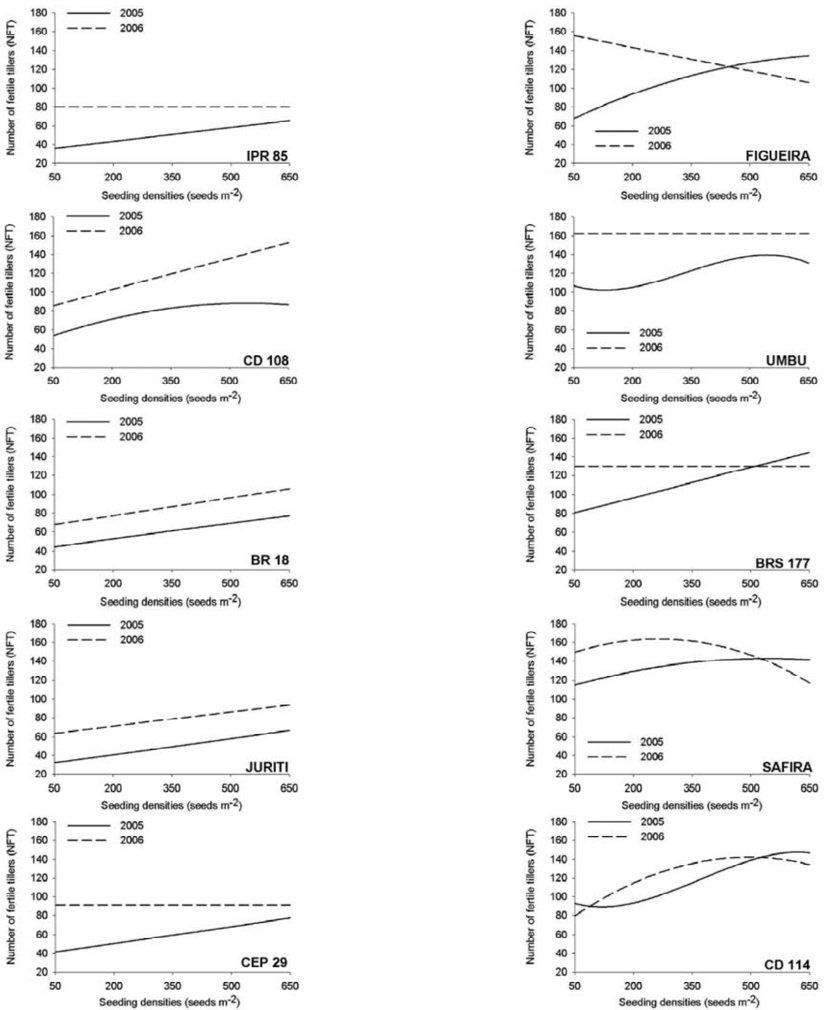
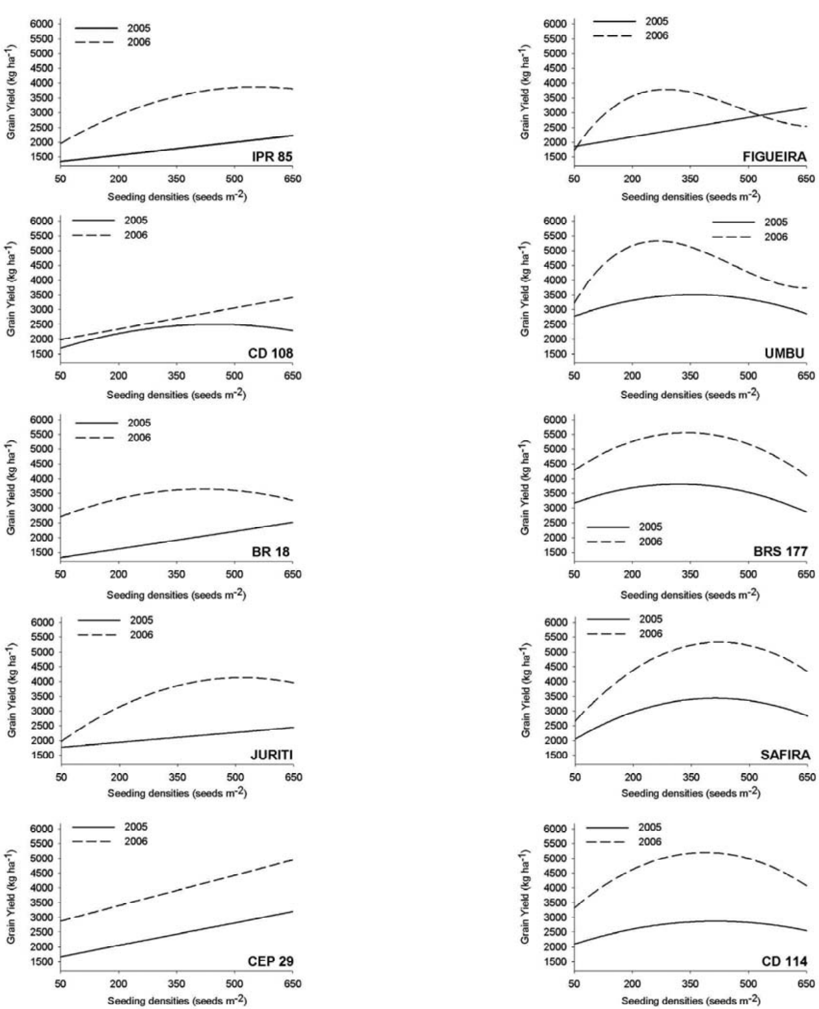
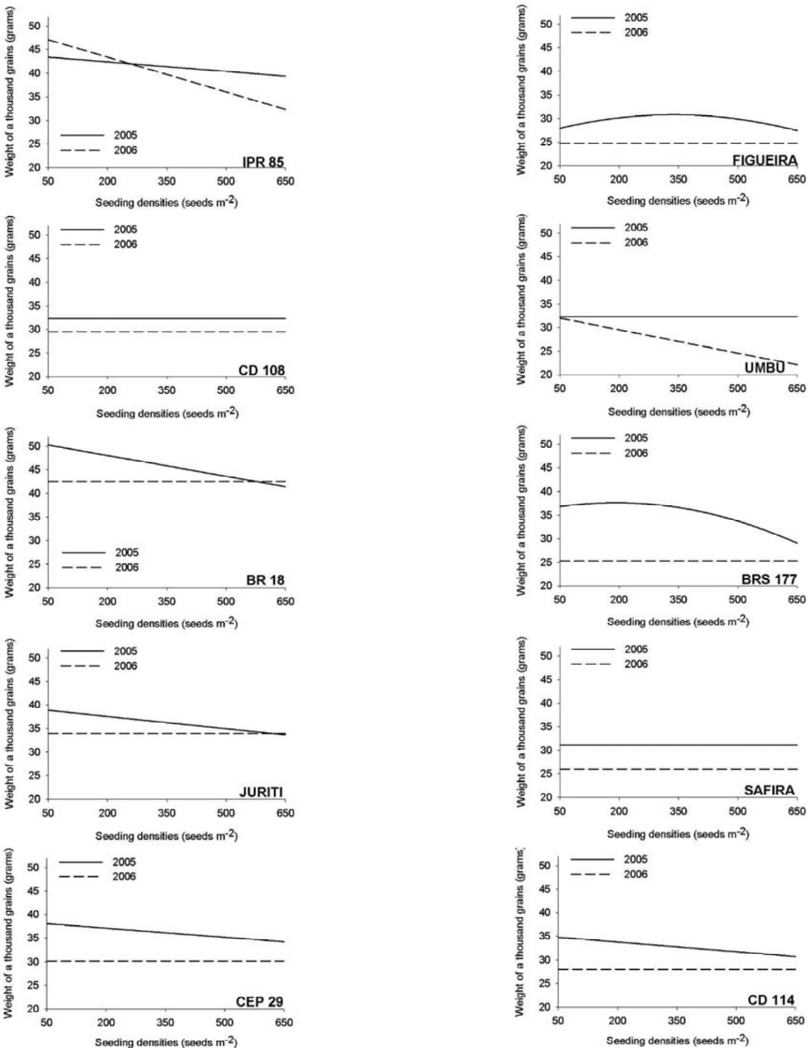
Seeding density adjustments is one of the practices that most influence grain yield, as well as other agronomic traits. Therefore, the objective of this study was to determine the ideal plant stand to achieve the maximum grain yield in genotypes showing differential tillering ability. Also, to establish the associations between the genotypes used with tillering and other agronomically important traits as weight of a thousand grains. Two experiments were conducted in 2005 and 2006 in Capão do Leão, Rio Grande do Sul state, Brazil. Five low (JURITI, BR 18, CEP 29, BR 18 and CD 108) and five high (CD 114, SAFIRA, FIGUEIRA, BRS 177 and UMBU) tillering potential wheat cultivars were tested for two years on a split-plot design. The results indicate the need for recommending cultivars based on more than one year of cultivation, especially when dealing with contrasting genotypes for the trait fertile tillers. Regarding the ideal plant stand, seeding density of low tillering ability genotypes ranges from 417 to 555 seeds m-2, in order to obtain maximum yield and grain weight. On the other hand, for high tillering ability genotypes, the ideal stand ranges from 221 to 422 seeds m-². These results were year independent. Furthermore, low tillering ability genotypes showed a closer association of number of fertile tillers with grain yield. However, an inverse association was found between number of fertile tillers and weight of a thousand grains.
Overview
The claims and statistics of this paper haven’t been checked yet.
Free: it reads the open-access text and checks the first 5 claims that cite a source we can check. Create a free account to check every claim.
Integrity signals
Registry
Cites
Statistics
Figures
Verification
Claims the paper makes
The claims and statistics of this paper haven’t been checked yet.
Free: it reads the open-access text and checks the first 5 claims that cite a source we can check. Create a free account to check every claim.
Claims other papers make about this one
Each is checked against this paper’s own text: does it say what the citing paper says it does?
The cited source says what the claim attributes to it.
In the citing paper
“Previous studies showed the optimum plant density depended on the cultivar’s tillering potential [4, 44], yield of a cultivar at very low planting density (i.e.: plant yield efficiency; [41]), and to lesser extent differences in leaf insertion angle (i.e.: planophile or erectophile; [16]).”
From A Bayesian framework to model variance of grain yield response to plant density (2025) · cites this paper as [44]
The cited source says what the claim attributes to it.
In the citing paper
“The model described in Eqs. 1–3 can be easily adapted to commonly used experimental designs of agricultural experiments, such as experiments testing the interaction of plant density and genotype (i.e. [44]:) or row spacing (i.e. [16]:).”
From A Bayesian framework to model variance of grain yield response to plant density (2025) · cites this paper as [44]
The cited source says what the claim attributes to it.
In the citing paper
“Another limitation of this study is that we evaluated a single cultivar, thus ignoring cultivar × plant density interactions that can occur in wheat [2, 15, 41, 44].”
From A Bayesian framework to model variance of grain yield response to plant density (2025) · cites this paper as [44]
Self-check
Percentages, sums and reported differences re-computed from the paper’s own numbers.
The self-check needs the paper’s full text.
Citations
Cites
Moreno, J. A. (2014) · Boletim Geográfico do Rio Grande do Sul · Cited by 829
Arduini, I., Masoni, A., Ercoli, L., & Mariotti, M. (2006) · European Journal of Agronomy · doi:10.1016/j.eja.2006.06.009 · Cited by 301 · cited 1×
“, the density in which the maximum yield was reached, a slight increase in grain nitrogen was observed, without any changes in the overall grain nutrition value (Arduini et al., 2006).”
BackgroundQuantitative Characterization of Vegetative Development in Small Cereal Grains1
Klepper, B., Rickman, R. W., & Peterson, C. M. (1982) · Agronomy Journal · doi:10.2134/agronj1982.00021962007400050005x · Cited by 253 · cited 1×
“Furthermore, the ideal should take into account environmental conditions, such as altitude, temperature, soil and seeding time (Klepper et al., 1982; Gade, 1995).”
Background(1985) · Springer eBooks · doi:10.1007/978-1-4899-3665-3 · Cited by 215
The physiological response of winter wheat to reductions in plant density
WHALEY, J. M., SPARKES, D. L., FOULKES, M. J., SPINK, J. H., SEMERE, T., & SCOTT, R. K. (2000) · Annals of Applied Biology · doi:10.1111/j.1744-7348.2000.tb00048.x · Cited by 184 · cited 2×
“Also, it provides an increase in green area for the plant, leading to an improvement in capturing radiation (Whaley et al., 2000).”
BackgroundPatterns of tillering and grain production of winter wheat at a wide range of plant densities.
Darwinkel, A. (1978) · Netherlands Journal of Agricultural Science · doi:10.18174/njas.v26i4.17081 · Cited by 170 · cited 1×
“This will be achieved with the ideal interaction with the environment, through plant competition for light, water and nutrients (Darwinkel, 1978).”
BackgroundLloveras, J., Manent, J., Viudas, J., López, A., & Santiveri, P. (2004) · Agronomy Journal · doi:10.2134/agronj2004.1258 · Cited by 166 · cited 5×
“Similar results are found in the literature, highlighting the lower GY of cultivars grown in dry winters, showing reduced tillering and reduced ear numbers (Lloveras et al., 2004).”
BackgroundResultInfluentialStraw Production and Grain Yield Relationships in Winter Wheat
Donaldson, E., Schillinger, W. F., & Dofing, S. M. (2001) · Crop Science · doi:10.2135/cropsci2001.411100x · Cited by 152 · cited 1×
“Distinct reports are found in the literature, where the character WTG appears to be the less affected by seeding density in wheat (Donaldson et al., 2001; Lloveras et al., 2004; Hiltbrunner et al., 2005 and Ozturk et al., 2006) and also in rice (Souza & Azevedo, 1994).”
BackgroundÖztürk, A., Çağlar, Ö., & Bulut, S. (2006) · Journal of Agronomy and Crop Science · doi:10.1111/j.1439-037x.2006.00187.x · Cited by 151 · cited 8×
“On the other hand, this character is highly influenced by the seeding time, which results in longer or shorter periods for grain filling (Ozturk et al., 2006).”
BackgroundResultInfluentialSeeding Rate and Genotype Effect on Agronomic Performance and End-Use Quality of Winter Wheat
Geleta, B., Atak, M., Baenziger, P. S., Nelson, L. A., Baltenesperger, D. D., Eskridge, K. M., Shipman, M. J., & Shelton, D. R. (2002) · Crop Science · doi:10.2135/cropsci2002.0827 · Cited by 145 · cited 1×
“Similar results were found by other investigations, reaching 33% (Geleta et al., 2002) and 49.3% (Ozturk et al., 2006) of increase in GY as a function of increase in density.”
ResultInfluentialThorne, G. N., & Wood, D. W. (1987) · Annals of Botany · doi:10.1093/oxfordjournals.aob.a087330 · Cited by 122 · cited 1×
“Several authors point high temperatures as major causes for tillering reduction (Cannell, 1969; Thorne & Wood, 1987; Hucl Sci. Agric.”
BackgroundCompetition Among Tillers in Winter Wheat: Consequences for Growth and Development of the Crop
Masle, J. (1985) · Springer eBooks · doi:10.1007/978-1-4899-3665-3_4 · Cited by 111 · cited 1×
“The higher tillering potential verified for FIGUEIRA, UMBU, CD 114, SAFIRA and BRS 177, in different seeding densities, indicates the best performance of these genotypes in reduced densities, likely due to a better water and nitrogen use (Masle, 1985).”
BackgroundDoes light quality initiate tiller death in wheat?
Sparkes, D. L., Holme, S. J., & Gaju, O. (2005) · European Journal of Agronomy · doi:10.1016/j.eja.2005.08.003 · Cited by 79 · cited 1×
“, v.66, n.1, p.28-39, January/February 2009 In highly populated conditions, there is a better closing of the canopy which absorbs red light in its upper part and allows far-red light to penetrate the inferior layers, shutting down tiller growth (Sparkes et al., 2006).”
BackgroundRow Spacing and Seeding Rate Effects on Yield and Yield Components of Soft Red Winter Wheat1
Joseph, K. D. S. M., Alley, M. M., Brann, D. E., & Gravelle, W. D. (1985) · Agronomy Journal · doi:10.2134/agronj1985.00021962007700020009x · Cited by 75 · cited 1×
“, v.66, n.1, p.28-39, January/February 2009 200-280 seeds m–2 (Ellen, 1990; Lock, 1993) and with 400 seeds m–2 (Joseph et al., 1985).”
Epidermal Cell Division and the Coordination of Leaf and Tiller Development
Skinner, R. H., & Nelson, C. J. (1994) · Annals of Botany · doi:10.1093/aob/74.1.9 · Cited by 74 · cited 1×
“According to Skinner & Nelson (1994), light acts as an early signal in cell division and causes a higher leaf growth which is correlated with new leaf and tiller formation.”
BackgroundWood, G. A., Welsh, J. P., Godwin, R. J., Taylor, J. C., Earl, R., & Knight, S. M. (2003) · Biosystems Engineering · doi:10.1016/s1537-5110(03)00006-0 · Cited by 73 · cited 1×
“Similar results have been found with 250 seeds m–2, with higher GY as compared to higher densities (Wood et al., 2003).”
ResultEffect of sowing date and seed rate on crop development and grain production of winter wheat.
Darwinkel, A., Hag, B. A. T., & Kuizenga, J. (1977) · Netherlands Journal of Agricultural Science · doi:10.18174/njas.v25i2.17134 · Cited by 72
Cannell, R. Q. (1969) · The Journal of Agricultural Science · doi:10.1017/s0021859600024837 · Cited by 57 · cited 1×
“Several authors point high temperatures as major causes for tillering reduction (Cannell, 1969; Thorne & Wood, 1987; Hucl Sci. Agric.”
BackgroundEffects of row spacing and liquid manure on directly drilled winter wheat in organic farming
Hiltbrunner, J., Liedgens, M., Stamp, P., & Streit, B. (2004) · European Journal of Agronomy · doi:10.1016/j.eja.2004.06.003 · Cited by 55 · cited 1×
“Distinct reports are found in the literature, where the character WTG appears to be the less affected by seeding density in wheat (Donaldson et al., 2001; Lloveras et al., 2004; Hiltbrunner et al., 2005 and Ozturk et al., 2006) and also in rice (Souza & Azevedo, 1994).”
BackgroundGrowth of Tiller Buds in Barley: Effects of Shade Treatment and Mineral Nutrition
FLETCHER, G. M., & Dale, J. E. (1974) · Annals of Botany · doi:10.1093/oxfordjournals.aob.a084802 · Cited by 52 · cited 2×
“For wheat and barley, McCall (1934) and Fletcher & Dale (1974) also suggested that vascular connection failures between the tiller and the whole plant would be the main reason for its retarded growth.”
BackgroundTime Distributions for Describing Appearance of Specific Culms of Winter Wheat1
Rickman, R. W., Klepper, B., & Peterson, C. M. (1983) · Agronomy Journal · doi:10.2134/agronj1983.00021962007500030031x · Cited by 47 · cited 1×
“Such effects have been observed in favorable and unfavorable conditions, where there is an uniform/disuniform culm population and regularly/irregularly spaced tillers, respectively (Rickman et al., 1983).”
BackgroundRow‐Spacing and Seeding‐Rate Effects on Wheat Yields in the Mid‐South
Freeze, D. M., & Bacon, R. K. (1990) · jpa · doi:10.2134/jpa1990.0345 · Cited by 46 · cited 2×
“This compensatory effect has special importance when related to yield (Freeze & Bacon, 1990).”
BackgroundEffect of Temperature and Fertilizer N on Apex Development in Spring Wheat1
Frank, A. B., & Bauer, A. (1982) · Agronomy Journal · doi:10.2134/agronj1982.00021962007400030024x · Cited by 43 · cited 1×
“This behavior can be a reflex of the physiological fitness in which the tillers are produced, prioritizing nutrition for the main culm instead tillers (Frank & Bauer, 1982).”
BackgroundEFFECT OF SEEDING DEPTH AND TEMPERATURE ON TILLERING CHARACTERISTICS OF FOUR SPRING WHEAT CULTIVARS
Hucl, P. J., & Baker, R. J. (1990) · Canadian Journal of Plant Science · doi:10.4141/cjps90-048 · Cited by 16
Ellen, J. (1990) · Journal of Agronomy and Crop Science · doi:10.1111/j.1439-037x.1990.tb00804.x · Cited by 13 · cited 1×
“, v.66, n.1, p.28-39, January/February 2009 200-280 seeds m–2 (Ellen, 1990; Lock, 1993) and with 400 seeds m–2 (Joseph et al., 1985).”
de Souza, A. F., & de Azevedo, S. M. (1994) · Pesquisa Agropecuária Brasileira · Cited by 1
Research works printed but not linked: 3
- 20. LOCK, A.A. Management strategies for winter wheat: limitation of yield, seeding rate and nitrogen timing. Aspects of Applied Biology, v.34, p.309-317, 1993.
- 24. McCALL, M.A. Developmental anatomy and homologies in wheat. Journal of Agricultural Research, v.48, p.283-321, 1934.
- 26. MOTA, F.S. Clima, tecnologia e produtividade do trigo no Brasil. In: MOTA, F.S. Agrometeorologia do trigo no Brasil. Campinas: Sociedade Brasileira de Agrometeorologia, 1989. p.1- 35.
Cited by
Bastos, L. M., Carciochi, W., Lollato, R. P., Jaenisch, B. R., Rezende, C. R., Schwalbert, R., Vara Prasad, P. V., Zhang, G., Fritz, A. K., Foster, C., et al. (2020) · Frontiers in Plant Science · doi:10.3389/fpls.2020.00054 · Cited by 164
“Surprisingly, the AOPD at high YE changed with the TP. Similarly, Valério et al. (2009) reported greater seeding rates needed to obtain maximum yield for low TP genotypes, compared to high TP (417 to 555 vs. 221 to 422 seeds m-2, respectively), with similar findings by Mehring (2016) and Balla…”
ResultHigh-throughput phenotyping early plant vigour of winter wheat
Kipp, S., Mistele, B., Baresel, J. P., & Schmidhalter, U. (2013) · European Journal of Agronomy · doi:10.1016/j.eja.2013.08.009 · Cited by 135
Seeding density in wheat: the more, the merrier?
Valério, I. P., de Carvalho, F. I. F., Benin, G., da Silveira, G., da Silva, J. A. G., Nörnberg, R., Hagemann, T. R., Luche, H. D. S., & de Oliveira, A. C. (2013) · Scientia Agricola · doi:10.1590/s0103-90162013000300006 · Cited by 87
“This competition is markedly higher than the one that occurs for low tillering ability genotypes, decreasing nutrient uptake and leading to higher lodging and disease rates (Ozturk et al., 2006; Valerio et al., 2009).”
BackgroundSelf-citationWilke, N., Siegmann, B., Postma, J. A., Muller, O., Krieger, V., Pude, R., & Rascher, U. (2021) · Computers and Electronics in Agriculture · doi:10.1016/j.compag.2021.106380 · Cited by 59
Hu, Y., Ren, T., Li, Z., Tang, Y., Ren, Z. L., & Yan, B. (2017) · Gene · doi:10.1016/j.gene.2017.08.039 · Cited by 59
Metadata
- Authors
- Valério, I. P., Carvalho, F. I. F. D., Oliveira, A. C. D., Benin, G., Souza, V. Q. D., Machado, A. D. A., Bertan, I., Busato, C. C., Silveira, G. D., & Fonseca, D. A. R.
- Affiliations
- Universidade Federal de Pelotas (BR)
- Universidade Tecnológica Federal do Paraná (BR)
- UFPel, Brasil
- Venue
- Scientia Agricola
- Publisher
- FapUNIFESP (SciELO)
- Published
- 2009-02
- Volume
- 66
- Issue
- 1
- Pages
- 28-39
- ISSN
- 0103-9016 (ISSN-L)
- OpenAlex
- W2161488643
- Cited by
- 62
- References
- 26
- Citations by year
- 2026: 4 · 2025: 6 · 2024: 4 · 2023: 4 · 2022: 6 · 2021: 5 · 2020: 6 · 2018: 4 · 2017: 8 · 2016: 2 · 2015: 4 · 2014: 4 · 2013: 2 · 2012: 3
- FWCI
- 2.12
- Type
- journal article
- Language
- en
- Open access
- gold
- doi.org
- Licence
- cc-by-nc
- Locations
- Scientia Agricola (publishedVersion, cc-by-nc)
- LA Referencia (Red Federada de Repositorios Institucionales de Publicaciones Científicas) (publishedVersion)
- LA Referencia (Red Federada de Repositorios Institucionales de Publicaciones Científicas) (publishedVersion, other-oa)
- Americanae (AECID Library) (submittedVersion, other-oa)
- DOAJ (DOAJ: Directory of Open Access Journals) (submittedVersion, cc-by-sa)
- Funders
- Coordenação de Aperfeiçoamento de Pessoal de Nível Superior
- Conselho Nacional de Desenvolvimento Científico e Tecnológico
- Fundação de Amparo à Pesquisa do Estado do Rio Grande do Sul
- Topics
- Life Sciences › Agricultural and Biological Sciences › Agronomy and Crop Science › Crop Yield and Soil Fertility
- Life Sciences › Agricultural and Biological Sciences › Plant Science › Wheat and Barley Genetics and Pathology
- Life Sciences › Agricultural and Biological Sciences › Plant Science › Genetics and Plant Breeding
- Keywords
- wheat, seeding rate, grain yield, productive tillers, cultivar recommendation, gene-environment interaction, agronomic traits
About these checks
Registry, retraction, Cites and statistics results are computed, not judged, with one exception: a printed reference that no index lists is read once by a model before it counts as a citation error. Claims are extracted by a model and kept only when their quote appears verbatim in the text; each cited source is then checked, with a model’s help, for whether it says what the claim relies on. Those verdicts can be wrong — read the claim’s quote and the cited source before relying on one.
Statistics and arithmetic are recomputed, not judged.
Confidence bands are shown only for fields calibrated on our annotated test set. None is calibrated yet, so no band is shown.
What counts as a claim ›How we measure confidence ›How we check this ›
Are you an author, or do you see a problem with this page? Request a review
Data sources
Bibliographic data: Semantic Scholar, OpenAlex, Crossref.
Contains information from the Semantic Scholar Academic Graph Datasets, made available under the ODC Attribution License (ODC-BY 1.0).
Semantic Scholar’s data is described in: Kinney, R., et al. (2023). The Semantic Scholar Open Data Platform. arXiv:2301.10140.
