

Sulfate attack testing approaches from concrete to cement paste: A review by RILEM TC 298-EBD
Open accessThe DOI matches its Crossref record; 119 of the 119 references it cites were found in a registry or an index; none of the 123 sources its claims cite is checked for support yet.
Abstract
Most existing test methods determine the sulfate resistance of concrete using accelerated methods in the laboratory, on mortar or concrete specimens. However, these accelerated tests often use high sulfate concentrations or require very complicated setups, which may alter the deterioration mechanisms, while still being laborious and time-consuming. Additionally, the need for more sustainable binders and distinctive properties of systems incorporating emerging supplementary cementitious materials (SCMs) may limit the applicability of conventional test methods. In this context, the Working Group 3 of RILEM TC 298-EBD aims to develop simple accelerated test methods on cement pastes for evaluating sulfate resistance, which directly investigate the reactive component of concrete. Working at this scale can provide reliable results in a much shorter time than traditional tests on mortars and concretes, while providing means to assess the impact of different SCMs and binders on the resistance to sulfate attack. This paper presents our first step, a critical literature review on sulfate deterioration testing from the concrete/mortar to the cement paste scale. We present a general introduction to sulfate attack, common test parameters, assessment methods, test setups for paste specimens, a discussion of potential approaches, and concluding remarks. Insights gained from this review will be instrumental in establishing an effective and reliable approach to sulfate deterioration testing on cement paste specimens.
Overview
CoChat Summary
TL;DR
This RILEM TC 298-EBD Working Group 3 review assesses sulfate attack testing across concrete, mortar, and cement paste scales, arguing that paste-scale tests can accelerate evaluation of sulfate resistance while preserving degradation mechanisms. It reviews common test parameters, degradation assessment methods, and paste-scale setups, concluding that small paste specimens at realistic low sulfate concentrations may support performance-based binder specifications.
Key findings
- Existing standard sulfate tests mostly use mortar or concrete and accelerated conditions: ASTM C1012 uses 50 g/L Na₂SO₄ and can require 6–12 months or longer, while field sulfate concentrations are often ≤3 g/L, with examples up to 15 g/L SO₄²⁻ in western Canada, 35 g/L in parts of the western/southwestern US, and 7 g/L in western China. High concentrations can alter deterioration mechanisms.
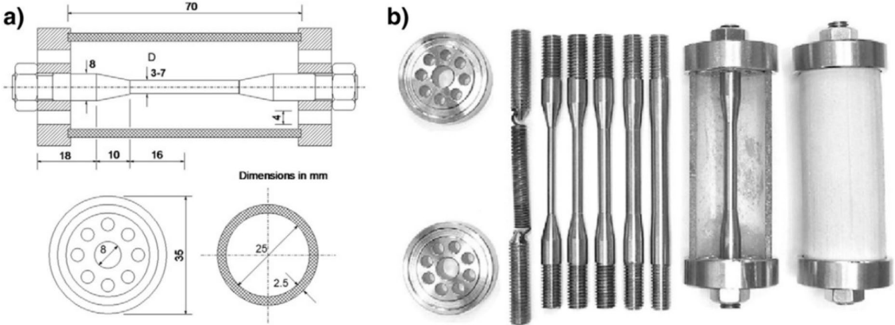
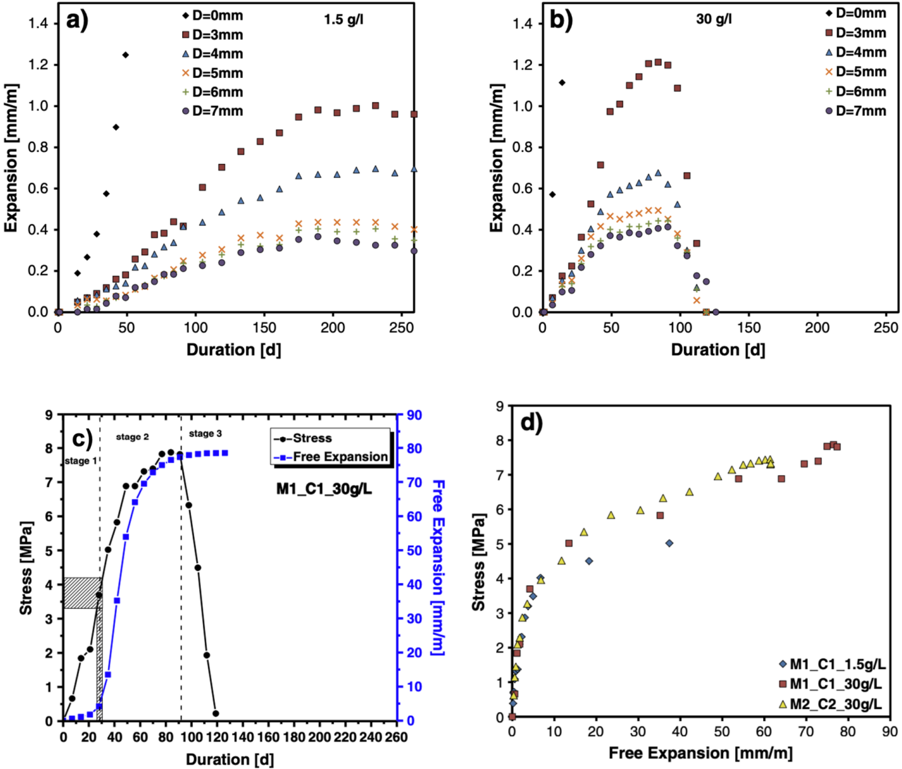
- Paste-scale methods show acceleration: the Koch-Steinegger method uses 10 × 10 × 60 mm paste/mortar specimens, 10 wt.% Na₂SO₄·10H₂O, and a <30% strength-loss criterion after 56 days; Ferraris found 0.1% expansion in paste at 15 days versus 49 days in mortar, and in fly ash paste at 10 days versus 55 days in mortar. Hollow-cylinder tests measured maximum expansion stress of 8 MPa in mortar and up to 13 MPa in hardened cement paste.
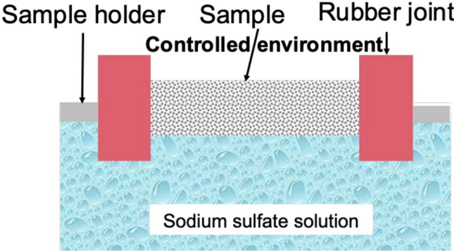
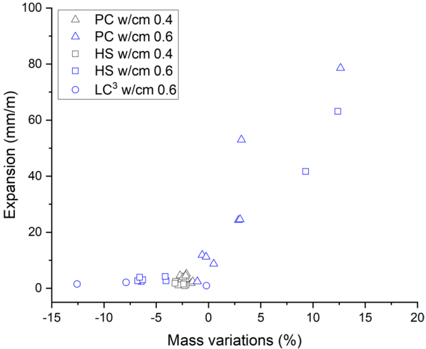
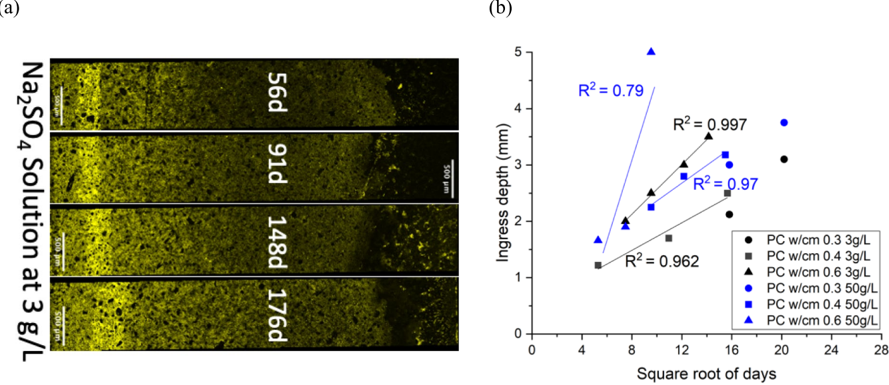
- The unidirectional penetration approach detected sulfate penetration beyond 3 mm at 3 g/L and w/cm 0.6, triggering 20 mm/m expansion; PC paste showed significant expansion with S/Ca > 0.20, while LC₃ paste showed no detectable expansion with S/Ca < 0.15. UPV decreased after 90 days in 8% sodium sulfate or 150 days in 5% sodium sulfate, and dynamic modulus decreased from 18 to 14 GPa after 150 days in 5% sodium sulfate.
- The review recommends small paste specimens with low w/cm (e.g., 0.4), low sulfate concentration (e.g., 3 g/L), and a few mm thickness for relatively rapid intrinsic sulfate resistance assessment; multiple tests may be needed, one for expansion and another for water absorption/drying, because expansion-resistant materials can be susceptible to salt crystallization attack.
Methods
- Design: Review by RILEM TC 298-EBD Working Group 3, comparing sulfate attack test parameters, degradation assessment methods, and test setups from concrete and mortar down to cement paste; no new experimental data are reported.
- Data/sample: Literature and standards on sulfate attack testing, including ASTM C452, ASTM C1012/C1012M, CSA A3004-C6/C8, DIN 19573, SIA 262/1, and GB/T 50082-2024, plus paste-scale methods such as Koch-Steinegger, hollow cement paste cylinders, unidirectional penetration, Mehta’s paste cubes, and an injection/oedometric cell method.
- Main analysis: Narrative synthesis and comparison of advantages, disadvantages, selected results, and feasibility of paste-scale sulfate testing, with discussion of acceleration approaches and links between paste, mortar, and concrete scales.
Limitations
- Stated in paper: There is no universally accepted method for measuring porosity, no unified sulfate-testing standards in regions such as the European Union, and laboratory and field results are known to widely diverge; paste specimens also lack the aggregate–paste interfacial transition zone and aggregate effects, and bleeding can be a problem at high w/cm.
- Stated in paper: Some paste-scale methods have repeatability or reproducibility concerns: the Ferraris paste expansion test was not robust in interlaboratory testing, Mehta’s paste cube method gave low reproducibility and contradictory results, and the reproducibility of the injection method is unclear; linking paste-scale results to concrete scale requires further investigation.
- Evident from text: The review is qualitative and does not report a systematic search protocol or quantitative meta-analysis; many cited results come from varied exposure conditions, specimen geometries, and binder systems, which limits direct comparability across studies.
Model-written summary. Check it against the paper before relying on it.
Integrity signals
Registry
Cites
Statistics
Figures

Verification
Claims the paper makes
0 Valid · 7 Not valid · 80 Not checked · 100 Own results and interpretations
A result the paper states — it cites no source for it, so there is none to check. The quote shows it is in the paper.
In the paper
“Concrete with a very low w/cm (e.g., w/cm = 0.3) shows negligible mass gain/loss”
§ Sulfate attack testing approaches from concrete to cement paste: A review by RILEM TC 298-EBD > 3.3 Mass changes
plain- Asserted: passes — The authors put it forward as true.
- Checkable: passes — It can be checked against evidence.
- Load-bearing: unclear — It is unclear whether the paper’s conclusions depend on it.
- Based: passes — The paper gives a reason why it holds.
In the paper
“Zhu et al. observed a decrease in UPV only after 90 days of exposure to an 8% sodium sulfate solution [97]”
§ Sulfate attack testing approaches from concrete to cement paste: A review by RILEM TC 298-EBD > 3.5 Non-destructive testing/evaluation methods
What the sources say
- Not checked yetcites [97] Zhu J, Cao YH, Chen JY (2013) Study on the evolu- tion of dynamic mechanics properties of cement mortar under sulfate attack. Constr Build Mater 43:286-292. https:// doi. org/ 10. 1016/J. CONBU ILDMAT. 2013. 02. 027 source
plainstates a cause- Asserted: passes — The authors put it forward as true.
- Checkable: passes — It can be checked against evidence.
- Load-bearing: unclear — It is unclear whether the paper’s conclusions depend on it.
- Based: passes — The paper gives a reason why it holds.
A result the paper states — it cites no source for it, so there is none to check. The quote shows it is in the paper.
In the paper
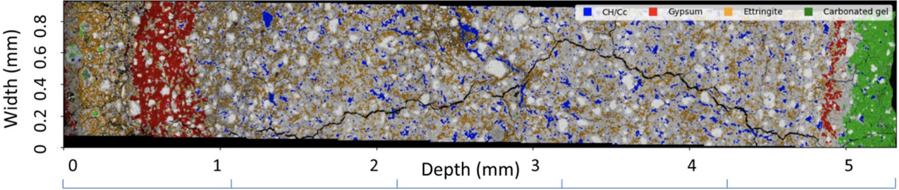
“Macroscopic behaviors were linked to microstructural changes, such as sulfate ingress depth, ingress rate, and gypsum presence.”
§ Sulfate attack testing approaches from concrete to cement paste: A review by RILEM TC 298-EBD > 3.3 Mass changes
plainstates an association- Asserted: passes — The authors put it forward as true.
- Checkable: passes — It can be checked against evidence.
- Load-bearing: unclear — It is unclear whether the paper’s conclusions depend on it.
- Based: passes — The paper gives a reason why it holds.
None of the sources cited for this claim have been checked yet.
In the paper
“although it has been found not to be directly linked to the expansion level [1,31,94].”
§ Sulfate attack testing approaches from concrete to cement paste: A review by RILEM TC 298-EBD > 3.3 Mass changes
What the sources say
- Not checked yetcites [1] Yu C, Sun W, Scrivener K (2013) Mechanism of expan- sion of mortars immersed in sodium sulfate solutions. Cem Concr Res 43:105-111. https:// doi. org/ 10. 1016/J. CEMCO NRES. 2012. 10. 001 source
- Not checked yetcites [31] Gollop RS, Taylor HFW (1995) Microstructural and microanalytical studies of sulfate attack III. Sulfate- resisting portland cement: reactions with sodium and magnesium sulfate solutions. Cem Concr Res 25:1581- 1590. https:// doi. org/ 10. 1016/ 0008-8846(95) 00151-2 source
- Not checked yetcites [94] Min D, Mingshu T (1994) Formation and expansion of ettringite crystals. Cem Concr Res 24:119-126. https:// doi. org/ 10. 1016/ 0008-8846(94) 90092-2 source
plain- Asserted: passes — The authors put it forward as true.
- Checkable: passes — It can be checked against evidence.
- Load-bearing: unclear — It is unclear whether the paper’s conclusions depend on it.
- Based: passes — The paper gives a reason why it holds.
None of the sources cited for this claim have been checked yet.
In the paper
“This zonation phenomenon was widely identified in experiments on samples undergoing external sulfate degradation [30,31].”
§ Sulfate attack testing approaches from concrete to cement paste: A review by RILEM TC 298-EBD > 3.3 Mass changes
What the sources say
- Not checked yetcites [30] Gollop RS, Taylor HFW (1992) Microstructural and microanalytical studies of sulfate attack. I. Ordinary portland cement paste. Cem Concr Res 22:1027-1038. https:// doi. org/ 10. 1016/ 0008-8846(92) 90033-R source
- Not checked yetcites [31] Gollop RS, Taylor HFW (1995) Microstructural and microanalytical studies of sulfate attack III. Sulfate- resisting portland cement: reactions with sodium and magnesium sulfate solutions. Cem Concr Res 25:1581- 1590. https:// doi. org/ 10. 1016/ 0008-8846(95) 00151-2 source
boostedstates an association- Asserted: passes — The authors put it forward as true.
- Checkable: passes — It can be checked against evidence.
- Load-bearing: unclear — It is unclear whether the paper’s conclusions depend on it.
- Based: passes — The paper gives a reason why it holds.
75 more claims
Create a free account to see all 187 claims and to verify the 121 references still open.
- Probably not a substantial claim. 56
- It may state two separate claims as one. 65
- The quote only partly states this claim. 1
Self-check
Percentages, sums and reported differences re-computed from the paper’s own numbers.
Each contradiction between two passages listed here was confirmed by an independent check.
Rated minor: it would not touch a result — a value no result rests on, a p-value that stays on the same side of the significance level, or a conflict that is clerical, resolved elsewhere in the paper, or outside its own findings.
In the paper
§ Sulfate attack testing approaches from concrete to cement paste: A review by RILEM TC 298-EBD > 3.3 Mass changes
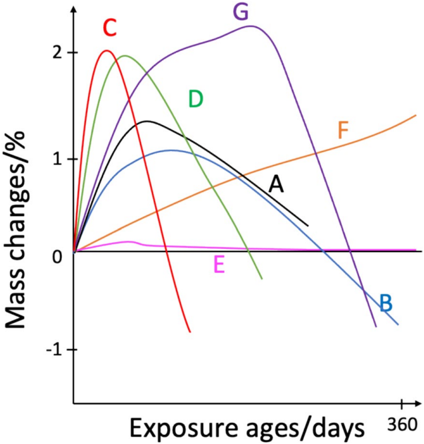
“Specimens with a 0.57 w/cm ratio did not show a slow increase stage, experiencing faster mass decrease due to larger pores and quicker crack formation (curve C in Fig. 4) [90].”
§ Sulfate attack testing approaches from concrete to cement paste: A review by RILEM TC 298-EBD > 3.3 Mass changes
“Portland cement-based concretes exhibited different mass change patterns compared to blended concretes (curve D represents OPC and HS concretes and C represent blended concretes incorporating FA, SF and MK in Fig. 4).”
Cited works that were retracted
Works this paper cites that were later retracted, from the retraction notices publishers deposit. Major when the notice came out before this paper was published.
Rated major: it would touch a result — a value a result rests on, reported and recomputed p-values on opposite sides of the significance level, two passages that conflict with no sign which is right, or a cited work retracted before this paper was published.
In the paper
“Bejaoui S, Bary B (2007) Modeling of the link between microstructure and effective diffusivity of cement pastes using a simplified composite model. Cem Concr Res 37:469–480. https://doi.org/10.1016/J.CEMCONRES.2006.06.004”
Cited work 10.1016/j.cemconres.2006.06.004 · retracted 2007-03-12 · notice 10.1016/j.cemconres.2007.03.001 · this paper published 2025-08-24
Citations
Cites
1 retracted
Béjaoui, S., & Bary, B. (2006) · Cement and Concrete Research · doi:10.1016/j.cemconres.2006.06.004 · Cited by 131
RetractedStress from crystallization of salt
Scherer, G. W. (2004) · Cement and Concrete Research · doi:10.1016/j.cemconres.2003.12.034 · Cited by 969
The confused world of sulfate attack on concrete
Neville, A. (2004) · Cement and Concrete Research · doi:10.1016/j.cemconres.2004.04.004 · Cited by 811
Taylor, H. F. W., Famy, C., & Scrivener, K. L. (2001) · Cement and Concrete Research · doi:10.1016/s0008-8846(01)00466-5 · Cited by 779
Future and emerging supplementary cementitious materials
Snellings, R., Suraneni, P., & Skibsted, J. (2023) · Cement and Concrete Research · doi:10.1016/j.cemconres.2023.107199 · Cited by 606
Self-citationDurability of metakaolin concrete to sulfate attack
Al‐Akhras, N. M. (2006) · Cement and Concrete Research · doi:10.1016/j.cemconres.2006.03.026 · Cited by 463
Does gypsum formation during sulfate attack on concrete lead to expansion?
Tian, B., & Cohen, M. D. (2000) · Cement and Concrete Research · doi:10.1016/s0008-8846(99)00211-2 · Cited by 453
Durability of concrete exposed to leaching and external sulphate attacks
Rozière, E., Loukili, A., El-Hachem, R., & Grondin, F. (2009) · Cement and Concrete Research · doi:10.1016/j.cemconres.2009.07.021 · Cited by 449
Sulfate attack expansion mechanisms
Müllauer, W., Beddoe, R. E., & Heinz, D. (2013) · Cement and Concrete Research · doi:10.1016/j.cemconres.2013.07.005 · Cited by 372
Modeling of Damage in Cement-Based Materials Subjected to External Sulfate Attack. I: Formulation
Tixier, R., & Mobasher, B. (2003) · Journal of Materials in Civil Engineering · doi:10.1061/(asce)0899-1561(2003)15:4(305 · Cited by 359
Research works printed but not linked: 4
- Köch ASH (1960) A rapid test method for cements for their behaviour under sulphate attack. Zem Kalk Gips 7:317-324 103.
- Ferraris CF, Stutzman PE, Snyder KA (2006) Sulfate resistance of concrete: a new approach. R&D Ser 2486:301–313
- Barbarulo R (2002) Comportement des matériaux cimen- taires: actions des sulfates et de la température. France- UniversitéUniversite Laval, Ecole Normale Supérieure de Cachan 118.
- Snellings R, Suraneni P, Skibsted J (2023) Future and emerging supplementary cementitious materials. Cem Concr Res 171:107199. https:// doi. org/ 10. 1016/J. CEMCO NRES. 2023. 107199 135. Li L, Liu W, You Q et al (2020) Waste ceramic pow- der as a pozzolanic supplementary filler of cement for developing sustainable building materials. J Clean Prod 259:120853. https:// doi. org/ 10. 1016/j. jclep ro. 2020. 120853 136. Najjar MF, Nehdi ML, Soliman AM, Azabi TM (2017) Damage mechanisms of two-stage concrete exposed to chemical and physical sulfate attack. Constr Build Mater 137:141-152. https:// doi. org/ 10. 1016/J. CONBU ILD- MAT. 2017. 01. 112 137. Sakr MR, Bassuoni MT (2021) Performance of concrete under accelerated physical salt attack and carbonation. Cem Concr Res 141:106324. https:// doi. org/ 10. 1016/J. CEMCO NRES. 2020. 106324 138. Zhang Z, Jin X, Luo W (2019) Long-term behaviors of concrete under low-concentration sulfate attack subjected to natural variation of environmental climate conditions. Cem Concr Res 116:217-230. https:// doi. org/ 10. 1016/j. cemco nres. 2018. 11. 017 · DOI · Paper page
Cited by
Maganti, T. R., Angoth, A., Purumani, S., Lavanya, D. L., Chowdary, L., & Yendava, P. (2026) · Sustainable Chemistry and Pharmacy · doi:10.1016/j.scp.2026.102375 · Cited by 24
Kong, D., Guo, Q., Zhang, J., Li, W., & Dong, W. (2025) · Construction and Building Materials · doi:10.1016/j.conbuildmat.2025.144266 · Cited by 15
Ramesh, G., Talakokula, V., Jyosyula, S. K. R., & Bansal, T. (2025) · Measurement · doi:10.1016/j.measurement.2025.119359 · Cited by 7
Durability of concrete prepared with low-carbon binders: Perspectives and insights
Machner, A., Suraneni, P., WEERDT, K. D., Krüger, M. E., Wilson, W., & Isgor, O. B. (2026) · Cement and Concrete Research · doi:10.1016/j.cemconres.2026.108273 · Cited by 5
Self-citationSulfate attack on fiber reinforced mortar with cassava peel ash as a partial replacement for cement
Akinpelu, M. A., Ajibade, I. A., Salman, A.-S., Adisa, M. A., & Akanbe, A. W. (2025) · Discover Civil Engineering · doi:10.1007/s44290-025-00370-1 · Cited by 5
Metadata
- Authors
- Wang, Q., Kunther, W., Li, Y., Visalakshi, T., Gomasa, R., Amroun, S., De Souza, D. J., Kasaniya, M., Tole, I., Li, X., Hooton, R. D., Suraneni, P., & Wilson, W.
- Affiliations
- RWTH Aachen University (DE)
- Technical University of Denmark (DK)
- University of Southampton (GB)
- University of Miami (US)
- University of New Brunswick (CA)
- University of Bath (GB)
- BASF (Germany) (DE)
- University of Toronto (CA)
- Université de Sherbrooke (CA)
- Corresponding author
- Wang, Qiao
- ORCID
- Venue
- Materials and Structures
- Published
- 2025-08-24
- Volume
- 58
- Issue
- 7
- Pages
- 232
- ISSN
- 0025-5432 (ISSN-L)
- 1359-5997
- 1871-6873
- OpenAlex
- W4413475607
- Semantic Scholar
- 4f55821a6b9cc0a835bedc547059ef1c7174dc73
- Cited by
- 46
- References
- 114
- Citations by year
- 2026: 40 · 2025: 6
- FWCI
- 12.20
- Type
- journal article
- Language
- en
- Open access
- hybrid
- doi.org
- Licence
- cc-by
- creativecommons.org/licenses/by/4.0 (tdm)
- creativecommons.org/licenses/by/4.0 (vor)
- Locations
- Materials and Structures (publishedVersion, cc-by)
- RWTH Publications (RWTH Aachen) (publishedVersion, other-oa)
- ePrints Soton (University of Southampton) (acceptedVersion)
- Funders
- RWTH Aachen University
- Topics
- Physical Sciences › Engineering › Civil and Structural Engineering › Concrete and Cement Materials Research
- Physical Sciences › Engineering › Civil and Structural Engineering › Concrete Corrosion and Durability
- Physical Sciences › Engineering › Civil and Structural Engineering › Concrete Properties and Behavior
- Keywords
- sulfate attack, sulfate resistance, cement paste, accelerated testing, concrete durability, supplementary cementitious materials, sustainable binders
About these checks
Registry, retraction, Cites and statistics results are computed, not judged, with one exception: a printed reference that no index lists is read once by a model before it counts as a citation error. Claims are extracted by a model and kept only when their quote appears verbatim in the text; each cited source is then checked, with a model’s help, for whether it says what the claim relies on. Those verdicts can be wrong — read the claim’s quote and the cited source before relying on one.
A language model drew the claims from the paper on 2026-11-27, under version 3 of the claim definition (model deepseek-v4.1-flash, prompt extract-v3).
A second model labelled each claim on 2026-11-27 (model jev-1.13-20260917, definition revision gold-guideline-v0.2).
Statistics and arithmetic are recomputed, not judged.
Confidence bands are shown only for fields calibrated on our annotated test set. None is calibrated yet, so no band is shown.
What counts as a claim ›How we measure confidence ›How we check this ›
Are you an author, or do you see a problem with this page? Request a review
How to cite
Cite CoChat for the checks on this page, and the paper for its own findings.
- This page
- CoChat. (2026). Citation check: Sulfate attack testing approaches from concrete to cement paste: A review by RILEM TC 298-EBD. https://app.cochat.ai/papers/10.1617/s11527-025-02759-x
- The paper
- Wang, Q., Kunther, W., Li, Y., Visalakshi, T., Gomasa, R., Amroun, S., De Souza, D. J., Kasaniya, M., Tole, I., Li, X., Hooton, R. D., Suraneni, P., & Wilson, W. (2025). Sulfate attack testing approaches from concrete to cement paste: A review by RILEM TC 298-EBD. Materials and Structures. https://doi.org/10.1617/s11527-025-02759-x
Data sources
Bibliographic data: Semantic Scholar, OpenAlex, Crossref.
Contains information from the Semantic Scholar Academic Graph Datasets, made available under the ODC Attribution License (ODC-BY 1.0).
Semantic Scholar’s data is described in: Kinney, R., et al. (2023). The Semantic Scholar Open Data Platform. arXiv:2301.10140.
