

The DOI matches its Crossref record; the references it cites are not checked yet.
Conglobation in the Pill Bug,Armadillidium vulgare, as a Water Conservation Mechanism
Open accessAbstract
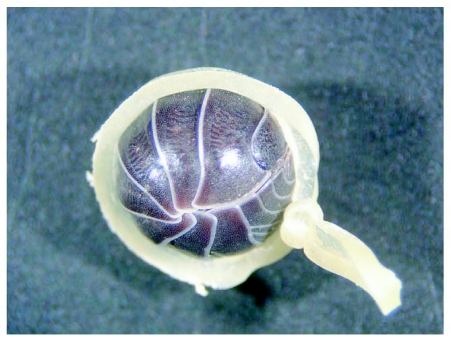
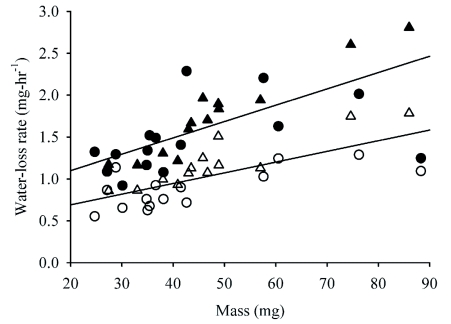
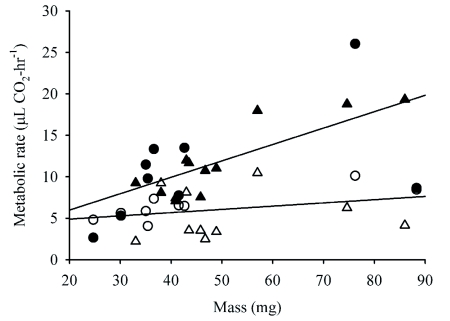
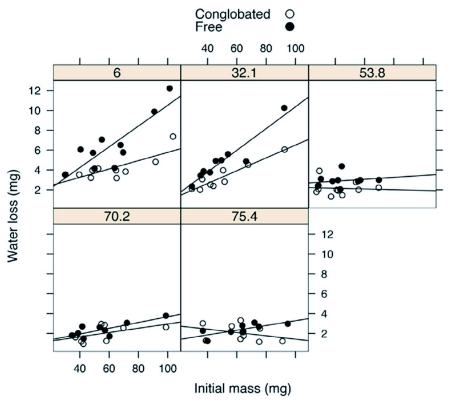
Water balance of the terrestrial isopod, Armadillidium vulgare, was investigated during conglobation (rolling-up behavior). Water loss and metabolic rates were measured at 18 +/- 1 degrees C in dry air using flow-through respirometry. Water-loss rates decreased 34.8% when specimens were in their conglobated form, while CO2 release decreased by 37.1%. Water loss was also measured gravimetrically at humidities ranging from 6 to 75 %RH. Conglobation was associated with a decrease in water-loss rates up to 53 %RH, but no significant differences were observed at higher humidities. Our findings suggest that conglobation behavior may help to conserve water, in addition to its demonstrated role in protection from predation.
Overview
The claims and statistics of this paper haven’t been checked yet.
Run the check — free, no account needed. It reads the open-access text and checks the sources it cites.
Integrity signals
Registry
Cites
Statistics
Figures
Verification
Claims the paper makes
The claims and statistics of this paper haven’t been checked yet.
Run the check — free, no account needed. It reads the open-access text and checks the sources it cites.
Self-check
Percentages, sums and reported differences re-computed from the paper’s own numbers.
The self-check needs the paper’s full text.
Citations
The citation lists are queued
They are fetched later and appear here then.
References 31 · Cited by 50
Research works printed but not linked: 31
- 10.1002/jez.1400450108 · DOI
- Castaneda LE, 2004, Evolutionary Ecology Research, 6, 579
- 10.1111/j.1469-7998.1969.tb02146.x · DOI
- Cloudsley-Thompson JL, 1977, The Water and Temperature Relations of Woodlice Meadowfield Press.
- Edney EB, 1951, Journal of Experimental Biology, 28, 91, 10.1242/jeb.28.1.91 · DOI
- Edney EB, 1953, Journal of Experimental Biology, 30, 331, 10.1242/jeb.30.3.331 · DOI
- 10.1126/science.156.3778.1059 · DOI
- Edney EB, 1968, American Zoologist, 8, 309, 10.1093/icb/8.3.309 · DOI
- Edney EB, 1954, Journal of Experimental Biology, 32, 256, 10.1242/jeb.32.2.256 · DOI
- Edney EB, 1955, Journal of Experimental Biology, 32, 256, 10.1242/jeb.32.2.256 · DOI
- Gibbs AG, 1998, American Zoologist, 38, 471, 10.1093/icb/38.3.471 · DOI
- 10.1016/S0022-1910(02)00059-8 · DOI
- Hadley NF, 1994, Water Relations of Terrestrial Arthropods
- 10.1111/j.1744-7410.2007.00075.x · DOI
- Hoffmann AA, 1993, Evolutionary Genetics and Environmental Stress
- 10.1242/jeb.01023 · DOI · Paper page
- 10.1007/BF00305148 · DOI
- Little C, 1983, The Colonisation of Land: Origins and Adaptations of Terrestrial Animals
- Nair GA, 2003, Entomology Experimental and Applied, 41, 283
- Plum N, 2005, Wetlands, 25, 721, 10.1672/0277-5212(2005)025[0721:TIIFGA]2.0.CO;2 · DOI
- 10.1016/S1146-609X(98)80041-6 · DOI
- Spencer JO, 1954, Journal of Experimental Biology, 31, 491, 10.1242/jeb.31.4.491 · DOI
- Sutton SL, 1980, Woodlice
- Warburg MR, 1993, Evolutionary Biology of Land Isopods, 10.1007/978-3-662-21889-1 · DOI
- 10.2307/1934124 · DOI
- 10.2307/1931961 · DOI
- 10.2307/1542232 · DOI
- Wright JC, 1993, Physiological Zoology, 66, 193, 10.1086/physzool.66.2.30163686 · DOI
- 10.1016/j.cbpa.2006.06.020 · DOI
- 10.1111/j.1365-3032.1997.tb01143.x · DOI
- 10.1023/A:1003005011515 · DOI
Metadata
- Authors
- Smigel, J. T., & Gibbs, A. G.
- Affiliations
- Midwestern University (US)
- University of Nevada, Las Vegas (US)
- ORCID
- Gibbs, Allen G.
- Venue
- Journal of Insect Science
- Publisher
- Oxford University Press (OUP)
- Published
- 2008-05
- Volume
- 8
- Issue
- 44
- Pages
- 1-9
- ISSN
- 1536-2442 (ISSN-L)
- PMC
- PMC3127403
- OpenAlex
- W2130681352
- Cited by
- 50
- References
- 31
- Citations by year
- 2026: 5 · 2025: 4 · 2024: 3 · 2023: 8 · 2022: 6 · 2020: 1 · 2019: 6 · 2018: 4 · 2017: 1 · 2016: 2 · 2015: 3 · 2014: 2 · 2013: 3 · 2012: 1
- FWCI
- 0.29
- Type
- journal article
- Language
- en
- Open access
- gold
- doi.org
- Licence
- cc-by
- Locations
- Journal of Insect Science (publishedVersion, cc-by)
- PubMed Central (publishedVersion, cc-by)
- PubMed (publishedVersion)
- BioOne Complete (BioOne) (submittedVersion)
- Funders
- National Science Foundation (0514402)
- University of Nevada, Las Vegas
- Topics
- Physical Sciences › Environmental Science › Ecology › Physiological and biochemical adaptations
- Physical Sciences › Environmental Science › Ecology › Crustacean biology and ecology
- Life Sciences › Agricultural and Biological Sciences › Ecology, Evolution, Behavior and Systematics › Tardigrade Biology and Ecology
- Keywords
- Armadillidium vulgare, pill bugs, water conservation, water balance, water loss, metabolic rate, humidity, terrestrial isopods, respiration, predator avoidance
- MeSH terms
- Animals, Behavior, Animal, Carbon Dioxide, Escape Reaction, Humidity, Water, Isopoda
About these checks
Registry, retraction, Cites and statistics results are computed, not judged, with one exception: a printed reference that no index lists is read once by a model before it counts as a citation error. Claims are extracted by a model and kept only when their quote appears verbatim in the text; each cited source is then checked, with a model’s help, for whether it says what the claim relies on. Those verdicts can be wrong — read the claim’s quote and the cited source before relying on one.
Statistics and arithmetic are recomputed, not judged.
Confidence bands are shown only for fields calibrated on our annotated test set. None is calibrated yet, so no band is shown.
What counts as a claim ›How we measure confidence ›How we check this ›
Are you an author, or do you see a problem with this page? Request a review
How to cite
Cite CoChat for the checks on this page, and the paper for its own findings.
- This page
- CoChat. (2026). Citation check: Conglobation in the Pill Bug,Armadillidium vulgare, as a Water Conservation Mechanism. https://app.cochat.ai/papers/10.1673/031.008.4401
- The paper
- Smigel, J. T., & Gibbs, A. G. (2008). Conglobation in the Pill Bug,Armadillidium vulgare, as a Water Conservation Mechanism. Journal of Insect Science. https://doi.org/10.1673/031.008.4401
