

The DOI matches its Crossref record; 72 of the 72 references it cites were found in a registry or an index; none of the 63 sources its claims cite is checked for support yet.
Reporting Writing Process Feedback in the Classroom. Using Keystroke Logging Data to Reflect on Writing Processes
Open accessAbstract
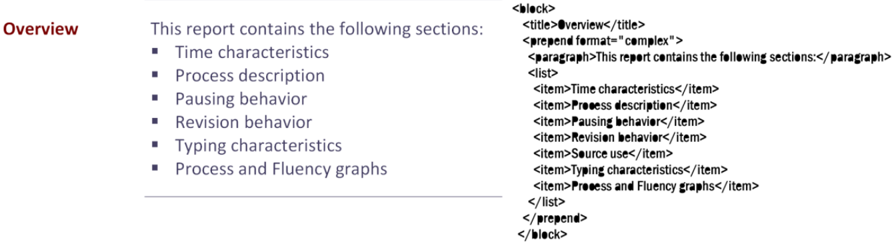
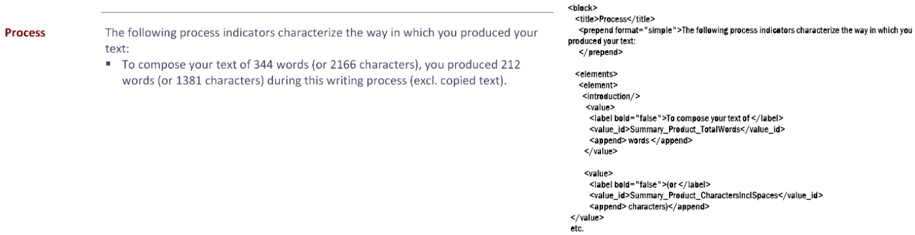
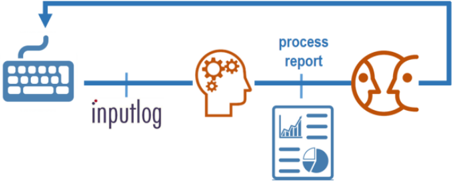
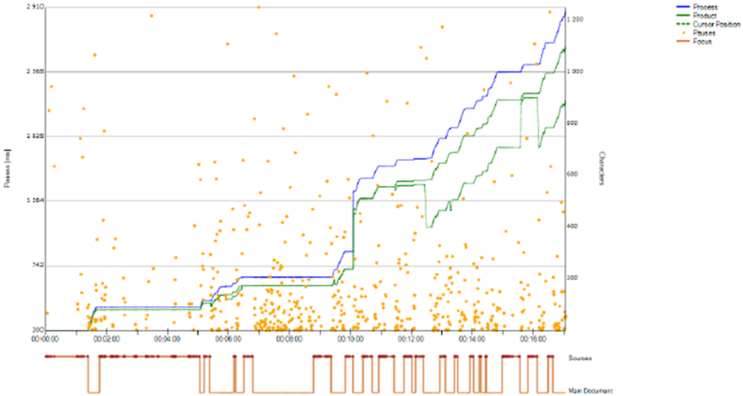
Keystroke loggers facilitate researchers to collect fine-grained process data and offer support in analyzing these data. Keystroke logging has become popular in writing research, and study by study we are now paving the path to a better understanding of writing process data. However, few researchers have concentrated on how to bring keystroke logging to the classroom. Not because they are not convinced that writing development could benefit from a more process-oriented pedagogy, but because 'translating' complex and large data sets to an educational context is challenging. Therefore, we have developed a new function in Inputlog, specifically aiming to facilitate writing tutors in providing process feedback to their students. Based on an XML- logfile, the so-called 'report' function automatically generates a pdf-file addressing different perspectives of the writing process: pausing, revision, source use, and fluency. These perspectives are reported either quantitatively or visually. Brief introductory texts explain the information presented. Inputlog provides a default feedback report, but users can also customize the report. This paper describes the process report and demonstrates the use of it in an intervention. We also present some additional pedagogical scenarios to actively use this type of feedback in writing classes.
Overview
CoChat Summary
TL;DR
The paper presents Inputlog’s process report, a PDF feedback tool that translates keystroke logging data into classroom-oriented feedback on pausing, revision, source use, and fluency, and illustrates its use in an intervention with Dutch grade 10 students. In that intervention, process feedback was associated with significantly better synthesis text quality, with effects comparable to almost one grade of regular schooling.
Key findings
- Inputlog’s process report automatically generates a PDF from an XML logfile, with default or custom templates, addressing pausing, revision, source use, and fluency; no technical background is needed to generate or understand it, and aggregated variables avoid exposing private or sensitive information.
- In the intervention with 33 Dutch grade 10 students, text quality increased from M = 78.07 (SD = 16.10) at Moment 1 to M = 83.32 (SD = 14.06) at Moment 2 and M = 85.78 (SD = 12.82) at Moment 3; repeated measures analysis showed an overall significant effect, F(2,64) = 4.992, p = .010, and Moment 3 was 7.71 points higher than Moment 1, p = .004.
- Effect sizes were small after the first feedback (ES = .35) and moderate after the second feedback (ES = .55); compared with the control condition’s grade 10 progress (ES = .60), the process feedback had an effect comparable to almost one grade of regular schooling.
- Questionnaire data showed that students who wrote better texts reported the feedback gave more insight into time use (r = .546, p = .004) and source use (r = .467, p = .025), evaluated the benchmark comparison positively (r = .394, p = .038), and considered time-use feedback while writing (r = .467, p = .019); self-efficacy increased for dealing with sources, F(1,27) = 6.95, p = .014, and structuring the text, F(1,27) = 6.68, p = .015.
Methods
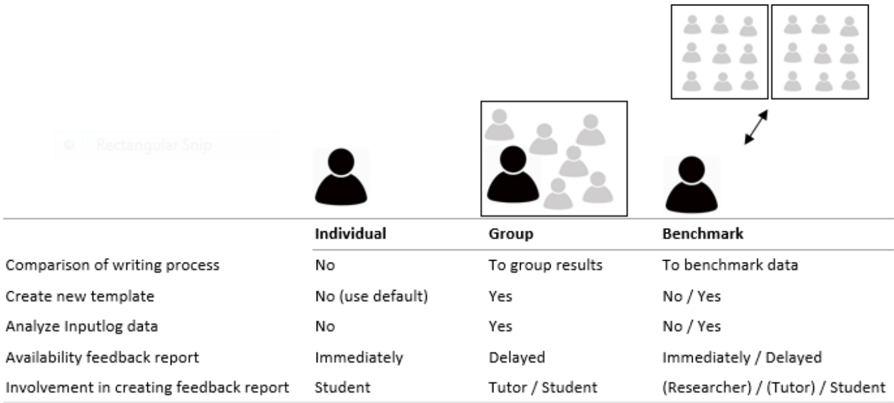
- Design: the paper describes the Inputlog process report and reports an intervention as an illustration; 33 Dutch upper-secondary grade 10 students (18 male, 15 female; average age 15.3 years, SD = .58) from three classes at one school wrote three informative synthesis texts at three measurement occasions within one week, with writing logged and analyzed using Inputlog 7.0; process feedback was given at occasions 2 and 3 before writing a new text, online, individually, within a fixed 30-minute limit.
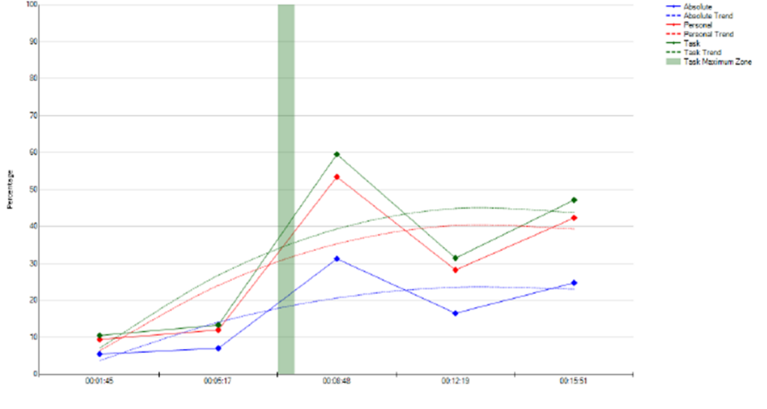
- Materials: a customized process report provided numerical data on 22 process variables and a process graph, grouped into use of time, production and fluency, revision, and source use/source switches; benchmark process graphs came from students scoring 1 SD and 2 SD higher; text quality was rated by three trained raters using a benchmark scale (Cronbach alpha = .73), with final scores as the average of three ratings.
- Analysis: repeated measures analysis and pairwise comparisons, effect sizes, comparison to a national baseline sample of 1081 texts from grades 10–12 without feedback, and questionnaire correlations and self-efficacy ANOVA.
Limitations
- Stated: motivation and novelty effects might have influenced results; no follow-up/long-term effect was tested; the precise effective feedback components are unknown; future studies need to control feedback components separately and control for task effects; revision data are not always fully reliable because logging does not yet fully account for automatic MS Word background operations; more research is needed mapping keystroke features to cognitive processes and investigating tutors’ needs.
- Stated: the process report on its own cannot be considered effective feedback; it should be embedded in a feedback flow with reflection and goal setting.
- Evident from the text: the intervention sample was small (33 students, one school), the intervention lasted one week, and the comparison was to a baseline sample rather than a randomized control group; no delayed posttest is reported.
Model-written summary. Check it against the paper before relying on it.
Integrity signals
Registry
Cites
Statistics
Figures
Verification
Claims the paper makes
0 Valid · 4 Not valid · 35 Not checked · 78 Own results and interpretations
A result the paper reports from its own data — it cites no other source for it, so there is none to check. The quote shows it is in the paper.
In the paper
“Repeated measures analysis showed that the intervention had an overall significant effect on the quality of the written texts (F(2,64) = 4.992; p = .010).”
§ Reporting Writing Process Feedback in the Classroom Using Keystroke Logging Data to Reflect on Writing Processes > 6.5 Results: Effect of the intervention
plainstates a cause- Asserted: passes — The authors put it forward as true.
- Checkable: passes — It can be checked against evidence.
- Load-bearing: passes — The paper’s conclusions depend on it.
- Based: passes — The paper gives a reason why it holds.
A result the paper reports from its own data — it cites no other source for it, so there is none to check. The quote shows it is in the paper.
In the paper
“These analyses allowed us to select a representative set of variables that could be included in the default report.”
§ Reporting Writing Process Feedback in the Classroom Using Keystroke Logging Data to Reflect on Writing Processes > 4.1.2 Content of the default report
plainstates a cause- Asserted: passes — The authors put it forward as true.
- Checkable: passes — It can be checked against evidence.
- Load-bearing: passes — The paper’s conclusions depend on it.
- Based: passes — The paper gives a reason why it holds.
A result the paper reports from its own data — it cites no other source for it, so there is none to check. The quote shows it is in the paper.
In the paper
“We observed a gradual increase of the scores over time.Moment 1: M = 78.07(SD = 16.10);Moment 2: M = 83.32(SD = 14.06);Moment 3: M = 85.78 (SD = 12.82).”
§ Reporting Writing Process Feedback in the Classroom Using Keystroke Logging Data to Reflect on Writing Processes > 6.5 Results: Effect of the intervention
plainstates a cause- Asserted: passes — The authors put it forward as true.
- Checkable: passes — It can be checked against evidence.
- Load-bearing: passes — The paper’s conclusions depend on it.
- Based: passes — The paper gives a reason why it holds.
None of the sources cited for this claim have been checked yet.
In the paper
“The current selection in the default report is mainly based on a set of studies in which we explored different aspects of writing dynamics (Baaijen et al., 2014;Leijten, Bernolet, et al., 2019;Van Waes & Leijten, 2015).”
§ Reporting Writing Process Feedback in the Classroom Using Keystroke Logging Data to Reflect on Writing Processes > 4.1.2 Content of the default report
What the sources say
plain- Asserted: passes — The authors put it forward as true.
- Checkable: passes — It can be checked against evidence.
- Load-bearing: unclear — It is unclear whether the paper’s conclusions depend on it.
- Based: passes — The paper gives a reason why it holds.
A result the paper reports from its own data — it cites no other source for it, so there is none to check. The quote shows it is in the paper.
In the paper
“The effect size for the difference in text quality scores between grade 10 and grade 11 was .60.”
§ Reporting Writing Process Feedback in the Classroom Using Keystroke Logging Data to Reflect on Writing Processes > 6.5 Results: Effect of the intervention
plain- Asserted: passes — The authors put it forward as true.
- Checkable: passes — It can be checked against evidence.
- Load-bearing: passes — The paper’s conclusions depend on it.
- Based: passes — The paper gives a reason why it holds.
20 more claims
Create a free account to see all 117 claims and to verify the 51 references still open.
- Probably not a substantial claim. 81
- It may state two separate claims as one. 32
- The quote only partly states this claim. 2
Citations
Cites
Hattie, J., & Timperley, H. (2007) · Review of Educational Research · doi:10.3102/003465430298487 · Cited by 12,905
Nicol, D. J., & Macfarlane‐Dick, D. (2006) · Studies in Higher Education · doi:10.1080/03075070600572090 · Cited by 5,846
Formative assessment and the design of instructional systems
Sadler, D. R. (1989) · Instructional Science · doi:10.1007/bf00117714 · Cited by 4,285
Feedback and Self-Regulated Learning: A Theoretical Synthesis
Butler, D. L., & Winne, P. H. (1995) · Review of Educational Research · doi:10.3102/00346543065003245 · Cited by 3,334
The development of student feedback literacy: Enabling uptake of feedback
Carless, D., & Boud, D. (2018) · Assessment & Evaluation in Higher Education · doi:10.1080/02602938.2018.1463354 · Cited by 2,428
Teacher beliefs and technology integration practices: A critical relationship
Ertmer, P. A., Ottenbreit-Leftwich, A. T., Sadik, O., Sendurur, E., & Sendurur, P. (2012) · Computers & Education · doi:10.1016/j.compedu.2012.02.001 · Cited by 2,107
Rethinking feedback practices in higher education: a peer review perspective
Nicol, D., Thomson, A., & Breslin, C. (2014) · Assessment & Evaluation in Higher Education · doi:10.1080/02602938.2013.795518 · Cited by 966
A Revised Writer(s)-Within-Community Model of Writing
Graham, S. (2018) · Educational Psychologist · doi:10.1080/00461520.2018.1481406 · Cited by 590
Goals and Progress Feedback: Effects on Self-Efficacy and Writing Achievement
Schunk, D. H., & Swartz, C. W. (1993) · Contemporary Educational Psychology · doi:10.1006/ceps.1993.1024 · Cited by 570
Keystroke Logging in Writing Research: Using Inputlog to Analyze and Visualize Writing Processes
Leijten, M., & Van Waes, L. (2013) · Written Communication · doi:10.1177/0741088313491692 · Cited by 513
Self-citation
Research works printed but not linked: 4
- Blok, H. (1986). Essay Rating by the Comparison Method. Tijdschrift Voor Onderwijsresearch, 11(4), 169-176.
- ch011 Lindgren, E., & Sullivan, K. (2019). Observing writing. Insights from keystroke logging and handwriting. Leiden: Brill. https://doi.org/https://doi.org/10.1163/9789004392526 · DOI
- Vandermeulen, N., De Maeyer, S., Van Steendam, E., Lesterhuis, M., van den Bergh, H., & Rijlaarsdam, G. (2020). Mapping synthesis writing in various levels of Dutch upper- secondary education. A national baseline study on text quality, writing process and students' perspectives on writing. Under Review.
- Vygotsky, L. S. (1986). Thought and language. Cambridge, MA: MIT Press.
Cited by
Wilson, J., Huang, Y., Palermo, C., Beard, G., & MacArthur, C. A. (2021) · International Journal of Artificial Intelligence in Education · doi:10.1007/s40593-020-00236-w · Cited by 89
Cotos, E., Huffman, S., & Link, S. (2020) · Journal of Writing Research · doi:10.17239/jowr-2020.12.01.07 · Cited by 42
Exploring feedback and regulation in online writing classes with keystroke logging
Bowen, N. E. J. A., Thomas, N., & Vandermeulen, N. (2022) · Computers & composition/Computers and composition · doi:10.1016/j.compcom.2022.102692 · Cited by 73
Self-citationDigital Writing Technologies in Higher Education: Theory, Research, and Practice
Kruse, O., Rapp, C., Anson, C. M., Benetos, K., Cotos, E., Devitt, A., & Shibani, A. (2023) · Springer eBooks · doi:10.1007/978-3-031-36033-6 · Cited by 73
Improving university argumentative writing through an online training
Luna, M., Villalón, R., Mateos, M., & Martín, E. (2020) · Journal of Writing Research · doi:10.17239/jowr-2020.12.01.08 · Cited by 72
Metadata
- Authors
- Vandermeulen, N., Leijten, M., & Van Waes, L.
- Affiliations
- University of Antwerp (BE)
- Venue
- Journal of Writing Research
- Published
- 2020-06
- Volume
- 12
- Issue
- vol. 12 issue 1
- Pages
- 109-140
- ISSN
- 2030-1006 (ISSN-L)
- 2294-3307
- OpenAlex
- W3033601069
- Cited by
- 87
- References
- 72
- Citations by year
- 2026: 16 · 2025: 12 · 2024: 3 · 2023: 19 · 2022: 16 · 2021: 10 · 2020: 11
- FWCI
- 13.59
- Type
- journal article
- Language
- en
- Open access
- diamond
- doi.org
- Licence
- cc-by-nc-nd
- Locations
- Journal of Writing Research (publishedVersion, cc-by-nc-nd)
- Lirias (KU Leuven) (publishedVersion, other-oa)
- Funders
- Nederlandse Organisatie voor Wetenschappelijk Onderzoek (405-14-301)
- Topics
- Social Sciences › Education › Writing and Handwriting Education
- Social Sciences › Arts and Humanities › Language and Linguistics › EFL/ESL Teaching and Learning
- Social Sciences › Education › Educational Research and Methods
- Keywords
- keystroke logging, writing tutors, writing development, pauses, revision, source use, writing fluency, writing intervention
About these checks
Registry, retraction, Cites and statistics results are computed, not judged, with one exception: a printed reference that no index lists is read once by a model before it counts as a citation error. Claims are extracted by a model and kept only when their quote appears verbatim in the text; each cited source is then checked, with a model’s help, for whether it says what the claim relies on. Those verdicts can be wrong — read the claim’s quote and the cited source before relying on one.
A language model drew the claims from the paper on 2026-11-18, under version 3 of the claim definition (model deepseek-v4.1-flash, prompt extract-v3).
A second model labelled each claim on 2026-11-18 (model jev-1.13-20260917, definition revision gold-guideline-v0.2).
Statistics and arithmetic are recomputed, not judged.
Confidence bands are shown only for fields calibrated on our annotated test set. None is calibrated yet, so no band is shown.
What counts as a claim ›How we measure confidence ›How we check this ›
Are you an author, or do you see a problem with this page? Request a review
How to cite
Cite CoChat for the checks on this page, and the paper for its own findings.
- This page
- CoChat. (2026). Citation check: Reporting Writing Process Feedback in the Classroom. Using Keystroke Logging Data to Reflect on Writing Processes. https://app.cochat.ai/papers/10.17239/jowr-2020.12.01.05
- The paper
- Vandermeulen, N., Leijten, M., & Van Waes, L. (2020). Reporting Writing Process Feedback in the Classroom. Using Keystroke Logging Data to Reflect on Writing Processes. Journal of Writing Research. https://doi.org/10.17239/jowr-2020.12.01.05
Data sources
Bibliographic data: Semantic Scholar, OpenAlex, Crossref.
Contains information from the Semantic Scholar Academic Graph Datasets, made available under the ODC Attribution License (ODC-BY 1.0).
Semantic Scholar’s data is described in: Kinney, R., et al. (2023). The Semantic Scholar Open Data Platform. arXiv:2301.10140.
