

Reporting Writing Process Feedback in the Classroom. Using Keystroke Logging Data to Reflect on Writing Processes
Open accessThe DOI matches its Crossref record; 72 of the 72 references it cites were found in a registry or an index; 1 of the 63 sources its claims cite were checked for support.
Abstract
Keystroke loggers facilitate researchers to collect fine-grained process data and offer support in analyzing these data. Keystroke logging has become popular in writing research, and study by study we are now paving the path to a better understanding of writing process data. However, few researchers have concentrated on how to bring keystroke logging to the classroom. Not because they are not convinced that writing development could benefit from a more process-oriented pedagogy, but because 'translating' complex and large data sets to an educational context is challenging. Therefore, we have developed a new function in Inputlog, specifically aiming to facilitate writing tutors in providing process feedback to their students. Based on an XML- logfile, the so-called 'report' function automatically generates a pdf-file addressing different perspectives of the writing process: pausing, revision, source use, and fluency. These perspectives are reported either quantitatively or visually. Brief introductory texts explain the information presented. Inputlog provides a default feedback report, but users can also customize the report. This paper describes the process report and demonstrates the use of it in an intervention. We also present some additional pedagogical scenarios to actively use this type of feedback in writing classes.
Overview
CoChat Summary
TL;DR
The paper presents Inputlog’s process report, a PDF feedback tool that translates keystroke logging data into classroom-oriented feedback on pausing, revision, source use, and fluency, and illustrates its use in an intervention with Dutch grade 10 students. In that intervention, process feedback was associated with significantly better synthesis text quality, with effects comparable to almost one grade of regular schooling.
Key findings
- Inputlog’s process report automatically generates a PDF from an XML logfile, with default or custom templates, addressing pausing, revision, source use, and fluency; no technical background is needed to generate or understand it, and aggregated variables avoid exposing private or sensitive information.
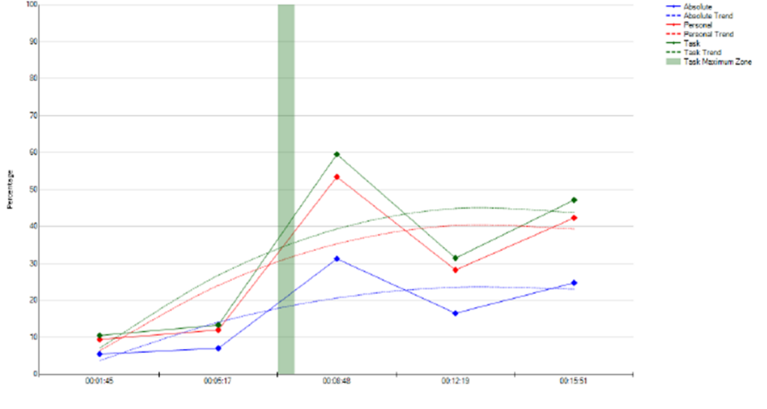
- In the intervention with 33 Dutch grade 10 students, text quality increased from M = 78.07 (SD = 16.10) at Moment 1 to M = 83.32 (SD = 14.06) at Moment 2 and M = 85.78 (SD = 12.82) at Moment 3; repeated measures analysis showed an overall significant effect, F(2,64) = 4.992, p = .010, and Moment 3 was 7.71 points higher than Moment 1, p = .004.
- Effect sizes were small after the first feedback (ES = .35) and moderate after the second feedback (ES = .55); compared with the control condition’s grade 10 progress (ES = .60), the process feedback had an effect comparable to almost one grade of regular schooling.
- Questionnaire data showed that students who wrote better texts reported the feedback gave more insight into time use (r = .546, p = .004) and source use (r = .467, p = .025), evaluated the benchmark comparison positively (r = .394, p = .038), and considered time-use feedback while writing (r = .467, p = .019); self-efficacy increased for dealing with sources, F(1,27) = 6.95, p = .014, and structuring the text, F(1,27) = 6.68, p = .015.
Methods
- Design: the paper describes the Inputlog process report and reports an intervention as an illustration; 33 Dutch upper-secondary grade 10 students (18 male, 15 female; average age 15.3 years, SD = .58) from three classes at one school wrote three informative synthesis texts at three measurement occasions within one week, with writing logged and analyzed using Inputlog 7.0; process feedback was given at occasions 2 and 3 before writing a new text, online, individually, within a fixed 30-minute limit.
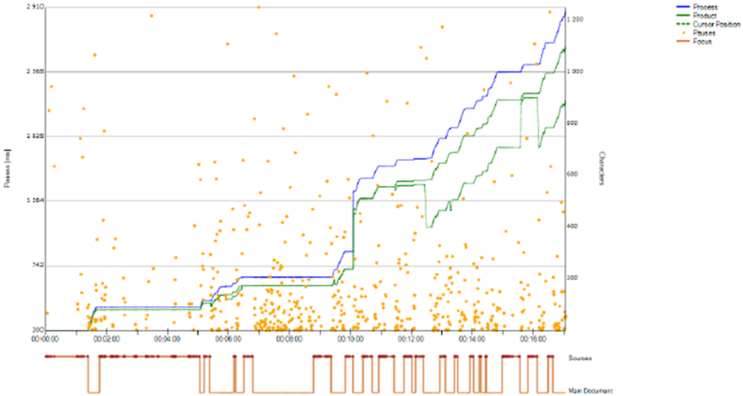
- Materials: a customized process report provided numerical data on 22 process variables and a process graph, grouped into use of time, production and fluency, revision, and source use/source switches; benchmark process graphs came from students scoring 1 SD and 2 SD higher; text quality was rated by three trained raters using a benchmark scale (Cronbach alpha = .73), with final scores as the average of three ratings.
- Analysis: repeated measures analysis and pairwise comparisons, effect sizes, comparison to a national baseline sample of 1081 texts from grades 10–12 without feedback, and questionnaire correlations and self-efficacy ANOVA.
Limitations
- Stated: motivation and novelty effects might have influenced results; no follow-up/long-term effect was tested; the precise effective feedback components are unknown; future studies need to control feedback components separately and control for task effects; revision data are not always fully reliable because logging does not yet fully account for automatic MS Word background operations; more research is needed mapping keystroke features to cognitive processes and investigating tutors’ needs.
- Stated: the process report on its own cannot be considered effective feedback; it should be embedded in a feedback flow with reflection and goal setting.
- Evident from the text: the intervention sample was small (33 students, one school), the intervention lasted one week, and the comparison was to a baseline sample rather than a randomized control group; no delayed posttest is reported.
Model-written summary. Check it against the paper before relying on it.
Integrity signals
Registry
Cites
Statistics
Figures
Verification
Claims the paper makes
1 Valid · 4 Not valid · 34 Not checked · 78 Own results and interpretations
The cited sources support only part of this claim — read each source’s verdict below.
In the paper
“Positive results are obtained by several empirically-based tools that provide automated and individual feedback to support students during the writing process.”
§ Reporting Writing Process Feedback in the Classroom Using Keystroke Logging Data to Reflect on Writing Processes > 2 Process-oriented feedback in the writing classroom
What the sources say
- Partly supportedcites Knight et al., 2020 matched to “AcaWriter: A learning analytics tool for formative feedback on academic writing” (2020) sourceExperimental — accuracy not yet measured
Our copy supports the narrower version of the claim: it presents one empirically-based automated feedback tool, AcaWriter, deployed and evaluated across several disciplinary contexts, with positive findings (Perceived usefulness sections, e.g. 85.7% of responded posts in the 5-7 positive range in Gibson et al. 2017, and 'All students found the intervention and AcaWriter useful' in the HDR section). But the claim's assertion that SEVERAL tools obtain positive results is not stated: the Introduction only catalogues kinds of writing tools (AES, AWE, intelligent tutoring systems, Interactive Writing Platforms) citing Shermis & Burstein, Warschauer & Grimes, Roscoe & McNamara and Strobl et al. (2019) for their existence and differences, not for their positive outcomes. Moreover the source hedges its own impact evidence — 'There is some evidence of impact - most notably in the law and accounting contexts - which suggests that students who receive feedback from AcaWriter are more likely to improve draft texts... However, further work is required' (Impact on writing) — and flags non-validated measures and motivation as confounds, so 'positive results are obtained' is stronger than the source states. (LLM, conf=0.72)
- Not checked yetcites Benetos & Bétrancourt, 2020 matched to “'Digital authoring support for argumentative writing: what does it change?” (2020) source
Checked before — its earlier verdict is held back until a new check runs.
- Not checked yetcites Cotos et al., 2020 matched to “Understanding Graduate Writers’ Interaction with and Impact of the Research Writing Tutor during Revision” (2020) source
Checked before — its earlier verdict is held back until a new check runs.
plainstates a cause- Asserted: passes — The authors put it forward as true.
- Checkable: passes — It can be checked against evidence.
- Load-bearing: unclear — It is unclear whether the paper’s conclusions depend on it.
- Based: passes — The paper gives a reason why it holds.
- Partly supported
A result the paper reports from its own data — it cites no other source for it, so there is none to check. The quote shows it is in the paper.
In the paper
“Repeated measures analysis showed that the intervention had an overall significant effect on the quality of the written texts (F(2,64) = 4.992; p = .010).”
§ Reporting Writing Process Feedback in the Classroom Using Keystroke Logging Data to Reflect on Writing Processes > 6.5 Results: Effect of the intervention
plainstates a cause- Asserted: passes — The authors put it forward as true.
- Checkable: passes — It can be checked against evidence.
- Load-bearing: passes — The paper’s conclusions depend on it.
- Based: passes — The paper gives a reason why it holds.
A result the paper reports from its own data — it cites no other source for it, so there is none to check. The quote shows it is in the paper.
In the paper
“These analyses allowed us to select a representative set of variables that could be included in the default report.”
§ Reporting Writing Process Feedback in the Classroom Using Keystroke Logging Data to Reflect on Writing Processes > 4.1.2 Content of the default report
plainstates a cause- Asserted: passes — The authors put it forward as true.
- Checkable: passes — It can be checked against evidence.
- Load-bearing: passes — The paper’s conclusions depend on it.
- Based: passes — The paper gives a reason why it holds.
A result the paper reports from its own data — it cites no other source for it, so there is none to check. The quote shows it is in the paper.
In the paper
“We observed a gradual increase of the scores over time.Moment 1: M = 78.07(SD = 16.10);Moment 2: M = 83.32(SD = 14.06);Moment 3: M = 85.78 (SD = 12.82).”
§ Reporting Writing Process Feedback in the Classroom Using Keystroke Logging Data to Reflect on Writing Processes > 6.5 Results: Effect of the intervention
plainstates a cause- Asserted: passes — The authors put it forward as true.
- Checkable: passes — It can be checked against evidence.
- Load-bearing: passes — The paper’s conclusions depend on it.
- Based: passes — The paper gives a reason why it holds.
None of the sources cited for this claim have been checked yet.
In the paper
“The current selection in the default report is mainly based on a set of studies in which we explored different aspects of writing dynamics (Baaijen et al., 2014;Leijten, Bernolet, et al., 2019;Van Waes & Leijten, 2015).”
§ Reporting Writing Process Feedback in the Classroom Using Keystroke Logging Data to Reflect on Writing Processes > 4.1.2 Content of the default report
What the sources say
- Not checked yetcites Baaijen et al., 2014 matched to “Effects of writing beliefs and planning on writing performance” (2014) source
- Not checked yetcites Leijten, Bernolet, et al., 2019 matched to “MAPPING MASTER’S STUDENTS’ USE OF EXTERNAL SOURCES IN SOURCE-BASED WRITING IN L1 AND L2” (2019) source
- Not matchedcites Van Waes & Leijten, 2015
More than one paper fits this citation.
plain- Asserted: passes — The authors put it forward as true.
- Checkable: passes — It can be checked against evidence.
- Load-bearing: unclear — It is unclear whether the paper’s conclusions depend on it.
- Based: passes — The paper gives a reason why it holds.
20 more claims
Create a free account to see all 117 claims and to verify the 51 references still open.
- Probably not a substantial claim. 81
- It may state two separate claims as one. 32
- The quote only partly states this claim. 2
Statistics recomputed
Every reported test result, recomputed from its test statistic and degrees of freedom. A result shows as not adding up only once an independent check has confirmed it.
- ConsistentF(2, 64) = 4.992reported p = .01 · recomputed p = .010
“F(2,64) = 4.992, p = .010”
- ConsistentF(2, 1078) = 40.91reported p < .001 · recomputed p < .001
“F(2,1078) = 40.91,p < .001”
- ConsistentF(1, 27) = 6.95reported p = .014 · recomputed p = .014
“F(1,27) = 6.95, p = .014”
- ConsistentF(1, 27) = 6.68reported p = .015 · recomputed p = .015
“F(1,27) = 6.68, p = .015”
Self-check
Percentages, sums and reported differences re-computed from the paper’s own numbers.
Self-check results appear here once an independent check has confirmed them.
Citations
Cites
Hattie, J., & Timperley, H. (2007) · Review of Educational Research · doi:10.3102/003465430298487 · Cited by 12,905
Nicol, D. J., & Macfarlane‐Dick, D. (2006) · Studies in Higher Education · doi:10.1080/03075070600572090 · Cited by 5,846
Formative assessment and the design of instructional systems
Sadler, D. R. (1989) · Instructional Science · doi:10.1007/bf00117714 · Cited by 4,285 · cited 4×
“Students need support to develop their selfregulating skills; they need to learn to monitor, direct and regulate their actions (Graham & Harris, 2018; Hattie & Timperley, 2007; Nicol & MacFarlane-Dick, 2006; Sadler, 1989).”
BackgroundMethodInfluentialFeedback and Self-Regulated Learning: A Theoretical Synthesis
Butler, D. L., & Winne, P. H. (1995) · Review of Educational Research · doi:10.3102/00346543065003245 · Cited by 3,334
The development of student feedback literacy: Enabling uptake of feedback
Carless, D., & Boud, D. (2018) · Assessment & Evaluation in Higher Education · doi:10.1080/02602938.2018.1463354 · Cited by 2,428
Teacher beliefs and technology integration practices: A critical relationship
Ertmer, P. A., Ottenbreit-Leftwich, A. T., Sadik, O., Sendurur, E., & Sendurur, P. (2012) · Computers & Education · doi:10.1016/j.compedu.2012.02.001 · Cited by 2,107
Rethinking feedback practices in higher education: a peer review perspective
Nicol, D., Thomson, A., & Breslin, C. (2014) · Assessment & Evaluation in Higher Education · doi:10.1080/02602938.2013.795518 · Cited by 966
A Revised Writer(s)-Within-Community Model of Writing
Graham, S. (2018) · Educational Psychologist · doi:10.1080/00461520.2018.1481406 · Cited by 590
Goals and Progress Feedback: Effects on Self-Efficacy and Writing Achievement
Schunk, D. H., & Swartz, C. W. (1993) · Contemporary Educational Psychology · doi:10.1006/ceps.1993.1024 · Cited by 570
Keystroke Logging in Writing Research: Using Inputlog to Analyze and Visualize Writing Processes
Leijten, M., & Van Waes, L. (2013) · Written Communication · doi:10.1177/0741088313491692 · Cited by 513
Self-citationVisual learning analytics of educational data: A systematic literature review and research agenda
Vieira, C., Parsons, P., & Byrd, V. (2018) · Computers & Education · doi:10.1016/j.compedu.2018.03.018 · Cited by 316
Mackey, A., & Gass, S. M. (2015) · doi:10.4324/9781315750606 · Cited by 262
Observational learning and the effects of model-observer similarity.
Braaksma, M. A. H., Rijlaarsdam, G., & van den Bergh, H. (2002) · Journal of Educational Psychology · doi:10.1037//0022-0663.94.2.405 · Cited by 188
Theories, Models and Methodology in Writing Research
Rijlaarsdam, G., Bergh, V. D., & Couzijn, M. (1996) · Amsterdam University Press eBooks · doi:10.5117/9789053561973 · Cited by 182
An investigation into written comments on assignments: do students find them usable?
Walker, M. (2009) · Assessment & Evaluation in Higher Education · doi:10.1080/02602930801895752 · Cited by 182
Relations Between Writing Processes and Text Quality: When and How?
Breetvelt, I., van den Bergh, H., & Rijlaarsdam, G. (1994) · Cognition and Instruction · doi:10.1207/s1532690xci1202_2 · Cited by 179
Fluency in Writing: A Multidimensional Perspective on Writing Fluency Applied to L1 and L2
Waes, L. V., & Leijten, M. (2015) · Computers & composition/Computers and composition · doi:10.1016/j.compcom.2015.09.012 · Cited by 177
Self-citationFrom copying to learning: using exemplars to engage students with assessment criteria and feedback
Handley, K., & Williams, L. (2011) · Assessment & Evaluation in Higher Education · doi:10.1080/02602930903201669 · Cited by 159
Writing in the workplace: Constructing documents using multiple digital sources
Leijten, M., Van Waes, L., Schriver, K., & Hayes, J. R. (2014) · Journal of Writing Research · doi:10.17239/jowr-2014.05.03.3 · Cited by 156
Self-citationA Polarized Epithelium Organized by β- and α-Catenin Predates Cadherin and Metazoan Origins
Dickinson, D. J., Nelson, W. J., & Weis, W. I. (2011) · Science · doi:10.1126/science.1199633 · Cited by 155
AcaWriter: A learning analytics tool for formative feedback on academic writing
Knight, S., Shibani, A., Abel, S., Gibson, A., & Ryan, P. (2020) · Journal of Writing Research · doi:10.17239/jowr-2020.12.01.06 · Cited by 151
COMBINED DEPLOYABLE KEYSTROKE LOGGING AND EYETRACKING FOR INVESTIGATING L2 WRITING FLUENCY
Chukharev‐Hudilainen, E., Sarıcaoğlu, A., Torrance, M., & Feng, H.-H. (2019) · Studies in Second Language Acquisition · doi:10.1017/s027226311900007x · Cited by 121
Examining Pauses in Writing: Theory, Methods and Empirical Data
Wengelin, Å. (2006) · Computer Key-Stroke Logging and Writing · doi:10.1163/9780080460932_008 · Cited by 113
BARKAOUI, K. (2016) · The Modern Language Journal · doi:10.1111/modl.12316 · Cited by 113
Hendry, G. D., Bromberger, N., & Armstrong, S. (2011) · Assessment & Evaluation in Higher Education · doi:10.1080/02602930903128904 · Cited by 105
Writing in first and second language. Empirical studies on text quality and writing processes.
Tillema, M. (2012) · Utrecht University Repository (Utrecht University) · Cited by 100
Writing process theory: A functional dynamic approach
van den Bergh, H., Rijlaarsdam, G., Steendam, E. V., MacArthur, C. A., Graham, S., & Fitzgerald, J. (2015) · UvA-DARE (University of Amsterdam) · Cited by 97
Aligning Keystrokes with Cognitive Processes in Writing
Galbraith, D., & Baaijen, V. M. (2019) · BRILL eBooks · doi:10.1163/9789004392526_015 · Cited by 91
Observing Writing: Insights from Keystroke Logging and Handwriting
Tiryakioglu, G., Peters, E., & Verschaffel, L. (2019) · BRILL eBooks · doi:10.1163/9789004392526 · Cited by 89
Redondo, R. F., Torrance, M., Rijlaarsdam, G., van den Bergh, H., & Álvarez, M. L. (2014) · Contemporary Educational Psychology · doi:10.1016/j.cedpsych.2014.11.004 · Cited by 85
Vandermeulen, N., van den Broek, B., Steendam, E. V., & Rijlaarsdam, G. (2019) · Reading and Writing · doi:10.1007/s11145-019-09958-3 · Cited by 85
Self-citationComputer keystroke logging and writing: methods and applications
Sullivan, K. P. H., & Lindgren, E. (2006) · Cited by 78
The Handbook of Cognition and Assessment: Frameworks, Methodologies, and Applications
(2016) · John Wiley & Sons, Inc. eBooks · doi:10.1002/9781118956588 · Cited by 76
Improving Writing in Primary Schools through a Comprehensive Writing Program
Rietdijk, S., Janssen, T., van Weijen, D., van den Bergh, H., & Rijlaarsdam, G. (2017) · Journal of Writing Research · doi:10.17239/jowr-2017.09.02.04 · Cited by 74
Beers, S. F., Mickail, T., Abbott, R., & Berninger, V. W. (2017) · Journal of Writing Research · doi:10.17239/jowr-2017.09.01.01 · Cited by 63
Bouwer, R., Koster, M., & van den Bergh, H. (2017) · Journal of Educational Psychology · doi:10.1037/edu0000206 · Cited by 61
Modeling Basic Writing Processes From Keystroke Logs
Guo, H., Deane, P., van Rijn, P. W., Zhang, M., & Bennett, R. E. (2018) · Journal of Educational Measurement · doi:10.1111/jedm.12172 · Cited by 60
Limpo, T., & Alves, R. A. (2017) · Journal of Writing Research · doi:10.17239/jowr-2017.09.02.01 · Cited by 58
Discovery Through Writing: Relationships with Writing Processes and Text Quality
Baaijen, V. M., & Galbraith, D. (2018) · Cognition and Instruction · doi:10.1080/07370008.2018.1456431 · Cited by 58
Prediction of Essay Scores From Writing Process and Product Features Using Data Mining Methods
Sinharay, S., Zhang, M., & Deane, P. (2019) · Applied Measurement in Education · doi:10.1080/08957347.2019.1577245 · Cited by 58
Understanding the keystroke log: the effect of writing task on keystroke features
Conijn, R., Roeser, J., & van Zaanen, M. (2019) · Reading and Writing · doi:10.1007/s11145-019-09953-8 · Cited by 55
Typing competencies in Alzheimer's disease: An exploration of copy tasks
Waes, L. V., Leijten, M., Mariën, P., & Engelborghs, S. (2017) · Computers in Human Behavior · doi:10.1016/j.chb.2017.03.050 · Cited by 51
Self-citationWriting process theory : a functional dynamic approach
Rijlaarsdam, G., van den Bergh, H., & Steendam, E. V. (2016) · UvA-DARE (University of Amsterdam) · Cited by 50
Handbook of Research on Computer-Enhanced Language Acquisition and Learning
Zhang, F., & Barber, B. (2008) · IGI Global eBooks · doi:10.4018/978-1-59904-895-6 · Cited by 48
Lindgren, E., & Sullivan, K. P. H. (2003) · Language Awareness · doi:10.1080/09658410308667075 · Cited by 48
An Examination of the Design Principles Underlying a Self-Regulated Strategy Development Study
Graham, S., & Harris, K. (2018) · Journal of Writing Research · doi:10.17239/jowr-2018.10.02.02 · Cited by 47
Writing in Test and Non-test Situations: Process and Product
Khuder, B., & Harwood, N. (2015) · Journal of Writing Research · doi:10.17239/jowr-2015.06.03.2 · Cited by 46
Analysing Keystroke Logging Data from a Linguistic Perspective
Leijten, M., Horenbeeck, E. V., & Waes, L. V. (2019) · BRILL eBooks · doi:10.1163/9789004392526_005 · Cited by 46
Self-citationCotos, E., Huffman, S., & Link, S. (2020) · Journal of Writing Research · doi:10.17239/jowr-2020.12.01.07 · Cited by 42
Process Features in Writing: Internal Structure and Incremental Value Over Product Features
Zhang, M., & Deane, P. (2015) · ETS Research Report Series · doi:10.1002/ets2.12075 · Cited by 39
Early prediction of writing quality using keystroke logging
Conijn, R., Cook, C. L., van Zaanen, M. M., & Waes, L. V. (2021) · International Journal of Artificial Intelligence in Education · doi:10.1007/s40593-021-00268-w · Cited by 39
MAPPING MASTER’S STUDENTS’ USE OF EXTERNAL SOURCES IN SOURCE-BASED WRITING IN L1 AND L2
Leijten, M., Van Waes, L., Schrijver, I., Bernolet, S., & Vangehuchten, L. (2019) · Studies in Second Language Acquisition · doi:10.1017/s0272263119000251 · Cited by 38
Self-citationEffects of writing beliefs and planning on writing performance
Baaijen, V. M., Galbraith, D., & de Glopper, K. (2014) · Learning and Instruction · doi:10.1016/j.learninstruc.2014.04.001 · Cited by 37
Effective Teaching and Learning of Writing
Rijlaarsdam, G., van den Bergh, H., & Couzijn, M. (1996) · Amsterdam University Press eBooks · doi:10.5117/9789053561980 · Cited by 36
Ranalli, J., Feng, H.-H., & Chukharev-Hudilainen, E. (2018) · Assessing Writing · doi:10.1016/j.asw.2018.03.007 · Cited by 36
López, P. H., Torrance, M., & Redondo, R. F. (2019) · Psicothema · doi:10.7334/psicothema2018.326 · Cited by 34
Automated Scoring with Validity in Mind
Bejar, I. I., Mislevy, R. J., & Zhang, M. (2016) · John Wiley & Sons, Inc. eBooks · doi:10.1002/9781118956588.ch10 · Cited by 32
de Smet, M. J. R., Brand-Gruwel, S., Leijten, M., & Kirschner, P. A. (2014) · Computers & Education · doi:10.1016/j.compedu.2014.06.010 · Cited by 30
Self-citationExploring the Feasibility of Using Writing Process Features to Assess Text Production Skills
Deane, P., & Zhang, M. (2015) · ETS Research Report Series · doi:10.1002/ets2.12071 · Cited by 29
Keystroke logging in writing research : Analyzing online writing processes
Waes, L. V., Leijten, M. L., Lindgren, E., & Wengelin, Å. (2015) · Cited by 25
Self-citationDisfluency effects on lexical selection
Medimorec, S., Young, T., & Risko, E. F. (2016) · Cognition · doi:10.1016/j.cognition.2016.10.008 · Cited by 22
Schrijver, I., Vaerenbergh, L. V., Leijten, M., & Waes, L. V. (2015) · Perspectives · doi:10.1080/0907676x.2015.1040034 · Cited by 19
Self-citationHuman-Centered Design of a Dashboard on Students’ Revisions During Writing
Conijn, R., Waes, L. V., & van Zaanen, M. M. (2020) · Lecture notes in computer science · doi:10.1007/978-3-030-57717-9_3 · Cited by 19
'Digital authoring support for argumentative writing: what does it change?
Benetos, K., & Betrancourt, M. (2020) · Journal of Writing Research · doi:10.17239/jowr-2020.12.01.09 · Cited by 15
The Effect of a Word Processor as an Accommodation for Students with Learning Disabilities
Berger, C., & Lewandowski, L. J. (2013) · Journal of Writing Research · doi:10.17239/jowr-2013.04.03.2 · Cited by 14
Supporting the Reflective Language Learner with Computer Keystroke Logging
Lindgren, E., Stevenson, M., & Sullivan, K. P. H. (2008) · Handbook of Research on Computer-Enhanced Language Acquisition and Learning · doi:10.4018/978-1-59904-895-6.ch011 · Cited by 10
The Power of Observational Learning Through Social Modeling
Albert, B. (2016) · Scientists Making a Difference · doi:10.1017/cbo9781316422250.052 · Cited by 10
Supporting Learner Reflection in the Language Translation Class
Lindgren, E., Sullivan, K. P. H., Deutschmann, M., & Steinvall, A. (2009) · International Journal of Information Communication Technologies and Human Development · doi:10.4018/jicthd.2009070102 · Cited by 9
Observing Writing and Website Browsing: Swedish Students Write L3 German
Knospe, Y., Sullivan, K. P. H., Malmqvist, A., & Valfridsson, I. (2019) · Observing Writing · doi:10.1163/9789004392526_013 · Cited by 9
(2017) · Levende Talen Tijdschrift
Self-citation(2017) · Journal of Learning in Higher Education
(2020) · Research portal (Tilburg University)
Research works printed but not linked: 4
- Blok, H. (1986). Essay Rating by the Comparison Method. Tijdschrift Voor Onderwijsresearch, 11(4), 169-176.
- ch011 Lindgren, E., & Sullivan, K. (2019). Observing writing. Insights from keystroke logging and handwriting. Leiden: Brill. https://doi.org/https://doi.org/10.1163/9789004392526 · DOI
- Vandermeulen, N., De Maeyer, S., Van Steendam, E., Lesterhuis, M., van den Bergh, H., & Rijlaarsdam, G. (2020). Mapping synthesis writing in various levels of Dutch upper- secondary education. A national baseline study on text quality, writing process and students' perspectives on writing. Under Review.
- Vygotsky, L. S. (1986). Thought and language. Cambridge, MA: MIT Press.
Cited by
Wilson, J., Huang, Y., Palermo, C., Beard, G., & MacArthur, C. A. (2021) · International Journal of Artificial Intelligence in Education · doi:10.1007/s40593-020-00236-w · Cited by 65
Cotos, E., Huffman, S., & Link, S. (2020) · Journal of Writing Research · doi:10.17239/jowr-2020.12.01.07 · Cited by 42
Exploring feedback and regulation in online writing classes with keystroke logging
Bowen, N. E. J. A., Thomas, N., & Vandermeulen, N. (2022) · Computers & composition/Computers and composition · doi:10.1016/j.compcom.2022.102692 · Cited by 74
Self-citationDigital Writing Technologies in Higher Education: Theory, Research, and Practice
Kruse, O., Rapp, C., Anson, C. M., Benetos, K., Cotos, E., Devitt, A., & Shibani, A. (2023) · Springer eBooks · doi:10.1007/978-3-031-36033-6 · Cited by 77
Improving university argumentative writing through an online training
Luna, M., Villalón, R., Mateos, M., & Martín, E. (2020) · Journal of Writing Research · doi:10.17239/jowr-2020.12.01.08 · Cited by 74
Metadata
- Authors
- Vandermeulen, N., Leijten, M., & Van Waes, L.
- Affiliations
- University of Antwerp (BE)
- Venue
- Journal of Writing Research
- Published
- 2020-06
- Volume
- 12
- Issue
- vol. 12 issue 1
- Pages
- 109-140
- ISSN
- 2030-1006 (ISSN-L)
- 2294-3307
- OpenAlex
- W3033601069
- Cited by
- 87
- References
- 72
- Citations by year
- 2026: 16 · 2025: 12 · 2024: 3 · 2023: 19 · 2022: 16 · 2021: 10 · 2020: 11
- FWCI
- 13.59
- Type
- journal article
- Language
- en
- Open access
- diamond
- doi.org
- Licence
- cc-by-nc-nd
- Locations
- Journal of Writing Research (publishedVersion, cc-by-nc-nd)
- Lirias (KU Leuven) (publishedVersion, other-oa)
- Funders
- Nederlandse Organisatie voor Wetenschappelijk Onderzoek (405-14-301)
- Topics
- Social Sciences › Education › Writing and Handwriting Education
- Social Sciences › Arts and Humanities › Language and Linguistics › EFL/ESL Teaching and Learning
- Social Sciences › Education › Educational Research and Methods
- Keywords
- keystroke logging, writing tutors, writing development, pauses, revision, source use, writing fluency, writing intervention
About these checks
Registry, retraction, Cites and statistics results are computed, not judged, with one exception: a printed reference that no index lists is read once by a model before it counts as a citation error. Claims are extracted by a model and kept only when their quote appears verbatim in the text; each cited source is then checked, with a model’s help, for whether it says what the claim relies on. Those verdicts can be wrong — read the claim’s quote and the cited source before relying on one.
The claim verdicts this report counts are experimental: their accuracy is not yet measured.
A language model drew the claims from the paper on 2026-11-18, under version 3 of the claim definition (model deepseek-v4.1-flash, prompt extract-v3).
A second model labelled each claim on 2026-11-18 (model jev-1.13-20260917, definition revision gold-guideline-v0.2).
Cited sources are checked with a language model’s help (qwen3.8-omni-flash).
Statistics and arithmetic are recomputed, not judged.
Confidence bands are shown only for fields calibrated on our annotated test set. None is calibrated yet, so no band is shown.
What counts as a claim ›How we measure confidence ›How we check this ›
Are you an author, or do you see a problem with this page? Request a review
Data sources
Bibliographic data: Semantic Scholar, OpenAlex, Crossref.
Contains information from the Semantic Scholar Academic Graph Datasets, made available under the ODC Attribution License (ODC-BY 1.0).
Semantic Scholar’s data is described in: Kinney, R., et al. (2023). The Semantic Scholar Open Data Platform. arXiv:2301.10140.
