

Second Language Learners' Strong Preference for Self-initiated Self-repair: Implications for Theory and Pedagogy
Open accessThe DOI matches its Crossref record; 13 of the 13 references it cites were found in a registry or an index; none of the 34 sources its claims cite is checked for support yet.
Abstract
This study employs a theoretical framework informed by Conversation Analysis to analyse the self-repairs of a particular group of teenage Chinese EFL learners. With an aim to report on the current development of the participants in using English socially in terms of managing repairs, this study explores their second language (L2) discourse in three communicative tasks. Audio-recorded conversations were analysed and searched for the four sequences of repair. Comparison of the participants' preference for repair sequence to native speakers shows that they can manage repairs and maintain conversation interactively and socially just as native speakers. This suggests that they should be treated as normal social beings in the language classroom and not to be interrupted by the teacher when troubles arise from conversational interaction. Thus, this study provides an account of the current development of these young learners in using the L2 interactively and socially, which holds implications for research on second language education as well as for classroom teaching.
Overview
CoChat Summary
TL;DR
This CA-informed case study of six teenage Chinese EFL learners found they overwhelmingly preferred self-initiated self-repair during pair-work communicative tasks, closely matching adult native speakers’ repair organization. The author argues this supports treating L2 learners as normal social interactants and advises teachers not to interrupt learners’ self-repair in communicative activities.
Key findings
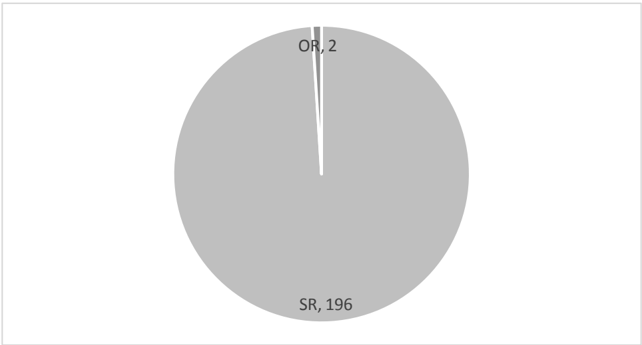
- Across nine independent conversations, 198 repair instances were identified; 99% were self-repairs and 1% other-repairs.
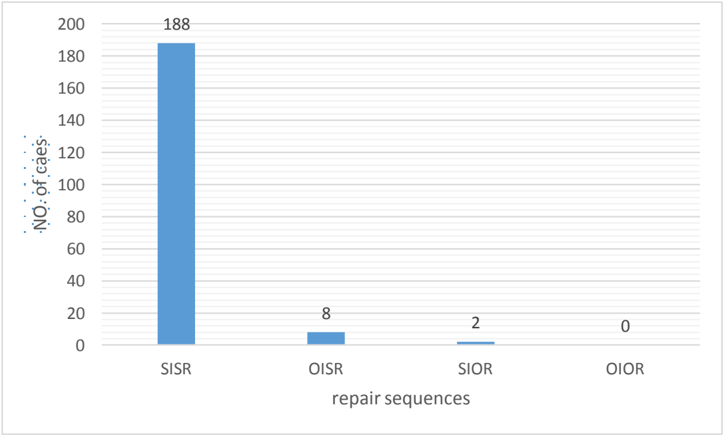
- SISR accounted for 95% of the 198 cases; OISR constituted 4%; SIOR was 1% (two cases); no OIOR was identified.
- The learners’ preference for self-initiated self-repair aligned with adult native speakers’ documented preference, despite the learners’ lower-intermediate proficiency.
- Pedagogically, the author recommends that teachers not initiate repair or interrupt learners during communicative tasks, reserving teacher-initiated adjustment for accuracy-focused activities.
Methods
- CA-informed short-term, small-scale classroom-based case study with six 15-year-old Chinese EFL learners in their 3rd year of secondary school, all lower intermediate, with more than six years of English learning and mostly no prior living/learning experience in English-speaking countries; arranged into three pairs: boy-girl, boy-boy, and girl-girl.
- Audio-recorded pair-work communicative tasks; participants chose three of four tasks: information-gap “ask the right question,” story telling, and jigsaw “complete the picture”; nine independent conversations were analyzed.
- Transcribed data were coded for the four repair sequences (SISR, OISR, SIOR, OIOR), counted, and ratios compared with native-speaker repair preferences.
Limitations
- The paper acknowledges a short-term, small-scale classroom-based case study with limited researcher time and access, and defends the small participant number as necessary for close analysis of talk.
- The paper notes all participants were lower intermediate, unlike prior studies with varied proficiency levels, and data came from only three tasks in one classroom context.
- Evident from the text: six learners in three pairs limit generalizability; no OIOR instances occurred, so that repair type is unrepresented; audio-only recording may not capture all interactional detail.
Model-written summary. Check it against the paper before relying on it.
Integrity signals
Registry
Cites
Statistics
Figures
Verification
Claims the paper makes
0 Valid · 2 Not valid · 25 Not checked · 28 Own results and interpretations
A result the paper reports from its own data — it cites no other source for it, so there is none to check. The quote shows it is in the paper.
In the paper
“Fig. 1 demonstrates that participants showed a overwhelmingly strong preference for self-repairs to other-repairs, as 99% of the instances are self-repairs.”
boostedn = 198- Asserted: passes — The authors put it forward as true.
- Checkable: passes — It can be checked against evidence.
- Load-bearing: passes — The paper’s conclusions depend on it.
- Based: passes — The paper gives a reason why it holds.
A result the paper reports from its own data — it cites no other source for it, so there is none to check. The quote shows it is in the paper.
In the paper
“No cases of OIOR were identified in the data.”
- Also stated in: § IV. RESULTS · p. 6 · plain
“no instance of OIOR is identified from the collected data.”
plainn = 198- Asserted: passes — The authors put it forward as true.
- Checkable: passes — It can be checked against evidence.
- Load-bearing: passes — The paper’s conclusions depend on it.
- Based: passes — The paper gives a reason why it holds.
- Also stated in: § IV. RESULTS · p. 6 · plain
A result the paper reports from its own data — it cites no other source for it, so there is none to check. The quote shows it is in the paper.
In the paper
“By analysing the full transcripts of the nine independent conversations made by the three pairs of participants, a sum of 198 instances of repairs were identified.”
plainn = 3- Asserted: passes — The authors put it forward as true.
- Checkable: passes — It can be checked against evidence.
- Load-bearing: passes — The paper’s conclusions depend on it.
- Based: passes — The paper gives a reason why it holds.
A result the paper reports from its own data — it cites no other source for it, so there is none to check. The quote shows it is in the paper.
In the paper
“Second Language Learners' Strong Preference for Self-initiated Self-repair: Implications for Theory and Pedagogy”
boosted- Asserted: passes — The authors put it forward as true.
- Checkable: passes — It can be checked against evidence.
- Load-bearing: passes — The paper’s conclusions depend on it.
- Based: passes — The paper gives a reason why it holds.
A result the paper reports from its own data — it cites no other source for it, so there is none to check. The quote shows it is in the paper.
In the paper
“The remaining 1% are two cases of SIOR and no instance of OIOR is identified from the collected data.”
plainn = 2- Asserted: passes — The authors put it forward as true.
- Checkable: passes — It can be checked against evidence.
- Load-bearing: unclear — It is unclear whether the paper’s conclusions depend on it.
- Based: passes — The paper gives a reason why it holds.
18 more claims
Create a free account to see all 55 claims and to verify the 13 references still open.
- It may state two separate claims as one. 10
- Probably not a substantial claim. 29
Citations
Cites
The Interactional Architecture of the Language Classroom: A Conversation Analysis Perspective
Seedhouse, P. (2004) · Newcastle University ePrints (Newcastle Univesity) · doi:10.25405/ncl.34098714 · Cited by 998
(2004) · Bloomsbury Academic eBooks · doi:10.5040/9781474212335 · Cited by 582
Error correction as an interactional resource
Jefferson, G. (1974) · Language in Society · doi:10.1017/s0047404500004334 · Cited by 506
Variation in Native Speaker Speech Modification to Non-Native Speakers
Gass, S. M., & Varonis, E. M. (1985) · Studies in Second Language Acquisition · doi:10.1017/s0272263100005143 · Cited by 192 · cited 3×
“(4) Lori: But y'know single beds'r awfully thin tuh sleep on.”
BackgroundDelayed next turn repair initiation in native/non-native speaker English conversation
Wong, J. (2000) · Applied Linguistics · doi:10.1093/applin/21.2.244 · Cited by 176
Self- and Other-Initiated Modified Output during Task-Based Interaction
Shehadeh, A. (2001) · TESOL Quarterly · doi:10.2307/3588030 · Cited by 104
Repair Sequences in Spanish L2 Dyadic Discourse: A Descriptive Study
Buckwalter, P. (2001) · The Modern Language Journal · doi:10.1111/0026-7902.00115 · Cited by 87 · cited 8×
“The four tasks included were initially chosen by the researcher because (1) they were recognised by researchers (e.”
BackgroundInfluentialRepair in Foreign Language Teaching
Kasper, G. (1985) · Studies in Second Language Acquisition · doi:10.1017/s0272263100005374 · Cited by 79
(1999) · IRAL - International Review of Applied Linguistics in Language Teaching · doi:10.1515/iral.1999.37.1.43 · Cited by 10
The Organization of Second Language Classroom Repair
Jung, E. H. (. (1999) · Issues in Applied Linguistics · doi:10.5070/l4102005020 · Cited by 7
Research works printed but not linked: 7
- [2][2] Chen, L., Li, J., & Zhao, W. (2005). Gender differences in self-repairs by Chinese non-English majors in their spoken English. Modern Foreign Languages ( Xiandai Waiyu ), 28 (3), 279-287. -
- [3][3] Chen, L., & Pu, J. (2007). A corpus-based analysis of self-repairs by college non-English majors. Foreign Language Education ( Waiyu Jiaoxue ), 28 (2), 57-61. -
- [9][9] Kazemi, A. (2006). A systemtatic study of self-repairs in second language classroom presentations: with some reference to social variables and language proficiency. Ph.D dissertation, The University of New South Wales. -
- [12][12] Pica, T., Kanagy, R., & Falodun, J. (2009). Choosing and using communication tasks for second language instruction. In K. Van der Branden, M. Bygate, J. M. Norris (Eds.), Task-Based Language Teaching: A reader . Philidelphia, PA: John Benjamins B.V., 171-192. -
- [14][14] Schegloff, E. A., Jefferson, G., & Sacks, H. (1977). The preference for self-correction in the organisation of repair in conversation. Language , 53(2), 361-382. -
- [15][15] Seedhouse, P. (1999). The Relationship Between Context and the Organization of Repair in the L2 Classroom. IRAL , 37 (1), 59-80. -
- [18][18] Van Hest, E. (1996). Self-repair in L1 and L2 production (V ol. 4). Tilburg: Tilburg University Press. -
Cited by
Still being checked.
Metadata
- Authors
- Zeng, S.
- Affiliations
- Harbin Institute of Technology (CN)
- Corresponding author
- Zeng, Simin
- ORCID
- Zeng, Simin
- Venue
- Journal of Language Teaching and Research
- Publisher
- Academy Publication
- Published
- 2019-05-01
- Volume
- 10
- Issue
- 3
- Pages
- 541
- ISSN
- 1798-4769 (ISSN-L)
- OpenAlex
- W2942252226
- Semantic Scholar
- e3f5ca708dd0907469d5fbdd70dadbcb746e7e5c
- Cited by
- 6
- References
- 13
- Citations by year
- 2025: 1 · 2024: 1 · 2022: 3 · 2019: 1
- FWCI
- 2.84
- Type
- journal article
- Language
- en
- Open access
- diamond
- doi.org
- Locations
- Journal of Language Teaching and Research (publishedVersion)
- Topics
- Social Sciences › Arts and Humanities › Language and Linguistics › EFL/ESL Teaching and Learning
- Social Sciences › Arts and Humanities › Language and Linguistics › Language, Discourse, Communication Strategies
- Social Sciences › Arts and Humanities › Language and Linguistics › Linguistics and Language Analysis
- Keywords
- self-healing, repair sequences, second language learners, Chinese learners of English, adolescent students, conversation, native speaker comparison, second language teaching, social interaction in language learning
About these checks
Registry, retraction, Cites and statistics results are computed, not judged, with one exception: a printed reference that no index lists is read once by a model before it counts as a citation error. Claims are extracted by a model and kept only when their quote appears verbatim in the text; each cited source is then checked, with a model’s help, for whether it says what the claim relies on. Those verdicts can be wrong — read the claim’s quote and the cited source before relying on one.
A language model drew the claims from the paper on 2026-11-26, under version 3 of the claim definition (model deepseek-v4.1-flash, prompt extract-v3).
A second model labelled each claim on 2026-11-26 (model jev-1.13-20260917, definition revision gold-guideline-v0.2).
Statistics and arithmetic are recomputed, not judged.
Confidence bands are shown only for fields calibrated on our annotated test set. None is calibrated yet, so no band is shown.
What counts as a claim ›How we measure confidence ›How we check this ›
Are you an author, or do you see a problem with this page? Request a review
Data sources
Bibliographic data: Semantic Scholar, OpenAlex, Crossref.
Contains information from the Semantic Scholar Academic Graph Datasets, made available under the ODC Attribution License (ODC-BY 1.0).
Semantic Scholar’s data is described in: Kinney, R., et al. (2023). The Semantic Scholar Open Data Platform. arXiv:2301.10140.
