

The Library’s Impact on University Students’ Academic Success and Learning
Open accessThe DOI matches its Crossref record; 21 of the 21 references it cites were found in a registry or an index; 9 of the 24 sources its claims cite were checked for support.
Abstract
Abstract Objective – The purpose of this study was to examine relationships among student library visits, library resource use, library space satisfaction (e.g., quiet study space), and students’ academic performance (i.e., Grade Point Average or GPA) using quantitative data and to better understand how the academic library has an impact on students’ learning from students’ perspectives using qualitative data. Methods – A survey was distributed during the Spring 2018 semester to graduate and undergraduate students at a large public research institution. Survey responses consisted of two types of data: (1) quantitative data pertaining to multiple choice questions related to the student library experience, and (2) qualitative data, including open-ended questions, regarding students’ perceptions of the library’s impact on their learning. Quantitative data was analyzed using Spearman’s rank correlations between students’ library experience and their GPAs, whereas qualitative data was analyzed employing thematic analysis. Results – The key findings from the quantitative data show that student library visits and library space satisfaction were negatively associated with their GPA, whereas most students’ use of library resources (e.g., journal articles and databases) was positively associated with their GPAs. The primary findings from the qualitative data reveal that students perceived the library as a place where they can concentrate and complete their work. Additionally, the students reported that they utilize both the quiet and collaborative study spaces interchangeably depending on their academic needs, and expressed that the library provides them with invaluable resources that enhance their coursework and research. Conclusions – While the findings show that the student library experience was associated with their academic achievements, there were mixed findings in the study. The findings suggest that as a student’s GPA increases, their in-person library visits and library space satisfaction decrease. On the other hand, as a student’s GPA increases, their library resource usage increases. Further investigation is needed to better understand the negative relationship between students’ library visits, library space satisfaction, and their GPAs.
Overview
CoChat Summary
TL;DR
This mixed-methods survey study examined relationships among students’ library visits, resource use, library space satisfaction, and GPA, alongside students’ perceptions of the library’s impact on learning. It found mixed associations: in-person visits and space satisfaction were negatively correlated with GPA, while most resource use and online visits were positively correlated, with qualitative themes emphasizing study space, resources, and staff assistance.
Key findings
- In-person library visits were negatively associated with GPA (rs [2,086] = -.24, p < .01), while online library visits were positively associated with GPA (rs [1,794] = .27, p < .01).
- Most library resource use was positively associated with GPA, including journal articles (rs = .29), databases (rs = .19), print books (rs = .10), and electronic books (rs = .10); some resources were negatively associated, including textbooks on reserve (rs = -.07), digital images (rs = -.06), streaming media (rs = -.08), and patient care tools (rs = -.07). DVDs on reserve were not significantly correlated (rs [2,062] = -.03, p = .126).
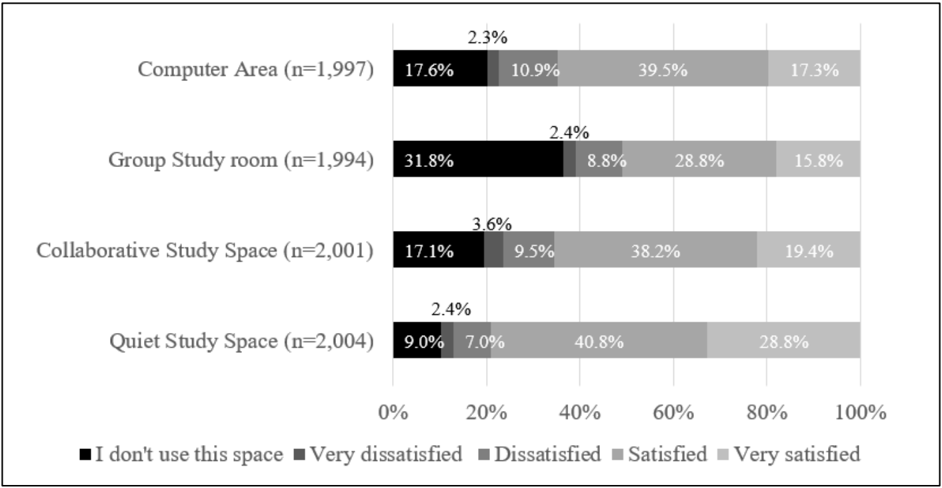
- All library space satisfaction items were negatively correlated with GPA: quiet study spaces (rs [1,896] = -.11), collaborative study spaces (rs [1,893] = -.11), group study rooms (rs [1,889] = -.11), and computer areas (rs [1,889] = -.09), all p < .01.
- Qualitative themes showed students used the library primarily for studying (n = 190), research (n = 111), and coursework/homework (n = 77); they valued quiet space for focus (n = 104), both quiet and collaborative spaces (n = 26), resources such as journal articles (n = 140), books (n = 89), and databases (n = 76), and librarian/staff assistance (n = 135).
Methods
- A locally developed survey was distributed in Spring 2018 to 28,725 undergraduate and graduate students at a large public Midwest research university; 2,277 completed the multiple-choice survey (8% response rate), and 992 completed the open-ended question. Cumulative GPAs were provided from fall 2017 institutional records.
- Quantitative analysis used SPSS 25: descriptive statistics, medians by class level, and two-tailed Spearman’s rank correlations between library visits, resource use, space satisfaction, and GPA.
- Qualitative analysis used NVivo 12 thematic analysis on 992 open-ended responses after excluding 14 “N/A” responses; coding combined provisional coding from research questions and inductive coding from quotations, followed by pattern coding into themes.
Limitations
- Stated: the open-ended question asked only about positive impact on coursework or research, which may bias responses, though some students still gave negative feedback; the study analyzed only overall library experience and GPA, not other factors such as degree sought; the negative relationships need further investigation.
- Evident from text: the response rate was 8%, and female and graduate students were overrepresented in both quantitative and qualitative samples; students were not asked which library location they used, so location could not be determined.
- Evident from text: correlations were weak (all rs < |.30|), the design was cross-sectional, and the authors caution that correlation does not indicate causation.
Model-written summary. Check it against the paper before relying on it.
Integrity signals
Registry
Cites
Statistics
Figures
Verification
Claims the paper makes
9 Valid · 0 Not valid · 9 Not checked · 92 Own results and interpretations
The sources with a verdict support this claim; the rest weren’t checked yet, have no full text we could read, or their verdicts aren’t rated yet.
In the paper
“Given that most of the variables, except for students' GPAs, are ordinal scale (e.g., from 0 [never] to 4 [daily]), the Spearman's rank correlation coefficient, also called Spearman Rho (coefficient) is appropriate.”
What the sources say
- Supportedcites Gust & D'journo, 2015 matched to “The use of correlation functions in thoracic surgery research.” (2015) doi:10.3978/j.issn.2072-1439.2015.01.54
The Introduction describes Spearman’s coefficient as a rank-based measure usable with discrete variables or a continuous and a categorical variable. This supports the citing authors’ choice for relationships involving mostly ordinal variables; the description of their variables and GPA is their own context, not a finding attributed to the source. (LLM, conf=0.88)
- Not checked — no full text of the sourcecites King & Minium, 2007
- Not matchedcites Pallant, 2011
An author–year citation the paper’s reference list doesn’t settle. We don’t search these by name.
plainstates an association- Asserted: passes — The authors put it forward as true.
- Checkable: passes — It can be checked against evidence.
- Load-bearing: passes — The paper’s conclusions depend on it.
- Based: passes — The paper gives a reason why it holds.
- Supported
A result the paper reports from its own data — it cites no other source for it, so there is none to check. The quote shows it is in the paper.
In the paper
“The key findings from the quantitative data show that student library visits and library space satisfaction were negatively associated with their GPA, whereas most students' use of library resources (e.g., journal articles and databases) was positively associated with their GPAs.”
plainstates an association- Asserted: passes — The authors put it forward as true.
- Checkable: passes — It can be checked against evidence.
- Load-bearing: passes — The paper’s conclusions depend on it.
- Based: passes — The paper gives a reason why it holds.
A result the paper reports from its own data — it cites no other source for it, so there is none to check. The quote shows it is in the paper.
In the paper
“The primary findings from the qualitative data reveal that students perceived the library as a place where they can concentrate and complete their work.”
plain- Asserted: passes — The authors put it forward as true.
- Checkable: passes — It can be checked against evidence.
- Load-bearing: unclear — It is unclear whether the paper’s conclusions depend on it.
- Based: passes — The paper gives a reason why it holds.
A result the paper reports from its own data — it cites no other source for it, so there is none to check. The quote shows it is in the paper.
In the paper
“Use of databases accounted for 4% variability with GPA.”
plainstates an association- Asserted: passes — The authors put it forward as true.
- Checkable: passes — It can be checked against evidence.
- Load-bearing: unclear — It is unclear whether the paper’s conclusions depend on it.
- Based: passes — The paper gives a reason why it holds.
A result the paper reports from its own data — it cites no other source for it, so there is none to check. The quote shows it is in the paper.
In the paper
“Most of the students' library resource use was shown to be positively associated with their GPAs.”
- Also stated in: § Discussion · p. 17 · plain
“This finding is also supported by the results of the quantitative data indicating that students' library resource u se was positively associated with their GPAs.”
- Also stated in: § Conclusion · p. 19 · plain
“When looking closely at the directions of the associati ons between students' library experiences and their GPAs, there were mixed findings: students' library in -person visits and library space satisfaction were negatively associated with their GPAs, whereas most students' library resource usage was positively associated with their GPAs.”
plainstates an association- Asserted: passes — The authors put it forward as true.
- Checkable: passes — It can be checked against evidence.
- Load-bearing: passes — The paper’s conclusions depend on it.
- Based: passes — The paper gives a reason why it holds.
- Also stated in: § Discussion · p. 17 · plain
42 more claims
Create a free account to see all 110 claims and every source verdict.
- Probably not a substantial claim. 42
- It may state two separate claims as one. 30
Self-check
Percentages, sums and reported differences re-computed from the paper’s own numbers.
Rated minor: it would not touch a result — a value no result rests on, a p-value that stays on the same side of the significance level, or a conflict that is clerical, resolved elsewhere in the paper, or outside its own findings.
In the paper
“| Online ( n = 1,924) | 447 (19.6%) | 572 (25.1%) | 364 (16%) | 429 (18.8%) | 112 (4.9%) |”
Reported 19.6 · recomputed 23.232848
Citations
Cites
Using thematic analysis in psychology
Braun, V., & Clarke, V. (2006) · Qualitative Research in Psychology · doi:10.1191/1478088706qp063oa · Cited by 194,414
Qualitative Data Analysis: A Methods Sourcebook
Miles, M. B., Huberman, A. M., & Saldaña, J. (1988) · Cited by 20,701
Research Design: Qualitative, Quantitative, and Mixed Methods Approaches
Sloane-Seale, A. (2009) · Canadian Journal of University Continuing Education · doi:10.21225/d54s3d · Cited by 14,328
(2009) · Cited by 6,311
Statistics without maths for psychology
Dancey, C. P., & Reidy, J. G. (1999) · Cited by 1,246
Concept Mapping as an Alternative Approach for the Analysis of Open-Ended Survey Responses
Jackson, K. M., & Trochim, W. M. K. (2002) · Organizational Research Methods · doi:10.1177/109442802237114 · Cited by 733
(2010) · Cited by 528
Soria, K. M., Fransen, J., & Nackerud, S. (2013) · portal: Libraries and the Academy · doi:10.1353/pla.2013.0010 · Cited by 238
(2007) · Cited by 131
Library Space Assessment: User Learning Behaviors in the Library
Montgomery, S. E. (2014) · The Journal of Academic Librarianship · doi:10.1016/j.acalib.2013.11.003 · Cited by 98
Research works printed but not linked: 3
- Brown, K. (2018). Evidence of academic library impact on student learning and success: Advancing library leadership and advocacy with assessment in action. In K. E. Brown, D. L. Gilchrist, S. Goek, L. J. Hinchliffe, K. J. Malenfant, C. Ollis, & A. Payne (Eds.), Shaping the campus conversation on student learning and experience: Activating the results of assessment in action ( pp. 9-22). Chicago, IL: Association of College & Research Libraries.
- Brown, K., & Malenfant, K. J. (2018b). Academic library impact on student learning and success: Findings from assessment in action team projects. In K. E. Brown, D. L. Gilchrist, S. Goek, L. J. Hinchliffe, K. J. Malenfant, C. Ollis, & A. Payne (Eds.), Shaping the campus conversation on student learning and experience: Activating the results of assessment in action ( pp. 105132). Chicago, IL: Association of College & Research Libraries.
- Pallant, J. F. (2011) SPSS survival manual: A step by step guide to data analysis using the SPSS program (4 th ed.). Crows Nest, NSW: Allen & Unwin Book Publishers.
Cited by
Impact of COVID-19 on the use of the academic library
Groote, S. L. D., & Scoulas, J. M. (2021) · Reference Services Review · doi:10.1108/rsr-07-2021-0043 · Cited by 50
Self-citationOh, D., Kim, J., Kim, H., Jang, H., Hong, T., & An, J. (2023) · Building and Environment · doi:10.1016/j.buildenv.2023.110845 · Cited by 36
LIBRARY AND INFORMATION SERVICES IN THE DIGITAL AGE: OPPORTUNITIES AND CHALLENGES
Onunka, O., Onunka, T., Fawole, A. A., Adeleke, I. J., & Daraojimba, C. (2023) · Acta Informatica Malaysia · doi:10.26480/aim.02.2023.113.121 · Cited by 106
Validating students' library experience survey using rasch model
Scoulas, J. M., Dünya, B. A., & Groote, S. L. D. (2021) · Library & Information Science Research · doi:10.1016/j.lisr.2021.101071 · Cited by 31
Self-citationKang, Q., Song, Z., Lu, J., Shi, T., & Yang, J. (2022) · The Journal of Academic Librarianship · doi:10.1016/j.acalib.2022.102525 · Cited by 24
Metadata
- Authors
- Scoulas, J. M., & De Groote, S. L.
- Affiliations
- University of Illinois Chicago (US)
- ORCID
- Scoulas, Jung Mi
- Venue
- Evidence Based Library and Information Practice
- Publisher
- University of Alberta Libraries
- Published
- 2019-09-11
- Volume
- 14
- Issue
- 3
- Pages
- 2-27
- ISSN
- 1715-720X (ISSN-L)
- OpenAlex
- W2974822183
- Semantic Scholar
- 6a1e63815ab6f9f6c1c13dfeda45e4d164ac0d8a
- Cited by
- 45
- References
- 21
- Citations by year
- 2026: 6 · 2025: 7 · 2024: 6 · 2023: 7 · 2022: 4 · 2021: 10 · 2020: 5
- FWCI
- 43.26
- Type
- journal article
- Language
- en
- Open access
- diamond
- doi.org
- Licence
- cc-by-nc-sa
- Locations
- Evidence Based Library and Information Practice (publishedVersion, cc-by-nc-sa)
- DOAJ (DOAJ: Directory of Open Access Journals) (submittedVersion)
- Érudit (Université de Montréal) (submittedVersion)
- Figshare (submittedVersion, cc-by)
- University of Illinois Chicago (cc-by)
- Funders
- University of Illinois at Urbana-Champaign
- University of Illinois at Chicago
- Topics
- Social Sciences › Library and Information Sciences › Library Science and Information Literacy
- Social Sciences › Library and Information Sciences › Web and Library Services
- Social Sciences › Library and Information Sciences › Library Science and Administration
- Keywords
- academic libraries, university students, library visits, library resource use, grade point average, academic performance, student perceptions of libraries
About these checks
Registry, retraction, Cites and statistics results are computed, not judged, with one exception: a printed reference that no index lists is read once by a model before it counts as a citation error. Claims are extracted by a model and kept only when their quote appears verbatim in the text; each cited source is then checked, with a model’s help, for whether it says what the claim relies on. Those verdicts can be wrong — read the claim’s quote and the cited source before relying on one.
The claim verdicts this report counts are experimental: their accuracy is not yet measured.
A language model drew the claims from the paper on 2026-10-10, under version 3 of the claim definition (model deepseek-v4.1-flash, prompt extract-v3).
A second model labelled each claim on 2026-10-10 (model jev-1.13-20260917, definition revision gold-guideline-v0.2).
Cited sources are checked with a language model’s help (gpt-6-sol).
Statistics and arithmetic are recomputed, not judged.
Confidence bands are shown only for fields calibrated on our annotated test set. None is calibrated yet, so no band is shown.
What counts as a claim ›How we measure confidence ›How we check this ›
Are you an author, or do you see a problem with this page? Request a review
How to cite
Cite CoChat for the checks on this page, and the paper for its own findings.
- This page
- CoChat. (2026). Citation check: The Library’s Impact on University Students’ Academic Success and Learning. https://app.cochat.ai/papers/10.18438/eblip29547
- The paper
- Scoulas, J. M., & De Groote, S. L. (2019). The Library’s Impact on University Students’ Academic Success and Learning. Evidence Based Library and Information Practice. https://doi.org/10.18438/eblip29547
Data sources
Bibliographic data: Semantic Scholar, OpenAlex, Crossref.
Contains information from the Semantic Scholar Academic Graph Datasets, made available under the ODC Attribution License (ODC-BY 1.0).
Semantic Scholar’s data is described in: Kinney, R., et al. (2023). The Semantic Scholar Open Data Platform. arXiv:2301.10140.
