

The DOI matches its Crossref record; 48 of the 48 references it cites were found in a registry or an index.
Reasoning Over Semantic-Level Graph for Fact Checking
Open accessAbstract
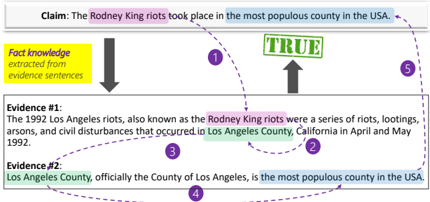
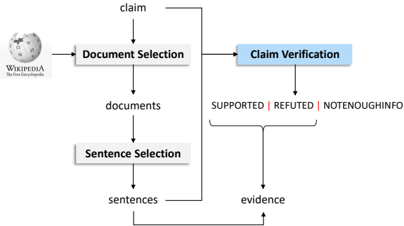
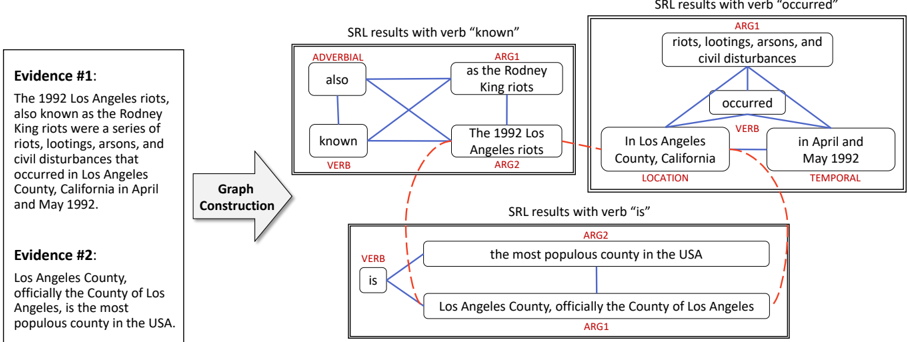
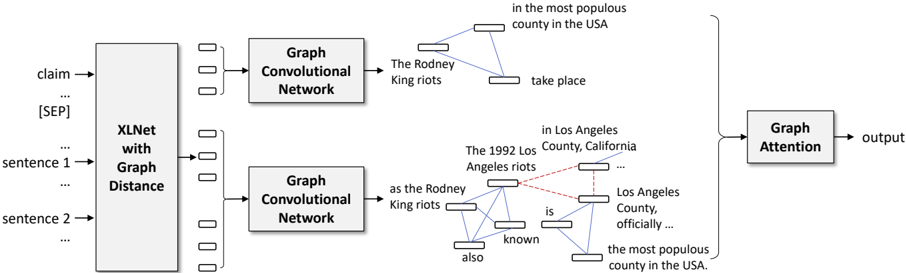
Fact checking is a challenging task because verifying the truthfulness of a claim requires reasoning about multiple retrievable evidence.In this work, we present a method suitable for reasoning about the semantic-level structure of evidence.Unlike most previous works, which typically represent evidence sentences with either string concatenation or fusing the features of isolated evidence sentences, our approach operates on rich semantic structures of evidence obtained by semantic role labeling.We propose two mechanisms to exploit the structure of evidence while leveraging the advances of pre-trained models like BERT, GPT or XLNet.Specifically, using XLNet as the backbone, we first utilize the graph structure to re-define the relative distances of words, with the intuition that semantically related words should have short distances.Then, we adopt graph convolutional network and graph attention network to propagate and aggregate information from neighboring nodes on the graph.We evaluate our system on FEVER, a benchmark dataset for fact checking, and find that rich structural information is helpful and both our graph-based mechanisms improve the accuracy.Our model is the state-of-the-art system in terms of both official evaluation metrics, namely claim verification accuracy and FEVER score.
Overview
The claims and statistics of this paper haven’t been checked yet.
Run the check — free, no account needed. It reads the open-access text and checks the sources it cites.
Integrity signals
Registry
Cites
Statistics
Figures
Verification
Claims the paper makes
The claims and statistics of this paper haven’t been checked yet.
Run the check — free, no account needed. It reads the open-access text and checks the sources it cites.
Claims other papers make about this one
Each is checked against this paper’s own text: does it say what the citing paper says it does?
The source backs part of the claim, not all of it — or backs it for a different population, condition or comparison.
In the citing paper
“Existing fact-verification approaches follow a multi-stage pipeline of claim detection, evidence retrieval and verdict prediction (Guo et al., 2022; Zhong et al., 2020). Such methods, however, require access to external databases and can have considerable inference costs.”
From SelfCheckGPT: Zero-Resource Black-Box Hallucination Detection for Generative Large Language Models (2023) · cites this paper as Zhong et al., 2020
Experimental — accuracy not yet measured
Self-check
Percentages, sums and reported differences re-computed from the paper’s own numbers.
The self-check needs the paper’s full text.
Citations
Cites
Vaswani, A., Shazeer, N., Parmar, N., Uszkoreit, J., Jones, L., Gomez, A. N., Kaiser, L., & Polosukhin, I. (2017) · arXiv · doi:10.48550/arxiv.1706.03762 · Cited by 120,404
BERT: Pre-training of Deep Bidirectional Transformers for Language Understanding
Devlin, J., Chang, M.-W., Lee, K., & Toutanova, K. (2018) · arXiv · doi:10.48550/arxiv.1810.04805 · Cited by 73,173
BERT: Pre-training of Deep Bidirectional Transformers for Language Understanding
Devlin, J., Chang, M.-W., Lee, K., & Toutanova, K. (2019) · Proceedings of the 2019 Conference of the North American Chapter of the Association for Computational Linguistics: Human Language Technologies, Volume 1 (Long and Short Papers) · doi:10.18653/v1/n19-1423 · Cited by 54,325
Semi-supervised classification with graph convolutional networks
Kipf, T. N., & Welling, M. (2016) · arXiv · doi:10.48550/arxiv.1609.02907 · Cited by 24,853
Graph Attention NetworksPreprint
Veličković, P., Casanova, A., Liò, P., Cucurull, G., Romero, A., & Bengio, Y. (2017) · arXiv (Cornell University) · doi:10.17863/cam.48429 · Cited by 19,745
RoBERTa: A Robustly Optimized BERT Pretraining Approach
Liu, Y., Ott, M., Goyal, N., Du, J., Joshi, M., Chen, D., Levy, O., Lewis, M., Zettlemoyer, L., & Stoyanov, V. (2019) · arXiv · doi:10.48550/arxiv.1907.11692 · Cited by 16,515
Veličković, P., Cucurull, G., Casanova, A., Romero, A., Liò, P., & Bengio, Y. (2017) · arXiv · doi:10.48550/arxiv.1710.10903 · Cited by 12,107
The spread of true and false news online
Vosoughi, S., Roy, D., & Aral, S. (2018) · Science · doi:10.1126/science.aap9559 · Cited by 8,847 · cited 1×
“Vosoughi et al. (2018) show that false news reaches more people than the truth.”
BackgroundXLNet: Generalized Autoregressive Pretraining for Language Understanding
Yang, Z., Dai, Z., Yang, Y., Carbonell, J., Salakhutdinov, R., & Le, Q. V. (2019) · arXiv · doi:10.48550/arxiv.1906.08237 · Cited by 6,687
Open Information Extraction from the Web
Etzioni, O., Banko, M., Cafarella, M. J., Soderland, S., & Weld, D. S. (2007) · CACM · doi:10.1145/1409360.1409378 · Cited by 2,620
Cited by
Sorted by citations
Graph neural networks: A review of methods and applications
Zhou, J., Cui, G., Hu, S., Zhang, Z., Yang, C., Liu, Z., Wang, L., Li, C., & Sun, M. (2020) · AI Open · doi:10.1016/j.aiopen.2021.01.001 · Cited by 6,880
Retrieval-Augmented Generation for Knowledge-Intensive NLP Tasks
Lewis, P., Perez, E., Piktus, A., Petroni, F., Karpukhin, V., Goyal, N., Küttler, H., Lewis, M., Yih, W.-T., Rocktäschel, T., et al. (2020) · arXiv · doi:10.48550/arxiv.2005.11401 · Cited by 3,101
SelfCheckGPT: Zero-Resource Black-Box Hallucination Detection for Generative Large Language Models
Manakul, P., Liusie, A., & Gales, M. (2023) · Proceedings of the 2023 Conference on Empirical Methods in Natural Language Processing · doi:10.18653/v1/2023.emnlp-main.557 · Cited by 557
A Survey on Automated Fact-Checking
Guo, Z., Schlichtkrull, M., & Vlachos, A. (2022) · Transactions of the Association for Computational Linguistics · doi:10.1162/tacl_a_00454 · Cited by 500
Compare to The Knowledge: Graph Neural Fake News Detection with External Knowledge
Hu, L., Yang, T., Zhang, L., Zhong, W., Tang, D., Shi, C., Duan, N., & Zhou, M. (2021) · doi:10.18653/v1/2021.acl-long.62 · Cited by 233
Self-citationExplainable Automated Fact-Checking for Public Health Claims
Kotonya, N., & Toni, F. (2020) · Proceedings of the 2020 Conference on Empirical Methods in Natural Language Processing (EMNLP) · doi:10.18653/v1/2020.emnlp-main.623 · Cited by 195
A Survey on Stance Detection for Mis- and Disinformation Identification
Hardalov, M., Arora, A., Nakov, P., & Augenstein, I. (2022) · Findings of the Association for Computational Linguistics: NAACL · doi:10.18653/v1/2022.findings-naacl.94 · Cited by 170
Evidence-aware Fake News Detection with Graph Neural Networks
Xu, W., Wu, J., Liu, Q., Wu, S., & Wang, L. (2022) · International World Wide Web Conference (WWW) · doi:10.1145/3485447.3512122 · Cited by 132
Entity-Oriented Multi-Modal Alignment and Fusion Network for Fake News Detection
Li, P., Sun, X., Yu, H., Tian, Y., Yao, F., & Xu, G. (2021) · IEEE Transactions on Multimedia · doi:10.1109/tmm.2021.3098988 · Cited by 112
Towards Fine-Grained Reasoning for Fake News Detection
Jin, Y., Wang, X., Yang, R., Sun, Y., Wang, W. W., Liao, H., & Xie, X. (2022) · Proceedings of the AAAI Conference on Artificial Intelligence · doi:10.1609/aaai.v36i5.20517 · Cited by 101
Distributed Graph Neural Network Training: A Survey
Shao, Y., Li, H., Gu, X., Yin, H., Li, Y., Miao, X., Zhang, W., Cui, B., & Chen, L. (2024) · ACM Computing Surveys · doi:10.1145/3648358 · Cited by 127
Towards Few-shot Fact-Checking via Perplexity
Lee, N., Bang, Y., Madotto, A., & Fung, P. (2021) · Conference of the North American Chapter of the Association for Computational Linguistics: Human Language Technologies (NAACL-HLT) · doi:10.18653/v1/2021.naacl-main.158 · Cited by 96
GERE: Generative Evidence Retrieval for Fact Verification
Chen, J., Zhang, R., Guo, J., Fan, Y., & Cheng, X. (2022) · Proceedings of the 45th International ACM SIGIR Conference on Research and Development in Information Retrieval · doi:10.1145/3477495.3531827 · Cited by 66
Fact-Checking Complex Claims with Program-Guided Reasoning
Pan, L., Wu, X., Lu, X., Luu, A. T., Wang, W. Y., Kan, M., & Nakov, P. (2023) · Proceedings of the conference - Association for Computational Linguistics. Meeting · doi:10.18653/v1/2023.acl-long.386 · Cited by 130
CRITIC: Large Language Models Can Self-Correct with Tool-Interactive Critiquing
Gou, Z., Shao, Z., Gong, Y., Shen, Y., Yang, Y., Duan, N., & Chen, W. (2023) · arXiv · doi:10.48550/arxiv.2305.11738 · Cited by 561
“[52] Wanjun Zhong, Jingjing Xu, Duyu Tang, Zenan Xu, Nan Duan, Ming Zhou, Jiahai Wang, and Jian Yin.”
BackgroundSelf-citationLiu, X., Zhao, Z., Zhang, Y., Liu, C., & Yang, F. (2022) · IEEE Transactions on Computational Social Systems · doi:10.1109/tcss.2022.3184745 · Cited by 53
ProoFVer: Natural Logic Theorem Proving for Fact Verification
Krishna, A., Riedel, S., & Vlachos, A. (2022) · Transactions of the Association for Computational Linguistics · doi:10.1162/tacl_a_00503 · Cited by 51
Improving Cyberbullying Detection with User Interaction
Ge, S., Cheng, L., & Liu, H. (2021) · Proceedings of the Web Conference 2021 · doi:10.1145/3442381.3449828 · Cited by 51
Machine Generation and Detection of Arabic Manipulated and Fake NewsPreprint
Nagoudi, E. M. B., Elmadany, A., Abdul-Mageed, M., Alhindi, T., & Cavusoglu, H. (2020) · arXiv (Cornell University) · doi:10.48550/arxiv.2011.03092 · Cited by 57
A Review on Fact Extraction and Verification
Bekoulis, G., Papagiannopoulou, C., & Deligiannis, N. (2023) · ACM Computing Surveys · doi:10.1145/3485127 · Cited by 48
Exploring Listwise Evidence Reasoning with T5 for Fact Verification
Jiang, K., Pradeep, R., & Lin, J. (2021) · doi:10.18653/v1/2021.acl-short.51 · Cited by 46
Adversarial Contrastive Learning for Evidence-Aware Fake News Detection With Graph Neural Networks
Wu, J., Xu, W., Liu, Q., Wu, S., & Wang, L. (2023) · IEEE Transactions on Knowledge and Data Engineering · doi:10.1109/tkde.2023.3341640 · Cited by 51
Zero-shot Fact Verification by Claim Generation
Pan, L., Chen, W., Xiong, W., Kan, M., & Wang, W. Y. (2021) · doi:10.18653/v1/2021.acl-short.61 · Cited by 43
Explainable Claim Verification via Knowledge-Grounded Reasoning with Large Language Models
Wang, H., & Shu, K. (2023) · Findings of the Association for Computational Linguistics: EMNLP (Findings of EMNLP) · doi:10.18653/v1/2023.findings-emnlp.416 · Cited by 83
Meet The Truth: Leverage Objective Facts and Subjective Views for Interpretable Rumor Detection
Li, J., Ni, S., & Kao, H. (2021) · Findings of the Association for Computational Linguistics: ACL (Findings of ACL) · doi:10.18653/v1/2021.findings-acl.63 · Cited by 40
SelfCheckGPT: Zero-Resource Black-Box Hallucination Detection for Generative Large Language Models
Manakul, P., Liusie, A., & Gales, M. J. F. (2023) · arXiv · doi:10.48550/arxiv.2303.08896 · Cited by 38
HHGN: A Hierarchical Reasoning-based Heterogeneous Graph Neural Network for fact verification
Chen, C., Cai, F., Hu, X., Chen, W., & Chen, H. (2021) · Information Processing & Management · doi:10.1016/j.ipm.2021.102659 · Cited by 38
LOREN: Logic-Regularized Reasoning for Interpretable Fact Verification
Chen, J., Bao, Q., Sun, C., Zhang, X., Chen, J., Zhou, H., Xiao, Y., & Li, L. (2022) · Proceedings of the AAAI Conference on Artificial Intelligence · doi:10.1609/aaai.v36i10.21291 · Cited by 42
Topic-Aware Evidence Reasoning and Stance-Aware Aggregation for Fact Verification
Si, J., Zhou, D., Li, T., Shi, X., & He, Y. (2021) · doi:10.18653/v1/2021.acl-long.128 · Cited by 38
DUCK: Rumour Detection on Social Media by Modelling User and Comment Propagation Networks
Tian, L., Zhang, X., & Lau, J. H. (2022) · Conference of the North American Chapter of the Association for Computational Linguistics: Human Language Technologies (NAACL-HLT) · doi:10.18653/v1/2022.naacl-main.364 · Cited by 33
Learn to Combine Linguistic and Symbolic Information for Table-based Fact Verification
Shi, Q., Yu, Z., Yin, Q., & Liu, T. (2020) · International Conference on Computational Linguistics · doi:10.18653/v1/2020.coling-main.466 · Cited by 31
CHEF: A Pilot Chinese Dataset for Evidence-Based Fact-Checking
Hu, X., Guo, Z., Wu, G., Liu, A., Wen, L., & Yu, P. (2022) · Conference of the North American Chapter of the Association for Computational Linguistics: Human Language Technologies (NAACL-HLT) · doi:10.18653/v1/2022.naacl-main.246 · Cited by 40
Counterfactual Debiasing for Fact Verification
Xu, W., Liu, Q., Wu, S., & Wang, L. (2023) · Proceedings of the conference - Association for Computational Linguistics. Meeting · doi:10.18653/v1/2023.acl-long.374 · Cited by 32
An entity-graph based reasoning method for fact verification
Chen, C., Cai, F., Hu, X., Zheng, J., Ling, Y., & Chen, H. (2021) · Information Processing & Management · doi:10.1016/j.ipm.2020.102472 · Cited by 28
Xu, W., Zhang, H., Cai, D., & Lam, W. P. (2021) · Findings of the Association for Computational Linguistics: ACL (Findings of ACL) · doi:10.18653/v1/2021.findings-acl.90 · Cited by 35
Panchendrarajan, R., & Zubiaga, A. (2024) · Expert Systems with Applications · doi:10.1016/j.eswa.2024.124097 · Cited by 29
Chern, I.-C., Chern, S., Chen, S., Yuan, W., Feng, K., Zhou, C., He, J., Neubig, G., & Liu, P. (2023) · arXiv · doi:10.48550/arxiv.2307.13528 · Cited by 29
“1, the creation of the FEVER dataset (Thorne et al., 2018a) spawned models (Zhong et al., 2020; Kr-ishna et al., 2022) that determine whether a given fine-grained claim made based on Wikipedia 1 articles is correct.”
BackgroundEvidenceNet: Evidence Fusion Network for Fact Verification
Chen, Z., Hui, S. C., Zhuang, F., Liao, L., Li, F., Jia, M., & Li, J. (2022) · International World Wide Web Conference (WWW) · doi:10.1145/3485447.3512135 · Cited by 24
Synthetic Disinformation Attacks on Automated Fact Verification Systems
Du, Y., Bosselut, A., & Manning, C. D. (2022) · Proceedings of the AAAI Conference on Artificial Intelligence · doi:10.1609/aaai.v36i10.21302 · Cited by 34
LoCal: Logical and Causal Fact-Checking with LLM-Based Multi-Agents
Ma, J., Hu, L., Li, R., & Fu, W. (2025) · International World Wide Web Conference (WWW) · doi:10.1145/3696410.3714748 · Cited by 30
Clickbait detection on WeChat: A deep model integrating semantic and syntactic information
Liu, T., Yu, K., Wang, L., Zhang, X., Hao, Z., & Wu, X. (2022) · Knowledge-Based Systems · doi:10.1016/j.knosys.2022.108605 · Cited by 26
ECENet: Explainable and Context-Enhanced Network for Muti-modal Fact verification
Zhang, F., Liu, J., Zhang, Q., Sun, E., Xie, J., & Zha, Z.-J. (2023) · ACM International Conference on Multimedia (ACM MM) · doi:10.1145/3581783.3612183 · Cited by 25
Learning Event Graph Knowledge for Abductive Reasoning
Du, L., Ding, X., Liu, T., & Qin, B. (2021) · doi:10.18653/v1/2021.acl-long.403 · Cited by 23
Interpretable Fake News Detection with Graph Evidence
Guo, H., Zeng, W., Tang, J., & Zhao, X. H. (2023) · ACM International Conference on Information and Knowledge Management (CIKM) · doi:10.1145/3583780.3614936 · Cited by 22
How Robust are Fact Checking Systems on Colloquial Claims?
Kim, B., Kim, H., Hong, S., & Kim, G. (2021) · Conference of the North American Chapter of the Association for Computational Linguistics: Human Language Technologies (NAACL-HLT) · doi:10.18653/v1/2021.naacl-main.121 · Cited by 23
A comparative study of language transformers for video question answering
Yang, Z., García, N., Chu, C., Otani, M., Nakashima, Y., & Takemura, H. (2021) · Neurocomputing · doi:10.1016/j.neucom.2021.02.092 · Cited by 21
Knowledge Enhanced Fact Checking and Verification
Zhu, B., Zhang, X., Gu, M., & Deng, Y. S. (2021) · IEEE/ACM Transactions on Audio Speech and Language Processing · doi:10.1109/taslp.2021.3120636 · Cited by 22
KAPALM: Knowledge grAPh enhAnced Language Models for Fake News Detection
Ma, J., Chen, C., Hou, C., & Yuan, X. (2023) · Findings of the Association for Computational Linguistics: EMNLP (Findings of EMNLP) · doi:10.18653/v1/2023.findings-emnlp.263 · Cited by 23
The Role of Context in Detecting Previously Fact-Checked Claims
Shaar, S., Alam, F., Martino, G. D. S., & Nakov, P. (2022) · Findings of the Association for Computational Linguistics: NAACL · doi:10.18653/v1/2022.findings-naacl.122 · Cited by 26
KAHAN: Knowledge-Aware Hierarchical Attention Network for Fake News detection on Social Media
Tseng, Y.-W., Yang, H.-K., Wang, W., & Peng, W.-C. (2022) · International World Wide Web Conference (WWW) · doi:10.1145/3487553.3524664 · Cited by 19
Shi, Q., Zhang, Y., Yin, Q., & Liu, T. (2021) · Conference on Empirical Methods in Natural Language Processing (EMNLP) · doi:10.18653/v1/2021.emnlp-main.16 · Cited by 21
Time-aware evidence ranking for fact-checking
Allein, L., Augenstein, I., & Moens, M. (2021) · Journal of Web Semantics · doi:10.1016/j.websem.2021.100663 · Cited by 25
Hidden Biases in Unreliable News Detection Datasets
Zhou, X., Elfardy, H., Christodoulopoulos, C., Butler, T., & Bansal, M. (2021) · Conference of the European Chapter of the Association for Computational Linguistics · doi:10.18653/v1/2021.eacl-main.211 · Cited by 20
Monant Medical Misinformation Dataset
Srba, I., Pecher, B., Tomlein, M., Móro, R., Štefancová, E., Šimko, J., & Bieliková, M. (2022) · International ACM SIGIR Conference on Research and Development in Information Retrieval (SIGIR) · doi:10.1145/3477495.3531726 · Cited by 19
BERT for Evidence Retrieval and Claim Verification
Soleimani, A., Monz, C., & Worring, M. (2020) · Lecture notes in computer science · doi:10.1007/978-3-030-45442-5_45 · Cited by 36
A Multi-Level Attention Model for Evidence-Based Fact Checking
Kruengkrai, C., Yamagishi, J., & Wang, X. (2021) · Findings of the Association for Computational Linguistics: ACL (Findings of ACL) · doi:10.18653/v1/2021.findings-acl.217 · Cited by 20
RMLM: A Flexible Defense Framework for Proactively Mitigating Word-level Adversarial Attacks
Wang, Z., Liu, Z., Zheng, X., Su, Q., & Wang, J. (2023) · Proceedings of the conference - Association for Computational Linguistics. Meeting · doi:10.18653/v1/2023.acl-long.155 · Cited by 16
Self-citationA DQN-based Approach to Finding Precise Evidences for Fact Verification
Wan, H., Chen, H., Du, J., Luo, W., & Ye, R. (2021) · doi:10.18653/v1/2021.acl-long.83 · Cited by 14
Support or Refute: Analyzing the Stance of Evidence to Detect Out-of-Context Mis- and Disinformation
Yuan, X., Guo, J., Qiu, W., Huang, Z., & Li, S. (2023) · Conference on Empirical Methods in Natural Language Processing (EMNLP) · doi:10.18653/v1/2023.emnlp-main.259 · Cited by 13
Dual-Channel Evidence Fusion for Fact Verification over Texts and Tables
Hu, N., Wu, Z., Lai, Y., Liu, X., & Feng, Y. (2022) · Conference of the North American Chapter of the Association for Computational Linguistics: Human Language Technologies (NAACL-HLT) · doi:10.18653/v1/2022.naacl-main.384 · Cited by 13
Claim-Dissector: An Interpretable Fact-Checking System with Joint Re-ranking and Veracity Prediction
Fajčík, M., Motlíček, P., & Smrž, P. (2023) · Findings of the Association for Computational Linguistics: ACL (Findings of ACL) · doi:10.18653/v1/2023.findings-acl.647 · Cited by 12
Fact-Driven Logical Reasoning for Machine Reading Comprehension
Ouyang, S., Zhang, Z., & Zhao, H. (2024) · Proceedings of the AAAI Conference on Artificial Intelligence · doi:10.1609/aaai.v38i17.29850 · Cited by 27
Heterogeneous Graph Reasoning for Fact Checking over Texts and Tables
Gong, H., Xu, W., Wu, S., Liu, Q., & Wang, L. (2024) · Proceedings of the AAAI Conference on Artificial Intelligence · doi:10.1609/aaai.v38i1.27760 · Cited by 12
Causal Walk: Debiasing Multi-Hop Fact Verification with Front-Door Adjustment
Zhang, C., Zhang, L., & Zhou, D. (2024) · Proceedings of the AAAI Conference on Artificial Intelligence · doi:10.1609/aaai.v38i17.29925 · Cited by 13
Maghdid, S. S., Rashid, T. A., & Askar, S. K. (2025) · International Journal of Data Science and Analytics · doi:10.1007/s41060-025-00797-w · Cited by 13
EPRD: Exploiting prior knowledge for evidence-providing automatic rumor detection
Li, J., Li, R., Ni, S., & Kao, H. (2023) · Neurocomputing · doi:10.1016/j.neucom.2023.126935 · Cited by 13
Fake news detection for the Russian language
Kuzmin, G., Larionov, D., Pisarevskaya, D., & Smirnov, I. (2020) · International Workshop Rumours and Deception Social Media · Cited by 11
Sun, Y., Liang, B., Bao, J., Yang, M., & Xu, R. (2022) · Findings of the Association for Computational Linguistics: EMNLP (Findings of EMNLP) · doi:10.18653/v1/2022.findings-emnlp.264 · Cited by 10
Fact-checking Vietnamese Information Using Knowledge Graph, Datalog, and KG-BERT
Duong, H. T., Ho, V., & Do, P. (2023) · ACM Transactions on Asian and Low-Resource Language Information Processing · doi:10.1145/3624557 · Cited by 11
Graph Reasoning with Context-Aware Linearization for Interpretable Fact Extraction and Verification
Kotonya, N., Spooner, T., Magazzeni, D., & Toni, F. (2021) · Fact Extraction and VERification Workshop (FEVER) · doi:10.18653/v1/2021.fever-1.3 · Cited by 11
Learning to Generate Programs for Table Fact Verification via Structure-Aware Semantic Parsing
Ou, S., & Liu, Y. (2022) · Proceedings of the conference - Association for Computational Linguistics. Meeting · doi:10.18653/v1/2022.acl-long.525 · Cited by 10
ProVe: A pipeline for automated provenance verification of knowledge graphs against textual sources
Amaral, G., Rodrigues, O., & Simperl, E. P. B. (2023) · Semantic Web · doi:10.3233/sw-233467 · Cited by 12
Explainability of Automated Fact Verification Systems: A Comprehensive Review
Vallayil, M., Nand, P., Yan, W., & Allende‐Cid, H. (2023) · Applied Sciences · doi:10.3390/app132312608 · Cited by 14
From Relevance to Utility: Evidence Retrieval with Feedback for Fact Verification
Zhang, H., Zhang, R., Guo, J., de Rijke, M., Fan, Y., & Cheng, X. (2023) · Findings of the Association for Computational Linguistics: EMNLP (Findings of EMNLP) · doi:10.18653/v1/2023.findings-emnlp.422 · Cited by 10
Reasoning over Entity-Action-Location Graph for Procedural Text Understanding
Huang, H., Geng, X., Pei, J., Long, G., & Jiang, D. (2021) · doi:10.18653/v1/2021.acl-long.396 · Cited by 9
Natural Logic-guided Autoregressive Multi-hop Document Retrieval for Fact Verification
Aly, R., & Vlachos, A. (2022) · Conference on Empirical Methods in Natural Language Processing (EMNLP) · doi:10.18653/v1/2022.emnlp-main.411 · Cited by 9
Robust Reasoning Over Heterogeneous Textual Information for Fact Verification
Wang, Y., Xia, C., Si, C., Yao, B., & Wang, T. (2020) · IEEE Access · doi:10.1109/access.2020.3019586 · Cited by 9
QACheck: A Demonstration System for Question-Guided Multi-Hop Fact-Checking
Pan, L., Lu, X., Kan, M., & Nakov, P. (2023) · Conference on Empirical Methods in Natural Language Processing: System Demonstrations (EMNLP) · doi:10.18653/v1/2023.emnlp-demo.23 · Cited by 15
Zero-shot Fact Verification by Claim GenerationPreprint
Pan, L., Chen, W., Xiong, W., Kan, M., & Wang, W. Y. (2021) · arXiv (Cornell University) · doi:10.48550/arxiv.2105.14682 · Cited by 15
Incorporating External Knowledge for Evidence-based Fact Verification
Barik, A. M., Hsu, W., & Lee, M. L. (2022) · International World Wide Web Conference (WWW) · doi:10.1145/3487553.3524622 · Cited by 7
FLEEK: Factual Error Detection and Correction with Evidence Retrieved from External Knowledge
Bayat, F. F., Qian, K., Han, B. H., Sang, Y., Belyy, A., Khorshidi, S., Wu, F. Q., Ilyas, I. F., & Li, Y. (2023) · Conference on Empirical Methods in Natural Language Processing: System Demonstrations (EMNLP) · doi:10.18653/v1/2023.emnlp-demo.10 · Cited by 7
Multi-Evidence Based Fact Verification via A Confidential Graph Neural Network
Lan, Y., Liu, Z., Gu, Y., Yi, X., Li, X., Yang, L., & Yu, G. (2024) · IEEE Transactions on Big Data · doi:10.1109/tbdata.2024.3403382 · Cited by 8
A syntactic evidence network model for fact verification
Chen, Z., Hui, S. C., Zhuang, F., Liao, L., Jia, M., Li, J., & Huang, H. (2024) · Neural Networks · doi:10.1016/j.neunet.2024.106424 · Cited by 8
Virtual Reality and Internet of Things-Based Music Online Learning via the Graph Neural Network
Lian, J., Zhou, Y., Han, L., & Yu, Z. (2022) · Computational Intelligence and Neuroscience · doi:10.1155/2022/3316886 · Cited by 7
LLM supporting knowledge tracing leveraging global subject and student specific knowledge graphs
Li, L., Wang, Z., Jose, J. M., & Ge, X. (2025) · Information Fusion · doi:10.1016/j.inffus.2025.103577 · Cited by 8
Rumor detection using BERT-based social circle and interaction network model
Thirumoorthy, K., Britto, J. J. J., Haripriya., R., & Shreenee, N. (2024) · Social Network Analysis and Mining · doi:10.1007/s13278-024-01362-2 · Cited by 6
CosG: A Graph-Based Contrastive Learning Method for Fact Verification
Chen, C., Zheng, J., & Chen, H. (2021) · Sensors · doi:10.3390/s21103471 · Cited by 7
Strong and Light Baseline Models for Fact-Checking Joint Inference
Tymoshenko, K., & Moschitti, A. (2021) · Findings of the Association for Computational Linguistics: ACL (Findings of ACL) · doi:10.18653/v1/2021.findings-acl.426 · Cited by 6
Improving task generalization via unified schema prompt
Zhong, W., Gao, Y., Ding, N., Liu, Z., Zhou, M., Wang, J., Yin, J., & Duan, N. (2023) · AI Open · doi:10.1016/j.aiopen.2023.08.011 · Cited by 8
Self-citationParagraph-based Transformer Pre-training for Multi-Sentence Inference
Liello, L. D., Garg, S., Soldaini, L., & Moschitti, A. (2022) · Conference of the North American Chapter of the Association for Computational Linguistics: Human Language Technologies (NAACL-HLT) · doi:10.18653/v1/2022.naacl-main.181 · Cited by 7
Gong, H., Wang, C., & Huang, X. (2023) · IEEE Access · doi:10.1109/access.2023.3304915 · Cited by 7
Fact-Checking, Fake News, Propaganda, and Media Bias: Truth Seeking in the Post-Truth Era
Nakov, P., & Martino, G. D. S. (2020) · doi:10.18653/v1/2020.emnlp-tutorials.2 · Cited by 7
Graph-based Retrieval for Claim Verification over Cross-document Evidence
Mongiovı̀, M., & Aldo Gangemi, A. (2022) · Studies in computational intelligence · doi:10.1007/978-3-030-93413-2_41 · Cited by 6
Natural Language Inference with Self-Attention for Veracity Assessment of Pandemic Claims
Arana‐Catania, M., Kochkina, E., Zubiaga, A., Liakata, M., Procter, R., & He, Y. (2022) · Conference of the North American Chapter of the Association for Computational Linguistics: Human Language Technologies (NAACL-HLT) · doi:10.18653/v1/2022.naacl-main.107 · Cited by 5
DocInfer: Document-level Natural Language Inference using Optimal Evidence Selection
Mathur, P., Kunapuli, G., Bhat, R. A., Shrivastava, M., Manocha, D., & Singh, M. (2022) · Conference on Empirical Methods in Natural Language Processing (EMNLP) · doi:10.18653/v1/2022.emnlp-main.51 · Cited by 6
A Survey Of Automatic Fact Verification Research
Yang, S., Xue, Y., Gan, T., & Wu, Y. C. (2024) · World Conference on Computing and Communication Technologies (WCCCT) · doi:10.1109/wccct60665.2024.10541489 · Cited by 5
SSRI-Net: Subthreads Stance–Rumor Interaction Network for rumor verification
Chen, Z., Hui, S. C., Liao, L., & Huang, H. (2024) · Neurocomputing · doi:10.1016/j.neucom.2024.127549 · Cited by 4
DisFact: Fact-Checking Disaster Claims
Adesokan, A., Hu, H., & Madria, S. (2024) · Lecture notes in computer science · doi:10.1007/978-981-96-0576-7_31 · Cited by 4
Automatic Fact-Checking with Document-level Annotations using BERT and Multiple Instance Learning
Sathe, A., & Park, J. (2021) · Fact Extraction and VERification Workshop (FEVER) · doi:10.18653/v1/2021.fever-1.11 · Cited by 5
Metadata
- Authors
- Zhong, W., Xu, J., Tang, D., Xu, Z., Duan, N., Zhou, M., Wang, J., & Yin, J.
- Affiliations
- Sun Yat-sen University (CN)
- Peking University (CN)
- Microsoft (United States) (US)
- Venue
- Proceedings of the 58th Annual Meeting of the Association for Computational Linguistics
- Published
- 2020
- Pages
- 6170-6180
- ISSN
- 0736-587X (ISSN-L)
- OpenAlex
- W3034808961
- Cited by
- 151
- References
- 36
- Citations by year
- 2026: 4 · 2025: 15 · 2024: 22 · 2023: 26 · 2022: 36 · 2021: 38 · 2020: 10
- FWCI
- 58.32
- Type
- conference paper
- Language
- en
- Open access
- hybrid
- doi.org
- Licence
- cc-by
- Locations
- Proceedings of the conference - Association for Computational Linguistics. Meeting (publishedVersion, cc-by)
- Funders
- National Natural Science Foundation of China (U1611264, U1711262, U1811261, U1811264, U1711261, U1911203)
- Basic and Applied Basic Research Foundation of Guangdong Province (2019B15 15130001)
- Topics
- Social Sciences › Sociology and Political Science › Misinformation and Its Impacts
- Physical Sciences › Computer Science › Artificial Intelligence › Topic Modeling
- Physical Sciences › Computer Science › Computer Vision and Pattern Recognition › Multimodal Machine Learning Applications
- Keywords
- fact-checking, claim verification, semantic role labeling, graph convolutional networks, graph attention networks, XLNet, FEVER dataset, word distance
About these checks
Registry, retraction, Cites and statistics results are computed, not judged, with one exception: a printed reference that no index lists is read once by a model before it counts as a citation error. Claims are extracted by a model and kept only when their quote appears verbatim in the text; each cited source is then checked, with a model’s help, for whether it says what the claim relies on. Those verdicts can be wrong — read the claim’s quote and the cited source before relying on one.
Statistics and arithmetic are recomputed, not judged.
Confidence bands are shown only for fields calibrated on our annotated test set. None is calibrated yet, so no band is shown.
What counts as a claim ›How we measure confidence ›How we check this ›
Are you an author, or do you see a problem with this page? Request a review
