

The DOI matches its Crossref record; 48 of the 48 references it cites were found in a registry or an index.
Reasoning Over Semantic-Level Graph for Fact Checking
Open accessAbstract
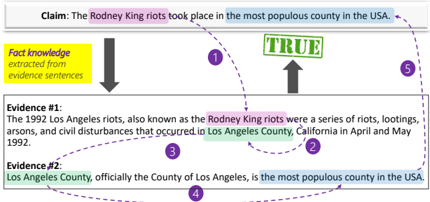
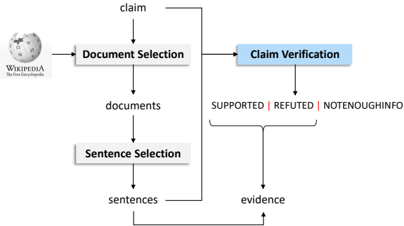
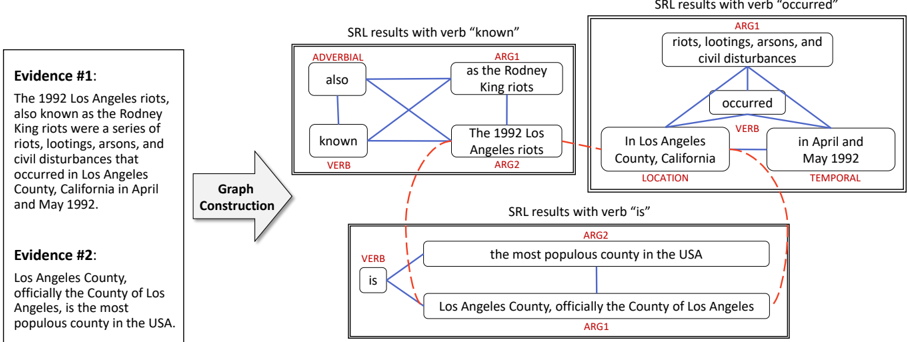
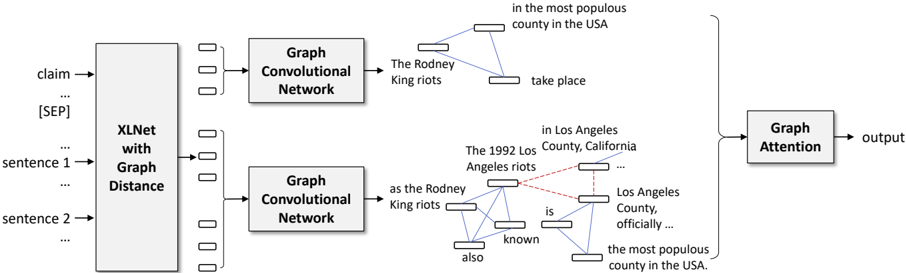
Fact checking is a challenging task because verifying the truthfulness of a claim requires reasoning about multiple retrievable evidence.In this work, we present a method suitable for reasoning about the semantic-level structure of evidence.Unlike most previous works, which typically represent evidence sentences with either string concatenation or fusing the features of isolated evidence sentences, our approach operates on rich semantic structures of evidence obtained by semantic role labeling.We propose two mechanisms to exploit the structure of evidence while leveraging the advances of pre-trained models like BERT, GPT or XLNet.Specifically, using XLNet as the backbone, we first utilize the graph structure to re-define the relative distances of words, with the intuition that semantically related words should have short distances.Then, we adopt graph convolutional network and graph attention network to propagate and aggregate information from neighboring nodes on the graph.We evaluate our system on FEVER, a benchmark dataset for fact checking, and find that rich structural information is helpful and both our graph-based mechanisms improve the accuracy.Our model is the state-of-the-art system in terms of both official evaluation metrics, namely claim verification accuracy and FEVER score.
Overview
The claims and statistics of this paper haven’t been checked yet.
Run the check — free, no account needed. It reads the open-access text and checks the sources it cites.
Integrity signals
Registry
Cites
Statistics
Figures
Verification
Claims the paper makes
The claims and statistics of this paper haven’t been checked yet.
Run the check — free, no account needed. It reads the open-access text and checks the sources it cites.
Claims other papers make about this one
Each is checked against this paper’s own text: does it say what the citing paper says it does?
The source backs part of the claim, not all of it — or backs it for a different population, condition or comparison.
In the citing paper
“Existing fact-verification approaches follow a multi-stage pipeline of claim detection, evidence retrieval and verdict prediction (Guo et al., 2022; Zhong et al., 2020). Such methods, however, require access to external databases and can have considerable inference costs.”
From SelfCheckGPT: Zero-Resource Black-Box Hallucination Detection for Generative Large Language Models (2023) · cites this paper as Zhong et al., 2020
Experimental — accuracy not yet measured
Self-check
Percentages, sums and reported differences re-computed from the paper’s own numbers.
The self-check needs the paper’s full text.
Citations
Cites
Vaswani, A., Shazeer, N., Parmar, N., Uszkoreit, J., Jones, L., Gomez, A. N., Kaiser, L., & Polosukhin, I. (2017) · arXiv · doi:10.48550/arxiv.1706.03762 · Cited by 120,404
BERT: Pre-training of Deep Bidirectional Transformers for Language Understanding
Devlin, J., Chang, M.-W., Lee, K., & Toutanova, K. (2018) · arXiv · doi:10.48550/arxiv.1810.04805 · Cited by 73,173
BERT: Pre-training of Deep Bidirectional Transformers for Language Understanding
Devlin, J., Chang, M.-W., Lee, K., & Toutanova, K. (2019) · Proceedings of the 2019 Conference of the North American Chapter of the Association for Computational Linguistics: Human Language Technologies, Volume 1 (Long and Short Papers) · doi:10.18653/v1/n19-1423 · Cited by 54,325
Semi-supervised classification with graph convolutional networks
Kipf, T. N., & Welling, M. (2016) · arXiv · doi:10.48550/arxiv.1609.02907 · Cited by 24,853
Graph Attention NetworksPreprint
Veličković, P., Casanova, A., Liò, P., Cucurull, G., Romero, A., & Bengio, Y. (2017) · arXiv (Cornell University) · doi:10.17863/cam.48429 · Cited by 19,745
RoBERTa: A Robustly Optimized BERT Pretraining Approach
Liu, Y., Ott, M., Goyal, N., Du, J., Joshi, M., Chen, D., Levy, O., Lewis, M., Zettlemoyer, L., & Stoyanov, V. (2019) · arXiv · doi:10.48550/arxiv.1907.11692 · Cited by 16,515
Veličković, P., Cucurull, G., Casanova, A., Romero, A., Liò, P., & Bengio, Y. (2017) · arXiv · doi:10.48550/arxiv.1710.10903 · Cited by 12,107
The spread of true and false news online
Vosoughi, S., Roy, D., & Aral, S. (2018) · Science · doi:10.1126/science.aap9559 · Cited by 8,847 · cited 1×
“Vosoughi et al. (2018) show that false news reaches more people than the truth.”
BackgroundXLNet: Generalized Autoregressive Pretraining for Language Understanding
Yang, Z., Dai, Z., Yang, Y., Carbonell, J., Salakhutdinov, R., & Le, Q. V. (2019) · arXiv · doi:10.48550/arxiv.1906.08237 · Cited by 6,687
Open Information Extraction from the Web
Etzioni, O., Banko, M., Cafarella, M. J., Soderland, S., & Weld, D. S. (2007) · CACM · doi:10.1145/1409360.1409378 · Cited by 2,620
Cited by
Sorted by citations
Graph neural networks: A review of methods and applications
Zhou, J., Cui, G., Hu, S., Zhang, Z., Yang, C., Liu, Z., Wang, L., Li, C., & Sun, M. (2020) · AI Open · doi:10.1016/j.aiopen.2021.01.001 · Cited by 6,880
Retrieval-Augmented Generation for Knowledge-Intensive NLP Tasks
Lewis, P., Perez, E., Piktus, A., Petroni, F., Karpukhin, V., Goyal, N., Küttler, H., Lewis, M., Yih, W.-T., Rocktäschel, T., et al. (2020) · arXiv · doi:10.48550/arxiv.2005.11401 · Cited by 3,101
SelfCheckGPT: Zero-Resource Black-Box Hallucination Detection for Generative Large Language Models
Manakul, P., Liusie, A., & Gales, M. (2023) · Proceedings of the 2023 Conference on Empirical Methods in Natural Language Processing · doi:10.18653/v1/2023.emnlp-main.557 · Cited by 557
A Survey on Automated Fact-Checking
Guo, Z., Schlichtkrull, M., & Vlachos, A. (2022) · Transactions of the Association for Computational Linguistics · doi:10.1162/tacl_a_00454 · Cited by 500
Compare to The Knowledge: Graph Neural Fake News Detection with External Knowledge
Hu, L., Yang, T., Zhang, L., Zhong, W., Tang, D., Shi, C., Duan, N., & Zhou, M. (2021) · doi:10.18653/v1/2021.acl-long.62 · Cited by 233
Self-citation
Metadata
- Authors
- Zhong, W., Xu, J., Tang, D., Xu, Z., Duan, N., Zhou, M., Wang, J., & Yin, J.
- Affiliations
- Sun Yat-sen University (CN)
- Peking University (CN)
- Microsoft (United States) (US)
- Venue
- Proceedings of the 58th Annual Meeting of the Association for Computational Linguistics
- Published
- 2020
- Pages
- 6170-6180
- ISSN
- 0736-587X (ISSN-L)
- OpenAlex
- W3034808961
- Cited by
- 151
- References
- 36
- Citations by year
- 2026: 4 · 2025: 15 · 2024: 22 · 2023: 26 · 2022: 36 · 2021: 38 · 2020: 10
- FWCI
- 58.32
- Type
- conference paper
- Language
- en
- Open access
- hybrid
- doi.org
- Licence
- cc-by
- Locations
- Proceedings of the conference - Association for Computational Linguistics. Meeting (publishedVersion, cc-by)
- Funders
- National Natural Science Foundation of China (U1611264, U1711262, U1811261, U1811264, U1711261, U1911203)
- Basic and Applied Basic Research Foundation of Guangdong Province (2019B15 15130001)
- Topics
- Social Sciences › Sociology and Political Science › Misinformation and Its Impacts
- Physical Sciences › Computer Science › Artificial Intelligence › Topic Modeling
- Physical Sciences › Computer Science › Computer Vision and Pattern Recognition › Multimodal Machine Learning Applications
- Keywords
- fact-checking, claim verification, semantic role labeling, graph convolutional networks, graph attention networks, XLNet, FEVER dataset, word distance
About these checks
Registry, retraction, Cites and statistics results are computed, not judged, with one exception: a printed reference that no index lists is read once by a model before it counts as a citation error. Claims are extracted by a model and kept only when their quote appears verbatim in the text; each cited source is then checked, with a model’s help, for whether it says what the claim relies on. Those verdicts can be wrong — read the claim’s quote and the cited source before relying on one.
Statistics and arithmetic are recomputed, not judged.
Confidence bands are shown only for fields calibrated on our annotated test set. None is calibrated yet, so no band is shown.
What counts as a claim ›How we measure confidence ›How we check this ›
Are you an author, or do you see a problem with this page? Request a review
