

HIBRIDS: Attention with Hierarchical Biases for Structure-aware Long Document Summarization
The DOI matches its Crossref record; 16 of the 16 references it cites were found in a registry or an index.
Abstract
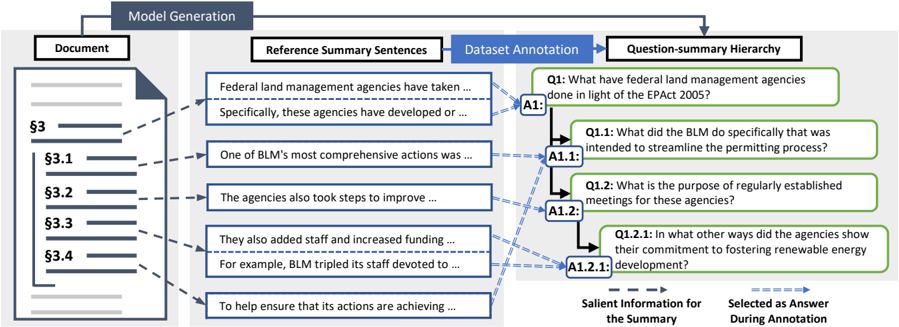
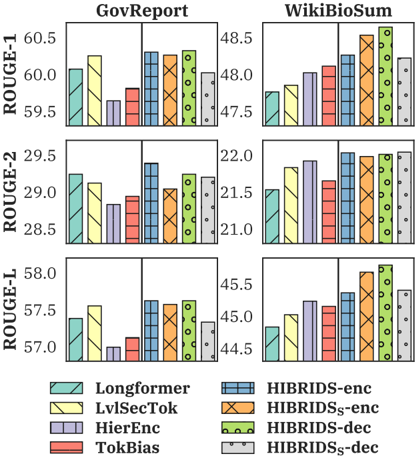
Document structure is critical for efficient information consumption.However, it is challenging to encode it efficiently into the modern Transformer architecture.In this work, we present HIBRIDS, which injects Hierarchical Biases foR Incorporating Document Structure into the calculation of attention scores.We further present a new task, hierarchical questionsummary generation, for summarizing salient content in the source document into a hierarchy of questions and summaries, where each follow-up question inquires about the content of its parent question-summary pair.We also annotate a new dataset with 6, 153 questionsummary hierarchies labeled on long government reports.Experiment results show that our model produces better question-summary hierarchies than comparisons on both hierarchy quality and content coverage, a finding also echoed by human judges.Additionally, our model improves the generation of longform summaries from lengthy government reports and Wikipedia articles, as measured by ROUGE scores.
Overview
The claims and statistics of this paper haven’t been checked yet.
Free: it reads the open-access text and checks the first 5 claims that cite a source we can check. Create a free account to check every claim.
Integrity signals
Registry
Cites
Statistics
Figures
Verification
Claims the paper makes
The claims and statistics of this paper haven’t been checked yet.
Free: it reads the open-access text and checks the first 5 claims that cite a source we can check. Create a free account to check every claim.
Claims other papers make about this one
Each is checked against this paper’s own text: does it say what the citing paper says it does?
In the citing paper
“Building on the idea that long texts often present subtopics and hierarchical structures (Cao & Wang, 2022;Dong et al., 2023b)”
From RAPTOR: Recursive Abstractive Processing for Tree-Organized Retrieval (2024) · cites this paper as Cao & Wang, 2022
Self-check
Percentages, sums and reported differences re-computed from the paper’s own numbers.
The self-check needs the paper’s full text.
Citations
Cites
Adam: A Method for Stochastic Optimization
Kingma, D. P., & Ba, J. (2014) · arXiv · doi:10.48550/arxiv.1412.6980 · Cited by 98,946
Sentence-BERT: Sentence Embeddings using Siamese BERT-Networks
Reimers, N., & Gurevych, I. (2019) · Proceedings of the 2019 Conference on Empirical Methods in Natural Language Processing and the 9th International Joint Conference on Natural Language Processing (EMNLP-IJCNLP) · doi:10.18653/v1/d19-1410 · Cited by 12,778
Exploring the Limits of Transfer Learning with a Unified Text-to-Text Transformer
Raffel, C., Shazeer, N., Roberts, A., Lee, K., Narang, S., Matena, M., Zhou, Y., Li, W., & Liu, P. J. (2019) · arXiv · doi:10.48550/arxiv.1910.10683 · Cited by 10,929
Lewis, M., Liu, Y., Goyal, N., Ghazvininejad, M., Mohamed, A., Levy, O., Stoyanov, V., & Zettlemoyer, L. (2020) · Proceedings of the 58th Annual Meeting of the Association for Computational Linguistics · doi:10.18653/v1/2020.acl-main.703 · Cited by 8,821
Transformers: State-of-the-Art Natural Language Processing
Wolf, T., Debut, L., Sanh, V., Chaumond, J., Delangue, C., Moi, A., Cistac, P., Rault, T., Louf, R., Funtowicz, M., et al. (2020) · Proceedings of the 2020 Conference on Empirical Methods in Natural Language Processing: System Demonstrations · doi:10.18653/v1/2020.emnlp-demos.6 · Cited by 8,741
Longformer: The Long-Document Transformer
Beltagy, I., Peters, M. E., & Cohan, A. (2020) · arXiv · doi:10.48550/arxiv.2004.05150 · Cited by 2,281
Big Bird: Transformers for Longer Sequences
Zaheer, M., Guruganesh, G., Dubey, A., Ainslie, J., Alberti, C., Ontanon, S., Pham, P., Ravula, A., Wang, Q., Yang, L., et al. (2020) · arXiv · doi:10.48550/arxiv.2007.14062 · Cited by 1,349
PEGASUS: Pre-training with Extracted Gap-sentences for Abstractive Summarization
Zhang, J., Zhao, Y., Saleh, M., & Liu, P. J. (2019) · arXiv · doi:10.48550/arxiv.1912.08777 · Cited by 1,206
Evaluating the Factual Consistency of Abstractive Text Summarization
Kryscinski, W., McCann, B., Xiong, C., & Socher, R. (2020) · Proceedings of the 2020 Conference on Empirical Methods in Natural Language Processing (EMNLP) · doi:10.18653/v1/2020.emnlp-main.750 · Cited by 669
A Discourse-Aware Attention Model for Abstractive Summarization of Long Documents
Cohan, A., Dernoncourt, F., Kim, D. S., Bui, T., Kim, S., Chang, W., & Goharian, N. (2018) · Proceedings of the 2018 Conference of the North American Chapter of the Association for Computational Linguistics: Human Language Technologies, Volume 2 (Short Papers) · doi:10.18653/v1/n18-2097 · Cited by 658
QuestEval: Summarization Asks for Fact-based Evaluation
Scialom, T., Dray, P.-A., Lamprier, S., Piwowarski, B., Staiano, J., Wang, A., & Gallinari, P. (2021) · Proceedings of the 2021 Conference on Empirical Methods in Natural Language Processing · doi:10.18653/v1/2021.emnlp-main.529 · Cited by 175
Harvesting Paragraph-level Question-Answer Pairs from Wikipedia
Du, X., & Cardie, C. (2018) · Proceedings of the 56th Annual Meeting of the Association for Computational Linguistics (Volume 1: Long Papers) · doi:10.18653/v1/p18-1177 · Cited by 168
Efficient Attentions for Long Document Summarization
Huang, L., Cao, S., Parulian, N., Ji, H., & Wang, L. (2021) · Proceedings of the 2021 Conference of the North American Chapter of the Association for Computational Linguistics: Human Language Technologies · doi:10.18653/v1/2021.naacl-main.112 · Cited by 146
Self-citationEvaluating Factuality in Generation with Dependency-level Entailment
Goyal, T., & Durrett, G. (2020) · Findings of the Association for Computational Linguistics: EMNLP 2020 · doi:10.18653/v1/2020.findings-emnlp.322 · Cited by 93
Generating Question-Answer Hierarchies
Krishna, K., & Iyyer, M. (2019) · Proceedings of the 57th Annual Meeting of the Association for Computational Linguistics · doi:10.18653/v1/p19-1224 · Cited by 44
Qu, F., Jia, X., & Wu, Y. (2021) · Proceedings of the 2021 Conference on Empirical Methods in Natural Language Processing · doi:10.18653/v1/2021.emnlp-main.202 · Cited by 30
Research works printed but not linked: 23
- Chris Alberti, Daniel Andor, Emily Pitler, Jacob Devlin, and Michael Collins. 2019. Synthetic QA corpora generation with roundtrip consistency. In Proceed- ings of the 57th Annual Meeting of the Association for Computational Linguistics, pages 6168-6173, Flo- rence, Italy. Association for Computational Linguis- tics. in Natural Language Processing and the 9th Inter- national Joint Conference on Natural Language Pro- cessing (EMNLP-IJCNLP), pages 4453-4462, Hong Kong, China. Association for Computational Linguis- tics. · DOI · Paper page
- Max Grusky, Mor Naaman, and Yoav Artzi. 2018. Newsroom: A dataset of 1.3 million summaries with diverse extractive strategies. In Proceedings of the 2018 Conference of the North American Chapter of the Association for Computational Linguistics: Hu- man Language Technologies, Volume 1 (Long Pa- pers), pages 708-719, New Orleans, Louisiana. As- sociation for Computational Linguistics. · DOI · Paper page
- John T. Guthrie, Tracy Britten, and K. Georgene Barker. 1991. Roles of document structure, cognitive strategy, and awareness in searching for information. Reading Research Quarterly, 26(3):300-324.
- Tsutomu Hirao, Yasuhisa Yoshida, Masaaki Nishino, Norihito Yasuda, and Masaaki Nagata. 2013. Single- document summarization as a tree knapsack problem. In Proceedings of the 2013 Conference on Empiri- cal Methods in Natural Language Processing, pages 1515-1520, Seattle, Washington, USA. Association for Computational Linguistics.
- David H. Jonassen. 1988. Designing structured hyper- text and structuring access to hypertext. Educational Technology, 28(11):13-16.
- Chin-Yew Lin. 2004. ROUGE: A package for auto- matic evaluation of summaries. In Text Summariza- tion Branches Out, pages 74-81, Barcelona, Spain. Association for Computational Linguistics.
- Bang Liu, Haojie Wei, Di Niu, Haolan Chen, and Yancheng He. 2020. Asking Questions the Human Way: Scalable Question-Answer Generation from Text Corpus, page 2032-2043. Association for Com- puting Machinery, New York, NY, USA. · DOI
- Yang Liu and Mirella Lapata. 2019. Hierarchical trans- formers for multi-document summarization. In Pro- ceedings of the 57th Annual Meeting of the Asso- ciation for Computational Linguistics, pages 5070- 5081, Florence, Italy. Association for Computational Linguistics. · DOI · Paper page
- Yang Liu, Ivan Titov, and Mirella Lapata. 2019. Single document summarization as tree induction. In Pro- ceedings of the 2019 Conference of the North Amer- ican Chapter of the Association for Computational Linguistics: Human Language Technologies, Volume 1 (Long and Short Papers), pages 1745-1755, Min- neapolis, Minnesota. Association for Computational Linguistics. · DOI
- Margaret G. McKeown, Isabel L. Beck, and Ronette G.K. Blake. 2009. Rethinking reading com- prehension instruction: A comparison of instruction for strategies and content approaches. Reading Re- search Quarterly, 44(3):218-253.
- Rui Meng, Khushboo Thaker, Lei Zhang, Yue Dong, Xingdi Yuan, Tong Wang, and Daqing He. 2021. Bringing structure into summaries: a faceted sum- marization dataset for long scientific documents. In Proceedings of the 59th Annual Meeting of the Asso- ciation for Computational Linguistics and the 11th International Joint Conference on Natural Language Processing (Volume 2: Short Papers), pages 1080- 1089, Online. Association for Computational Linguis- tics. · DOI
- Bonnie J. F. Meyer, David M. Brandt, and George J. Bluth. 1980. Use of top-level structure in text: Key for reading comprehension of ninth-grade students. Reading Research Quarterly, 16(1):72-103.
- Myle Ott, Sergey Edunov, Alexei Baevski, Angela Fan, Sam Gross, Nathan Ng, David Grangier, and Michael Auli. 2019. fairseq: A fast, extensible toolkit for sequence modeling. In Proceedings of NAACL-HLT 2019: Demonstrations.
- Kishore Papineni, Salim Roukos, Todd Ward, and Wei- Jing Zhu. 2002. Bleu: a method for automatic evalu- ation of machine translation. In Proceedings of the 40th Annual Meeting of the Association for Compu- tational Linguistics, pages 311-318, Philadelphia, Pennsylvania, USA. Association for Computational Linguistics. · DOI · Paper page
- Pranav Rajpurkar, Jian Zhang, Konstantin Lopyrev, and Percy Liang. 2016. SQuAD: 100,000+ questions for machine comprehension of text. In Proceedings of the 2016 Conference on Empirical Methods in Natu- ral Language Processing, pages 2383-2392, Austin, Texas. Association for Computational Linguistics. · DOI · Paper page
- Mrinmaya Sachan and Eric Xing. 2018. Self-training for jointly learning to ask and answer questions. In Proceedings of the 2018 Conference of the North American Chapter of the Association for Computa- tional Linguistics: Human Language Technologies, Volume 1 (Long Papers), pages 629-640, New Or- leans, Louisiana. Association for Computational Lin- guistics. · DOI · Paper page
- Dafna Shahaf, Carlos Guestrin, and Eric Horvitz. 2012. Trains of thought: Generating information maps. In Proceedings of the 21st international conference on World Wide Web, pages 899-908.
- Richard J. Shavelson. 1974. Methods for examining representations of a subject-matter structure in a stu- dent's memory. Journal of Research in Science Teaching, 11(3):231-249. · DOI · Paper page
- Manfred Stede and David Schlangen. 2004. Information-seeking chat: Dialogues driven by topic-structure. In Proceedings of Catalog (the 8th workshop on the semantics and pragmatics of dialogue; SemDial04). Citeseer.
- Barbara M. Taylor and Richard W. Beach. 1984. The ef- fects of text structure instruction on middle-grade stu- dents' comprehension and production of expository text. Reading Research Quarterly, 19(2):134-146.
- Lu Wang, Claire Cardie, and Galen Marchetti. 2015. Socially-informed timeline generation for complex events. In Proceedings of the 2015 Conference of the North American Chapter of the Association for Computational Linguistics: Human Language Tech- nologies, pages 1055-1065, Denver, Colorado. Asso- ciation for Computational Linguistics. · DOI
- Wen Xiao and Giuseppe Carenini. 2019. Extractive summarization of long documents by combining global and local context. In Proceedings of the 2019 Conference on Empirical Methods in Natu- ral Language Processing and the 9th International Joint Conference on Natural Language Processing (EMNLP-IJCNLP), pages 3011-3021, Hong Kong, China. Association for Computational Linguistics. · DOI · Paper page
- Jiacheng Xu, Zhe Gan, Yu Cheng, and Jingjing Liu. 2020. Discourse-aware neural extractive text sum- marization. In Proceedings of the 58th Annual Meet- ing of the Association for Computational Linguistics, pages 5021-5031, Online. Association for Computa- tional Linguistics. 15 https://www.apache.org/licenses/ LICENSE-2.0 16 https://huggingface.co/allenai/ led-large-16384 17 https://opensource.org/licenses/MIT and GOVREPORT. Importantly, we adopt gradi- ent checkpointing (Chen et al., 2016) to reduce the memory consumption of back propagation. Decoding Settings. A beam search with a beam size of 4 is used for decoding. The maximum de- coding length is 1,024. We also disable the genera- tion of repeated 5-grams. Running Time. HIBRIDS takes 2, 2, 5, and 12 hours for training on QSGen-Hier, QSGen- ChildQ, WIKIBIOSUM, and GOVREPORT with 4 GPUs. Decoding on QSGen-Hier and QSGen- ChildQ takes one hour. For decoding on WIKIBIO- SUM, and GOVREPORT, it uses 3 and 4 hours. Evaluation. We compute ROUGE scores (Lin, 2004) using the implementation by Google Re- search 18 . For BLEU scores, we use NLTK 3.5 (Bird et al., 2009). · DOI · Paper page
Cited by
RAPTOR: Recursive Abstractive Processing for Tree-Organized Retrieval
Sarthi, P., Abdullah, S., Tuli, A., Khanna, S., Goldie, A., & Manning, C. D. (2024) · arXiv · doi:10.48550/arxiv.2401.18059 · Cited by 36
Conditional Generation with a Question-Answering Blueprint
Narayan, S., Maynez, J., Amplayo, R. K., Ganchev, K., Louis, A., Huot, F., Sandholm, A., Das, D., & Lapata, M. (2022) · arXiv · doi:10.48550/arxiv.2207.00397 · Cited by 24
SCM: Enhancing Large Language Model with Self-Controlled Memory Framework
Wang, B., Liang, X., Yang, J., Huang, H., Wu, S., Wu, P., Lu, L., Ma, Z., & Li, Z. (2023) · arXiv · doi:10.48550/arxiv.2304.13343 · Cited by 5
Metadata
- Authors
- Cao, S., & Wang, L.
- Venue
- Proceedings of the 60th Annual Meeting of the Association for Computational Linguistics (Volume 1: Long Papers)
- Published
- 2022
- Pages
- 786-807
- Cited by
- 24
- References
- 16
About these checks
Registry, retraction, Cites and statistics results are computed, not judged, with one exception: a printed reference that no index lists is read once by a model before it counts as a citation error. Claims are extracted by a model and kept only when their quote appears verbatim in the text; each cited source is then checked, with a model’s help, for whether it says what the claim relies on. Those verdicts can be wrong — read the claim’s quote and the cited source before relying on one.
Statistics and arithmetic are recomputed, not judged.
Confidence bands are shown only for fields calibrated on our annotated test set. None is calibrated yet, so no band is shown.
What counts as a claim ›How we measure confidence ›How we check this ›
Are you an author, or do you see a problem with this page? Request a review
Data sources
Bibliographic data: Semantic Scholar, OpenAlex, Crossref.
Contains information from the Semantic Scholar Academic Graph Datasets, made available under the ODC Attribution License (ODC-BY 1.0).
Semantic Scholar’s data is described in: Kinney, R., et al. (2023). The Semantic Scholar Open Data Platform. arXiv:2301.10140.
