

The DOI matches its Crossref record; 31 of the 31 references it cites were found in a registry or an index.
Fine-tuning BERT Models for Summarizing German Radiology Findings
Open accessAbstract
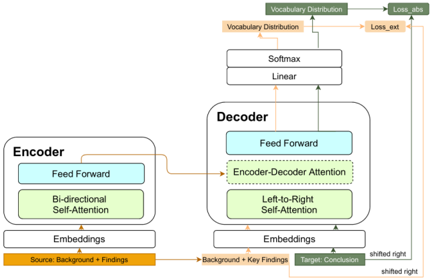
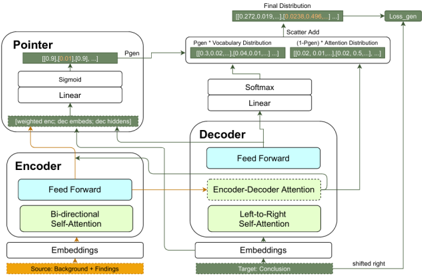
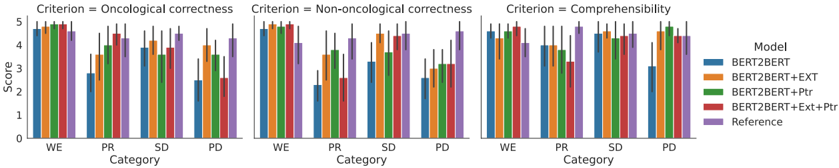
Writing the conclusion section of radiology reports is essential for communicating the radiology findings and its assessment to physician in a condensed form.In this work, we employ a transformer-based Seq2Seq model for generating the conclusion section of German radiology reports.The model is initialized with the pretrained parameters of a German BERT model and fine-tuned in our downstream task on our domain data.We proposed two strategies to improve the factual correctness of the model.In the first method, next to the abstractive learning objective, we introduce an extraction learning objective to train the decoder in the model to both generate one summary sequence and extract the key findings from the source input.The second approach is to integrate the pointer mechanism into the transformer-based Seq2Seq model.The pointer network helps the Seq2Seq model to choose between generating tokens from the vocabulary or copying parts from the source input during generation.The results of the automatic and human evaluations show that the enhanced Seq2Seq model is capable of generating human-like radiology conclusions and that the improved models effectively reduce the factual errors in the generations despite the small amount of training data.
Overview
The claims and statistics of this paper haven’t been checked yet.
Run the check — free, no account needed. It reads the open-access text and checks the sources it cites.
Integrity signals
Registry
Cites
Statistics
Figures
Verification
Claims the paper makes
The claims and statistics of this paper haven’t been checked yet.
Run the check — free, no account needed. It reads the open-access text and checks the sources it cites.
Claims other papers make about this one
Each is checked against this paper’s own text: does it say what the citing paper says it does?
In the citing paper
“So far, most authors focused on summarization of radiology reports, i.e., on the creation of a shorter version that includes all important aspects at the same level of text complexity [23–26].”
From ChatGPT makes medicine easy to swallow: an exploratory case study on simplified radiology reports (2023) · cites this paper as [25]
Self-check
Percentages, sums and reported differences re-computed from the paper’s own numbers.
The self-check needs the paper’s full text.
Citations
Cites
BERT: Pre-training of Deep Bidirectional Transformers for Language Understanding
Devlin, J., Chang, M.-W., Lee, K., & Toutanova, K. (2018) · arXiv · doi:10.48550/arxiv.1810.04805 · Cited by 73,173
(2004) · Cited by 9,718
A statistical interpretation of term specificity and its application in retrieval
Jones, K. S. (2021) · J. Documentation · doi:10.1108/eb026526 · Cited by 5,541
Get To The Point: Summarization with Pointer-Generator Networks
See, A., Liu, P. J., & Manning, C. D. (2017) · Proceedings of the 55th Annual Meeting of the Association for Computational Linguistics (Volume 1: Long Papers) · doi:10.18653/v1/p17-1099 · Cited by 3,775
TextRank: Bringing Order into Text
Mihalcea, R. F., & Tarau, P. (2004) · Conference on Empirical Methods in Natural Language Processing (EMNLP) · Cited by 3,631
HuggingFace's Transformers: State-of-the-art Natural Language Processing
Wolf, T., Debut, L., Sanh, V., Chaumond, J., Delangue, C., Moi, A., Cistac, P., Rault, T., Louf, R., Funtowicz, M., et al. (2019) · arXiv · doi:10.48550/arxiv.1910.03771 · Cited by 3,347
Text Summarization with Pretrained Encoders
Liu, Y., & Lapata, M. (2019) · Conference on Empirical Methods in Natural Language Processing (EMNLP) · doi:10.18653/v1/d19-1387 · Cited by 1,934
Abstractive Sentence Summarization with Attentive Recurrent Neural Networks
Chopra, S., Auli, M., & Rush, A. M. (2016) · Conference of the North American Chapter of the Association for Computational Linguistics: Human Language Technologies (NAACL-HLT) · doi:10.18653/v1/n16-1012 · Cited by 896
Evaluating the Factual Consistency of Abstractive Text Summarization
Kryscinski, W., McCann, B., Xiong, C., & Socher, R. (2020) · Proceedings of the 2020 Conference on Empirical Methods in Natural Language Processing (EMNLP) · doi:10.18653/v1/2020.emnlp-main.750 · Cited by 669
Fast Abstractive Summarization with Reinforce-Selected Sentence Rewriting
Chen, Y.-C., & Bansal, M. (2018) · Proceedings of the conference - Association for Computational Linguistics. Meeting · doi:10.18653/v1/p18-1063 · Cited by 636
Cited by
Sorted by citations
ChatGPT makes medicine easy to swallow: an exploratory case study on simplified radiology reports
Jeblick, K., Schachtner, B., Dexl, J., Mittermeier, A., Stüber, A. T., Topalis, J., Weber, T., Wesp, P., Sabel, B. O., Ricke, J., et al. (2023) · European Radiology · doi:10.1007/s00330-023-10213-1 · Cited by 549
Self-citationScientific evidence for clinical text summarization using large language models: scoping review
Bednarczyk, L., Reichenpfader, D., Gaudet-Blavignac, C., Ette, A. K., Zaghir, J., Zheng, Y., Bensahla, A., Bjelogrlic, M., & Lovis, C. (2025) · Journal of Medical Internet Research · doi:10.2196/68998 · Cited by 83
Metadata
- Authors
- Liang, S., Kades, K., Fink, M., Full, P., Weber, T., Kleesiek, J., Strube, M., & Maier-Hein, K.
- Affiliations
- German Research Centre for Artificial Intelligence (DE)
- German Cancer Research Center (DE)
- University Hospital Heidelberg (DE)
- Deutsches Konsortium für Translationale Krebsforschung (DE)
- Heidelberg Institute for Theoretical Studies (DE)
- Venue
- Proceedings of the 4th Clinical Natural Language Processing Workshop
- Published
- 2022
- OpenAlex
- W4287888487
- Cited by
- 8
- References
- 31
- Citations by year
- 2025: 1 · 2024: 3 · 2023: 4
- FWCI
- 1.11
- Type
- conference paper
- Language
- en
- Open access
- hybrid
- doi.org
- Licence
- cc-by
- Locations
- Clinical Natural Language Processing Workshop (ClinicalNLP) (publishedVersion, cc-by)
- Funders
- Deutsches Krebsforschungszentrum
- Deutschen Konsortium für Translationale Krebsforschung
- Topics
- Physical Sciences › Computer Science › Artificial Intelligence › Topic Modeling
- Physical Sciences › Computer Science › Computer Vision and Pattern Recognition › Multimodal Machine Learning Applications
- Health Sciences › Medicine › Health Informatics › Artificial Intelligence in Healthcare and Education
- Keywords
- radiology report summarization, German language, BERT fine-tuning, sequence-to-sequence models, pointer networks, factual accuracy, abstractive summarization, clinical text generation
About these checks
Registry, retraction, Cites and statistics results are computed, not judged, with one exception: a printed reference that no index lists is read once by a model before it counts as a citation error. Claims are extracted by a model and kept only when their quote appears verbatim in the text; each cited source is then checked, with a model’s help, for whether it says what the claim relies on. Those verdicts can be wrong — read the claim’s quote and the cited source before relying on one.
Statistics and arithmetic are recomputed, not judged.
Confidence bands are shown only for fields calibrated on our annotated test set. None is calibrated yet, so no band is shown.
What counts as a claim ›How we measure confidence ›How we check this ›
Are you an author, or do you see a problem with this page? Request a review
