

Temporal Knowledge Question Answering via Abstract Reasoning Induction
The DOI matches its Crossref record; 8 of the 8 references it cites were found in a registry or an index.
Abstract
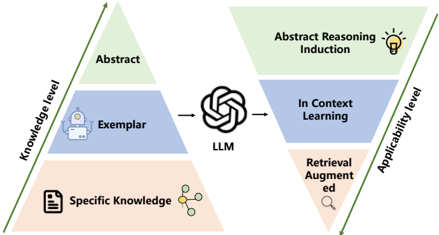
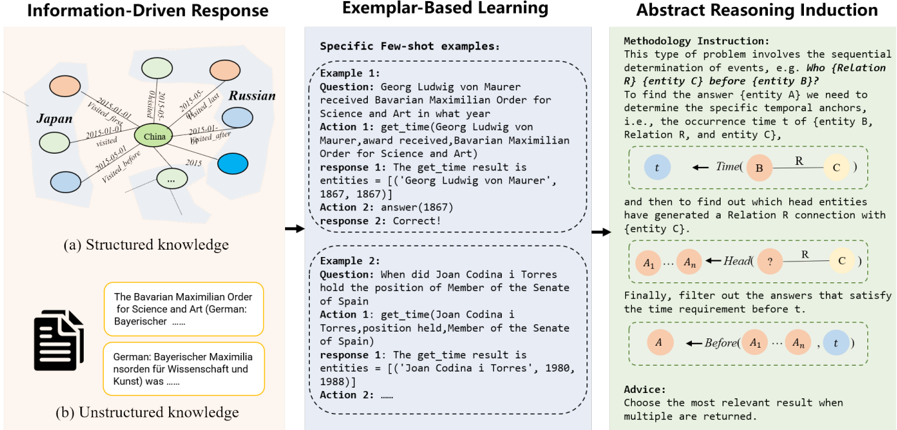
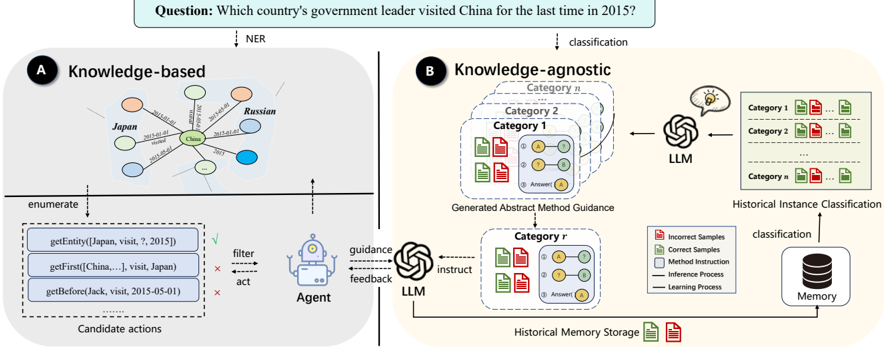
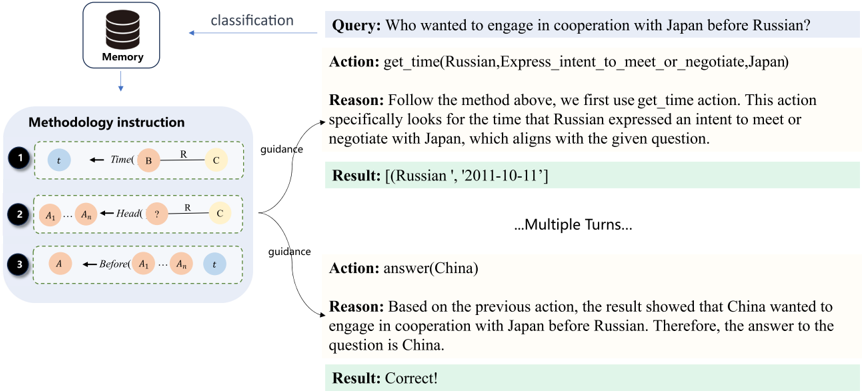
In this study, we address the challenge of enhancing temporal knowledge reasoning in Large Language Models (LLMs).LLMs often struggle with this task, leading to the generation of inaccurate or misleading responses.This issue mainly arises from their limited ability to handle evolving factual knowledge and complex temporal logic.To overcome these limitations, we propose Abstract Reasoning Induction (ARI) framework, which divides temporal reasoning into two distinct phases: Knowledgeagnostic and Knowledge-based.This framework offers factual knowledge support to LLMs while minimizing the incorporation of extraneous noisy data.Concurrently, informed by the principles of constructivism, ARI provides LLMs the capability to engage in proactive, self-directed learning from both correct and incorrect historical reasoning samples.By teaching LLMs to actively construct knowledge and methods, it can significantly boosting their temporal reasoning abilities.Our approach achieves significant improvements, with relative gains of 29.7% and 9.27% on two temporal QA datasets, underscoring its efficacy in advancing temporal reasoning in LLMs.The code can be found at https: //github.com/czy1999/ARI-QA.
Overview
The claims and statistics of this paper haven’t been checked yet.
Free: it reads the open-access text and checks the first 5 claims that cite a source we can check. Create a free account to check every claim.
Integrity signals
Registry
Cites
Statistics
Figures
Verification
Claims the paper makes
The claims and statistics of this paper haven’t been checked yet.
Free: it reads the open-access text and checks the first 5 claims that cite a source we can check. Create a free account to check every claim.
Claims other papers make about this one
Each is checked against this paper’s own text: does it say what the citing paper says it does?
The source backs part of the claim, not all of it — or backs it for a different population, condition or comparison.
In the citing paper
“Despite inherent flexibility, iterative exploration remains vulnerable to error propagation.”
From Temporal Evidence Chain for Temporal Knowledge Graph Question Answering with Large Language Models (2026) · cites this paper as Chen et al., 2024
Experimental — accuracy not yet measuredThe cited source says what the claim attributes to it.
In the citing paper
“Existing LLM-based TKGQA methods typically utilize RAG-based or agent-based paradigms, yet both struggle to construct reliable temporal evidence chains.”
From Temporal Evidence Chain for Temporal Knowledge Graph Question Answering with Large Language Models (2026) · cites this paper as Chen et al., 2024
In the citing paper
“Retrieval-Augmented Generation (RAG) has emerged as a solution, enabling LLMs to retrieve relevant documents from external sources to enhance response accuracy8–10.”
From A Question Answering Dataset for Temporal-Sensitive Retrieval-Augmented Generation (2025) · cites this paper as [8]
In the citing paper
“iterative agents are prone to error propagation during multi-step reasoning.”
From Temporal Evidence Chain for Temporal Knowledge Graph Question Answering with Large Language Models (2026) · cites this paper as Chen et al., 2024
Self-check
Percentages, sums and reported differences re-computed from the paper’s own numbers.
The self-check needs the paper’s full text.
Citations
Cites
Wikidata: a free collaborative knowledgebase
Vrandečić, D., & Krötzsch, M. (2014) · Communications of the ACM · doi:10.1145/2629489 · Cited by 3,342
A Survey of Knowledge Graph Reasoning on Graph Types: Static, Dynamic, and Multi-Modal
Liang, K., Meng, L., Liu, M., Liu, Y., Tu, W., Wang, S., Zhou, S., Liu, X., Sun, F., & He, K. (2024) · IEEE Transactions on Pattern Analysis and Machine Intelligence · doi:10.1109/tpami.2024.3417451 · Cited by 553
(2020) · doi:10.18653/v1/2020.acl-main.412 · Cited by 542
Towards Reasoning in Large Language Models: A Survey
Huang, J., & Chang, K. C.-C. (2022) · arXiv · doi:10.48550/arxiv.2212.10403 · Cited by 428
Augmented Language Models: a Survey
Mialon, G., Dessì, R., Lomeli, M., Nalmpantis, C., Pasunuru, R., Raileanu, R., Rozière, B., Schick, T., Dwivedi-Yu, J., Celikyilmaz, A., et al. (2023) · arXiv · doi:10.48550/arxiv.2302.07842 · Cited by 160
Think-on-Graph: Deep and Responsible Reasoning of Large Language Model on Knowledge Graph
Sun, J., Xu, C., Tang, L., Wang, S., Lin, C., Gong, Y., Ni, L. M., Shum, H.-Y., & Guo, J. (2023) · arXiv · doi:10.48550/arxiv.2307.07697 · Cited by 74
Learning From Mistakes Makes LLM Better Reasoner
An, S., Ma, Z., Lin, Z., Zheng, N., Lou, J.-G., & Chen, W. (2023) · arXiv · doi:10.48550/arxiv.2310.20689 · Cited by 7
MemoChat: Tuning LLMs to Use Memos for Consistent Long-Range Open-Domain Conversation
Lu, J., An, S., Lin, M., Pergola, G., He, Y., Yin, D., Sun, X., & Wu, Y. (2023) · arXiv · doi:10.48550/arxiv.2308.08239 · Cited by 6
Research works printed but not linked: 39
- Jinheon Baek, Alham Fikri Aji, and Amir Saffari. 2023. Knowledge-augmented language model prompting for zero-shot knowledge graph question answering. CoRR, abs/2306.04136. · arXiv
- Ziyang Chen, Jinzhi Liao, and Xiang Zhao. 2023. Multi- granularity temporal question answering over knowl- edge graphs. In Proceedings of the 61st Annual Meet- ing of the Association for Computational Linguistics (Volume 1: Long Papers).
- Jacob Devlin, Ming-Wei Chang, Kenton Lee, and Kristina Toutanova. 2019. BERT: pre-training of deep bidirectional transformers for language under- standing. In Proceedings of the 2019 Conference of the North American Chapter of the Association for Computational Linguistics: Human Language Tech- nologies, NAACL-HLT 2019, Minneapolis, MN, USA, June 2-7, 2019, Volume 1 (Long and Short Papers), pages 4171-4186. Association for Computational Linguistics.
- Qingxiu Dong, Lei Li, Damai Dai, Ce Zheng, Zhiyong Wu, Baobao Chang, Xu Sun, Jingjing Xu, Lei Li, and Zhifang Sui. 2023. A survey for in-context learning. ArXiv, abs/2301.00234. · arXiv
- Thibault Févry, Livio Baldini Soares, Nicholas FitzGer- ald, Eunsol Choi, and Tom Kwiatkowski. 2020. En- tities as experts: Sparse memory access with entity supervision. In Proceedings of the 2020 Conference on Empirical Methods in Natural Language Process- ing, EMNLP 2020, Online, November 16-20, 2020, pages 4937-4951. Association for Computational Linguistics.
- Yu Gu, Xiang Deng, and Yu Su. 2023. Don't gener- ate, discriminate: A proposal for grounding language models to real-world environments. In Proceedings of the 61st Annual Meeting of the Association for Computational Linguistics (Volume 1: Long Papers), ACL 2023, Toronto, Canada, July 9-14, 2023, pages 4928-4949. Association for Computational Linguis- tics.
- Yu Gu and Yu Su. 2022. Arcaneqa: Dynamic program induction and contextualized encoding for knowledge base question answering. In Proceedings of the 29th International Conference on Computational Linguis- tics, COLING 2022, Gyeongju, Republic of Korea, October 12-17, 2022, pages 1718-1731. International Committee on Computational Linguistics.
- Johannes Hoffart, Fabian M. Suchanek, Klaus Berberich, Edwin Lewis-Kelham, Gerard de Melo, and Gerhard Weikum. 2011. YAGO2: exploring and querying world knowledge in time, space, context, and many languages. In Proceedings of the 20th In- ternational Conference on World Wide Web, WWW 2011, Hyderabad, India, March 28 -April 1, 2011 (Companion Volume), pages 229-232. ACM.
- Zhen Jia, Abdalghani Abujabal, Rishiraj Saha Roy, Jannik Strötgen, and Gerhard Weikum. 2018. TEQUILA: temporal question answering over knowl- edge bases. In Proceedings of the 27th ACM Inter- national Conference on Information and Knowledge Management, CIKM 2018, Torino, Italy, October 22- 26, 2018, pages 1807-1810. ACM.
- Brenden M Lake and Marco Baroni. 2023. Human-like systematic generalization through a meta-learning neural network. Nature, pages 1-7.
- Zhenzhong Lan, Mingda Chen, Sebastian Goodman, Kevin Gimpel, Piyush Sharma, and Radu Soricut. 2020. ALBERT: A lite BERT for self-supervised learning of language representations. In 8th Inter- national Conference on Learning Representations, ICLR 2020, Addis Ababa, Ethiopia, April 26-30, 2020. OpenReview.net.
- Yunxin Li, Baotian Hu, Xinyu Chen, Lin Ma, and Min Zhang. 2023b. Lmeye: An interactive perception network for large language models. arXiv preprint arXiv:2305.03701. · arXiv
- Yunxin Li, Baotian Hu, Wei Wang, Xiaochun Cao, and Min Zhang. 2023c. Towards vision enhancing llms: Empowering multimodal knowledge storage and shar- ing in llms. arXiv preprint arXiv:2311.15759. · arXiv
- Ke Liang, Yue Liu, Sihang Zhou, Wenxuan Tu, Yi Wen, Xihong Yang, Xiangjun Dong, and Xinwang Liu. 2023a. Knowledge graph contrastive learning based on relation-symmetrical structure. IEEE Transac- tions on Knowledge and Data Engineering, pages 1-12. · DOI · Paper page
- Ke Liang, Lingyuan Meng, Meng Liu, Yue Liu, Wenx- uan Tu, Siwei Wang, Sihang Zhou, and Xinwang Liu. 2023b. Learn from relational correlations and periodic events for temporal knowledge graph reason- ing. In Proceedings of the 46th International ACM SIGIR Conference on Research and Development in Information Retrieval, pages 1559-1568.
- Ke Liang, Lingyuan Meng, Meng Liu, Yue Liu, Wenx- uan Tu, Siwei Wang, Sihang Zhou, Xinwang Liu, and Fuchun Sun. 2022. Reasoning over different types of knowledge graphs: Static, temporal and multi-modal. arXiv preprint arXiv:2212.05767. · arXiv
- Ruibo Liu, Guoqing Zheng, Shashank Gupta, Radhika Gaonkar, Chongyang Gao, Soroush Vosoughi, Mi- lad Shokouhi, and Ahmed Hassan Awadallah. 2022. Knowledge infused decoding. In The Tenth Inter- national Conference on Learning Representations, ICLR 2022, Virtual Event, April 25-29, 2022. Open- Review.net.
- Haoran Luo, Haihong E, Zichen Tang, Shiyao Peng, Yikai Guo, Wentai Zhang, Chenghao Ma, Guanting Dong, Meina Song, and Wei Lin. 2023. Chatkbqa: A generate-then-retrieve framework for knowledge base question answering with fine-tuned large language models. CoRR, abs/2310.08975. · arXiv
- Aman Madaan, Niket Tandon, Peter Clark, and Yim- ing Yang. 2022. Memory-assisted prompt editing to improve GPT-3 after deployment. In Proceedings of the 2022 Conference on Empirical Methods in Natu- ral Language Processing, EMNLP 2022, Abu Dhabi, United Arab Emirates, December 7-11, 2022, pages 2833-2861. Association for Computational Linguis- tics.
- Costas Mavromatis, Prasanna Lakkur Subramanyam, Vassilis N. Ioannidis, Soji Adeshina, Phillip R. Howard, Tetiana Grinberg, Nagib Hakim, and George Karypis. 2021. Tempoqr: Temporal question reason- ing over knowledge graphs. CoRR, abs/2112.05785. · arXiv
- Sewon Min, Xinxi Lyu, Ari Holtzman, Mikel Artetxe, Mike Lewis, Hannaneh Hajishirzi, and Luke Zettle- moyer. 2022. Rethinking the role of demonstra- tions: What makes in-context learning work? ArXiv, abs/2202.12837. · arXiv
- Liangming Pan, Michael Saxon, Wenda Xu, Deepak Nathani, Xinyi Wang, and William Yang Wang. 2023. Automatically correcting large language models: Sur- veying the landscape of diverse self-correction strate- gies. CoRR, abs/2308.03188. · arXiv
- Baolin Peng, Michel Galley, Pengcheng He, Hao Cheng, Yujia Xie, Yu Hu, Qiuyuan Huang, Lars Liden, Zhou Yu, Weizhu Chen, and Jianfeng Gao. 2023. Check your facts and try again: Improving large language models with external knowledge and automated feed- back. CoRR, abs/2302.12813. · arXiv
- John F. Roddick and Myra Spiliopoulou. 2002. A sur- vey of temporal knowledge discovery paradigms and methods. IEEE Trans. Knowl. Data Eng., 14(4):750- 767.
- Apoorv Saxena, Soumen Chakrabarti, and Partha P. Talukdar. 2021a. Question answering over temporal knowledge graphs. In Proceedings of the 59th An- nual Meeting of the Association for Computational Linguistics and the 11th International Joint Confer- ence on Natural Language Processing, ACL/IJCNLP 2021, (Volume 1: Long Papers), Virtual Event, Au- gust 1-6, 2021, pages 6663-6676. Association for Computational Linguistics.
- Apoorv Saxena, Soumen Chakrabarti, and Partha P. Talukdar. 2021b. Question answering over temporal knowledge graphs. In Proceedings of the 59th An- nual Meeting of the Association for Computational Linguistics and the 11th International Joint Confer- ence on Natural Language Processing, ACL/IJCNLP 2021, (Volume 1: Long Papers), Virtual Event, Au- gust 1-6, 2021, pages 6663-6676. Association for Computational Linguistics.
- Noah Shinn, Beck Labash, and Ashwin Gopinath. 2023. Reflexion: an autonomous agent with dynamic mem- ory and self-reflection. CoRR, abs/2303.11366. · arXiv
- Danqing Wang and Lei Li. 2023. Learning from mis- takes via cooperative study assistant for large lan- guage models. In Proceedings of the 2023 Confer- ence on Empirical Methods in Natural Language Pro- cessing, EMNLP 2023, Singapore, December 6-10, 2023, pages 10667-10685. Association for Computa- tional Linguistics.
- Qingyue Wang, Liang Ding, Yanan Cao, Zhiliang Tian, Shi Wang, Dacheng Tao, and Li Guo. 2023. Recursively summarizing enables long-term dia- logue memory in large language models. CoRR, abs/2308.15022. · arXiv
- Jason Wei, Xuezhi Wang, Dale Schuurmans, Maarten Bosma, Brian Ichter, Fei Xia, Ed H. Chi, Quoc V. Le, and Denny Zhou. 2022. Chain-of-thought prompt- ing elicits reasoning in large language models. In NeurIPS.
- Fangzhi Xu, Zhiyong Wu, Qiushi Sun, Siyu Ren, Fei Yuan, Shuai Yuan, Qika Lin, Yu Qiao, and Jun Liu. 2023. Symbol-llm: Towards foundational symbol- centric interface for large language models. CoRR, abs/2311.09278. · arXiv
- Linyao Yang, Hongyang Chen, Zhao Li, Xiao Ding, and Xindong Wu. 2023a. Chatgpt is not enough: Enhancing large language models with knowledge graphs for fact-aware language modeling. CoRR, abs/2306.11489. · arXiv
- Zeyuan Yang, Peng Li, and Yang Liu. 2023b. Fail- ures pave the way: Enhancing large language models through tuning-free rule accumulation. In Proceed- ings of the 2023 Conference on Empirical Methods in Natural Language Processing, EMNLP 2023, Sin- gapore, December 6-10, 2023, pages 1751-1777. As- sociation for Computational Linguistics.
- Shunyu Yao, Jeffrey Zhao, Dian Yu, Nan Du, Izhak Shafran, Karthik R. Narasimhan, and Yuan Cao. 2023. React: Synergizing reasoning and acting in language models. In The Eleventh International Conference on Learning Representations, ICLR 2023, Kigali, Rwanda, May 1-5, 2023. OpenReview.net.
- Junchi Yu, Ran He, and Rex Ying. 2023. Thought propa- gation: An analogical approach to complex reasoning with large language models. CoRR, abs/2310.03965. · arXiv
- Danyang Zhang, Lu Chen, Situo Zhang, Hongshen Xu, Zihan Zhao, and Kai Yu. 2023. Large lan- guage model is semi-parametric reinforcement learn- ing agent. arXiv preprint arXiv:2306.07929. · arXiv
- Wayne Xin Zhao, Kun Zhou, Junyi Li, Tianyi Tang, Xiaolei Wang, Yupeng Hou, Yingqian Min, Be- ichen Zhang, Junjie Zhang, Zican Dong, Yifan Du, Chen Yang, Yushuo Chen, Zhipeng Chen, Jinhao Jiang, Ruiyang Ren, Yifan Li, Xinyu Tang, Zikang Liu, Peiyu Liu, Jian-Yun Nie, and Ji-Rong Wen. 2023a. A survey of large language models. CoRR, abs/2303.18223. · arXiv
- Ziwang Zhao, Linmei Hu, Hanyu Zhao, Yingxia Shao, and Yequan Wang. 2023b. Knowledgeable parameter efficient tuning network for commonsense question answering. In Proceedings of the 61st Annual Meet- ing of the Association for Computational Linguis- tics (Volume 1: Long Papers), ACL 2023, Toronto, Canada, July 9-14, 2023, pages 9051-9063. Associa- tion for Computational Linguistics.
- Wanjun Zhong, Lianghong Guo, Qiqi Gao, He Ye, and Yanlin Wang. 2023. Memorybank: Enhancing large language models with long-term memory. CoRR, abs/2305.10250. · arXiv
Cited by
Qian, X., Zhang, Y., Zhao, Y., Zhou, B., Sui, X., Zhang, L., & Song, K. (2024) · Proceedings of the 2024 Conference on Empirical Methods in Natural Language Processing · doi:10.18653/v1/2024.emnlp-main.394 · Cited by 35
A Question Answering Dataset for Temporal-Sensitive Retrieval-Augmented Generation
Chen, Z., Min, E., Zhao, X., Li, Y., Jia, X., Liao, J., Li, J., Wang, S., Hu, B., & Yin, D. (2025) · Scientific Data · doi:10.1038/s41597-025-06098-y · Cited by 20
Self-citationDyG-RAG: Dynamic Graph Retrieval-Augmented Generation with Event-Centric Reasoning
Sun, Q., Yuan, J., He, S., Guan, X., Yuan, H., Fu, X., Li, J., & Yu, P. S. (2025) · arXiv · doi:10.48550/arxiv.2507.13396 · Cited by 14
SAR: A Structure-Aligned Reasoning Framework for Temporal Knowledge Graph Question Answering
Hu, Q., Liu, J., Tu, X., & Wang, S. (2026) · Proceedings of the AAAI Conference on Artificial Intelligence · doi:10.1609/aaai.v40i37.40369 · Cited by 3
Temporal Evidence Chain for Temporal Knowledge Graph Question Answering with Large Language Models
Liu, S., Zhou, X., Wang, B., & Zhang, G. (2026) · Proceedings of the 64th Annual Meeting of the Association for Computational Linguistics (Volume 1: Long Papers) · doi:10.18653/v1/2026.acl-long.1361 · Cited by 3
Metadata
- Authors
- Chen, Z., Li, D., Zhao, X., Hu, B., & Zhang, M.
- Venue
- Proceedings of the 62nd Annual Meeting of the Association for Computational Linguistics (Volume 1: Long Papers)
- Published
- 2024
- Pages
- 4872-4889
- Cited by
- 16
- References
- 8
About these checks
Registry, retraction, Cites and statistics results are computed, not judged, with one exception: a printed reference that no index lists is read once by a model before it counts as a citation error. Claims are extracted by a model and kept only when their quote appears verbatim in the text; each cited source is then checked, with a model’s help, for whether it says what the claim relies on. Those verdicts can be wrong — read the claim’s quote and the cited source before relying on one.
Statistics and arithmetic are recomputed, not judged.
Confidence bands are shown only for fields calibrated on our annotated test set. None is calibrated yet, so no band is shown.
What counts as a claim ›How we measure confidence ›How we check this ›
Are you an author, or do you see a problem with this page? Request a review
Data sources
Bibliographic data: Semantic Scholar, OpenAlex, Crossref.
Contains information from the Semantic Scholar Academic Graph Datasets, made available under the ODC Attribution License (ODC-BY 1.0).
Semantic Scholar’s data is described in: Kinney, R., et al. (2023). The Semantic Scholar Open Data Platform. arXiv:2301.10140.
