

The DOI matches its Crossref record; 27 of the 29 references it cites were found in a registry or an index, and 2 are not checked yet; none of the 16 sources its claims cite is checked for support yet.
Temporal Evidence Chain for Temporal Knowledge Graph Question Answering with Large Language Models
Open accessAbstract
Temporal Knowledge Graph Question Answering (TKGQA) aims to answer temporal questions using knowledge from Temporal Knowledge Graphs (TKGs).Existing LLM-based TKGQA methods typically utilize RAG-based or agent-based paradigms, yet both struggle to construct reliable temporal evidence chains.RAG-based approaches primarily rely on semantic retrieval to fetch question-relevant contexts but overlook the structural dependencies within TKGs, leading to broken evidence chains, whereas iterative agents are prone to error propagation during multi-step reasoning.To address these limitations, we propose TECQA, a framework designed to construct temporal evidence chains for LLM reasoning.Firstly, TECQA employs structure-guided subgraph retrieval to capture structural dependencies and intermediate reasoning paths.Subsequently, it utilizes a k-nearest temporal neighbor pruning strategy to filter irrelevant noise while strictly preserving the continuous local history surrounding critical events.Finally, the retained temporal neighbors are serialized by temporal proximity to explicitly reconstruct a coherent temporal evidence chain.Extensive experiments on MultiTQ and CronQuestions demonstrate that TECQA achieves stateof-the-art performance, outperforming strong baselines by 45.3% particularly on complex queries.
Checked 2026-11-18 · 2 references not checked yet
Overview
CoChat Summary
TL;DR
TECQA constructs timeline-consistent temporal evidence chains for LLM-based temporal knowledge graph question answering via structure-guided retrieval, temporal anchor pruning, and proximity-based serialization. It achieves state-of-the-art Hits@1 on MultiTQ (0.811) and CronQuestions (0.980), with large gains on complex queries.
Key findings
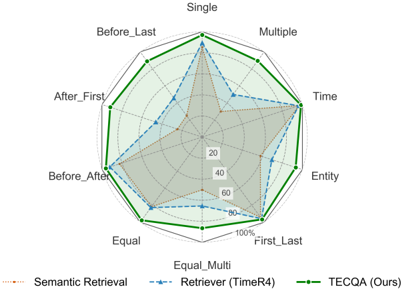
- TECQA achieves Overall Hits@1 of 0.811 on MultiTQ and 0.980 on CronQuestions; on MultiTQ’s complex Multiple category it reaches Hits@1 0.616, with the abstract reporting it outperforms strong baselines by 45.3% particularly on complex queries.
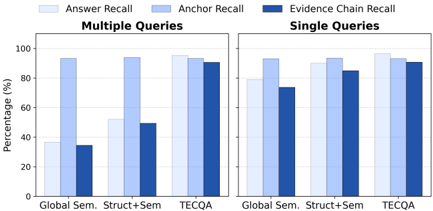
- Structure-guided retrieval achieves 99.33% answer recall; k-nearest temporal neighbor pruning maintains 94.12% answer recall while condensing context to an average of only 20 quadruples. Figure 2 reports semantic retrieval saturates at 68% and TimeR4 at 78%, while TECQA reaches 94%.
- Ablations on MultiTQ show removing structure-guided retrieval drops Overall to 0.657 and Multiple to 0.172; removing k-nearest temporal neighbor pruning drops Overall to 0.726 and Multiple to 0.291; removing proximity-based serialization drops Overall to 0.742 and Multiple to 0.425.
- Optimal hyperparameters are K = 40 for both datasets, with N = 2 implicit anchors for MultiTQ and N = 5 for CronQuestions; with Qwen3-8B generalist, TECQA leads TimeR4 by 27.8%, and reasoning models generally outperform non-reasoning counterparts.
Methods
- TECQA has three stages: (1) structure-guided subgraph construction, where an LLM extracts entities/relations and a main entity, schema grounding maps them to the TKG, and retrieval forms a high-recall candidate set from main-entity facts and auxiliary-entity interactions; (2) temporal evidence chain construction, which extracts explicit regex-based anchors and implicit top-N semantic anchors, applies bidirectional k-nearest temporal neighbor pruning around anchors, and serializes retained facts by proximity to anchors; (3) LLM reasoning over the serialized evidence chain.
- Evaluated on MultiTQ (500K question-answer pairs, multiple temporal granularities) and CronQuestions (410K questions, time intervals), using Hits@1. Implementation uses Gemini-2.5-flash for structural parsing, bge-base-en-v1.5 for grounding, and Qwen3-8B for reasoning with temperature fixed at 0; K = 40, N = 2 for MultiTQ, N = 5 for CronQuestions.
- Baselines span PLMs (BERT, ALBERT), traditional TKGQA methods (CronKGQA, TempoQR, MultiQA, LGQA, QC-MHM), and LLM-based frameworks (ARI, TempAgent, TimeR4, RTQA, PoK). Ablations remove structure-guided retrieval (w/o SG), k-nearest temporal neighbor pruning (w/o KNTN), and proximity-based serialization (w/o PS).
Limitations
- The paper states: TECQA depends on upstream structural parsing accuracy, so ambiguous queries or out-of-domain entities where schema grounding fails may degrade performance; k-nearest temporal neighbor pruning assumes temporal locality and may underperform on long-horizon reasoning where the answer is temporally distant from the anchor; and evaluation is confined to structured TKGQA, with extension to unstructured text or real-time streaming data left as future work.
- Evident from the error analysis: on the MultiTQ test set of 54,584 queries, 159 queries (0.29%) yield an empty subgraph, and 86 of these failures are directly caused by incorrect main-entity extraction; first/last queries can also fail when conservative anchor exploration and neighbor retention truncate the temporal span and exclude the true earliest or latest event.
Model-written summary. Check it against the paper before relying on it.
Integrity signals
Registry
Cites
Statistics
Figures




Verification
Claims the paper makes
0 Valid · 2 Not valid · 9 Not checked · 70 Own results and interpretations
A result the paper reports from its own data — it cites no other source for it, so there is none to check. The quote shows it is in the paper.
In the paper
“While semantic retrieval and TimeR 4 saturate at 68% and 78% respectively, TECQA achieves 94%.”
§ Temporal Evidence Chain for Temporal Knowledge Graph Question Answering with Large Language Models > Laos
plain- Asserted: passes — The authors put it forward as true.
- Checkable: passes — It can be checked against evidence.
- Load-bearing: passes — The paper’s conclusions depend on it.
- Based: passes — The paper gives a reason why it holds.
A result the paper states — it cites no source for it, so there is none to check. The quote shows it is in the paper.
In the paper
“Replacing temporal K-NN pruning with semantic selection on the structure-guided subgraph leads to a significant performance decline on Multiple queries.”
§ Temporal Evidence Chain for Temporal Knowledge Graph Question Answering with Large Language Models > Impact of Structure-Guided Retrieval.
plainstates a cause- Asserted: passes — The authors put it forward as true.
- Checkable: passes — It can be checked against evidence.
- Load-bearing: passes — The paper’s conclusions depend on it.
- Based: passes — The paper gives a reason why it holds.
- Rests on an assumption not shown here.
A result the paper states — it cites no source for it, so there is none to check. The quote shows it is in the paper.
In the paper
“Replacing structure-guided retrieval with semantic retrieval causes a substantial performance degradation across both datasets, most notably on Multiple questions in MultiTQ.”
§ Temporal Evidence Chain for Temporal Knowledge Graph Question Answering with Large Language Models > Impact of Structure-Guided Retrieval.
plainstates a cause- Asserted: passes — The authors put it forward as true.
- Checkable: passes — It can be checked against evidence.
- Load-bearing: passes — The paper’s conclusions depend on it.
- Based: passes — The paper gives a reason why it holds.
A check of a cited source is scheduled, or we don’t hold its full text yet; the claim is checked once it runs.
In the paper
“TimeR 4 exhibits a significant performance drop when switching from its fine-tuned version to the generalist Qwen3-8B (Yang et al., 2025), suggesting its reliance on parametric knowledge to mitigate retrieval noise.”
§ Temporal Evidence Chain for Temporal Knowledge Graph Question Answering with Large Language Models > Interplay between Retrieval and Reasoning.
What the sources say
- Not checked yetcites Yang et al., 2025 source
A check is scheduled.
plainstates a cause- Asserted: passes — The authors put it forward as true.
- Checkable: passes — It can be checked against evidence.
- Load-bearing: passes — The paper’s conclusions depend on it.
- Based: passes — The paper gives a reason why it holds.
- Not checked yet
A result the paper reports from its own data — it cites no other source for it, so there is none to check. The quote shows it is in the paper.
In the paper
“The left panel shows that semantic-based baselines suffer a sharp drop in Evidence Chain Recall on complex queries despite maintaining high Anchor Recall.”
§ Temporal Evidence Chain for Temporal Knowledge Graph Question Answering with Large Language Models > 5.6 Evidence Chain Integrity Analysis (Q5)
plainstates a cause- Asserted: passes — The authors put it forward as true.
- Checkable: passes — It can be checked against evidence.
- Load-bearing: passes — The paper’s conclusions depend on it.
- Based: passes — The paper gives a reason why it holds.
33 more claims
Create a free account to see all 81 claims and to verify the 12 references still open.
- It may state two separate claims as one. 29
- The quote only partly states this claim. 2
- Probably not a substantial claim. 18
Self-check
Percentages, sums and reported differences re-computed from the paper’s own numbers.
Each contradiction between two passages listed here was confirmed by an independent check.
Rated minor: it would not touch a result — a value no result rests on, a p-value that stays on the same side of the significance level, or a conflict that is clerical, resolved elsewhere in the paper, or outside its own findings.
In the paper
§ Temporal Evidence Chain for Temporal Knowledge Graph Question Answering with Large Language Models > Interplay between Retrieval and Reasoning.
“TECQA achieves a dramatic 27.8% lead over TimeR 4 with Qwen3-8B”
§ Temporal Evidence Chain for Temporal Knowledge Graph Question Answering with Large Language Models > Prompt 4: Question answering
“| Qwen3-8B Generalist | TimeR 4 TECQA | 0.533 0.778 |”
Citations
Cites
BERT: Pre-training of Deep Bidirectional Transformers for Language Understanding
Devlin, J., Chang, M.-W., Lee, K., & Toutanova, K. (2019) · Proceedings of the 2019 Conference of the North American Chapter of the Association for Computational Linguistics: Human Language Technologies, Volume 1 (Long and Short Papers) · doi:10.18653/v1/n19-1423 · Cited by 54,325
DeepSeek-R1: Incentivizing Reasoning Capability in LLMs via Reinforcement Learning
DeepSeek-AI, Guo, D., Yang, D., Zhang, H., Song, J., Wang, P., Zhu, Q., Xu, R., Zhang, R., Ma, S., et al. (2025) · arXiv · doi:10.48550/arxiv.2501.12948 · Cited by 18,918
Self-citationYang, A., Li, A., Yang, B., Zhang, B., Hui, B., Zheng, B., Yu, B., Gao, C., Huang, C., Lv, C., et al. (2025) · arXiv · doi:10.48550/arxiv.2505.09388 · Cited by 17,283
Self-citationLlama 2: Open Foundation and Fine-Tuned Chat Models
Touvron, H., Martin, L., Stone, K., Albert, P., Almahairi, A., Babaei, Y., Bashlykov, N., Batra, S., Bhargava, P., Bhosale, S., et al. (2023) · arXiv · doi:10.48550/arxiv.2307.09288 · Cited by 2,604
ReAct: Synergizing Reasoning and Acting in Language Models
Yao, S., Zhao, J., Yu, D., Du, N., Shafran, I., Narasimhan, K., & Cao, Y. (2022) · arXiv · doi:10.48550/arxiv.2210.03629 · Cited by 608
C-Pack: Packed Resources For General Chinese Embeddings
Xiao, S., Liu, Z., Zhang, P., Muennighoff, N., Lian, D., & Nie, J.-Y. (2024) · Proceedings of the 47th International ACM SIGIR Conference on Research and Development in Information Retrieval · doi:10.1145/3626772.3657878 · Cited by 523
C-Pack: Packed Resources For General Chinese Embeddings
Xiao, S., Liu, Z., Zhang, P., Muennighoff, N., Lian, D., & Nie, J.-Y. (2023) · arXiv · doi:10.48550/arxiv.2309.07597 · Cited by 514
Grattafiori, A., Dubey, A., Jauhri, A., Pandey, A., Kadian, A., Al-Dahle, A., Letman, A., Mathur, A., Schelten, A., Vaughan, A., et al. (2024) · arXiv · doi:10.48550/arxiv.2407.21783 · Cited by 505
Learning Sequence Encoders for Temporal Knowledge Graph Completion
García-Durán, A., Dumančić, S., & Niepert, M. (2018) · Proceedings of the 2018 Conference on Empirical Methods in Natural Language Processing · doi:10.18653/v1/d18-1516 · Cited by 449
DeepSeek-AI, Liu, A., Feng, B., Xue, B., Wang, B., Wu, B., Lu, C., Zhao, C., Deng, C., Zhang, C., et al. (2024) · arXiv · doi:10.48550/arxiv.2412.19437 · Cited by 294
Self-citation
Research works printed but not linked: 3
- Zhenzhong Lan, Mingda Chen, Sebastian Goodman, Kevin Gimpel, Piyush Sharma, and Radu Soricut. 2020. ALBERT: A lite BERT for self-supervised learning of language representations. In ICLR. Open- Review.net.
- Costas Mavromatis, Prasanna Lakkur Subramanyam, Vassilis N. Ioannidis, Soji Adeshina, Phillip R. Howard, Tetiana Grinberg, Nagib Hakim, and George Karypis. 2021b. Tempoqr: Temporal ques- tion reasoning over knowledge graphs. Preprint, arXiv:2112.05785. · arXiv
- Apoorv Saxena, Soumen Chakrabarti, and Partha Taluk- dar. 2021a. Question Answering Over Temporal Knowledge Graphs. Preprint, arxiv:2106.01515. · arXiv
Cited by
Yuen, I. (2026) · Automated Knowledge Base Construction · doi:10.18653/2026.akbc-1.10
CoSTA: Co-Evolving Self-Play Timeline Agents for Complex Temporal Knowledge Graph Question AnsweringPreprint
Liu, H., Yan, Z., Guo, S., Gu, J., Basulto, V. G., Wang, J., & Li, R. (2026) · arXiv (Cornell University) · doi:10.48550/arxiv.2610.38450
CREDO: Evidence-Conditioned Credit Assignment for Temporal Reasoning AgentsPreprint
Leng, Y., Wen, S., Chen, X., Zeng, X., Tian, Y., & Huang, S.-J. (2026) · arXiv (Cornell University) · doi:10.48550/arxiv.2611.01643
Metadata
- Authors
- Liu, S., Zhou, X., Wang, B., & Zhang, G.
- Affiliations
- Chinese Academy of Sciences (CN)
- University of International Business and Economics (CN)
- Venue
- Proceedings of the 64th Annual Meeting of the Association for Computational Linguistics (Volume 1: Long Papers)
- Published
- 2026
- Pages
- 29515-29529
- ISSN
- 0736-587X (ISSN-L)
- OpenAlex
- W7166805089
- Cited by
- 3
- References
- 26
- Citations by year
- 2026: 3
- FWCI
- 2.66
- Type
- conference paper
- Language
- en
- Open access
- hybrid
- doi.org
- Licence
- cc-by
- Locations
- Proceedings of the conference - Association for Computational Linguistics. Meeting (publishedVersion, cc-by)
- Funders
- National Natural Science Foundation of China (62176252)
- Topics
- Physical Sciences › Computer Science › Artificial Intelligence › Advanced Graph Neural Networks
- Physical Sciences › Computer Science › Artificial Intelligence › Topic Modeling
- Physical Sciences › Computer Science › Artificial Intelligence › Semantic Web and Ontologies
- Keywords
- temporal knowledge graphs, large language models, temporal proximity, LLM reasoning
About these checks
Registry, retraction, Cites and statistics results are computed, not judged, with one exception: a printed reference that no index lists is read once by a model before it counts as a citation error. Claims are extracted by a model and kept only when their quote appears verbatim in the text; each cited source is then checked, with a model’s help, for whether it says what the claim relies on. Those verdicts can be wrong — read the claim’s quote and the cited source before relying on one.
A language model drew the claims from the paper on 2026-11-18, under version 3 of the claim definition (model deepseek-v4.1-flash, prompt extract-v3).
A second model labelled each claim on 2026-11-18 (model jev-1.13-20260917, definition revision gold-guideline-v0.2).
Statistics and arithmetic are recomputed, not judged.
Confidence bands are shown only for fields calibrated on our annotated test set. None is calibrated yet, so no band is shown.
What counts as a claim ›How we measure confidence ›How we check this ›
Are you an author, or do you see a problem with this page? Request a review
How to cite
Cite CoChat for the checks on this page, and the paper for its own findings.
- This page
- CoChat. (2026). Citation check: Temporal Evidence Chain for Temporal Knowledge Graph Question Answering with Large Language Models. https://app.cochat.ai/papers/10.18653/v1/2026.acl-long.1361
- The paper
- Liu, S., Zhou, X., Wang, B., & Zhang, G. (2026). Temporal Evidence Chain for Temporal Knowledge Graph Question Answering with Large Language Models. Proceedings of the 64th Annual Meeting of the Association for Computational Linguistics (Volume 1: Long Papers). https://doi.org/10.18653/v1/2026.acl-long.1361
Data sources
Bibliographic data: Semantic Scholar, OpenAlex, Crossref.
Contains information from the Semantic Scholar Academic Graph Datasets, made available under the ODC Attribution License (ODC-BY 1.0).
Semantic Scholar’s data is described in: Kinney, R., et al. (2023). The Semantic Scholar Open Data Platform. arXiv:2301.10140.
