

Lookback Lens: Detecting and Mitigating Contextual Hallucinations in Large Language Models Using Only Attention Maps
The DOI matches its Crossref record; 14 of the 14 references it cites were found in a registry or an index.
Abstract
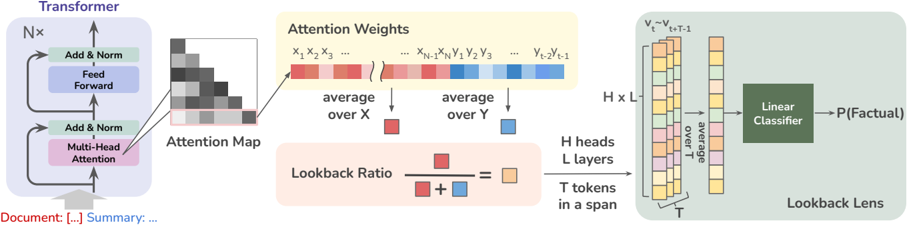
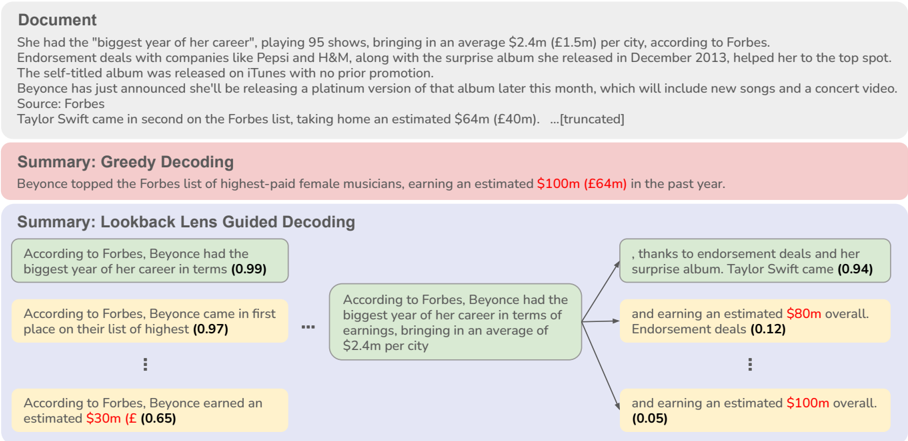
When asked to summarize articles or answer questions given a passage, large language models (LLMs) can hallucinate details and respond with unsubstantiated answers that are inaccurate with respect to the input context.This paper describes a simple approach for detecting such contextual hallucinations.We hypothesize that contextual hallucinations are related to the extent to which an LLM attends to information in the provided context versus its own generations.Based on this intuition, we propose a simple hallucination detection model whose input features are given by the ratio of attention weights on the context versus newly generated tokens (for each attention head).We find that a linear classifier based on these lookback ratio features is as effective as a richer detector that utilizes the entire hidden states of an LLM or a text-based entailment model.The lookback ratio-based detector-Lookback Lens-is found to transfer across tasks and even models, allowing a detector that is trained on a 7B model to be applied (without retraining) to a larger 13B model.We further apply this detector to mitigate contextual hallucinations, and find that a simple classifier-guided decoding approach is able to reduce the amount of hallucination, for example by 9.6% in the XSum summarization task. 1
Overview
The claims and statistics of this paper haven’t been checked yet.
Free: it reads the open-access text and checks the first 5 claims that cite a source we can check. Create a free account to check every claim.
Integrity signals
Registry
Cites
Statistics
Figures

Verification
Claims the paper makes
The claims and statistics of this paper haven’t been checked yet.
Free: it reads the open-access text and checks the first 5 claims that cite a source we can check. Create a free account to check every claim.
Claims other papers make about this one
Each is checked against this paper’s own text: does it say what the citing paper says it does?
In the citing paper
“Even when provided with accurate context, models may misinterpret the data or include details that are not supported by the context (Shi et al., 2024;Chuang et al., 2024).”
From SelfCite: Self-Supervised Alignment for Context Attribution in Large Language Models (2025) · cites this paper as Chuang et al., 2024
Self-check
Percentages, sums and reported differences re-computed from the paper’s own numbers.
The self-check needs the paper’s full text.
Citations
Cites
Survey of Hallucination in Natural Language Generation
Ji, Z., Lee, N., Frieske, R., Yu, T., Su, D., Xu, Y., Ishii, E., Bang, Y., Chen, D., Dai, W., et al. (2022) · arXiv · doi:10.48550/arxiv.2202.03629 · Cited by 4,981
Llama 2: Open Foundation and Fine-Tuned Chat Models
Touvron, H., Martin, L., Stone, K., Albert, P., Almahairi, A., Babaei, Y., Bashlykov, N., Batra, S., Bhargava, P., Bhosale, S., et al. (2023) · arXiv · doi:10.48550/arxiv.2307.09288 · Cited by 2,604
On Faithfulness and Factuality in Abstractive Summarization
Maynez, J., Narayan, S., Bohnet, B., & McDonald, R. (2020) · arXiv · doi:10.48550/arxiv.2005.00661 · Cited by 1,185
Plug and Play Language Models: A Simple Approach to Controlled Text Generation
Dathathri, S., Madotto, A., Lan, J., Hung, J., Frank, E., Molino, P., Yosinski, J., & Liu, R. (2019) · arXiv · doi:10.48550/arxiv.1912.02164 · Cited by 508
He, P., Gao, J., & Chen, W. (2021) · arXiv (Cornell University) · doi:10.48550/arxiv.2111.09543 · Cited by 389
Complex Claim Verification with Evidence Retrieved in the WildPreprint
Chen, J.-F., Kim, G., Sriram, A., Durrett, G., & Choi, E. (2023) · North American Chapter of the Association for Computational Linguistics · doi:10.48550/arxiv.2305.11859 · Cited by 154
QAFactEval: Improved QA-Based Factual Consistency Evaluation for SummarizationPreprint
Fabbri, A. R., Wu, C.-S., Liu, W., & Xiong, C. (2021) · arXiv (Cornell University) · doi:10.48550/arxiv.2112.08542 · Cited by 66
Attention Interpretability Across NLP Tasks
Vashishth, S., Upadhyay, S., Tomar, G. S., & Faruqui, M. (2019) · arXiv (Cornell University) · doi:10.48550/arxiv.1909.11218 · Cited by 63
In-Context Sharpness as Alerts: An Inner Representation Perspective for Hallucination MitigationPreprint
Chen, S., Xiong, M., Liu, J., Wu, Z., Xiao, T., Gao, S., & He, J. (2024) · arXiv (Cornell University) · doi:10.48550/arxiv.2403.01548 · Cited by 60
Constructing Benchmarks and Interventions for Combating Hallucinations in LLMsPreprint
Simhi, A., Herzig, J., Szpektor, I., & Belinkov, Y. (2024) · arXiv (Cornell University) · doi:10.48550/arxiv.2404.09971 · Cited by 31
Campbell, J., Ren, R., & Guo, P. (2023) · arXiv (Cornell University) · doi:10.48550/arxiv.2311.15131 · Cited by 31
Chern, I.-C., Chern, S., Chen, S., Yuan, W., Feng, K., Zhou, C., He, J., Neubig, G., & Liu, P. (2023) · arXiv · doi:10.48550/arxiv.2307.13528 · Cited by 29
FActScore: Fine-grained Atomic Evaluation of Factual Precision in Long Form Text Generation
Min, S., Krishna, K., Lyu, X., Lewis, M., Yih, W.-T., Koh, P. W., Iyyer, M., Zettlemoyer, L., & Hajishirzi, H. (2023) · arXiv · doi:10.48550/arxiv.2305.14251 · Cited by 14
Trusting Your Evidence: Hallucinate Less with Context-aware Decoding
Shi, W., Han, X., Lewis, M., Tsvetkov, Y., Zettlemoyer, L., & Yih, S. W.-T. (2023) · arXiv · doi:10.48550/arxiv.2305.14739 · Cited by 6
Research works printed but not linked: 30
- Amos Azaria and Tom Mitchell. 2023. The internal state of an llm knows when it's lying. In Findings of the Association for Computational Linguistics: EMNLP 2023, pages 967-976.
- Dzmitry Bahdanau, Kyung Hyun Cho, and Yoshua Ben- gio. 2015. Neural machine translation by jointly learning to align and translate. In 3rd International Conference on Learning Representations, ICLR 2015.
- Collin Burns, Haotian Ye, Dan Klein, and Jacob Stein- hardt. 2023. Discovering latent knowledge in lan- guage models without supervision. In The Eleventh International Conference on Learning Representa- tions.
- Zhongzhi Chen, Xingwu Sun, Xianfeng Jiao, Fengzong Lian, Zhanhui Kang, Di Wang, and Chengzhong Xu. 2024b. Truth forest: Toward multi-scale truthful- ness in large language models through intervention without tuning. In Proceedings of the AAAI Con- ference on Artificial Intelligence, volume 38, pages 20967-20974.
- Cheng-Han Chiang and Hung-Yi Lee. 2023. Can large language models be an alternative to human evalua- tions? In Proceedings of the 61st Annual Meeting of the Association for Computational Linguistics (Vol- ume 1: Long Papers), pages 15607-15631.
- Yung-Sung Chuang, Yujia Xie, Hongyin Luo, Yoon Kim, James R Glass, and Pengcheng He. 2024. Dola: Decoding by contrasting layers improves factuality in large language models. In The Twelfth International Conference on Learning Representations.
- Kevin Clark, Urvashi Khandelwal, Omer Levy, and Christopher D Manning. 2019. What does bert look at? an analysis of bert's attention. arXiv preprint arXiv:1906.04341. · arXiv
- Yaru Hao, Li Dong, Furu Wei, and Ke Xu. 2021. Self- attention attribution: Interpreting information interac- tions inside transformer. In Proceedings of the AAAI Conference on Artificial Intelligence, volume 35, pages 12963-12971.
- Or Honovich, Roee Aharoni, Jonathan Herzig, Hagai Taitelbaum, Doron Kukliansy, Vered Cohen, Thomas Scialom, Idan Szpektor, Avinatan Hassidim, and Yossi Matias. 2022. True: Re-evaluating factual consistency evaluation. In Proceedings of the 2022 Conference of the North American Chapter of the Association for Computational Linguistics: Human Language Technologies, pages 3905-3920.
- Nikhil Kandpal, Haikang Deng, Adam Roberts, Eric Wallace, and Colin Raffel. 2023. Large language models struggle to learn long-tail knowledge. In In- ternational Conference on Machine Learning, pages 15696-15707.
- PMLR.
- Tom Kwiatkowski, Jennimaria Palomaki, Olivia Red- field, Michael Collins, Ankur Parikh, Chris Alberti, Danielle Epstein, Illia Polosukhin, Jacob Devlin, Ken- ton Lee, et al. 2019. Natural questions: a benchmark for question answering research. Transactions of the Association for Computational Linguistics, 7:453- 466.
- Philippe Laban, Tobias Schnabel, Paul N Bennett, and Marti A Hearst. 2022. Summac: Re-visiting nli- based models for inconsistency detection in summa- rization. Transactions of the Association for Compu- tational Linguistics, 10:163-177.
- Junyi Li, Xiaoxue Cheng, Wayne Xin Zhao, Jian-Yun Nie, and Ji-Rong Wen. 2023. Halueval: A large- scale hallucination evaluation benchmark for large language models. In Proceedings of the 2023 Con- ference on Empirical Methods in Natural Language Processing, pages 6449-6464.
- Kenneth Li, Oam Patel, Fernanda Viégas, Hanspeter Pfister, and Martin Wattenberg. 2024. Inference- time intervention: Eliciting truthful answers from a language model. Advances in Neural Information Processing Systems, 36.
- Chin-Yew Lin. 2004. Rouge: A package for automatic evaluation of summaries. In Text summarization branches out, pages 74-81.
- Nelson F Liu, Kevin Lin, John Hewitt, Ashwin Paran- jape, Michele Bevilacqua, Fabio Petroni, and Percy Liang. 2024. Lost in the middle: How language mod- els use long contexts. Transactions of the Association for Computational Linguistics, 12:157-173.
- Yang Liu, Dan Iter, Yichong Xu, Shuohang Wang, Ruochen Xu, and Chenguang Zhu. 2023. G-eval: Nlg evaluation using gpt-4 with better human align- ment. In Proceedings of the 2023 Conference on Empirical Methods in Natural Language Processing, pages 2511-2522.
- Minh-Thang Luong, Hieu Pham, and Christopher D Manning. 2015. Effective approaches to attention- based neural machine translation. In Proceedings of the 2015 Conference on Empirical Methods in Natural Language Processing, pages 1412-1421.
- Alex Mallen, Akari Asai, Victor Zhong, Rajarshi Das, Daniel Khashabi, and Hannaneh Hajishirzi. 2023. When not to trust language models: Investigating effectiveness of parametric and non-parametric mem- ories. In Proceedings of the 61st Annual Meeting of the Association for Computational Linguistics (Vol- ume 1: Long Papers), pages 9802-9822.
- Shashi Narayan, Shay B Cohen, and Mirella Lapata. 2018. Don't give me the details, just the summary! topic-aware convolutional neural networks for ex- treme summarization. In Proceedings of the 2018 Conference on Empirical Methods in Natural Lan- guage Processing, pages 1797-1807.
- Ella Neeman, Roee Aharoni, Or Honovich, Leshem Choshen, Idan Szpektor, and Omri Abend. 2023. Disentqa: Disentangling parametric and contextual knowledge with counterfactual question answering. In Proceedings of the 61st Annual Meeting of the Association for Computational Linguistics (Volume 1: Long Papers), pages 10056-10070.
- Tal Schuster, Adam Fisch, and Regina Barzilay. 2021. Get your vitamin C! robust fact verification with contrastive evidence. In Proceedings of the 2021 Conference of the North American Chapter of the Association for Computational Linguistics: Human Language Technologies, pages 624-643, Online. As- sociation for Computational Linguistics. · DOI · Paper page
- Abigail See, Peter J Liu, and Christopher D Manning. 2017. Get to the point: Summarization with pointer- generator networks. In Proceedings of the 55th An- nual Meeting of the Association for Computational Linguistics (Volume 1: Long Papers), pages 1073- 1083.
- James Thorne, Andreas Vlachos, Christos Christodoulopoulos, and Arpit Mittal. 2018. FEVER: a large-scale dataset for fact extraction and VERification. In NAACL-HLT.
- Ashish Vaswani, Noam Shazeer, Niki Parmar, Jakob Uszkoreit, Llion Jones, Aidan N Gomez, Łukasz Kaiser, and Illia Polosukhin. 2017. Attention is all you need. Advances in neural information processing systems, 30.
- Kevin Yang and Dan Klein. 2021. Fudge: Controlled text generation with future discriminators. In Pro- ceedings of the 2021 Conference of the North Amer- ican Chapter of the Association for Computational Linguistics: Human Language Technologies, pages 3511-3535.
- Shaolei Zhang, Tian Yu, and Yang Feng. 2024. Truthx: Alleviating hallucinations by editing large language models in truthful space. arXiv preprint arXiv:2402.17811. · arXiv
- Yuan Zhang, Jason Baldridge, and Luheng He. 2019b. PAWS: Paraphrase Adversaries from Word Scram- bling. In Proc. of NAACL.
- Lianmin Zheng, Wei-Lin Chiang, Ying Sheng, Siyuan Zhuang, Zhanghao Wu, Yonghao Zhuang, Zi Lin, Zhuohan Li, Dacheng Li, Eric Xing, et al. 2024. Judging llm-as-a-judge with mt-bench and chatbot arena. Advances in Neural Information Processing Systems, 36.
Cited by
SelfCite: Self-Supervised Alignment for Context Attribution in Large Language Models
Chuang, Y.-S., Cohen-Wang, B., Shen, S. Z., Wu, Z., Xu, H., Lin, X. V., Glass, J., Li, S.-W., & Yih, W.-T. (2025) · arXiv · doi:10.48550/arxiv.2502.09604
Self-citation
Metadata
- Authors
- Chuang, Y.-S., Qiu, L., Hsieh, C.-Y., Krishna, R., Kim, Y., & Glass, J. R.
- Venue
- Proceedings of the 2024 Conference on Empirical Methods in Natural Language Processing
- Published
- 2024
- Pages
- 1419-1436
- Cited by
- 33
- References
- 14
About these checks
Registry, retraction, Cites and statistics results are computed, not judged, with one exception: a printed reference that no index lists is read once by a model before it counts as a citation error. Claims are extracted by a model and kept only when their quote appears verbatim in the text; each cited source is then checked, with a model’s help, for whether it says what the claim relies on. Those verdicts can be wrong — read the claim’s quote and the cited source before relying on one.
Statistics and arithmetic are recomputed, not judged.
Confidence bands are shown only for fields calibrated on our annotated test set. None is calibrated yet, so no band is shown.
What counts as a claim ›How we measure confidence ›How we check this ›
Are you an author, or do you see a problem with this page? Request a review
Data sources
Bibliographic data: Semantic Scholar, OpenAlex, Crossref.
Contains information from the Semantic Scholar Academic Graph Datasets, made available under the ODC Attribution License (ODC-BY 1.0).
Semantic Scholar’s data is described in: Kinney, R., et al. (2023). The Semantic Scholar Open Data Platform. arXiv:2301.10140.
