

The DOI matches its Crossref record; 2 of the 2 references it cites were found in a registry or an index.
InstructEval: Systematic Evaluation of Instruction Selection Methods
Abstract
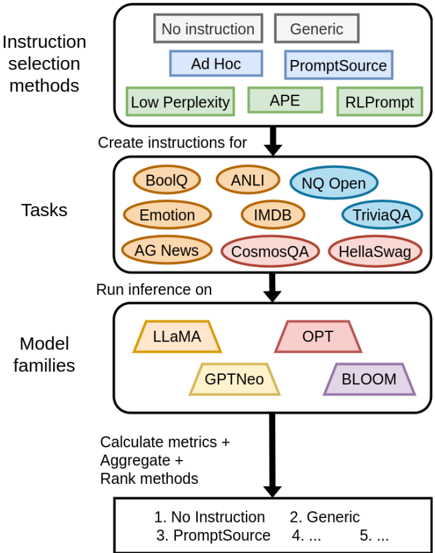
In-context learning (ICL) performs tasks by prompting a large language model (LLM) using an instruction and a small set of annotated examples called demonstrations.Recent work has shown that precise details of the inputs used in the ICL prompt significantly impact performance, which has incentivized instruction selection algorithms.The effect of instructionchoice however is severely underexplored, with existing analyses restricted to shallow subsets of models and tasks, limiting the generalizability of their insights.We develop InstructEval, an ICL evaluation suite to conduct a thorough assessment of these techniques.The suite includes 13 open-sourced LLMs of varying scales from four model families, and covers nine tasks across three categories.Using the suite, we evaluate the relative performance of seven popular instruction selection methods over five metrics relevant to ICL.Our experiments reveal that using curated manually-written instructions or simple instructions without any task-specific descriptions often elicits superior ICL performance overall than that of automatic instruction-induction methods, pointing to a lack of generalizability among the latter.We release our evaluation suite for benchmarking instruction selection approaches and enabling more generalizable methods in this space.
Overview
The claims and statistics of this paper haven’t been checked yet.
Run the check — free, no account needed. It reads the open-access text and checks the sources it cites.
Integrity signals
Registry
Cites
Statistics
Figures
Verification
Claims the paper makes
The claims and statistics of this paper haven’t been checked yet.
Run the check — free, no account needed. It reads the open-access text and checks the sources it cites.
Claims other papers make about this one
Each is checked against this paper’s own text: does it say what the citing paper says it does?
The source backs part of the claim, not all of it — or backs it for a different population, condition or comparison.
In the citing paper
“Ajith et al. (2024) show that generic, task-agnostic instructions (i.e., no instruction or”
From The Prompt Report: A Systematic Survey of Prompt Engineering Techniques (2024) · cites this paper as Ajith et al., 2024
Experimental — accuracy not yet measuredThe source backs part of the claim, not all of it — or backs it for a different population, condition or comparison.
In the citing paper
“concluding instruction-following abilities can be achieved via exemplars alone.”
From The Prompt Report: A Systematic Survey of Prompt Engineering Techniques (2024) · cites this paper as Ajith et al., 2024
Experimental — accuracy not yet measured
Self-check
Percentages, sums and reported differences re-computed from the paper’s own numbers.
The self-check needs the paper’s full text.
Citations
Cites
TriviaQA: A Large Scale Distantly Supervised Challenge Dataset for Reading Comprehension
Joshi, M., Choi, E., Weld, D. S., & Zettlemoyer, L. (2017) · arXiv · doi:10.48550/arxiv.1705.03551 · Cited by 1,650
RLPrompt: Optimizing Discrete Text Prompts with Reinforcement Learning
Deng, M., Wang, J., Hsieh, C.-P., Wang, Y., Guo, H., Shu, T., Song, M., Xing, E. P., & Hu, Z. (2022) · arXiv · doi:10.48550/arxiv.2205.12548 · Cited by 14
Research works printed but not linked: 23
- Tom Brown, Benjamin Mann, Nick Ryder, Melanie Subbiah, Jared D Kaplan, Prafulla Dhariwal, Arvind Neelakantan, Pranav Shyam, Girish Sastry, Amanda Askell, et al. 2020. Language models are few-shot learners. Advances in neural information processing systems, 33:1877-1901.
- Christopher Clark, Kenton Lee, Ming-Wei Chang, Tom Kwiatkowski, Michael Collins, and Kristina Toutanova. 2019. Boolq: Exploring the surprising difficulty of natural yes/no questions. In NAACL.
- Or Honovich, Uri Shaham, Samuel R Bowman, and Omer Levy. 2022. Instruction induction: From few examples to natural language task descriptions. arXiv preprint arXiv:2205.10782. · arXiv
- Lifu Huang, Ronan Le Bras, Chandra Bhagavatula, and Yejin Choi. 2019. Cosmos QA: Machine reading comprehension with contextual commonsense rea- soning. In Proceedings of the 2019 Conference on Empirical Methods in Natural Language Processing and the 9th International Joint Conference on Natural Language Processing (EMNLP-IJCNLP), pages 2391-2401, Hong Kong, China. Association for Computational Linguistics. · DOI · Paper page
- Tom Kwiatkowski, Jennimaria Palomaki, Olivia Red- field, Michael Collins, Ankur Parikh, Chris Alberti, Danielle Epstein, Illia Polosukhin, Jacob Devlin, Ken- ton Lee, Kristina Toutanova, Llion Jones, Matthew Kelcey, Ming-Wei Chang, Andrew M. Dai, Jakob Uszkoreit, Quoc Le, and Slav Petrov. 2019. Nat- ural questions: A benchmark for question answer- ing research. Transactions of the Association for Computational Linguistics, 7:453-466. · DOI · Paper page
- Jiachang Liu, Dinghan Shen, Yizhe Zhang, Bill Dolan, Lawrence Carin, and Weizhu Chen. 2021a. What makes good in-context examples for gpt-3? In Workshop on Knowledge Extraction and Integration for Deep Learning Architectures; Deep Learning Inside Out.
- Yao Lu, Max Bartolo, Alastair Moore, Sebastian Riedel, and Pontus Stenetorp. 2021a. Fantastically or- dered prompts and where to find them: Overcom- ing few-shot prompt order sensitivity. arXiv preprint arXiv:2104.08786. · arXiv
- Yao Lu, Max Bartolo, Alastair Moore, Sebastian Riedel, and Pontus Stenetorp. 2021b. Fantastically ordered prompts and where to find them: Over- coming few-shot prompt order sensitivity. CoRR, abs/2104.08786. · arXiv
- Andrew L. Maas, Raymond E. Daly, Peter T. Pham, Dan Huang, Andrew Y. Ng, and Christopher Potts. 2011. Learning word vectors for sentiment analysis. In Proceedings of the 49th Annual Meeting of the Association for Computational Linguistics: Human Language Technologies, pages 142-150, Portland, Oregon, USA. Association for Computational Lin- guistics.
- Swaroop Mishra, Daniel Khashabi, Chitta Baral, and Hannaneh Hajishirzi. 2022. Cross-task generaliza- tion via natural language crowdsourcing instructions. In Proceedings of the 60th Annual Meeting of the Association for Computational Linguistics (Volume 1: Long Papers), pages 3470-3487, Dublin, Ireland. Association for Computational Linguistics. · DOI · Paper page
- Saif Mohammad, Felipe Bravo-Marquez, Mohammad Salameh, and Svetlana Kiritchenko. 2018. Semeval- 2018 task 1: Affect in tweets. In Proceedings of the 12th international workshop on semantic evaluation, pages 1-17.
- Yixin Nie, Adina Williams, Emily Dinan, Mohit Bansal, Jason Weston, and Douwe Kiela. 2020. Adversarial nli: A new benchmark for natu- ral language understanding. In Proceedings of the 58th Annual Meeting of the Association for Computational Linguistics. Association for Compu- tational Linguistics.
- Ethan Perez, Douwe Kiela, and Kyunghyun Cho. 2021. True few-shot learning with language mod- els. In Advances in Neural Information Processing Systems.
- Ohad Rubin, Jonathan Herzig, and Jonathan Berant. 2022. Learning to retrieve prompts for in-context learning. In Proceedings of the 2022 Conference of the North American Chapter of the Association for Computational Linguistics: Human Language Technologies, pages 2655-2671.
- Teven Le Scao, Angela Fan, Christopher Akiki, Elizabeth-Jane Pavlick, Suzana Ili'c, Daniel Hesslow, Roman Castagn'e, Alexandra Sasha Luccioni, Franc- cois Yvon, Matthias Gallé, Jonathan Tow, Alexan- der M. Rush, Stella Rose Biderman, Albert Web- son, Pawan Sasanka Ammanamanchi, Thomas Wang, Benoît Sagot, Niklas Muennighoff, Albert Villanova del Moral, Olatunji Ruwase, Rachel Bawden, Stas Bekman, et al. 2022a. Bloom: A 176b-parameter open-access multilingual language model. ArXiv, abs/2211.05100. · arXiv
- Teven Le Scao, Angela Fan, Christopher Akiki, El- lie Pavlick, Suzana Ilić, Daniel Hesslow, Roman Castagné, Alexandra Sasha Luccioni, François Yvon, Matthias Gallé, Jonathan Tow, Alexander M. Rush, Stella Biderman, Albert Webson, Pawan Sasanka Am- manamanchi, Thomas Wang, Benoît Sagot, Niklas Muennighoff, Albert Villanova del Moral, Olatunji Ruwase, Rachel Bawden, Stas Bekman, Angelina McMillan-Major, Iz Beltagy, Huu Nguyen, Lucile Saulnier, Samson Tan, Pedro Ortiz Suarez, Vic- tor Sanh, Hugo Laurençon, Yacine Jernite, Julien Launay, Margaret Mitchell, Colin Raffel, Aaron Gokaslan, Adi Simhi, Aitor Soroa, Alham Fikri Aji, Amit Alfassy, Anna Rogers, Ariel Kreisberg Nitzav, Canwen Xu, Chenghao Mou, Chris Emezue, Christopher Klamm, Colin Leong, Daniel van Strien, David Ifeoluwa Adelani, Dragomir Radev, Ed- uardo González Ponferrada, Efrat Levkovizh, Ethan Kim, Eyal Bar Natan, Francesco De Toni, Gérard Dupont, Germán Kruszewski, Giada Pistilli, Hady Elsahar, Hamza Benyamina, Hieu Tran, Ian Yu, Idris Abdulmumin, Isaac Johnson, Itziar Gonzalez-Dios, Javier de la Rosa, Jenny Chim, Jesse Dodge, Jian Zhu, Jonathan Chang, Jörg Frohberg, Joseph Tobing, Joy- deep Bhattacharjee, Khalid Almubarak, Kimbo Chen, Kyle Lo, Leandro Von Werra, Leon Weber, Long Phan, Loubna Ben allal, Ludovic Tanguy, Manan Dey, Manuel Romero Muñoz, Maraim Masoud, María Grandury, Mario Šaško, Max Huang, Max- imin Coavoux, Mayank Singh, Mike Tian-Jian Jiang, Minh Chien Vu, Mohammad A. Jauhar, Mustafa Ghaleb, Nishant Subramani, Nora Kassner, Nuru- laqilla Khamis, Olivier Nguyen, Omar Espejel, Ona de Gibert, Paulo Villegas, Peter Henderson, Pierre Colombo, Priscilla Amuok, Quentin Lhoest, Rheza Harliman, Rishi Bommasani, Roberto Luis López, Rui Ribeiro, Salomey Osei, Sampo Pyysalo, Se- bastian Nagel, Shamik Bose, Shamsuddeen Hassan Muhammad, Shanya Sharma, Shayne Longpre, So- maieh Nikpoor, Stanislav Silberberg, Suhas Pai, Syd- ney Zink, Tiago Timponi Torrent, Timo Schick, Tris- tan Thrush, Valentin Danchev, Vassilina Nikoulina, Veronika Laippala, Violette Lepercq, Vrinda Prabhu, Zaid Alyafeai, Zeerak Talat, Arun Raja, Benjamin Heinzerling, Chenglei Si, Elizabeth Salesky, Sab- rina J. Mielke, Wilson Y. Lee, Abheesht Sharma, An- drea Santilli, Antoine Chaffin, Arnaud Stiegler, Deba- jyoti Datta, Eliza Szczechla, Gunjan Chhablani, Han Wang, Harshit Pandey, Hendrik Strobelt, Jason Alan Fries, Jos Rozen, Leo Gao, Lintang Sutawika, M Sai- ful Bari, Maged S. Al-shaibani, Matteo Manica, Ni- hal Nayak, Ryan Teehan, Samuel Albanie, Sheng Shen, Srulik Ben-David, Stephen H. Bach, Taewoon Kim, Tali Bers, Thibault Fevry, Trishala Neeraj, Ur- Hongjin Su, Jungo Kasai, Chen Henry Wu, Weijia Shi, Tianlu Wang, Jiayi Xin, Rui Zhang, Mari Ostendorf, Luke Zettlemoyer, Noah A. Smith, and Tao Yu. 2022. Selective annotation makes language models better few-shot learners. ArXiv, abs/2209.01975. · arXiv
- Xinyi Wang, Wanrong Zhu, and William Yang Wang. 2023a. Large language models are implicitly topic models: Explaining and finding good demonstrations for in-context learning. ArXiv, abs/2301.11916. · arXiv
- Albert Webson and Ellie Pavlick. 2022. Do prompt- based models really understand the meaning of their prompts? In Proceedings of the 2022 Conference of the North American Chapter of the Association for Computational Linguistics: Human Language Technologies, pages 2300-2344, Seattle, United States. Association for Computational Linguistics. · DOI · Paper page
- Jason Wei, Xuezhi Wang, Dale Schuurmans, Maarten Bosma, Fei Xia, Ed H Chi, Quoc V Le, Denny Zhou, et al. Chain-of-thought prompting elicits reasoning in large language models. In Advances in Neural Information Processing Systems.
- Jerry W. Wei, Jason Wei, Yi Tay, Dustin Tran, Al- bert Webson, Yifeng Lu, Xinyun Chen, Hanxiao Liu, Da Huang, Denny Zhou, and Tengyu Ma. 2023. Larger language models do in-context learning dif- ferently. ArXiv, abs/2303.03846. · arXiv
- Rowan Zellers, Ari Holtzman, Yonatan Bisk, Ali Farhadi, and Yejin Choi. 2019. Hellaswag: Can a machine really finish your sentence? In Proceedings of the 57th Annual Meeting of the Association for Computational Linguistics.
- Susan Zhang, Stephen Roller, Naman Goyal, Mikel Artetxe, Moya Chen, Shuohui Chen, Christopher De- wan, Mona Diab, Xian Li, Xi Victoria Lin, Todor Mi- haylov, Myle Ott, Sam Shleifer, Kurt Shuster, Daniel Simig, Punit Singh Koura, Anjali Sridhar, Tianlu Wang, and Luke Zettlemoyer. 2022a. Opt: Open pre-trained transformer language models. ArXiv, abs/2205.01068. · arXiv
- Xiang Zhang, Junbo Jake Zhao, and Yann LeCun. 2015. Character-level convolutional networks for text clas- sification. In NIPS.
Cited by
The Prompt Report: A Systematic Survey of Prompt Engineering Techniques
Schulhoff, S., Ilie, M., Balepur, N., Kahadze, K., Liu, A., Si, C., Li, Y., Gupta, A., Han, H., Schulhoff, S., et al. (2024) · arXiv · doi:10.48550/arxiv.2406.06608 · Cited by 118
RLHF Deciphered: A Critical Analysis of Reinforcement Learning from Human Feedback for LLMs
Chaudhari, S., Aggarwal, P., Murahari, V., Rajpurohit, T., Kalyan, A., Narasimhan, K., Deshpande, A., & Castro da Silva, B. (2026) · ACM Computing Surveys · doi:10.1145/3743127 · Cited by 92
Self-citation
Metadata
- Authors
- Ajith, A., Pan, C., Xia, M., Deshpande, A., & Narasimhan, K.
- Venue
- Findings of the Association for Computational Linguistics: NAACL 2024
- Published
- 2024
- Pages
- 4336-4350
- Cited by
- 3
- References
- 2
About these checks
Registry, retraction, Cites and statistics results are computed, not judged, with one exception: a printed reference that no index lists is read once by a model before it counts as a citation error. Claims are extracted by a model and kept only when their quote appears verbatim in the text; each cited source is then checked, with a model’s help, for whether it says what the claim relies on. Those verdicts can be wrong — read the claim’s quote and the cited source before relying on one.
Statistics and arithmetic are recomputed, not judged.
Confidence bands are shown only for fields calibrated on our annotated test set. None is calibrated yet, so no band is shown.
What counts as a claim ›How we measure confidence ›How we check this ›
Are you an author, or do you see a problem with this page? Request a review
How to cite
Cite CoChat for the checks on this page, and the paper for its own findings.
- This page
- CoChat. (2026). Citation check: InstructEval: Systematic Evaluation of Instruction Selection Methods. https://app.cochat.ai/papers/10.18653/v1/2024.findings-naacl.270
- The paper
- Ajith, A., Pan, C., Xia, M., Deshpande, A., & Narasimhan, K. (2024). InstructEval: Systematic Evaluation of Instruction Selection Methods. Findings of the Association for Computational Linguistics: NAACL 2024. https://doi.org/10.18653/v1/2024.findings-naacl.270
Data sources
Bibliographic data: Semantic Scholar, OpenAlex, Crossref.
Contains information from the Semantic Scholar Academic Graph Datasets, made available under the ODC Attribution License (ODC-BY 1.0).
Semantic Scholar’s data is described in: Kinney, R., et al. (2023). The Semantic Scholar Open Data Platform. arXiv:2301.10140.
