

The DOI matches its Crossref record; 2 of the 2 references it cites were found in a registry or an index.
DeepResearcher: Scaling Deep Research via Reinforcement Learning in Real-world Environments
Overview
The claims and statistics of this paper haven’t been checked yet.
Run the check — free, no account needed. It reads the open-access text and checks the sources it cites.
Integrity signals
Registry
Cites
Statistics
Figures
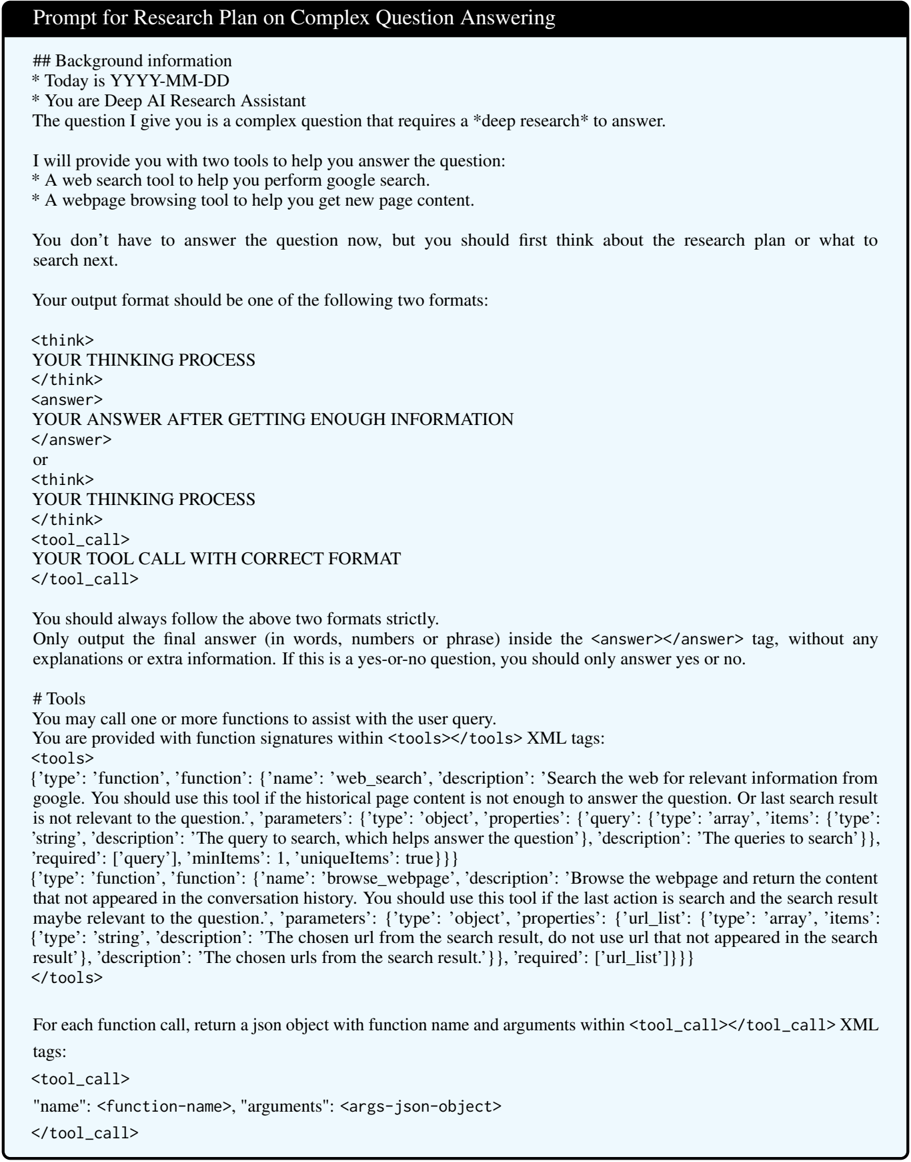
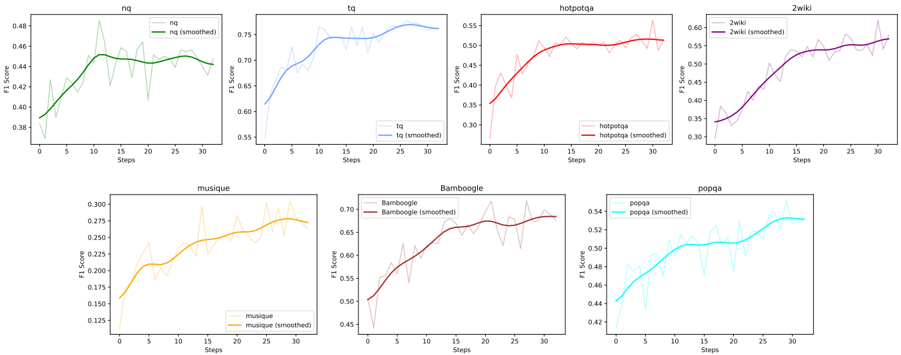
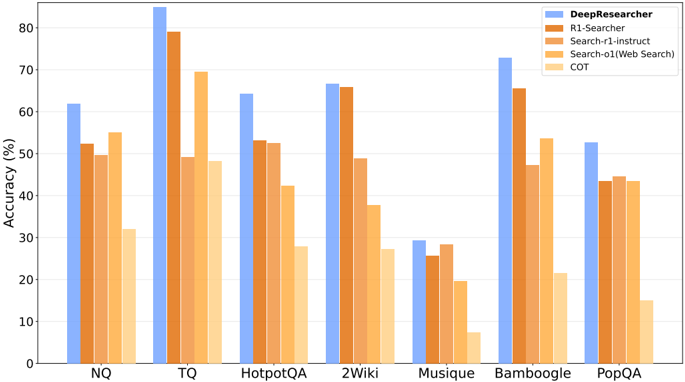
Verification
Claims the paper makes
The claims and statistics of this paper haven’t been checked yet.
Run the check — free, no account needed. It reads the open-access text and checks the sources it cites.
Claims other papers make about this one
Each is checked against this paper’s own text: does it say what the citing paper says it does?
In the citing paper
“The framework employs RL (specifically GRPO with an F1 score-based reward for answer accuracy ) to train agents that interact with live web search APIs and browse actual webpages.”
From Reasoning RAG via System 1 or System 2: A Survey on Reasoning Agentic Retrieval-Augmented Generation for Industry Challenges (2025) · cites this paper as Zheng et al., 2025
Self-check
Percentages, sums and reported differences re-computed from the paper’s own numbers.
The self-check needs the paper’s full text.
Citations
Cites
Retrieval-Augmented Generation for Large Language Models: A Survey
Gao, Y., Xiong, Y., Gao, X., Jia, K., Pan, J., Bi, Y., Dai, Y., Sun, J., Wang, M., & Wang, H. (2023) · arXiv · doi:10.48550/arxiv.2312.10997 · Cited by 876
Search-R1: Training LLMs to Reason and Leverage Search Engines with Reinforcement Learning
Jin, B., Zeng, H., Yue, Z., Yoon, J., Arik, S., Wang, D., Zamani, H., & Han, J. (2025) · arXiv · doi:10.48550/arxiv.2503.09516 · Cited by 13
Research works printed but not linked: 31
- Salaheddin Alzubi, Creston Brooks, Purva Chiniya, Edoardo Contente, Chiara von Gerlach, Lucas Irwin, Yihan Jiang, Arda Kaz, Windsor Nguyen, Sewoong Oh, and 1 others. 2025. Open deep search: Democ- ratizing search with open-source reasoning agents. arXiv preprint arXiv:2503.20201. · arXiv
- Mingyang Chen, Tianpeng Li, Haoze Sun, Yijie Zhou, Chenzheng Zhu, Haofen Wang, Jeff Z. Pan, Wen Zhang, Huajun Chen, Fan Yang, Zenan Zhou, and Weipeng Chen. 2025. Research: Learning to rea- son with search for llms via reinforcement learning. Preprint, arXiv:2503.19470. · arXiv
- Wenfeng Feng, Chuzhan Hao, Yuewei Zhang, Jingyi Song, and Hao Wang. 2025. Airrag: Activat- ing intrinsic reasoning for retrieval augmented gen- eration via tree-based search. arXiv preprint arXiv:2501.10053. · arXiv
- Dayuan Fu, Keqing He, Yejie Wang, Wentao Hong, Zhuoma Gongque, Weihao Zeng, Wei Wang, Jin- gang Wang, Xunliang Cai, and Weiran Xu. 2025. Agentrefine: Enhancing agent generalization through refinement tuning. arXiv preprint arXiv:2501.01702. · arXiv
- Daya Guo, Dejian Yang, Haowei Zhang, Junxiao Song, Ruoyu Zhang, Runxin Xu, Qihao Zhu, Shi- rong Ma, Peiyi Wang, Xiao Bi, and 1 others. 2025. Deepseek-r1: Incentivizing reasoning capability in llms via reinforcement learning. arXiv preprint arXiv:2501.12948. · arXiv
- Xanh Ho, Anh-Khoa Duong Nguyen, Saku Sugawara, and Akiko Aizawa. 2020. Constructing a multi- hop QA dataset for comprehensive evaluation of reasoning steps. In Proceedings of the 28th Inter- national Conference on Computational Linguistics, pages 6609-6625, Barcelona, Spain (Online). Inter- national Committee on Computational Linguistics.
- Sirui Hong, Mingchen Zhuge, Jonathan Chen, Xiawu Zheng, Yuheng Cheng, Jinlin Wang, Ceyao Zhang, Zili Wang, Steven Ka Shing Yau, Zijuan Lin, Liyang Zhou, Chenyu Ran, Lingfeng Xiao, Chenglin Wu, and Jürgen Schmidhuber. 2024. MetaGPT: Meta pro- gramming for a multi-agent collaborative framework. In The Twelfth International Conference on Learning Representations.
- Aaron Hurst, Adam Lerer, Adam P Goucher, Adam Perelman, Aditya Ramesh, Aidan Clark, AJ Ostrow, Akila Welihinda, Alan Hayes, Alec Radford, and 1 others. 2024. Gpt-4o system card. arXiv preprint arXiv:2410.21276. · arXiv
- Mandar Joshi, Eunsol Choi, Daniel Weld, and Luke Zettlemoyer. 2017. TriviaQA: A large scale distantly supervised challenge dataset for reading comprehen- sion. In Proceedings of the 55th Annual Meeting of the Association for Computational Linguistics (Vol- ume 1: Long Papers), pages 1601-1611, Vancouver, Canada. Association for Computational Linguistics. · DOI · Paper page
- Tom Kwiatkowski, Jennimaria Palomaki, Olivia Red- field, Michael Collins, Ankur Parikh, Chris Alberti, Danielle Epstein, Illia Polosukhin, Jacob Devlin, Ken- ton Lee, Kristina Toutanova, Llion Jones, Matthew Kelcey, Ming-Wei Chang, Andrew M. Dai, Jakob Uszkoreit, Quoc Le, and Slav Petrov. 2019. Natu- ral questions: A benchmark for question answering research. Transactions of the Association for Compu- tational Linguistics, 7:452-466. · DOI · Paper page
- Xiaoxi Li, Guanting Dong, Jiajie Jin, Yuyao Zhang, Yujia Zhou, Yutao Zhu, Peitian Zhang, and Zhicheng Dou. 2025a. Search-o1: Agentic search- enhanced large reasoning models. arXiv preprint arXiv:2501.05366. · arXiv
- Xuefeng Li, Haoyang Zou, and Pengfei Liu. 2025b. Limr: Less is more for rl scaling. Preprint, arXiv:2502.11886. · arXiv
- Xuefeng Li, Haoyang Zou, and Pengfei Liu. 2025c. Torl: Scaling tool-integrated rl. Preprint, arXiv:2503.23383. · arXiv
- Alex Mallen, Akari Asai, Victor Zhong, Rajarshi Das, Hannaneh Hajishirzi, and Daniel Khashabi. 2022. When not to trust language models: Investigating effectiveness and limitations of parametric and non- parametric memories. arXiv preprint.
- Ofir Press, Muru Zhang, Sewon Min, Ludwig Schmidt, Noah A Smith, and Mike Lewis. 2022. Measuring and narrowing the compositionality gap in language models. arXiv preprint arXiv:2210.03350. · arXiv
- Yujia Qin, Shihao Liang, Yining Ye, Kunlun Zhu, Lan Yan, Yaxi Lu, Yankai Lin, Xin Cong, Xiangru Tang, Bill Qian, and 1 others. 2023. Toolllm: Facilitating large language models to master 16000+ real-world apis. arXiv preprint arXiv:2307.16789. · arXiv
- Qwen, :, An Yang, Baosong Yang, Beichen Zhang, Binyuan Hui, Bo Zheng, Bowen Yu, Chengyuan Li, Dayiheng Liu, Fei Huang, Haoran Wei, Huan Lin, Jian Yang, Jianhong Tu, Jianwei Zhang, Jianxin Yang, Jiaxi Yang, Jingren Zhou, and 25 oth- ers. 2025. Qwen2.5 technical report. Preprint, arXiv:2412.15115. · arXiv
- Timo Schick, Jane Dwivedi-Yu, Roberto Dessì, Roberta Raileanu, Maria Lomeli, Eric Hambro, Luke Zettle- moyer, Nicola Cancedda, and Thomas Scialom. 2023. Toolformer: Language models can teach themselves to use tools. Advances in Neural Information Pro- cessing Systems, 36:68539-68551.
- Huatong Song, Jinhao Jiang, Yingqian Min, Jie Chen, Zhipeng Chen, Wayne Xin Zhao, Lei Fang, and Ji- Rong Wen. 2025. R1-searcher: Incentivizing the search capability in llms via reinforcement learning. arXiv preprint arXiv:2503.05592. · arXiv
- Kimi Team, Angang Du, Bofei Gao, Bowei Xing, Changjiu Jiang, Cheng Chen, Cheng Li, Chenjun Xiao, Chenzhuang Du, Chonghua Liao, and 1 others. 2025. Kimi k1.5: Scaling reinforcement learning with llms. arXiv preprint arXiv:2501.12599. · arXiv
- Harsh Trivedi, Niranjan Balasubramanian, Tushar Khot, and Ashish Sabharwal. 2022. MuSiQue: Multi- hop questions via single-hop question composition. Transactions of the Association for Computational Linguistics.
- Prakhar Verma, Sukruta Prakash Midigeshi, Gaurav Sinha, Arno Solin, Nagarajan Natarajan, and Amit Sharma. 2025. Plan*rag: Efficient test-time plan- ning for retrieval augmented generation. Preprint, arXiv:2410.20753. · arXiv
- Xiaohua Wang, Zhenghua Wang, Xuan Gao, Feiran Zhang, Yixin Wu, Zhibo Xu, Tianyuan Shi, Zhengyuan Wang, Shizheng Li, Qi Qian, and 1 oth- ers. 2024a. Searching for best practices in retrieval- augmented generation. In Proceedings of the 2024 Conference on Empirical Methods in Natural Lan- guage Processing, pages 17716-17736.
- Ziting Wang, Haitao Yuan, Wei Dong, Gao Cong, and Feifei Li. 2024b. Corag: A cost-constrained retrieval optimization system for retrieval-augmented genera- tion. arXiv preprint arXiv:2411.00744. xAI. 2025. Grok 3. · arXiv
- Yuqing Yang, Ethan Chern, Xipeng Qiu, Graham Neu- big, and Pengfei Liu. 2024. Alignment for honesty. Advances in Neural Information Processing Systems, 37:63565-63598.
- Zhilin Yang, Peng Qi, Saizheng Zhang, Yoshua Ben- gio, William W. Cohen, Ruslan Salakhutdinov, and Christopher D. Manning. 2018. HotpotQA: A dataset for diverse, explainable multi-hop question answer- ing. In Conference on Empirical Methods in Natural Language Processing (EMNLP).
- Tian Yu, Shaolei Zhang, and Yang Feng. 2024. Auto-rag: Autonomous retrieval-augmented gener- ation for large language models. arXiv preprint arXiv:2411.19443. · arXiv
- Murong Yue, Wenlin Yao, Haitao Mi, Dian Yu, Ziyu Yao, and Dong Yu. 2024a. Dots: Learning to reason dynamically in llms via optimal reasoning trajectories search. arXiv preprint arXiv:2410.03864. · arXiv
- Zhenrui Yue, Honglei Zhuang, Aijun Bai, Kai Hui, Rolf Jagerman, Hansi Zeng, Zhen Qin, Dong Wang, Xuan- hui Wang, and Michael Bendersky. 2024b. Inference scaling for long-context retrieval augmented genera- tion. arXiv preprint arXiv:2410.04343. · arXiv
- Lianmin Zheng, Wei-Lin Chiang, Ying Sheng, Siyuan Zhuang, Zhanghao Wu, Yonghao Zhuang, Zi Lin, Zhuohan Li, Dacheng Li, Eric P. Xing, Hao Zhang, Joseph E. Gonzalez, and Ion Stoica. 2023. Judging llm-as-a-judge with mt-bench and chatbot arena. In Advances in Neural Information Processing Systems 36: Annual Conference on Neural Information Pro- cessing Systems 2023, NeurIPS 2023, New Orleans, LA, USA, December 10 -16, 2023.
- Yuxiang Zheng, Shichao Sun, Lin Qiu, Dongyu Ru, Cheng Jiayang, Xuefeng Li, Jifan Lin, Binjie Wang, Yun Luo, Renjie Pan, Yang Xu, Qingkai Min, Zizhao Zhang, Yiwen Wang, Wenjie Li, and Pengfei Liu. 2024. OpenResearcher: Unleashing AI for accel- erated scientific research. In Proceedings of the 2024 Conference on Empirical Methods in Natu- ral Language Processing: System Demonstrations, pages 209-218, Miami, Florida, USA. Association for Computational Linguistics. · DOI · Paper page
Cited by
A Survey of Context Engineering for Large Language Models
Mei, L., Yao, J., Ge, Y., Wang, Y., Bi, B., Cai, Y., Liu, J., Li, M., Li, Z.-Z., Zhang, D., et al. (2025) · arXiv · doi:10.48550/arxiv.2507.13334 · Cited by 281
The landscape of agentic reinforcement learning for LLMs: a survey
Zhang, G., Geng, H., Yu, X., Yin, Z., Zhang, Z., Tan, Z., Zhou, H., Li, Z., Xue, X., Li, Y., et al. (2025) · arXiv · doi:10.48550/arxiv.2509.02547 · Cited by 229
MEM1: Learning to Synergize Memory and Reasoning for Efficient Long-Horizon Agents
Zhou, Z., Qu, A., Wu, Z., Kim, S., Prakash, A., Rus, D., Zhao, J., Low, B. K. H., & Liang, P. P. (2025) · arXiv · doi:10.48550/arxiv.2506.15841 · Cited by 218
Liang, J., Su, G., Lin, H., Wu, Y., Zhao, R., & Li, Z. (2025) · arXiv · doi:10.48550/arxiv.2506.10408 · Cited by 23
Meta-Cognitive Memory Policy Optimization for Long-Horizon LLM Agents
Liu, Z., Hao, Z., Chen, Y., Wang, H., Hou, J., Ding, R., Yang, Y., Ji, W., Xia, W., & Liu, F. (2026) · arXiv · Cited by 12
Metadata
- Authors
- Zheng, Y., Fu, D., Hu, X., Cai, X., Ye, L., Lu, P., & Liu, P.
- Venue
- Proceedings of the 2025 Conference on Empirical Methods in Natural Language Processing
- Published
- 2025
- Pages
- 414-431
- Cited by
- 35
- References
- 2
About these checks
Registry, retraction, Cites and statistics results are computed, not judged, with one exception: a printed reference that no index lists is read once by a model before it counts as a citation error. Claims are extracted by a model and kept only when their quote appears verbatim in the text; each cited source is then checked, with a model’s help, for whether it says what the claim relies on. Those verdicts can be wrong — read the claim’s quote and the cited source before relying on one.
Statistics and arithmetic are recomputed, not judged.
Confidence bands are shown only for fields calibrated on our annotated test set. None is calibrated yet, so no band is shown.
What counts as a claim ›How we measure confidence ›How we check this ›
Are you an author, or do you see a problem with this page? Request a review
How to cite
Cite CoChat for the checks on this page, and the paper for its own findings.
- This page
- CoChat. (2026). Citation check: DeepResearcher: Scaling Deep Research via Reinforcement Learning in Real-world Environments. https://app.cochat.ai/papers/10.18653/v1/2025.emnlp-main.22
- The paper
- Zheng, Y., Fu, D., Hu, X., Cai, X., Ye, L., Lu, P., & Liu, P. (2025). DeepResearcher: Scaling Deep Research via Reinforcement Learning in Real-world Environments. Proceedings of the 2025 Conference on Empirical Methods in Natural Language Processing. https://doi.org/10.18653/v1/2025.emnlp-main.22
Data sources
Bibliographic data: Semantic Scholar, OpenAlex, Crossref.
Contains information from the Semantic Scholar Academic Graph Datasets, made available under the ODC Attribution License (ODC-BY 1.0).
Semantic Scholar’s data is described in: Kinney, R., et al. (2023). The Semantic Scholar Open Data Platform. arXiv:2301.10140.
