

RTQA : Recursive Thinking for Complex Temporal Knowledge Graph Question Answering with Large Language Models
The DOI matches its Crossref record; 1 of the 1 references it cites were found in a registry or an index.
Abstract
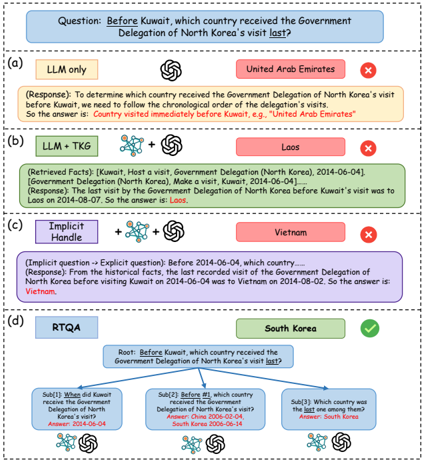
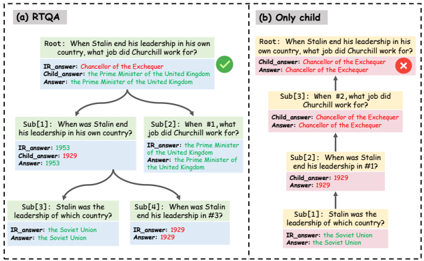
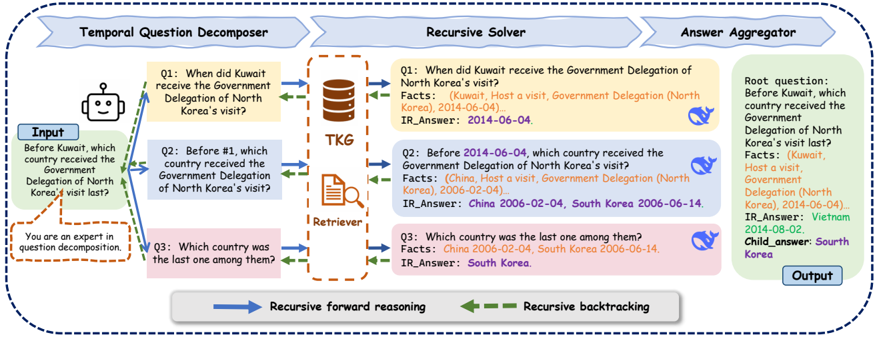
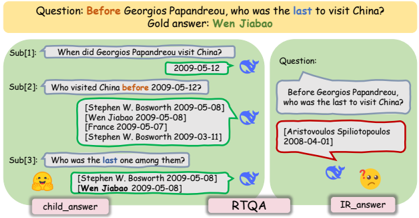
Current temporal knowledge graph question answering (TKGQA) methods primarily focus on implicit temporal constraints, lacking the capability of handling more complex temporal queries, and struggle with limited reasoning abilities and error propagation in decomposition frameworks.We propose RTQA, a novel framework to address these challenges by enhancing reasoning over TKGs without requiring training.Following recursive thinking, RTQA recursively decomposes questions into sub-problems, solves them bottom-up using LLMs and TKG knowledge, and employs multi-path answer aggregation to improve fault tolerance.RTQA consists of three core components: the Temporal Question Decomposer, the Recursive Solver, and the Answer Aggregator.Experiments on MultiTQ and TimelineKGQA benchmarks demonstrate significant Hits@1 improvements in "Multiple" and "Complex" categories, outperforming state-of-the-art methods.Our code and data are available at https://github.com/zjukg/RTQA.Historical Facts South Korea hosted a visit from China on 2009-05-12.Stephen W. Bosworth made a visit to China on 2009-05-13.Lawrence Cannon made a visit to China on 2009-05-12.China made a visit to South Korea on 2009-05-12.Abdullah Gül hosted a visit from China on 2009-05-12.Stephen W. Bosworth made a visit to China on 2009-05-08.Kuomintang made a visit to China on 2009-05-27.Lawrence Cannon made a visit to China on 2009-05-13.Stephen W. Bosworth made a visit to China on 2009-05-15.Wen Jiabao made a visit to China on 2009-05-09.Kuomintang made a visit to China on 2009-05-26.China hosted a visit from Iran on 2009-10-15.Wen Jiabao made a visit to China on 2009-05-08.China hosted a visit from France on 2009-05-07.Ma Biao made a visit to China on 2009-07-05.Georgios Papandreou made a visit to China on 2009-05-12.China made a visit to Kazakhstan on 2009-06-12.Abhisit Vejjajiva made a visit to China on 2009-06-15.Wen Jiabao made a visit to China on 2009-05-28.Wu Po-hsiung made a visit to China on 2009-05-25.Eric Chu made a visit to China on 2009-05-17.Barack Obama made a visit to China on 2009-10-12.Abhisit Vejjajiva made a visit to China on 2009-06-25.Xi Jinping made a visit to China on 2009-06-22.China hosted a
Overview
The claims and statistics of this paper haven’t been checked yet.
Free: it reads the open-access text and checks the first 5 claims that cite a source we can check. Create a free account to check every claim.
Integrity signals
Registry
Cites
Statistics
Figures
Verification
Claims the paper makes
The claims and statistics of this paper haven’t been checked yet.
Free: it reads the open-access text and checks the first 5 claims that cite a source we can check. Create a free account to check every claim.
Claims other papers make about this one
Each is checked against this paper’s own text: does it say what the citing paper says it does?
The source backs part of the claim, not all of it — or backs it for a different population, condition or comparison.
In the citing paper
“RAG-based approaches primarily rely on semantic retrieval to fetch question-relevant contexts but overlook the structural dependencies within TKGs, leading to broken evidence chains”
From Temporal Evidence Chain for Temporal Knowledge Graph Question Answering with Large Language Models (2026) · cites this paper as Gong et al., 2025
Experimental — accuracy not yet measuredThe cited source says what the claim attributes to it.
In the citing paper
“Although ensuring high execution rates, such methods typically lack the reasoning depth required for complex temporal queries (Gong et al., 2025).”
From Temporal Evidence Chain for Temporal Knowledge Graph Question Answering with Large Language Models (2026) · cites this paper as Gong et al., 2025
Self-check
Percentages, sums and reported differences re-computed from the paper’s own numbers.
The self-check needs the paper’s full text.
Citations
Cites
(2020) · doi:10.18653/v1/2020.acl-main.412 · Cited by 542
Research works printed but not linked: 29
- James F. Allen. 1984. Towards a general theory of action and time. Artif. Intell., 23(2):123-154.
- Amos Azaria, Rina Azoulay, and Shulamit Reches. 2024. Chatgpt is a remarkable tool-for experts. Data Intelligence, 6(1):240-296. · DOI · Paper page
- Shulin Cao, Jiaxin Shi, Liangming Pan, Lunyiu Nie, Yutong Xiang, Lei Hou, Juanzi Li, Bin He, and Hanwang Zhang. 2022. KQA pro: A dataset with explicit compositional programs for complex question answering over knowledge base. In ACL (1), pages 6101-6119. Association for Computational Linguistics.
- Shulin Cao, Jiajie Zhang, Jiaxin Shi, Xin Lv, Zijun Yao, Qi Tian, Lei Hou, and Juanzi Li. 2023. Probabilistic tree-of-thought reasoning for answering knowledge- intensive complex questions. In EMNLP (Findings), pages 12541-12560. Association for Computational Linguistics.
- Huajun Chen. 2024. Large knowledge model: Perspectives and challenges. Data Intelligence, 6(3):587-620. · DOI
- Jianlv Chen, Shitao Xiao, Peitian Zhang, Kun Luo, Defu Lian, and Zheng Liu. 2024a. BGE m3-embedding: Multi-lingual, multi-functionality, multi-granularity text embeddings through self-knowledge distillation. CoRR, abs/2402.03216. · arXiv
- Zhuo Chen, Zhao Zhang, Zixuan Li, Fei Wang, Yutao Zeng, Xiaolong Jin, and Yongjun Xu. 2024b. Self- improvement programming for temporal knowledge graph question answering. In LREC/COLING, pages 14579-14594. ELRA and ICCL.
- Ziyang Chen, Dongfang Li, Xiang Zhao, Baotian Hu, and Min Zhang. 2024c. Temporal knowledge question answering via abstract reasoning induction. In ACL (1), pages 4872-4889. Association for Computational Linguistics.
- Ziyang Chen, Jinzhi Liao, and Xiang Zhao. 2023. Multi-granularity temporal question answering over knowledge graphs. In ACL (1), pages 11378-11392. Association for Computational Linguistics.
- Jacob Devlin, Ming-Wei Chang, Kenton Lee, and Kristina Toutanova. 2019. BERT: pre-training of deep bidirectional transformers for language under- standing. In NAACL-HLT (1), pages 4171-4186. Association for Computational Linguistics.
- Wentao Ding, Hao Chen, Huayu Li, and Yuzhong Qu. 2022. Semantic framework based query generation for temporal question answering over knowledge graphs. In EMNLP, pages 1867-1877. Association for Computational Linguistics.
- Matthijs Douze, Alexandr Guzhva, Chengqi Deng, Jeff Johnson, Gergely Szilvasy, Pierre-Emmanuel Mazaré, Maria Lomeli, Lucas Hosseini, and Hervé Jégou. 2024. The faiss library. CoRR, abs/2401.08281. · arXiv
- Yifu Gao, Linbo Qiao, Zhigang Kan, Zhihua Wen, Yongquan He, and Dongsheng Li. 2024. Two- stage generative question answering on temporal knowledge graph using large language models. In ACL (Findings), pages 6719-6734. Association for Computational Linguistics.
- Alberto García-Durán, Sebastijan Dumancic, and Math- ias Niepert. 2018. Learning sequence encoders for temporal knowledge graph completion. In EMNLP, pages 4816-4821. Association for Computational Linguistics.
- Zhen Jia, Abdalghani Abujabal, Rishiraj Saha Roy, Jannik Strötgen, and Gerhard Weikum. 2018. TEQUILA: temporal question answering over knowledge bases. In CIKM, pages 1807-1810. ACM.
- Zhen Jia, Philipp Christmann, and Gerhard Weikum. 2024. Faithful temporal question answering over heterogeneous sources. In WWW, pages 2052-2063. ACM.
- Tushar Khot, Harsh Trivedi, Matthew Finlayson, Yao Fu, Kyle Richardson, Peter Clark, and Ashish Sabharwal. 2023. Decomposed prompting: A modular approach for solving complex tasks. In ICLR. OpenReview.net.
- Zhenzhong Lan, Mingda Chen, Sebastian Goodman, Kevin Gimpel, Piyush Sharma, and Radu Soricut. 2020. ALBERT: A lite BERT for self-supervised learning of language representations. In ICLR. OpenReview.net.
- Yonghao Liu, Di Liang, Mengyu Li, Fausto Giunchiglia, Ximing Li, Sirui Wang, Wei Wu, Lan Huang, Xiaoyue Feng, and Renchu Guan. 2023. Local and global: Temporal question answering via information fusion. In IJCAI, pages 5141-5149. ijcai.org.
- Costas Mavromatis, Prasanna Lakkur Subramanyam, Vassilis N. Ioannidis, Adesoji Adeshina, Phillip Ryan Howard, Tetiana Grinberg, Nagib Hakim, and George Karypis. 2022. Tempoqr: Temporal question reasoning over knowledge graphs. In AAAI, pages 5825-5833. AAAI Press.
- Sumit Neelam, Udit Sharma, Hima Karanam, Shajith Ik- bal, Pavan Kapanipathi, Ibrahim Abdelaziz, Nandana Mihindukulasooriya, Young-Suk Lee, Santosh K. Srivastava, Cezar Pendus, Saswati Dana, Dinesh Garg, Achille Fokoue, G. P. Shrivatsa Bhargav, Dinesh Khandelwal, Srinivas Ravishankar, Sairam Gurajada, Maria Chang, Rosario Uceda-Sosa, and 6 others. 2021. SYGMA: system for generalizable modular question answering overknowledge bases. CoRR, abs/2109.13430. · arXiv
- Xinying Qian, Ying Zhang, Yu Zhao, Baohang Zhou, Xuhui Sui, Li Zhang, and Kehui Song. 2024. Timer4 : Time-aware retrieval-augmented large language models for temporal knowledge graph question answering. In EMNLP, pages 6942-6952. Association for Computational Linguistics.
- Victor Sanh, Lysandre Debut, Julien Chaumond, and Thomas Wolf. 2019. Distilbert, a distilled version of BERT: smaller, faster, cheaper and lighter. CoRR, abs/1910.01108. · arXiv
- Apoorv Saxena, Soumen Chakrabarti, and Partha P. Talukdar. 2021. Question answering over temporal knowledge graphs. In ACL/IJCNLP (1), pages 6663- 6676. Association for Computational Linguistics.
- Apoorv Saxena, Aditay Tripathi, and Partha P. Talukdar. 2020. Improving multi-hop question answering over knowledge graphs using knowledge base embeddings. In ACL, pages 4498-4507. Association for Computational Linguistics.
- Aditya Sharma, Apoorv Saxena, Chitrank Gupta, Seyed Mehran Kazemi, Partha P. Talukdar, and Soumen Chakrabarti. 2023. Twirgcn: Temporally weighted graph convolution for question answering over temporal knowledge graphs. In EACL, pages 2041-2052. Association for Computational Linguistics.
- Qiang Sun, Sirui Li, Du Huynh, Mark Reynolds, and Wei Liu. 2025. Timelinekgqa: A comprehensive question-answer pair generator for temporal knowl- edge graphs. CoRR, abs/2501.04343. · arXiv
- Hugo Touvron, Louis Martin, Kevin Stone, Peter Albert, Amjad Almahairi, Yasmine Babaei, Nikolay Bashlykov, Soumya Batra, Prajjwal Bhargava, Shruti Bhosale, Dan Bikel, Lukas Blecher, Cristian Canton-Ferrer, Moya Chen, Guillem Cucurull, David Esiobu, Jude Fernandes, Jeremy Fu, Wenyin Fu, and 49 others. 2023. Llama 2: Open foundation and fine-tuned chat models. CoRR, abs/2307.09288. · arXiv
- Harsh Trivedi, Niranjan Balasubramanian, Tushar Khot, and Ashish Sabharwal. 2022. Musique: Multihop questions via single-hop question composition. Trans. Assoc. Comput. Linguistics, 10:539-554.
Cited by
Temporal Evidence Chain for Temporal Knowledge Graph Question Answering with Large Language Models
Liu, S., Zhou, X., Wang, B., & Zhang, G. (2026) · Proceedings of the 64th Annual Meeting of the Association for Computational Linguistics (Volume 1: Long Papers) · doi:10.18653/v1/2026.acl-long.1361 · Cited by 3
Metadata
- Authors
- Gong, Z., Li, J., Liu, Z., Liang, L., Chen, H., & Zhang, W.
- Venue
- Proceedings of the 2025 Conference on Empirical Methods in Natural Language Processing
- Published
- 2025
- Pages
- 9864-9881
- Cited by
- 8
- References
- 1
About these checks
Registry, retraction, Cites and statistics results are computed, not judged, with one exception: a printed reference that no index lists is read once by a model before it counts as a citation error. Claims are extracted by a model and kept only when their quote appears verbatim in the text; each cited source is then checked, with a model’s help, for whether it says what the claim relies on. Those verdicts can be wrong — read the claim’s quote and the cited source before relying on one.
Statistics and arithmetic are recomputed, not judged.
Confidence bands are shown only for fields calibrated on our annotated test set. None is calibrated yet, so no band is shown.
What counts as a claim ›How we measure confidence ›How we check this ›
Are you an author, or do you see a problem with this page? Request a review
How to cite
Cite CoChat for the checks on this page, and the paper for its own findings.
- This page
- CoChat. (2026). Citation check: RTQA : Recursive Thinking for Complex Temporal Knowledge Graph Question Answering with Large Language Models. https://app.cochat.ai/papers/10.18653/v1/2025.emnlp-main.499
- The paper
- Gong, Z., Li, J., Liu, Z., Liang, L., Chen, H., & Zhang, W. (2025). RTQA : Recursive Thinking for Complex Temporal Knowledge Graph Question Answering with Large Language Models. Proceedings of the 2025 Conference on Empirical Methods in Natural Language Processing. https://doi.org/10.18653/v1/2025.emnlp-main.499
Data sources
Bibliographic data: Semantic Scholar, OpenAlex, Crossref.
Contains information from the Semantic Scholar Academic Graph Datasets, made available under the ODC Attribution License (ODC-BY 1.0).
Semantic Scholar’s data is described in: Kinney, R., et al. (2023). The Semantic Scholar Open Data Platform. arXiv:2301.10140.
