

The DOI matches its Crossref record; 29 of the 29 references it cites were found in a registry or an index; none of the 11 sources its claims cite is checked for support yet.
ATOM: AdapTive and OptiMized dynamic temporal knowledge graph construction using LLMs
Open accessAbstract
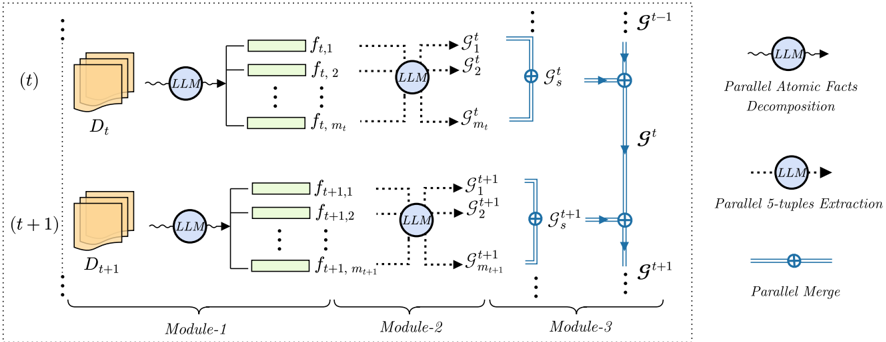
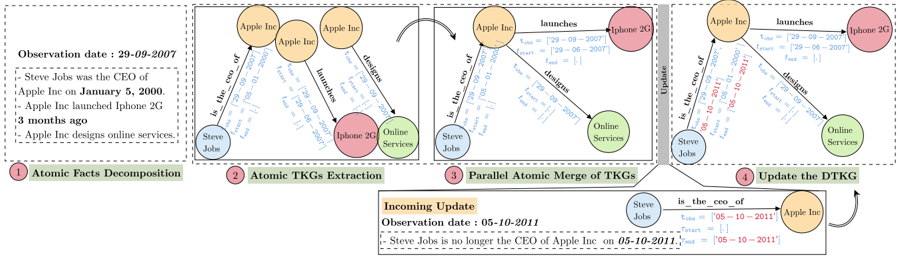
In today's rapidly expanding data landscape, knowledge extraction from unstructured text is vital for real-time analytics, temporal inference, and dynamic memory frameworks.However, traditional static knowledge graph (KG) construction often overlooks the dynamic and time-sensitive nature of real-world data, limiting adaptability to continuous changes.Moreover, recent zero-or few-shot approaches that avoid domain-specific fine-tuning or reliance on prebuilt ontologies often suffer from instability across multiple runs, as well as incomplete coverage of key facts.To address these challenges, we introduce ATOM 1 (AdapTive and OptiMized), a few-shot and scalable approach that builds and continuously updates Temporal Knowledge Graphs (TKGs) from unstructured texts.ATOM splits input documents into minimal, self-contained "atomic" facts, improving extraction exhaustivity and stability.Then, it constructs atomic TKGs from these facts, employing a dual-time modeling that distinguishes between when information is observed and when it is valid.The resulting atomic TKGs are subsequently merged in parallel.Empirical evaluations demonstrate that ATOM achieves ∼ 18% higher exhaustivity, ∼ 33% better stability, and over 90% latency reduction compared to baseline methods, demonstrating a strong scalability potential for dynamic TKG construction.
Overview
CoChat Summary
TL;DR
ATOM is a few-shot, parallel approach that decomposes unstructured text into atomic facts, extracts temporal 5-tuples into atomic TKGs, and merges them with dual-time modeling to build and update dynamic temporal knowledge graphs. On a COVID-19 NYT subset, it reports higher exhaustivity and stability and large latency reductions over baselines.
Key findings
- On 2020-COVID-NYT, atomic-fact extraction improved factual recall \(R_f\) by ∼31% (0.405 ± 0.150 for lead paragraphs vs. 0.720 ± 0.143 for atomic facts) and factual-temporal recall \(R_{f,t}\) by ∼18% (0.176 ± 0.123 vs. 0.354 ± 0.165); \(F_{1,f}\) rose from 0.504 to 0.638 and \(F_{1,f,t}\) from 0.220 to 0.313. Precision was lower for atomic facts: \(P_f\) 0.667 → 0.572 and \(P_{f,t}\) 0.292 → 0.281, described as a marginal ∼1% decrease in factual-temporal precision.
- Stability across reruns was higher for atomic facts (Run 2: 0.552 ± 0.124; Run 3: 0.534 ± 0.12) than for lead paragraphs (Run 2: 0.212 ± 0.181; Run 3: 0.218 ± 0.195), a gain of ∼33%.
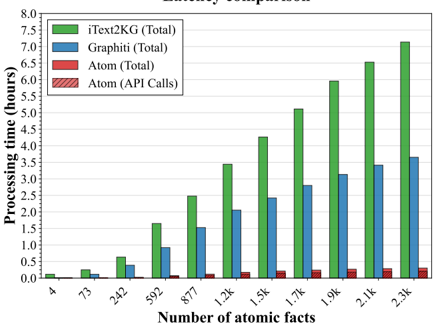
- ATOM reduced latency by 93.8% compared with Graphiti and 95.3% compared with iText2KG; its Module-3 merge accounted for only 13% of total latency.
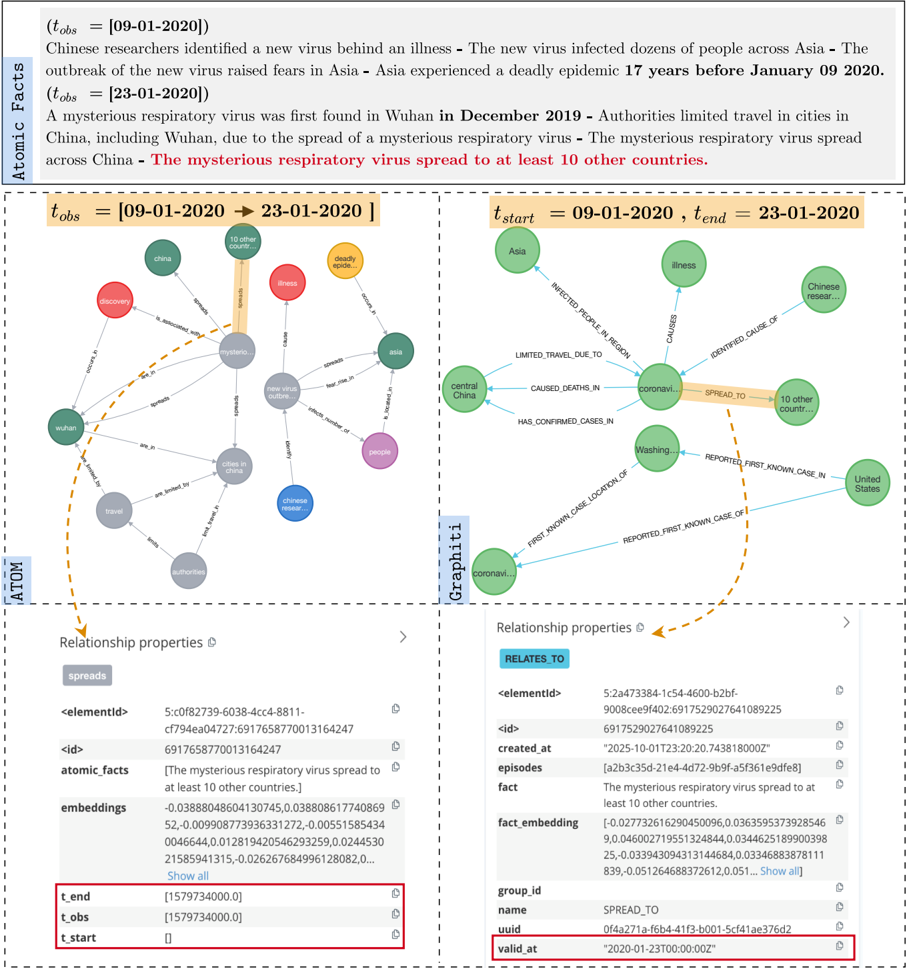
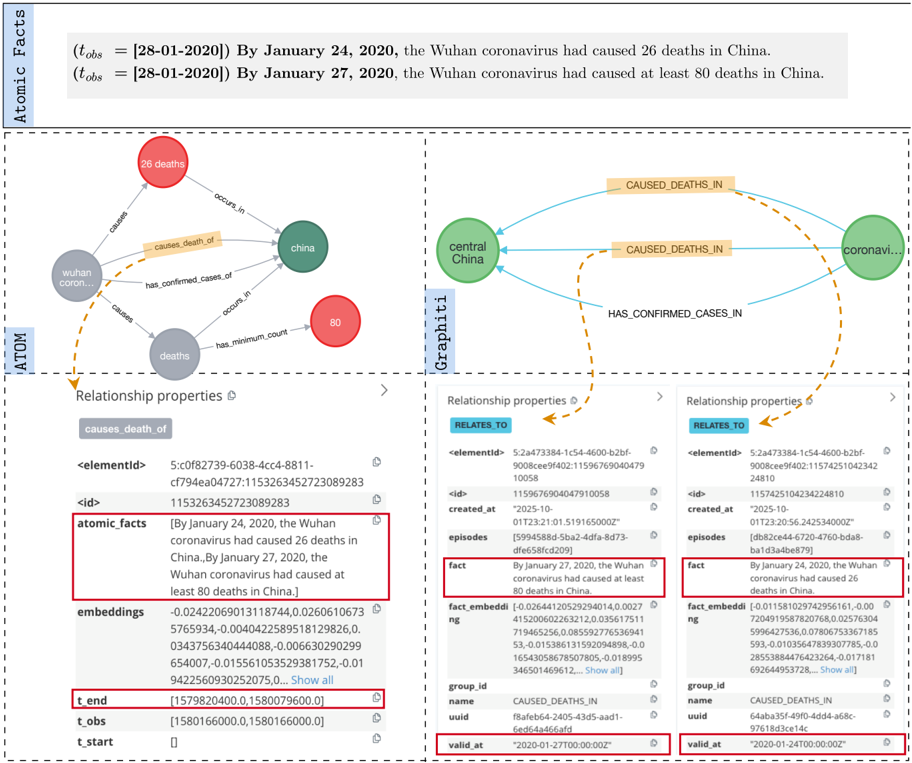
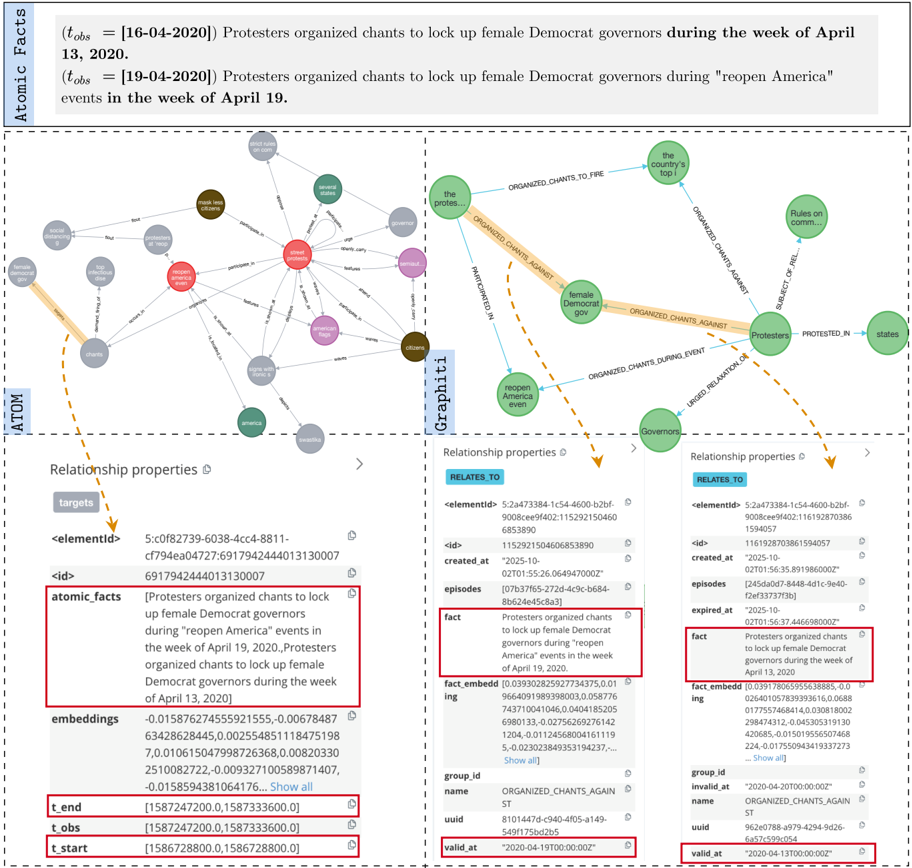
- On DTKG construction, ATOM achieved entity-resolution \(F_1\) 0.994 and relation-resolution \(F_1\) 1, versus Graphiti (0.959, 0.902) and iText2KG (0.977, 0.989); temporal resolution was compared qualitatively, with ATOM extending validity periods and avoiding Graphiti’s treatment of observation time as \(t_{start}\).
Methods
- ATOM decomposes documents into minimal, self-contained atomic facts, extracts 5-tuples in parallel to form atomic TKGs, then merges them via a parallel binary merge algorithm. Entity resolution uses exact name/label matches then cosine similarity with \(\theta_E = 0.8\); relation resolution uses \(\theta_R = 0.7\); temporal resolution merges observation and validity time sets. Dual-time modeling separates observation time from validity start/end, and merging avoids LLM calls.
- Evaluation used the 2020-COVID-NYT subset of the NYT News dynamic and temporal dataset: 1,076 articles, 274 grouped by publication date, average 206 ± 156 tokens per group, date range 2020-01-09 to 2020-12-30; 4,223 atomic facts (2,037 with validity time, 2,186 without), 7,210 5-tuples, 4,223 atomic TKGs, and ∼2 5-tuples per atomic TKG. The subset was enriched with human-verified atomic facts and 5-tuples; publication dates were used as observation dates.
- Models/settings: claude-sonnet-4-2025-01-31 for atomic fact decomposition, gpt-4.1-2025-04-14 for 5-tuple extraction, temperature 0, text-embedding-large-3 embeddings; baselines were Graphiti and iText2KG. Metrics included factual and factual-temporal recall, precision, and \(F_1\); stability via Jaccard similarity across runs; wall-clock latency; entity/relation resolution precision, recall, and \(F_1\); and qualitative temporal resolution.
Limitations
- Stated: atomic fact decomposition can propagate errors—the LLM may generate inferred facts not present in the source, increasing hallucination, and may fail to assign temporal information, lowering factual-temporal precision. Distance-metric merging can occasionally merge semantically distinct but highly similar named entities (e.g., gpt-5:model and gpt-3.5:model). ATOM also costs more than direct extraction due to the added decomposition step and increased output tokens.
- Evident from the text: evaluation is limited to one news subset (2020-COVID-NYT) and uses lead paragraphs rather than full articles; temporal resolution is evaluated qualitatively, with quantitative evaluation listed as future work; stability improves but remains imperfect (atomic-fact Jaccard ∼0.55); and the approach relies on proprietary LLM APIs and thresholds estimated from prior work or generated pairs.
Model-written summary. Check it against the paper before relying on it.
Integrity signals
Registry
Cites
Statistics
Figures
Verification
Claims the paper makes
0 Valid · 4 Not valid · 11 Not checked · 53 Own results and interpretations
A result the paper reports from its own data — it cites no other source for it, so there is none to check. The quote shows it is in the paper.
In the paper
“Rerunning the same prompt multiple times leads to variations in output.”
§ ATOM: AdapTive and OptiMized dynamic temporal knowledge graph construction using LLMs > 4.4 TKG stability
plainstates a cause- Asserted: passes — The authors put it forward as true.
- Checkable: passes — It can be checked against evidence.
- Load-bearing: passes — The paper’s conclusions depend on it.
- Based: passes — The paper gives a reason why it holds.
A result the paper reports from its own data — it cites no other source for it, so there is none to check. The quote shows it is in the paper.
In the paper
“we empirically determine the optimal chunk size at < 400 tokens to keep the exhaustivity > 0.8.”
§ ATOM: AdapTive and OptiMized dynamic temporal knowledge graph construction using LLMs > 4.3 Exhaustivity deterioration in longer contexts
plainstates a cause- Asserted: passes — The authors put it forward as true.
- Checkable: passes — It can be checked against evidence.
- Load-bearing: passes — The paper’s conclusions depend on it.
- Based: passes — The paper gives a reason why it holds.
A result the paper reports from its own data — it cites no other source for it, so there is none to check. The quote shows it is in the paper.
In the paper
“Empirical evaluations demonstrate that ATOM achieves ∼ 18% higher exhaustivity, ∼ 33% better stability, and over 90% latency reduction compared to baseline methods”
§ ATOM: AdapTive and OptiMized dynamic temporal knowledge graph construction using LLMs > Abstract
boostedstates a cause- Asserted: passes — The authors put it forward as true.
- Checkable: passes — It can be checked against evidence.
- Load-bearing: passes — The paper’s conclusions depend on it.
- Based: passes — The paper gives a reason why it holds.
A result the paper states — it cites no source for it, so there is none to check. The quote shows it is in the paper.
In the paper
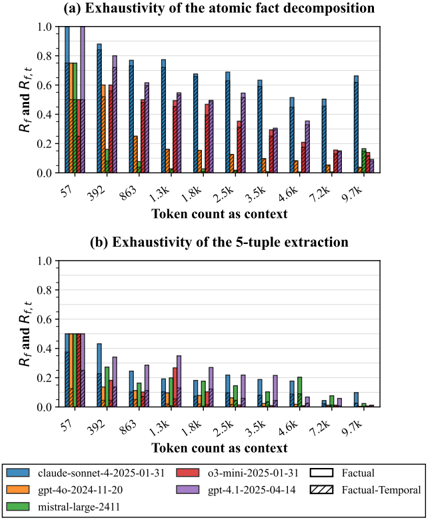
“Moreover, all models show higher exhaustivity for atomic fact decomposition than 5-tuple extraction.”
§ ATOM: AdapTive and OptiMized dynamic temporal knowledge graph construction using LLMs > 4.3 Exhaustivity deterioration in longer contexts
plainstates an association- Asserted: passes — The authors put it forward as true.
- Checkable: passes — It can be checked against evidence.
- Load-bearing: passes — The paper’s conclusions depend on it.
- Based: passes — The paper gives a reason why it holds.
A result the paper reports from its own data — it cites no other source for it, so there is none to check. The quote shows it is in the paper.
In the paper
“Third, ATOM entails higher costs than direct extraction (Ta-ble T.2 in the Appendices) due to the added decomposition step and the increased output tokens required to maintain high exhaustivity.”
§ ATOM: AdapTive and OptiMized dynamic temporal knowledge graph construction using LLMs > 6 Limitations
plainstates a cause- Asserted: passes — The authors put it forward as true.
- Checkable: passes — It can be checked against evidence.
- Load-bearing: unclear — It is unclear whether the paper’s conclusions depend on it.
- Based: passes — The paper gives a reason why it holds.
21 more claims
Create a free account to see all 68 claims and to verify the 10 references still open.
- Probably not a substantial claim. 21
- It may state two separate claims as one. 29
Citations
Cites
Lost in the Middle: How Language Models Use Long Contexts
Liu, N. F., Lin, K., Hewitt, J., Paranjape, A., Bevilacqua, M., Petroni, F., & Liang, P. (2024) · Transactions of the Association for Computational Linguistics · doi:10.1162/tacl_a_00638 · Cited by 1,612
The rise and potential of large language model based agents: a survey
Xi, Z., Chen, W., Guo, X., He, W., Ding, Y., Hong, B., Zhang, M., Wang, J., Jin, S., Zhou, E., et al. (2025) · Science China Information Sciences · doi:10.1007/s11432-024-4222-0 · Cited by 970
DocRED: A Large-Scale Document-Level Relation Extraction Dataset
Yao, Y., Ye, D., Li, P., Han, X., Lin, Y., Liu, Z., Liu, Z., Huang, L., Zhou, J., & Sun, M. (2019) · Proceedings of the 57th Annual Meeting of the Association for Computational Linguistics · doi:10.18653/v1/p19-1074 · Cited by 550
Large Language Models on Graphs: A Comprehensive Survey
Jin, B., Liu, G., Han, C., Jiang, M., Ji, H., & Han, J. (2024) · IEEE Transactions on Knowledge and Data Engineering · doi:10.1109/tkde.2024.3469578 · Cited by 428
A Comprehensive Survey on Automatic Knowledge Graph Construction
Zhong, L., Wu, J., Li, Q., Peng, H., & Wu, X. (2024) · ACM Computing Surveys · doi:10.1145/3618295 · Cited by 382
Non-Determinism of "Deterministic" LLM SettingsPreprint
Atil, B., Aykent, S., Chittams, A., Fu, L., Passonneau, R. J., Radcliffe, E., Rajagopal, G. R., Sloan, A., Tudrej, T., Ture, F., et al. (2024) · arXiv (Cornell University) · doi:10.48550/arxiv.2408.04667 · Cited by 366
Named Entity Extraction for Knowledge Graphs: A Literature Overview
Al-Moslmi, T., Gallofre Ocana, M., L. Opdahl, A., & Veres, C. (2020) · IEEE Access · doi:10.1109/access.2020.2973928 · Cited by 229
LLM-TIKG: Threat intelligence knowledge graph construction utilizing large language model
Hu, Y., Zou, F., Han, J., Sun, X., & Wang, Y. (2024) · Computers & Security · doi:10.1016/j.cose.2024.103999 · Cited by 217
Revisiting DocRED - Addressing the False Negative Problem in Relation Extraction
Tan, Q., Xu, L., Bing, L., Ng, H. T., & Aljunied, S. M. (2022) · Proceedings of the 2022 Conference on Empirical Methods in Natural Language Processing · doi:10.18653/v1/2022.emnlp-main.580 · Cited by 207
From local to global: a graph rag approach to query-focused summarization
Edge, D., Trinh, H., Cheng, N., Bradley, J., Chao, A., Mody, A., Truitt, S., Metropolitansky, D., Ness, R. O., & Larson, J. (2024) · arXiv · doi:10.48550/arxiv.2404.16130 · Cited by 159
Cited by
TACTIC-KG: Toward Small Agent Teams for Cyber Threat Intelligence Knowledge Graph Construction
Bouchiha, M. A., & Blanc, G. (2026) · Lecture notes in computer science · doi:10.1007/978-3-032-38692-2_24 · Cited by 3
Kato, M. (2026) · arXiv (Cornell University) · doi:10.48550/arxiv.2606.20041 · Cited by 1
Hammoud, M. (2026) · arXiv (Cornell University) · doi:10.48550/arxiv.2607.21327 · Cited by 1
C-Unseen: Weak Signal Detection in Dynamic Temporal Knowledge Graphs via LLM ReasoningPreprint
Lairgi, Y., Moncla, L., Benabdeslem, K., Cazabet, R., & Cléau, P. (2026) · arXiv (Cornell University) · doi:10.48550/arxiv.2608.26870
Self-citationTemporal-Aware Person-Job Matching via LLM-Extracted Knowledge Graphs and Graph Convolution
Liu, M., Gong, H., Lin, X., Song, X., Zhu, R., & Pan, L. (2026) · International Conference on Big Data and Information Analytics (BigDIA) · doi:10.1109/bigdia71496.2026.11684658
Metadata
- Authors
- Lairgi, Y., Moncla, L., Benabdeslem, K., Cazabet, R., & Cléau, P.
- Affiliations
- Lyon 1 Université (FR)
- Venue
- Findings of the Association for Computational Linguistics: EACL 2026
- Published
- 2026
- Pages
- 950-966
- OpenAlex
- W7140084193
- Cited by
- 7
- References
- 29
- Citations by year
- 2026: 7
- FWCI
- 6.53
- Type
- conference paper
- Language
- en
- Open access
- hybrid
- doi.org
- Licence
- cc-by
- Locations
- Findings of the Association for Computational Linguistics: EACL (publishedVersion, cc-by)
- HAL (submittedVersion)
- Topics
- Physical Sciences › Computer Science › Artificial Intelligence › Topic Modeling
- Physical Sciences › Computer Science › Artificial Intelligence › Advanced Graph Neural Networks
- Physical Sciences › Computer Science › Artificial Intelligence › Semantic Web and Ontologies
- Keywords
- temporal knowledge graphs, knowledge graph construction, few-shot learning, large language models, atomic facts, knowledge graph updating
About these checks
Registry, retraction, Cites and statistics results are computed, not judged, with one exception: a printed reference that no index lists is read once by a model before it counts as a citation error. Claims are extracted by a model and kept only when their quote appears verbatim in the text; each cited source is then checked, with a model’s help, for whether it says what the claim relies on. Those verdicts can be wrong — read the claim’s quote and the cited source before relying on one.
A language model drew the claims from the paper on 2026-11-18, under version 3 of the claim definition (model deepseek-v4.1-flash, prompt extract-v3).
A second model labelled each claim on 2026-11-18 (model jev-1.13-20260917, definition revision gold-guideline-v0.2).
Statistics and arithmetic are recomputed, not judged.
Confidence bands are shown only for fields calibrated on our annotated test set. None is calibrated yet, so no band is shown.
What counts as a claim ›How we measure confidence ›How we check this ›
Are you an author, or do you see a problem with this page? Request a review
How to cite
Cite CoChat for the checks on this page, and the paper for its own findings.
- This page
- CoChat. (2026). Citation check: ATOM: AdapTive and OptiMized dynamic temporal knowledge graph construction using LLMs. https://app.cochat.ai/papers/10.18653/v1/2026.findings-eacl.49
- The paper
- Lairgi, Y., Moncla, L., Benabdeslem, K., Cazabet, R., & Cléau, P. (2026). ATOM: AdapTive and OptiMized dynamic temporal knowledge graph construction using LLMs. Findings of the Association for Computational Linguistics: EACL 2026. https://doi.org/10.18653/v1/2026.findings-eacl.49
Data sources
Bibliographic data: Semantic Scholar, OpenAlex, Crossref.
Contains information from the Semantic Scholar Academic Graph Datasets, made available under the ODC Attribution License (ODC-BY 1.0).
Semantic Scholar’s data is described in: Kinney, R., et al. (2023). The Semantic Scholar Open Data Platform. arXiv:2301.10140.
