

Aligning Knowledge and Text Embeddings by Entity Descriptions
Open accessThe DOI matches its Crossref record; 15 of the 15 references it cites were found in a registry or an index.
Abstract
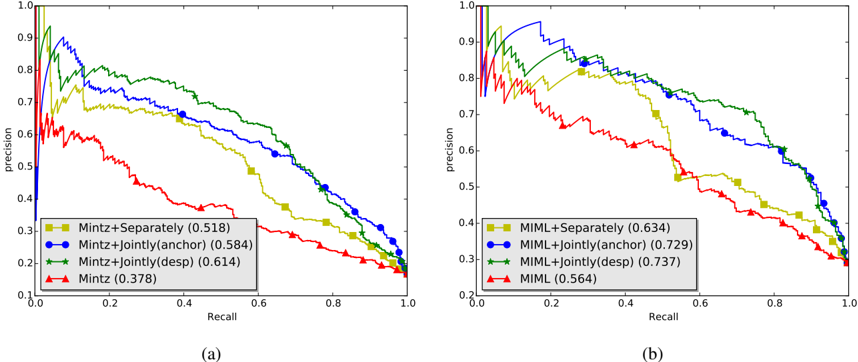
We study the problem of jointly embedding a knowledge base and a text corpus.The key issue is the alignment model making sure the vectors of entities, relations and words are in the same space.Wang et al. (2014a) rely on Wikipedia anchors, making the applicable scope quite limited.In this paper we propose a new alignment model based on text descriptions of entities, without dependency on anchors.We require the embedding vector of an entity not only to fit the structured constraints in KBs but also to be equal to the embedding vector computed from the text description.Extensive experiments show that, the proposed approach consistently performs comparably or even better than the method of Wang et al. (2014a), which is encouraging as we do not use any anchor information.
Overview
The claims and statistics of this paper haven’t been checked yet.
Free: it reads the open-access text and checks the first 5 claims that cite a source we can check. Create a free account to check every claim.
Integrity signals
Registry
Cites
Statistics
Figures
Verification
Claims the paper makes
The claims and statistics of this paper haven’t been checked yet.
Free: it reads the open-access text and checks the first 5 claims that cite a source we can check. Create a free account to check every claim.
Claims other papers make about this one
Each is checked against this paper’s own text: does it say what the citing paper says it does?
The check wasn’t confident either way, so it gives no verdict — never disputed.
In the citing paper
“The distributed word vectors, along with a simple supervised model, can learn to predict numeric and binary attributes of entities with a reasonable degree of accuracy.”
From Pre-trained models for natural language processing: A survey (2020) · cites this paper as [119]
Experimental — accuracy not yet measuredIn the citing paper
“Similarly, Gupta et al. [119] showed that word2vec embeddings implicitly encode referential attributes of entities.”
From Pre-trained models for natural language processing: A survey (2020) · cites this paper as [119]
Self-check
Percentages, sums and reported differences re-computed from the paper’s own numbers.
The self-check needs the paper’s full text.
Citations
Cites
Efficient Estimation of Word Representations in Vector Space
Mikolov, T., Chen, K., Corrado, G., & Dean, J. (2013) · arXiv · doi:10.48550/arxiv.1301.3781 · Cited by 26,568
Distributed Representations of Words and Phrases and their Compositionality
Mikolov, T., Sutskever, I., Chen, K., Corrado, G., & Dean, J. (2013) · arXiv · doi:10.48550/arxiv.1310.4546 · Cited by 24,533
(2013) · Cited by 5,726
Knowledge Graph Embedding by Translating on Hyperplanes
Wang, Z., Zhang, J., Feng, J., & Chen, Z. (2014) · Proceedings of the AAAI Conference on Artificial Intelligence · doi:10.1609/aaai.v28i1.8870 · Cited by 3,915 · cited 23×
“It is used in (Socher et al., 2013; Wang et al., 2014b; Wang et al., 2014a).”
BackgroundMethodResultInfluentialSelf-citationLearning Entity and Relation Embeddings for Knowledge Graph Completion
Lin, Y., Liu, Z., Sun, M., Liu, Y., & Zhu, X. (2015) · Proceedings of the AAAI Conference on Artificial Intelligence · doi:10.1609/aaai.v29i1.9491 · Cited by 3,749
Distant supervision for relation extraction without labeled data
Mintz, M., Bills, S., Snow, R., & Jurafsky, D. (2009) · Proceedings of the Joint Conference of the 47th Annual Meeting of the ACL and the 4th International Joint Conference on Natural Language Processing of the AFNLP: Volume 2 - ACL-IJCNLP '09 · doi:10.3115/1690219.1690287 · Cited by 2,752
Reasoning With Neural Tensor Networks for Knowledge Base Completion
Socher, R., Chen, D., Manning, C. D., & Ng, A. Y. (2013) · neural information processing systems · Cited by 2,228
Modeling Relations and Their Mentions without Labeled Text
Riedel, S., Yao, L., & McCallum, A. (2010) · Lecture Notes in Computer Science · doi:10.1007/978-3-642-15939-8_10 · Cited by 1,270
Learning Structured Embeddings of Knowledge Bases
Bordes, A., Weston, J., Collobert, R., & Bengio, Y. (2011) · Proceedings of the AAAI Conference on Artificial Intelligence · doi:10.1609/aaai.v25i1.7917 · Cited by 829
Bordes, A., Glorot, X., Weston, J., & Bengio, Y. (2014) · Machine Learning · doi:10.1007/s10994-013-5363-6 · Cited by 675
Research works printed but not linked: 1
- Tomas Mikolov, Ilya Sutskever, Kai Chen, Greg S Cor- rado, and Jeff Dean. 2013b. Distributed representa- tions of words and phrases and their compositional- ity. In Advances in Neural Information Processing Systems, pages 3111-3119.
Cited by
Items 101–163 of 163
Knowledge Semantic Representation: A Generative Model for Interpretable Knowledge Graph Embedding.Preprint
Xiao, H., Huang, M., & Zhu, X. (2016) · arXiv (Cornell University) · Cited by 8
Lexical Sememe Prediction using Dictionary Definitions by Capturing Local Semantic CorrespondencePreprint
Du, J., Qi, F., Sun, M., & Liu, Z. (2020) · arXiv (Cornell University) · doi:10.48550/arxiv.2001.05954 · Cited by 9
Semantically Enhanced Models for Commonsense Knowledge Acquisition
Alhussien, I., Cambria, E., & NengSheng, Z. (2018) · IEEE ... International Conference on Data Mining workshops · doi:10.1109/icdmw.2018.00146 · Cited by 6
MUKG: Unifying Multi-Task and Knowledge Graph Method for Recommender System
Sun, J., & Shagar, M. M. B. (2020) · International Conference on Image Processing and Machine Vision (IPMV) · doi:10.1145/3421558.3421561 · Cited by 6
What can Open Domain Model Tell Us about the Missing Software Requirements: A Preliminary Study
Zhao, Z., Zhang, L., & Lian, X. (2021) · IEEE International Requirements Engineering Conference (RE) · doi:10.1109/re51729.2021.00010 · Cited by 6
Word Embedding as Maximum A Posteriori Estimation
Jameel, S., Fu, Z., Shi, B., Lam, W. P., & Schockaert, S. (2019) · Proceedings of the AAAI Conference on Artificial Intelligence · doi:10.1609/aaai.v33i01.33016562 · Cited by 6
Structural and Textual Information Fusion for Symptom and Disease Representation Learning
Zhao, S., Jiang, M., Qin, B., Liu, T., Zhai, C., & Wang, F. (2020) · IEEE Transactions on Knowledge and Data Engineering · doi:10.1109/tkde.2020.3039469 · Cited by 6
W-KG2Vec: a weighted text-enhanced meta-path-based knowledge graph embedding for similarity search
Do, P., & Pham, P. (2021) · Neural Computing and Applications · doi:10.1007/s00521-021-06252-8 · Cited by 10
Automatic Construction of Sememe Knowledge Bases via Dictionaries
Qi, F., Chen, Y., Wang, F., Liu, Z., Chen, X. D., & Sun, M. (2021) · Findings of the Association for Computational Linguistics: ACL (Findings of ACL) · doi:10.18653/v1/2021.findings-acl.411 · Cited by 7
Suo, X., Guo, B., Shen, Y., Chen, Y., & Wang, W. (2023) · Information Processing & Management · doi:10.1016/j.ipm.2023.103411 · Cited by 5
The Role of Knowledge in Determining Identity of Long-Tail Entities
Ilievski, F., Hovy, E. H., Vossen, P. T. J. M., Schlobach, S., & Xie, Q. (2020) · Journal of Web Semantics · doi:10.1016/j.websem.2020.100565 · Cited by 6
Neural Tensor Network for Multi- Label Classification
Hong, W., Xu, W., Qi, J., & Weng, Y. (2019) · IEEE Access · doi:10.1109/access.2019.2930206 · Cited by 5
World Knowledge Representation
Liu, Z., Lin, Y., & Sun, M. (2020) · Springer eBooks · doi:10.1007/978-981-15-5573-2_7 · Cited by 6
HRS: Hybrid Recommendation System based on Attention Mechanism and Knowledge Graph Embedding
Dong, C., Ju, X., & Ma, Y. (2021) · IEEE/WIC/ACM International Conference on Web Intelligence · doi:10.1145/3498851.3498987 · Cited by 5
JECI: A Joint Knowledge Graph Embedding Model for Concepts and Instances
Zhou, J. L., Wang, P., Pan, Z., & Xu, Z. (2020) · Lecture notes in computer science · doi:10.1007/978-3-030-41407-8_6 · Cited by 5
SCEF: A Support-Confidence-aware Embedding Framework for Knowledge Graph RefinementPreprint
Zhao, Y., & Liu, J. (2019) · arXiv (Cornell University) · doi:10.48550/arxiv.1902.06377 · Cited by 6
RETRO: Relation Retrofitting For In-Database Machine Learning on Textual DataPreprint
Günther, M., Thiele, M., & Lehner, W. (2019) · arXiv (Cornell University) · doi:10.48550/arxiv.1911.12674 · Cited by 5
Chawla, A., Mulay, N., Bishnoi, V., & Dhama, G. (2021) · arXiv (Cornell University) · doi:10.48550/arxiv.2111.15436 · Cited by 5
Joint Representations of Knowledge Graphs and Textual Information via Reference Sentences
Ji, Z., Lei, Z., Shen, T., & Zhang, J. (2020) · IEICE Transactions on Information and Systems · doi:10.1587/transinf.2019edp7229 · Cited by 6
Self-citationLearning from Textual Data in Database Systems
Günther, M., Oehme, P., Thiele, M., & Lehner, W. (2020) · ACM International Conference on Information and Knowledge Management (CIKM) · doi:10.1145/3340531.3412056 · Cited by 4
Learning Context-based Embeddings for Knowledge Graph Completion
Pu, F., Zhang, Z., Feng, Y., & Yang, B. (2022) · Journal of Data and Information Science · doi:10.2478/jdis-2022-0009 · Cited by 4
KRL_Match: knowledge graph objects matching for knowledge representation learning
Suo, X., Guo, B., Shen, Y. H., Dai, S., Wang, W., Chen, Y., & Zhang, Z. (2022) · Knowledge and Information Systems · doi:10.1007/s10115-022-01764-8 · Cited by 6
JKRL: Joint Knowledge Representation Learning of Text Description and Knowledge Graph
Xu, G., Zhang, Q., Yu, D., Lu, S., & Lu, Y. (2023) · Symmetry · doi:10.3390/sym15051056 · Cited by 4
Usefulness of open domain model for identifying missing software requirements concepts
Zhao, Z., Zhang, L., & Lian, X. (2023) · Software Practice and Experience · doi:10.1002/spe.3285 · Cited by 4
The concept information of graph granule with application to knowledge graph embedding
Niu, J., Chen, D., Ma, Y., & Li, J. (2024) · International Journal of Machine Learning and Cybernetics · doi:10.1007/s13042-024-02267-4 · Cited by 3
Text-Augmented Knowledge Representation Learning Based on Convolutional Network
Liu, C., Zhang, Y., Yu, M., Yu, R., Li, X., Zhao, M., Xu, T., Liu, H., & Yu, J. X. (2019) · Lecture notes in computer science · doi:10.1007/978-3-030-36708-4_16 · Cited by 3
Text-Enhanced Knowledge Representation Learning Based on Gated Convolutional Networks
Liu, C., Zhang, Y., Yu, M., Li, X., Zhao, M., Xu, T., Yu, J. X., & Yu, R. (2019) · IEEE International Conference on Tools with Artificial Intelligence (ICTAI) · doi:10.1109/ictai.2019.00051 · Cited by 3
Robust and Scalable Entity Alignment in Big Data
Flamino, J., Abriola, C., Zimmerman, B., Li, Z., & Douglas, J. (2020) · IEEE International Conference on Big Data (BigData) · doi:10.1109/bigdata50022.2020.9378273 · Cited by 5
A Systematic Investigation of KB-Text Embedding Alignment at Scale
Pahuja, V., Gu, Y., Chen, W., Bahrami, M., Liu, L., Chen, W., & Su, Y. (2021) · doi:10.18653/v1/2021.acl-long.139 · Cited by 3
Neighborhood aggregation based graph attention networks for open-world knowledge graph reasoning
Chen, X., Ding, L., & Xiang, Y. (2021) · Journal of Intelligent & Fuzzy Systems · doi:10.3233/jifs-211889 · Cited by 5
Rule-Guided Compositional Representation Learning on Knowledge Graphs with Hierarchical Types
Mao, Y., & Chen, H. (2021) · Mathematics · doi:10.3390/math9161978 · Cited by 3
Efficient and Tractable Conflict Detection in Knowledge Graphs via Path Analysis
Wang, Y., Song, Q., Zheng, L., & Li, X. (2025) · IEEE Transactions on Big Data · doi:10.1109/tbdata.2025.3575948 · Cited by 3
Open-World Relationship Prediction
Wang, J., Wang, X., Luo, X., & Qin, W. (2020) · IEEE International Conference on Tools with Artificial Intelligence (ICTAI) · doi:10.1109/ictai50040.2020.00058 · Cited by 3
Jointly Modeling Fact Triples and Text Information for Knowledge Base Completion
Li, X., Li, Z., Duan, Z., Xu, J., Liu, N., & Wang, J. (2021) · IEEE International Conference on Big Knowledge (ICBK) · doi:10.1109/ickg52313.2021.00037 · Cited by 3
SERVANT LEADERSHIP AND EMPLOYEES’ KNOWLEDGE HIDING BEHAVIOR: TESTING MEDIATING ROLE OF SELF-EFFICACY
Baş, M., & Ekinci, L. O. (2024) · Erzincan Binali Yıldırım Üniversitesi İktisadi ve İdari Bilimler Fakültesi Dergisi · doi:10.46482/ebyuiibfdergi.1488964 · Cited by 2
A Joint Model for Representation Learning of Tibetan Knowledge Graph Based on Encyclopedia
Sun, Y., Chen, A., Chen, C., Xia, T., & Zhao, X. (2021) · ACM Transactions on Asian and Low-Resource Language Information Processing · doi:10.1145/3447248 · Cited by 6
Zhao, E., Chen, B., BianBaDroMa, ‘., & Ngodrup (2024) · Knowledge and Information Systems · doi:10.1007/s10115-024-02174-8 · Cited by 2
EHP:Entity Hyperplane Projection for Knowledge Graph Embedding with Entity Descriptions
Qin, S., Wang, N., Wang, H., Zhou, L., & Zhan, H. (2019) · Computing, Communications and IoT Applications (ComComAp) · doi:10.1109/comcomap46287.2019.9018804 · Cited by 2
Hybrid Approach for Accurate and Interpretable Representation Learning of Knowledge Graph
Yogendran, N., Kanagarajah, A., Chandiran, K., & Thayasivam, U. (2020) · Moratuwa Engineering Research Conference (MERCon) · doi:10.1109/mercon50084.2020.9185274 · Cited by 2
Retrofitting Soft Rules for Knowledge Representation Learning
An, B., Han, X., Fu, C., & Sun, L. (2020) · Big Data Research · doi:10.1016/j.bdr.2020.100156 · Cited by 2
Gutiérrez-Basulto, V., & Schockaert, S. (2018) · arXiv (Cornell University) · Cited by 3
An End-to-End Structure Aware Graph Convolutional Network for Modeling Multi-relational Data
Nie, B., Sun, S., & Yu, D. (2019) · Lecture notes in computer science · doi:10.1007/978-3-030-29911-8_23 · Cited by 1
Geometric Connectionist Machines for Triple Classification
Dong, T. (2020) · Studies in computational intelligence · doi:10.1007/978-3-030-56275-5_7 · Cited by 1
Hakami, H., Hakami, M., Mandya, A., & Bollegala, D. (2022) · Conference of the North American Chapter of the Association for Computational Linguistics: Human Language Technologies (NAACL-HLT) · doi:10.18653/v1/2022.naacl-main.209 · Cited by 1
Multimodal knowledge graph representation learning with entity description
Sun, Y., Wang, L., Huang, Y., & Zhang, Z. (2023) · International Conference on Artificial Intelligence, Automation and High Performance Computing (AIAHPC) · doi:10.1117/12.2684616 · Cited by 1
Domain-Specific Knowledge Graph Adaption with Industrial Text Data
Hamann, F., & Ulges, A. (2023) · Lecture notes in computer science · doi:10.1007/978-3-031-36819-6_25 · Cited by 1
Knowledge Representation Learning and Knowledge-Guided NLP
Han, X., Chen, W., Liu, Z., Lin, Y., & Sun, M. (2023) · Springer eBooks · doi:10.1007/978-981-99-1600-9_9 · Cited by 2
Supervised and unsupervised methods for learning representations of linguistic units
Rothe, S. (2017) · doi:10.5282/edoc.20938 · Cited by 1
Mining Commonsense Facts from the Physical WorldPreprint
Zou, Y., Lu, W., & Sun, X. (2020) · arXiv (Cornell University) · doi:10.48550/arxiv.2002.03149 · Cited by 1
Analyzing the Impact of Negative Sampling on Fact-Prediction Algorithms
Bansal, I. (2020) · RIT Scholar Works (Rochester Institute of Technology) · Cited by 1
Plausible reasoning based on qualitative entity embeddings
Schockaert, S., & Jameel, S. (2016) · ORCA Online Research @Cardiff (Cardiff University)
Incorporating Text into the Triple Context for Knowledge Graph Embedding
Zhang, L., Shi, J., Qi, G., & Li, W. (2018) · Lecture notes in computer science · doi:10.1007/978-3-030-04284-4_5
Leveraging structure for learning representations of words, sentences and knowledge bases
Komninos, A. (2018) · White Rose eTheses Online (University of Leeds, The University of Sheffield, University of York)
Knowledge graph embedding models for automatic commonsense knowledge acquisition
Ikhlas, M. S. A. (2019) · doi:10.32657/10220/47795
Retrofitting Soft Rules for Knowledge Representation Learning
An, B., Han, X., & Sun, L. (2020) · Lecture notes in computer science · doi:10.1007/978-3-030-41407-8_17
Graph Representation Learning-Based Recommender Systems
Sang, L. (2020) · OPUS - Open Publications of UTS Scholars (University of Technology Sydney)
Complementing Language Embeddings with Knowledge Bases for Specific Domains.
Tenti, P., Pasi, G., & Peñaloza, R. (2021)
Bridging Text Space and Knowledge Space via Transference Methods
Liu, M., Wang, B., Gao, Q., Zhang, L., Lin, X., & Lang, B. (2021) · IEEE International Conference on Tools with Artificial Intelligence (ICTAI) · doi:10.1109/ictai52525.2021.00153 · Cited by 1
Research on Representation Learning Method by Incorporating External Information
Han, Z., & Wang, L. (2021) · IEEE International Conference on Frontiers Technology of Information and Computer (ICFTIC) · doi:10.1109/icftic54370.2021.9647282
Knowledge Graph Representation Learning via Generated Descriptions
Hu, M., Lin, Z., & Marshall, A. H. (2023) · Lecture notes in computer science · doi:10.1007/978-3-031-35320-8_26
Constructing Method of FOD Knowledge Graph Based on Civil Aircraft Assembly Process
Wu, X., Cheng, S., Guo, W., Lü, J., Liu, L., & Zhao, Q. (2024) · Asia Conference Mechanical and Aerospace Engineering · doi:10.1109/meae62008.2024.11026759
Unsupervised Linking of Unstructured Data Entities to a Knowledge Graph
Dumont, G., Laso, P. M., & Puentes, J. (2026) · Lecture notes in computer science · doi:10.1007/978-981-95-5009-8_29
Malik, A., Malik, N., & Mishra, A. (2026) · IEEE Access · doi:10.1109/access.2026.3711191 · Cited by 1
Metadata
- Authors
- Zhong, H., Zhang, J., Wang, Z., Wan, H., & Chen, Z.
- Affiliations
- Sun Yat-sen University (CN)
- Microsoft (United States) (US)
- Venue
- Proceedings of the 2015 Conference on Empirical Methods in Natural Language Processing
- Published
- 2015
- Pages
- 267-272
- OpenAlex
- W2250807343
- Cited by
- 163
- References
- 15
- Citations by year
- 2026: 1 · 2025: 1 · 2024: 5 · 2023: 10 · 2022: 11 · 2021: 25 · 2020: 33 · 2019: 27 · 2018: 27 · 2017: 11 · 2016: 12
- FWCI
- 9.39
- Type
- conference paper
- Language
- en
- Open access
- hybrid
- doi.org
- Licence
- cc-by
- Locations
- Conference on Empirical Methods in Natural Language Processing (EMNLP) (publishedVersion, cc-by)
- Topics
- Physical Sciences › Computer Science › Artificial Intelligence › Topic Modeling
- Physical Sciences › Computer Science › Artificial Intelligence › Advanced Graph Neural Networks
- Physical Sciences › Computer Science › Computer Vision and Pattern Recognition › Multimodal Machine Learning Applications
- Keywords
- knowledge base embedding, text embeddings, entity alignment, entity descriptions, entity embeddings, relation embeddings, word embeddings
About these checks
Registry, retraction, Cites and statistics results are computed, not judged, with one exception: a printed reference that no index lists is read once by a model before it counts as a citation error. Claims are extracted by a model and kept only when their quote appears verbatim in the text; each cited source is then checked, with a model’s help, for whether it says what the claim relies on. Those verdicts can be wrong — read the claim’s quote and the cited source before relying on one.
Statistics and arithmetic are recomputed, not judged.
Confidence bands are shown only for fields calibrated on our annotated test set. None is calibrated yet, so no band is shown.
What counts as a claim ›How we measure confidence ›How we check this ›
Are you an author, or do you see a problem with this page? Request a review
Data sources
Bibliographic data: Semantic Scholar, OpenAlex, Crossref.
Contains information from the Semantic Scholar Academic Graph Datasets, made available under the ODC Attribution License (ODC-BY 1.0).
Semantic Scholar’s data is described in: Kinney, R., et al. (2023). The Semantic Scholar Open Data Platform. arXiv:2301.10140.
