

Mimicking Word Embeddings using Subword RNNs
Open accessThe DOI matches its Crossref record; 21 of the 21 references it cites were found in a registry or an index.
Abstract
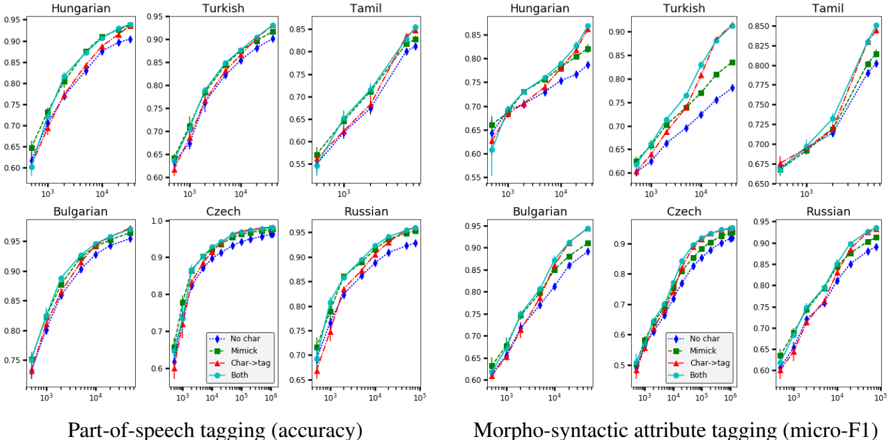
Word embeddings improve generalization over lexical features by placing each word in a lower-dimensional space, using distributional information obtained from unlabeled data.However, the effectiveness of word embeddings for downstream NLP tasks is limited by out-of-vocabulary (OOV) words, for which embeddings do not exist.In this paper, we present MIM-ICK, an approach to generating OOV word embeddings compositionally, by learning a function from spellings to distributional embeddings.Unlike prior work, MIMICK does not require re-training on the original word embedding corpus; instead, learning is performed at the type level.Intrinsic and extrinsic evaluations demonstrate the power of this simple approach.On 23 languages, MIMICK improves performance over a word-based baseline for tagging part-of-speech and morphosyntactic attributes.It is competitive with (and complementary to) a supervised characterbased model in low-resource settings.
Overview
The claims and statistics of this paper haven’t been checked yet.
Free: it reads the open-access text and checks the first 5 claims that cite a source we can check. Create a free account to check every claim.
Integrity signals
Registry
Cites
Statistics
Figures

Verification
Claims the paper makes
The claims and statistics of this paper haven’t been checked yet.
Free: it reads the open-access text and checks the first 5 claims that cite a source we can check. Create a free account to check every claim.
Claims other papers make about this one
Each is checked against this paper’s own text: does it say what the citing paper says it does?
The source backs part of the claim, not all of it — or backs it for a different population, condition or comparison.
In the citing paper
“However, it is hard to extract contextual information from characters to form meaningful words [50], [51], [52].”
From Log-based Anomaly Detection Without Log Parsing (2021) · cites this paper as [50]
Experimental — accuracy not yet measuredThe check wasn’t confident either way, so it gives no verdict — never disputed.
In the citing paper
“Therefore, Log2Vec could not effectively handle some domain-specific words, such as technical terms or entity names [50], [51], [52].”
From Log-based Anomaly Detection Without Log Parsing (2021) · cites this paper as [50]
Experimental — accuracy not yet measured
Self-check
Percentages, sums and reported differences re-computed from the paper’s own numbers.
The self-check needs the paper’s full text.
Citations
Cites
Hochreiter, S., & Schmidhuber, J. (1997) · Neural Computation · doi:10.1162/neco.1997.9.8.1735 · Cited by 102,318 · cited 1×
“(2015) propose a multi-level long shortterm memory (LSTM; Hochreiter and Schmidhuber, 1997), in which word embeddings are built compositionally from an LSTM over characters, and then tagging is performed by an LSTM over”
BackgroundEnriching Word Vectors with Subword Information
Bojanowski, P., Grave, E., Joulin, A., & Mikolov, T. (2017) · Transactions of the Association for Computational Linguistics · doi:10.1162/tacl_a_00051 · Cited by 9,645 · cited 5×
“compare to FastText (Bojanowski et al., 2016), a high-vocabulary, high-dimensionality embedding benchmark.”
MethodResultInfluentialCharacter-Aware Neural Language Models
Kim, Y., Jernite, Y., Sontag, D., & Rush, A. M. (2015) · arXiv · doi:10.48550/arxiv.1508.06615 · Cited by 1,530 · cited 1×
“Character-based approaches avoid these problems: for example, Kim et al. (2016) train a recurrent neural network over words, whose embeddings are constructed by convolution over character embeddings; Wiet-ing et al. (2016) learn embeddings of character n-grams, and then sum them into word…”
BackgroundCharacter-Aware Neural Language Models
Kim, Y., Jernite, Y., Sontag, D., & Rush, A. (2016) · Proceedings of the AAAI Conference on Artificial Intelligence · doi:10.1609/aaai.v30i1.10362 · Cited by 1,491 · cited 1×
“Character-based approaches avoid these problems: for example, Kim et al. (2016) train a recurrent neural network over words, whose embeddings are constructed by convolution over character embeddings; Wiet-ing et al. (2016) learn embeddings of character n-grams, and then sum them into word…”
BackgroundBetter Word Representations with Recursive Neural Networks for Morphology
Luong, M.-T., Socher, R., & Manning, C. D. (2013) · Conference on Computational Natural Language Learning · Cited by 1,020
A Universal Part-of-Speech Tagset
Petrov, S., Das, D., & McDonald, R. (2012) · Language Resources and Evaluation Conference (LREC) · doi:10.63317/3pjyez8kmkhz · Cited by 722
Learning Character-level Representations for Part-of-Speech Tagging
dos Santos, C., & Zadrozny, B. (2014) · Cited by 519
Universal Stanford dependencies: A cross-linguistic typology
de Marneffe, M.-C., Dozat, T., Silveira, N., Haverinen, K., Ginter, F., Nivre, J., & Manning, C. D. (2014) · Language Resources and Evaluation Conference (LREC) · doi:10.63317/4ok3zdjx8t96 · Cited by 456 · cited 5×
“phosyntactic annotations through the Universal Dependencies (UD) corpus (De Marneffe et al., 2014). For example, Faruqui et al. (2016) propose a graph-based technique for propagating typelevel morphological information across a lexicon, improving token-level morphosyntactic tagging in 11 languages, using an SVM tagger.”
BackgroundMethodInfluentialEnriching Word Vectors with Subword Information
Bojanowski, P., Grave, É., Joulin, A., & Mikolov, T. (2016) · arXiv (Cornell University) · doi:10.48550/arxiv.1607.04606 · Cited by 384 · cited 5×
“compare to FastText (Bojanowski et al., 2016), a high-vocabulary, high-dimensionality embedding benchmark.”
MethodResultInfluentialDyNet: The Dynamic Neural Network Toolkit
Neubig, G., Dyer, C., Goldberg, Y., Matthews, A., Ammar, W., Anastasopoulos, A., Ballesteros, M., Chiang, D., Clothiaux, D., Cohn, T., et al. (2017) · arXiv (Cornell University) · doi:10.48550/arxiv.1701.03980 · Cited by 302 · cited 2×
“We initialize character embeddings randomly, and use DyNet to implement the model (Neubig et al., 2017).”
MethodPolyglot: Distributed Word Representations for Multilingual NLP
Al‐Rfou, R., Perozzi, B., & Skiena, S. (2013) · arXiv (Cornell University) · doi:10.48550/arxiv.1307.1662 · Cited by 289 · cited 2×
“The pretrained embeddings we use in our experiments are obtained from Polyglot (Al-Rfou et al., 2013), a multilingual word embedding effort.”
MethodCompositional Morphology for Word Representations and Language Modelling
Botha, J. A., & Blunsom, P. (2014) · arXiv (Cornell University) · doi:10.48550/arxiv.1405.4273 · Cited by 149 · cited 1×
“Botha and Blunsom (2014) compute word embeddings by summing over embeddings of the morphemes; Luong et al. (2013) construct a recursive neural network over each word’s morphological parse; Bhatia et al. (2016) use morpheme embeddings as a prior distribution over probabilistic word embeddings.”
Yin, W., & Schütze, H. (2016) · Proceedings of the conference - Association for Computational Linguistics. Meeting · doi:10.18653/v1/p16-1128 · Cited by 126 · cited 1×
“The training objective is similar to that of Yin and Sch¨utze (2016).”
ResultBuilding a tree-bank of modern hebrew text
Winter, Y., Altman, A., Sima’an, K., Itai, A., & Nativ, N. (2001) · UvA-DARE (University of Amsterdam) · Cited by 105
Tagging and morphological disambiguation of Turkish text
Oflazer, K., & Kuruöz, Ì. (1994) · Conference on Applied Natural Language Processing · doi:10.3115/974358.974391 · Cited by 80 · cited 1×
“The task of morpho-syntactic tagging dates back at least to the mid 1990s (Oflazer and Kuru¨oz, 1994; Hajiˇc and Hladk´a, 1998), and interest has been rejuvenated by the availability of large-scale multilingual mor-phosyntactic annotations through the Universal Dependencies (UD) corpus (De Marneffe…”
BackgroundMorphological Priors for Probabilistic Neural Word Embeddings
Bhatia, P., Guthrie, R., & Eisenstein, J. (2016) · Conference on Empirical Methods in Natural Language Processing (EMNLP) · doi:10.18653/v1/d16-1047 · Cited by 47 · cited 3×
“Botha and Blunsom (2014) compute word embeddings by summing over embeddings of the morphemes; Luong et al. (2013) construct a recursive neural network over each word’s morphological parse; Bhatia et al. (2016) use morpheme embeddings as a prior distribution over probabilistic word embeddings.”
BackgroundMethodSelf-citationCharagram: Embedding Words and Sentences via Character n-grams
Wieting, J., Bansal, M., Gimpel, K., & Livescu, K. (2016) · arXiv (Cornell University) · doi:10.48550/arxiv.1607.02789 · Cited by 36
Feature-Rich Part-of-speech Tagging for Morphologically Complex Languages: Application to BulgarianPreprint
Georgiev, G., Zhikov, V., Osenova, P., Simov, K., & Nakov, P. (2019) · arXiv (Cornell University) · doi:10.48550/arxiv.1911.11503 · Cited by 24 · cited 1×
“Georgiev et al. (2012) report token-level accuracy for exact all-attribute tags (e.g. ‘Ncmsh’ for “Noun short masculine singular definite”) in Bulgarian, reaching a tagset of size 680.”
BackgroundMorphosyntactic Tagging of Slovene: Evaluating Taggers and Tagsets
Džeroski, S., Erjavec, T., & Zavrel, J. (2000) · Language Resources and Evaluation Conference (LREC) · doi:10.63317/58wet78uwqtg · Cited by 21 · cited 3×
“Dzeroski et al. (2000) report pertag accuracies on a morphosyntactically tagged corpus of Slovene.”
BackgroundInfluentialMorpho-syntactic Lexicon Generation Using Graph-based Semi-supervised Learning
Faruqui, M., McDonald, R., & Soricut, R. (2016) · Transactions of the Association for Computational Linguistics · doi:10.1162/tacl_a_00079 · Cited by 18 · cited 2×
“For example, Faruqui et al. (2016) propose a graph-based technique for propagating type-level morphological information across a lexicon, improving token-level morphosyntactic tagging in 11 languages, using an SVM tagger.”
MethodInfluentialEmpirically Sampling Universal Dependencies
Schluter, N., & Agić, Ż. (2017) · IT University Of Copenhagen (IT University of Copenhagen) · Cited by 8
Research works printed but not linked: 8
- Željko Agić, Nikola Ljubešić, and Danijela Merkler. 2013. Lemmatization and morphosyntactic tagging of Croatian and Serbian. In 4th Biennial Interna- tional Workshop on Balto-Slavic Natural Language Processing (BSNLP 2013).
- Marta R Costa-jussà, David Aldón, and José AR Fonol- losa. 2017. Chinese-spanish neural machine trans- lation enhanced with character and word bitmap fonts. Machine Translation, pages 1-13.
- Marie-Catherine De Marneffe, Timothy Dozat, Na- talia Silveira, Katri Haverinen, Filip Ginter, Joakim Nivre, and Christopher D Manning. 2014. Univer- sal stanford dependencies: A cross-linguistic typol- ogy. In Proceedings of the Language Resources and Evaluation Conference (LREC), pages 4585-4592.
- Manaal Faruqui, Jesse Dodge, Sujay K Jauhar, Chris Dyer, Eduard Hovy, and Noah A Smith. 2015. Retrofitting word vectors to semantic lexicons. In Proceedings of the North American Chapter of the Association for Computational Linguistics (NAACL), Denver, CO.
- Jan Hajič and Barbora Hladká. 1998. Tagging inflec- tive languages: Prediction of morphological cate- gories for a rich, structured tagset. In Proceed- ings of the Association for Computational Linguis- tics (ACL), pages 483-490.
- Wang Ling, Tiago Luís, Luís Marujo, Ramón Fernan- dez Astudillo, Silvio Amir, Chris Dyer, Alan W Black, and Isabel Trancoso. 2015. Finding function in form: Compositional character models for open vocabulary word representation. In Proceedings of Empirical Methods for Natural Language Process- ing (EMNLP).
- Thomas Müller, Helmut Schmid, and Hinrich Schütze. 2013. Efficient higher-order CRFs for morpholog- ical tagging. In Proceedings of Empirical Methods for Natural Language Processing (EMNLP), pages 322-332.
- Barbara Plank, Anders Søgaard, and Yoav Goldberg. 2016. Multilingual part-of-speech tagging with bidirectional long short-term memory models and auxiliary loss. In Proceedings of the Association for Computational Linguistics (ACL), Berlin.
Cited by
Recent Trends in Deep Learning Based Natural Language Processing [Review Article]
Young, T., Hazarika, D., Poria, S., & Cambria, E. (2018) · IEEE Computational Intelligence Magazine · doi:10.1109/mci.2018.2840738 · Cited by 2,921
Recent Trends in Deep Learning Based Natural Language Processing
Young, T., Hazarika, D., Poria, S., & Cambria, E. (2017) · arXiv (Cornell University) · doi:10.48550/arxiv.1708.02709 · Cited by 1,192
“[38] provided an interesting approach Fig.”
Log-based Anomaly Detection Without Log Parsing
Le, V.-H., & Zhang, H. (2021) · 2021 36th IEEE/ACM International Conference on Automated Software Engineering (ASE) · doi:10.1109/ase51524.2021.9678773 · Cited by 361
“Besides, Log2Vec also adopts MIMICK [49], an approach of inducing word embedding from character-level features to handle OOV words to improve anomaly detection performance.”
MethodBPE-Dropout: Simple and Effective Subword Regularization
Provilkov, I., Emelianenko, D., & Voita, E. (2020) · Proceedings of the 58th Annual Meeting of the Association for Computational Linguistics · doi:10.18653/v1/2020.acl-main.170 · Cited by 218
Towards generalisable hate speech detection: a review on obstacles and solutions
Yin, W., & Zubiaga, A. (2021) · PeerJ Computer Science · doi:10.7717/peerj-cs.598 · Cited by 207
“MIMICK (Pinter, Guthrie, & Eisenstein, 2017)-based model displayed similar performances (P. Mishra, Yannakoudakis, & Shutova, 2018).”
Metadata
- Authors
- Pinter, Y., Guthrie, R., & Eisenstein, J.
- Affiliations
- Georgia Institute of Technology (US)
- ORCID
- Pinter, Yuval
- Venue
- Proceedings of the 2017 Conference on Empirical Methods in Natural Language Processing
- Published
- 2017
- Pages
- 102-112
- OpenAlex
- W2737092125
- Cited by
- 177
- References
- 20
- Citations by year
- 2026: 1 · 2025: 5 · 2024: 6 · 2023: 14 · 2022: 17 · 2021: 35 · 2020: 29 · 2019: 40 · 2018: 27 · 2017: 2
- FWCI
- 12.22
- Type
- conference paper
- Language
- en
- Open access
- hybrid
- doi.org
- Licence
- cc-by
- Locations
- Conference on Empirical Methods in Natural Language Processing (EMNLP) (publishedVersion, cc-by)
- arXiv (Cornell University) (submittedVersion)
- arXiv (Cornell University)
- Funders
- Defense Threat Reduction Agency (HDTRA1)
- Topics
- Physical Sciences › Computer Science › Artificial Intelligence › Topic Modeling
- Physical Sciences › Computer Science › Artificial Intelligence › Natural Language Processing Techniques
- Physical Sciences › Computer Science › Artificial Intelligence › Domain Adaptation and Few-Shot Learning
- Keywords
- word embeddings, out-of-vocabulary words, distributional semantics, part-of-speech tagging, morphosyntactic tagging, low-resource languages, multilingual word representation
About these checks
Registry, retraction, Cites and statistics results are computed, not judged, with one exception: a printed reference that no index lists is read once by a model before it counts as a citation error. Claims are extracted by a model and kept only when their quote appears verbatim in the text; each cited source is then checked, with a model’s help, for whether it says what the claim relies on. Those verdicts can be wrong — read the claim’s quote and the cited source before relying on one.
Statistics and arithmetic are recomputed, not judged.
Confidence bands are shown only for fields calibrated on our annotated test set. None is calibrated yet, so no band is shown.
What counts as a claim ›How we measure confidence ›How we check this ›
Are you an author, or do you see a problem with this page? Request a review
Data sources
Bibliographic data: Semantic Scholar, OpenAlex, Crossref.
Contains information from the Semantic Scholar Academic Graph Datasets, made available under the ODC Attribution License (ODC-BY 1.0).
Semantic Scholar’s data is described in: Kinney, R., et al. (2023). The Semantic Scholar Open Data Platform. arXiv:2301.10140.
