

Abstractive Timeline Summarization
Open accessThe DOI matches its Crossref record; 39 of the 40 references it cites were found in a registry or an index.
Abstract
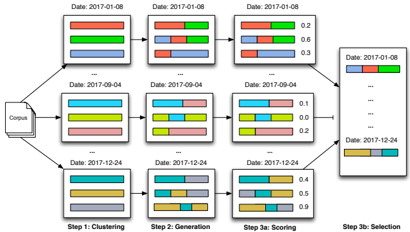
Timeline summarization (TLS) automatically identifies key dates of major events and provides short descriptions of what happened on these dates.Previous approaches to TLS have focused on extractive methods.In contrast, we suggest an abstractive timeline summarization system.Our system is entirely unsupervised, which makes it especially suited to TLS where there are very few gold summaries available for training of supervised systems.In addition, we present the first abstractive oracle experiments for TLS.Our system outperforms extractive competitors in terms of ROUGE when the number of input documents is high and the output requires strong compression.In these cases, our oracle experiments confirm that our approach also has a higher upper bound for ROUGE scores than extractive methods.A study with human judges shows that our abstractive system also produces output that is easy to read and understand.
Overview
The claims and statistics of this paper haven’t been checked yet.
Free: it reads the open-access text and checks the first 5 claims that cite a source we can check. Create a free account to check every claim.
Integrity signals
Registry
Cites
Statistics
Figures
Verification
Claims the paper makes
The claims and statistics of this paper haven’t been checked yet.
Free: it reads the open-access text and checks the first 5 claims that cite a source we can check. Create a free account to check every claim.
Self-check
Percentages, sums and reported differences re-computed from the paper’s own numbers.
The self-check needs the paper’s full text.
Citations
Cites
(1999) · Cited by 12,854
(2004) · Cited by 9,718
Exploring Network Structure, Dynamics, and Function Using NetworkX
Hagberg, A. A., Schult, D. A., & Swart, P. J. (2008) · Proceedings of the Python in Science Conference · doi:10.25080/tcwv9851 · Cited by 7,477 · cited 1×
“We use the shortest path algorithm of Yen (1971) as implemented in the networkx-library (Hagberg et al., 2008) to generate up to 2500 candidate summary sentences per cluster.”
MethodThe Stanford CoreNLP Natural Language Processing Toolkit
Manning, C., Surdeanu, M., Bauer, J., Finkel, J., Bethard, S., & McClosky, D. (2014) · Proceedings of 52nd Annual Meeting of the Association for Computational Linguistics: System Demonstrations · doi:10.3115/v1/p14-5010 · Cited by 7,037 · cited 1×
“4 We preprocess all corpora with Stanford CoreNLP (Manning et al., 2014) and use Hei-deltime (Str¨otgen and Gertz, 2013) for resolving time expressions.”
MethodClustering by Passing Messages Between Data Points
Frey, B. J., & Dueck, D. (2007) · Science · doi:10.1126/science.1136800 · Cited by 6,758 · cited 2×
“Preference values are the median of in-coming similarities (Frey and Dueck, 2007).”
BackgroundMethodGet To The Point: Summarization with Pointer-Generator Networks
See, A., Liu, P. J., & Manning, C. D. (2017) · Proceedings of the 55th Annual Meeting of the Association for Computational Linguistics (Volume 1: Long Papers) · doi:10.18653/v1/p17-1099 · Cited by 3,775 · cited 3×
“As an abstractive comparison, we use the popular Pointer Generator (See et al., 2017) (Neural).”
BackgroundMethodTextRank: Bringing Order into Text
Mihalcea, R. F., & Tarau, P. (2004) · Conference on Empirical Methods in Natural Language Processing (EMNLP) · Cited by 3,631
Finding the K Shortest Loopless Paths in a Network
Yen, J. Y. (1971) · Management Science · doi:10.1287/mnsc.17.11.712 · Cited by 2,618
Teaching Machines to Read and Comprehend
Hermann, K. M., Kočiský, T., Grefenstette, E., Espeholt, L., Kay, W., Suleyman, M., & Blunsom, P. (2015) · arXiv (Cornell University) · doi:10.48550/arxiv.1506.03340 · Cited by 2,521 · cited 1×
“It was trained on the CCN/Daily Mail single document summarization corpus (Hermann et al., 2015).”
MethodLexRank: Graph-based Lexical Centrality as Salience in Text Summarization
Erkan, G., & Radev, D. R. (2004) · Journal of Artificial Intelligence Research · doi:10.1613/jair.1523 · Cited by 1,700 · cited 1×
“Following Zhang et al. (2018) we use the LexRank score (Erkan and Radev, 2004) to rank the sentences in S d .”
Method
Research works printed but not linked: 3
- Siddhartha Banerjee, Prasenjit Mitra, and Kazunari Sugiyama. 2015. Multi-document abstractive sum- marization using ilp based multi-sentence compres- sion. In Proceedings of the 24th International Con- ference on Artificial Intelligence, IJCAI'15, pages 1208-1214. AAAI Press.
- Sebastian Martschat and Katja Markert. 2018. A tem- porally sensitive submodularity framework for time- line summarization. In Proceedings of the 22nd Conference on Computational Natural Language Learning, pages 230-240. Association for Compu- tational Linguistics.
- Rui Yan, Liang Kong, Congrui Huang, Xiaojun Wan, Xiaoming Li, and Yan Zhang. 2011a. Timeline gen- eration through evolutionary trans-temporal sum- marization. In Proceedings of the Conference on Empirical Methods in Natural Language Process- ing, EMNLP '11, pages 433-443, Stroudsburg, PA, USA. Association for Computational Linguistics.
Cited by
Mavi, V., Jangra, A., & Jatowt, A. (2024) · Foundations and Trends® in Information Retrieval · doi:10.1561/1500000102 · Cited by 169
Examining the State-of-the-Art in News Timeline Summarization
Ghalandari, D. G., & Ifrim, G. (2020) · Proceedings of the conference - Association for Computational Linguistics. Meeting · doi:10.18653/v1/2020.acl-main.122 · Cited by 98
Jain, R., Sojitra, D., Acharya, A., Saha, S., Jatowt, A., & Dandapat, S. (2023) · Conference on Empirical Methods in Natural Language Processing (EMNLP) · doi:10.18653/v1/2023.emnlp-main.418 · Cited by 92
Timeline Summarization based on Event Graph Compression via Time-Aware Optimal Transport
Li, M., Ma, T., Yu, M., Wu, L., Gao, T., Ji, H., & McKeown, K. R. (2021) · Conference on Empirical Methods in Natural Language Processing (EMNLP) · doi:10.18653/v1/2021.emnlp-main.519 · Cited by 58
“, 2016; Martschat and Markert, 2018), with a few abstractive methods (Steen and Markert, 2019; Chen et al., 2019; Ansah et al., 2019) that require a few gold summaries to work.”
BackgroundMethodResultInfluentialBiTimeBERT: Extending Pre-Trained Language Representations with Bi-Temporal Information
Wang, J., Jatowt, A., Yoshikawa, M., & Cai, Y. (2023) · International ACM SIGIR Conference on Research and Development in Information Retrieval (SIGIR) · doi:10.1145/3539618.3591686 · Cited by 57
“Event detection and ordering [14, 47], timeline summarization [2, 10, 36, 46, 50], event occurrence time prediction [54], temporal clustering [9], question answering [39, 52] and semantic change detection [41, 42] are other example tasks where utilizing temporal information has proven beneficial.”
BackgroundYu, Y., Jatowt, A., Doucet, A., Sugiyama, K., & Yoshikawa, M. (2021) · doi:10.18653/v1/2021.acl-long.32 · Cited by 55
“Subsequently, TLS works (Steen and Markert, 2019; Gholipour Ghalandari and Ifrim, 2020; Born et al., 2020) have followed this framework to evaluate their models.”
BackgroundMethodZhang, Z., Cao, Y., Ye, C., Ma, Y., Liao, L., & Chua, T. (2024) · Proceedings of the conference - Association for Computational Linguistics. Meeting · doi:10.18653/v1/2024.acl-long.87 · Cited by 48
From Moments to Milestones: Incremental Timeline Summarization Leveraging Large Language Models
Hu, Q., Moon, G., & Ng, H. T. (2024) · Proceedings of the conference - Association for Computational Linguistics. Meeting · doi:10.18653/v1/2024.acl-long.390 · Cited by 39
Chen, X., Li, M., Gao, S., Chan, Z., Zhao, D., Gao, X., Zhang, X., & Yan, R. (2023) · ACM Transactions on Information Systems · doi:10.1145/3517221 · Cited by 35
“Themost similar work to ours is proposed by Steen and Markert [58], where they construct a word-adjacency graph and then generate new sentences from this graph by finding paths from the sentence start node to the sentence end node.”
MethodCrisisLTLSum: A Benchmark for Local Crisis Event Timeline Extraction and Summarization
Faghihi, H. R., Alhafni, B., Zhang, K., Ran, S., Tetreault, J., & Jaimes, A. (2022) · Findings of the Association for Computational Linguistics: EMNLP (Findings of EMNLP) · doi:10.18653/v1/2022.findings-emnlp.400 · Cited by 32
Event Time Extraction and Propagation via Graph Attention Networks
Wen, H., Qu, Y., Ji, H., Ning, Q., Han, J., Sil, A., Tong, H., & Roth, D. (2021) · Conference of the North American Chapter of the Association for Computational Linguistics: Human Language Technologies (NAACL-HLT) · doi:10.18653/v1/2021.naacl-main.6 · Cited by 30
“Event time extraction is also useful for many downstream Natural Language Processing (NLP) applications such as event timeline generation (Huang and Huang, 2013; Wang et al., 2015; Ge et al., 2015; Steen and Markert, 2019), temporal event tracking and prediction (Ji et al.”
BackgroundUnfolding the Headline: Iterative Self-Questioning for News Retrieval and Timeline Summarization
Wu, W., Huang, S., Jiang, Y., Xie, P., Huang, F., & Zhao, H. V. (2025) · Findings of the Association for Computational Linguistics: NAACL · doi:10.18653/v1/2025.findings-naacl.248 · Cited by 25
Song, J., Chim, J., Tsakalidis, A., Ive, J., Atzil–Slonim, D., & Liakata, M. (2024) · Findings of the Association for Computational Linguistics: ACL (Findings of ACL) · doi:10.18653/v1/2024.findings-acl.873 · Cited by 25
Multi-Modal Supplementary-Complementary Summarization using Multi-Objective Optimization
Jangra, A., Saha, S., Jatowt, A., & Hasanuzzaman, M. (2021) · International ACM SIGIR Conference on Research and Development in Information Retrieval (SIGIR) · doi:10.1145/3404835.3462877 · Cited by 25
“These text summarization techniques have been used in diverse tasks such as micro-blog summarization [35], query-based summarization [13], timeline summarization [38, 41], comparative summarization [6], medical report summarization [1, 46], etc.”
MethodJones, S. M., Klein, M., Weigle, M. C., & Nelson, M. L. (2023) · ACM Transactions on the Web · doi:10.1145/3606030 · Cited by 24
“Our output consists of text, images, and additional story metadata generated from the exemplars or the collection as a whole; thus, it has more visual cues to help readers than solutions that only produce sentences or sentences combined with dates [18, 19, 21, 31, 33, 41, 51, 87, 112, 131, 141, 146, 157, 159, 160, 164…”
BackgroundTemporal reasoning for timeline summarisation in social media
Song, J., Akhter, M. E., Atzil–Slonim, D., & Liakata, M. (2025) · Proceedings of the conference - Association for Computational Linguistics. Meeting · doi:10.18653/v1/2025.acl-long.1362 · Cited by 19
Wang, J., Jatowt, A., & Yoshikawa, M. (2021) · International ACM SIGIR Conference on Research and Development in Information Retrieval (SIGIR) · doi:10.1145/3404835.3462885 · Cited by 19
“Event time information in particular has been exploited in various diverse tasks, such as search results diversification [3, 13, 38], multi-document summarization [31], timeline construction [11, 26, 39, 49], named entity disambiguation [1] and historical event ordering [14].”
BackgroundJoint Learning-based Heterogeneous Graph Attention Network for Timeline Summarization
You, J., Li, D., Kamigaito, H., Funakoshi, K., & Okumura, M. (2022) · Conference of the North American Chapter of the Association for Computational Linguistics: Human Language Technologies (NAACL-HLT) · doi:10.18653/v1/2022.naacl-main.301 · Cited by 15
“, 2021) first select salient dates then construct a timeline for each date individually with sentences of the highest score; and 3) event detection algorithms (Steen and Markert, 2019; Duan et al., 2020; Yu et al., 2021) detect events by clustering sentences from multi-timeline news articles then identify several of t…”
BackgroundA storytree-based model for inter-document causal relation extraction from news articles
Zhang, C., Lyu, J., & Xu, K. (2022) · Knowledge and Information Systems · doi:10.1007/s10115-022-01781-7 · Cited by 12
“Another two-stage approach consisting of date selection and date summarization is proposed to build timelines [39].”
BackgroundWang, J., Jatowt, A., & Cai, Y. (2025) · ACM Transactions on the Web · doi:10.1145/3723352 · Cited by 12
“The TSEMLM task specifically masks "Person" entities within the text after masking content temporal information, and the model is then tasked with predicting these masked tokens.”
From task to evaluation: an automatic text summarization review
Lu, L., Liu, Y., Xu, W., Li, H., & Sun, G. (2023) · Artificial Intelligence Review · doi:10.1007/s10462-023-10582-5 · Cited by 10
“Steen and Markert (2019) first introduce an abstractive system for timeline summarization.”
BackgroundCrisisLTLSum: A Benchmark for Local Crisis Event Timeline Extraction and Summarization
Faghihi, H. R., Alhafni, B., Zhang, K., Ran, S., Tetreault, J., & Jaimes, A. (2022) · arXiv · doi:10.48550/arxiv.2210.14190 · Cited by 9
“, 2019), and news headlines (Steen and Markert, 2019), where the humanwritten summaries are directly collected from the web.”
BackgroundExplicitly Modeling Importance and Coherence for Timeline Summarization
Mao, Q., Li, J., Wang, J., Li, X., Peng, H., Wang, L., & Wang, Z. (2022) · IEEE International Conference on Acoustics Speech and Signal Processing · doi:10.1109/icassp43922.2022.9746383 · Cited by 8
Creation and evaluation of timelines for longitudinal user posts
Hills, A., Tsakalidis, A., Nanni, F., Zachos, I., & Liakata, M. (2023) · Conference of the European Chapter of the Association for Computational Linguistics · doi:10.18653/v1/2023.eacl-main.274 · Cited by 6
Joint Learning-based Heterogeneous Graph Attention Network for Timeline Summarization
You, J., Li, D., Kamigaito, H., Funakoshi, K., & Okumura, M. (2023) · Journal of Natural Language Processing · doi:10.5715/jnlp.30.184 · Cited by 6
SumREN: Summarizing Reported Speech about Events in News
Reddy, R. G., Elfardy, H., Chan, H. P., Small, K., & Ji, H. (2023) · Proceedings of the AAAI Conference on Artificial Intelligence · doi:10.1609/aaai.v37i11.26506 · Cited by 6
Gutehrlé, N., Doucet, A., & Jatowt, A. (2023) · arXiv (Cornell University) · doi:10.48550/arxiv.2301.13479 · Cited by 6
“Finally, we could also use a Natural Language Generation (NLG) system as in Steen and Markert (2019), as these generated texts are often easier to understand than text extracted from the documents.”
BackgroundMethodHsu, T.-H., Chin, L.-H., Huang, Y.-H., & Chen, Y.-S. (2024) · ACM International Conference on Information and Knowledge Management (CIKM) · doi:10.1145/3627673.3679723 · Cited by 5
“Recent advancements [13, 15, 23, 29, 32, 36] Clustering-based: These methods [29, 36] define an event as a set of sentences sharing similar key information – such as actions, entities, locations, and times – and cluster sentences based on semantic and temporal similarity.”
Incremental Extractive Opinion Summarization Using Cover TreesPreprint
Chowdhury, S. B. R., Monath, N., Dubey, A., Zaheer, M., McCallum, A., Ahmed, A. A., & Chaturvedi, S. (2024) · arXiv (Cornell University) · doi:10.48550/arxiv.2401.08047 · Cited by 5
“Timeline summaries (Yan et al., 2011b;a; Steen & Markert, 2019; Chen et al., 2023) are expected to have the following features: summaries should discuss important events in a time segment and consecutive summaries should not be redundant.”
BackgroundVideo Timeline Modeling For News Story Understanding
Liu, M., Zhang, M., Liu, J., Dai, H., Yang, M.-H., Ji, S., Feng, Z., & Gong, B. (2023) · neural information processing systems · doi:10.52202/075280-1230 · Cited by 4
Automated Timeline Length Selection for Flexible Timeline Summarization.Preprint
Li, X., Mao, Q., Peng, H., Zhu, H., Li, J., & Wang, Z. (2021) · arXiv (Cornell University) · Cited by 4
ETimeline: An Extensive Timeline Generation Dataset based on Large Language ModelPreprint
Liu, X., & Zhang, Y. (2025) · arXiv (Cornell University) · doi:10.48550/arxiv.2502.07474 · Cited by 4
Future Timelines: Extraction and Visualization of Future-related Content From News Articles
Regev, J., Jatowt, A., & Färber, M. (2024) · ACM International Conference on Web Search and Data Mining (WSDM) · doi:10.1145/3616855.3635693 · Cited by 3
“Sentence rankings inside of a topic or event often depend on the similarity to a centroid sentence [2] or on metrics like date-importance and informativeness [18].”
BackgroundMethodProceedings of the First Workshop on Interactive Learning for Natural Language Processing
(2021) · doi:10.18653/v1/2021.internlp-1 · Cited by 3
“Abstractive timeline summarisation methods can address this problem (Steen and Markert, 2019; Barros et al., 2019) but few neural network models have been proposed due to the lack of reference timelines for supervised learning.”
HEAL-Summ: a lightweight and ethical framework for accessible summarization of health information
Fisher, A., Srinivasan, K. K., Hillier, S. A., & Mago, V. (2025) · Frontiers in Public Health · doi:10.3389/fpubh.2025.1619274 · Cited by 2
“Timeline summarization (TLS) was an early effort to address this challenge by producing time-ordered summaries of events (20).”
TiCCo: Time-Centric Content Exploration
Hausner, P., Aumiller, D., & Gertz, M. (2020) · ACM International Conference on Information and Knowledge Management (CIKM) · doi:10.1145/3340531.3417432 · Cited by 2
“Recently, Steen and Markert [10] introduced an abstractive timeline summarization model that computes timelines completely unsupervised using multi-sentence-compression.”
BackgroundDiachronic Analysis of Time References in News Articles
Jatowt, A., Doucet, A., & Campos, R. (2022) · International World Wide Web Conference (WWW) · doi:10.1145/3487553.3524671 · Cited by 2
“[22] could incorporate the expected similarity change between de-”
BackgroundSim, T., Yang, K., Xin, S., & Kawaguchi, K. (2025) · arXiv (Cornell University) · doi:10.48550/arxiv.2507.21903 · Cited by 2
Leveraging Large Language Model to Generate Multi-modal Timeline Summarization
Liu, Z., & Wang, C. (2024) · Lecture notes of the Institute for Computer Sciences, Social Informatics and Telecommunications Engineering · doi:10.1007/978-3-031-71716-1_13 · Cited by 1
Unsupervised Timeline Summarization via Time-Aware Graph Structural Entropy Minimization
Peng, F., Yantuan, X., Wang, H., Huang, Y., Song, R., & Yu, Z. (2025) · IEEE International Conference on Big Data (BigData) · doi:10.1109/bigdata66926.2025.11400759 · Cited by 1
“Reference [15] and [16] develop memory-based TLS models incorporating temporal and event data, while [17] employ supervised learning for date selection and sentence ranking.”
Event-centric multimodal knowledge acquisition
Li, M. (2023) · Illinois Digital Environment for Access to Learning and Scholarship (University of Illinois at Urbana-Champaign) · Cited by 1
A Proposal: Interactively Learning to Summarise Timelines by Reinforcement Learning
Ye, Y., & Simpson, E. (2021) · doi:10.18653/v1/2021.internlp-1.4 · Cited by 1
“Abstractive timeline summarisation methods can address this problem (Steen and Markert, 2019; Barros et al., 2019) but few neural network models have been proposed due to the lack of reference timelines for supervised learning.”
BackgroundMethodTowards Abstractive Timeline Summarisation Using Preference-Based Reinforcement Learning
Ye, Y., & Simpson, E. (2023) · Frontiers in artificial intelligence and applications · doi:10.3233/faia230601 · Cited by 1
“Other work on abstractive TLS managed to obviate model training by utilising the word-graph [27].”
BackgroundMethodInfluentialSynergizing Unsupervised Episode Detection with LLMs for Large-Scale News Events
Kargupta, P., Zhang, Y., Jiao, Y., Ouyang, S., & Han, J. (2025) · Proceedings of the conference - Association for Computational Linguistics. Meeting · doi:10.18653/v1/2025.acl-long.1433 · Cited by 1
Ge, Y., Romeo, S., Cai, J., Shu, R., Sunkara, M., Benajiba, Y., & Zhang, Y. (2025) · arXiv · doi:10.48550/arxiv.2502.01630 · Cited by 3
“As LLMs may struggle with capturing temporal information in dialogues, particularly relative time, we propose a time-aware memorization strategy using timeline summarization (Steen and Markert, 2019; Rajaby Faghihi et al., 2022; Sojitra et al., 2024).”
Constructing Timeline Summarization as a Heterogeneous Graph Attention Network
You, J. (2022) · Journal of Natural Language Processing · doi:10.5715/jnlp.29.1284
Muller, M. L., Saaman, E., van der Werf, J. M. E. M., Jeurgens, C., & Reijers, H. A. (2024) · Lecture notes in business information processing · doi:10.1007/978-3-031-59465-6_13
“The Timeline Summarization (TLS) line of research aims at automatically identifying key dates of major events from a corpus of texts along with short descriptions of what happened on these dates [16].”
BackgroundTransformer-based Live Update Generation for Soccer Matches from Microblog Posts
Oshika, M., Yamada, K. C., Sasano, R., & Takeda, K. (2024) · Journal of Natural Language Processing · doi:10.5715/jnlp.31.1545
Hu, C., Hu, W., Yu, P., Hua, Z., & Bao, B.-K. (2025) · arXiv (Cornell University) · doi:10.48550/arxiv.2506.21616
Event time representation, propagation and prediction in temporal information extraction
Wen, H. (2021) · Illinois Digital Environment for Access to Learning and Scholarship (University of Illinois at Urbana-Champaign)
Jointly Learn Graph Node Embeddings and Graph Clustering with Temporal Information
You, J., & Jingyi, Y. (2023) · Institutional Repositories DataBase (IRDB)
Ethical Considerations of Large Language Models: Challenges and Best Practices
(2026) · Frontiers research topics · doi:10.3389/978-2-8325-7702-8
CAST-ACF: Robust Generation and Evaluation for Multi-Granularity Timeline Summarization
Ai, Y., & Kong, F. (2026) · IEEE International Conference on Acoustics Speech and Signal Processing · doi:10.1109/icassp55912.2026.11464589
Li, X., Mao, Q., Sun, J., Han, Z., Shang, W., & Liu, J. (2026) · IEEE Transactions on Computational Social Systems · doi:10.1109/tcss.2026.3678533
“2) Date-Wise Summarization Approaches: Date-wise summarization methods [40], [41], [42] employ a two-step process to generate TLS.”
Large Language Model-Powered Query-Driven Event Timeline Summarization in Industrial Search
Wang, M., Xie, X., Yang, H., Gao, L., Su, L., Chen, G., Yin, D., & Shi, D. (2026) · ACM SIGKDD Conference on Knowledge Discovery and Data Mining (KDD) · doi:10.1145/3770855.3818439
“To address this challenge, large-scale search systems such as Baidu are increasingly adopting Timeline Summarization (TLS) [1–4], which condenses large document collections into temporally structured event narratives that help users quickly comprehend event evolution.”
Lyu, F., Yan, H., Duan, S., Wu, H., Gu, S., Qiao, X., Zhang, W., & Wu, H. (2026) · arXiv (Cornell University) · doi:10.48550/arxiv.2606.13171
“In abstractive methods, Steen et al. [29] proposed an unsupervised system to generate a summary for each cluster of the same event.”
InfluentialAgent Newsroom: Efficient Chronological Report Generation via Dynamic Multi-Agent Collaboration
Wang, Z., Wang, C., Geng, Y., & Wang, B. (2026) · Proceedings of the conference - Association for Computational Linguistics. Meeting · doi:10.18653/v1/2026.acl-long.1149
TimelineReasoner: Advancing Timeline Summarization with Large Reasoning Models
Zhang, L., Li, X., & Dou, Z. (2026) · International ACM SIGIR Conference on Research and Development in Information Retrieval (SIGIR) · doi:10.1145/3805712.3809710
Nayeem, M. T., Chakraborty, S., & Rafiei, D. (2026) · arXiv (Cornell University) · doi:10.48550/arxiv.2609.36218
Deep Learning for Natural Language Understanding and Summarization
Quatra, M. L. (2022) · PORTO@Iris
Metadata
- Authors
- Steen, J., & Markert, K.
- Affiliations
- Heidelberg University (DE)
- Venue
- Proceedings of the 2nd Workshop on New Frontiers in Summarization
- Published
- 2019
- Pages
- 21-31
- OpenAlex
- W2983651678
- Cited by
- 34
- References
- 40
- Citations by year
- 2026: 3 · 2025: 3 · 2024: 6 · 2023: 7 · 2022: 5 · 2021: 8 · 2020: 2
- Type
- conference abstract
- Language
- en
- Open access
- hybrid
- doi.org
- Licence
- cc-by
- Locations
- Workshop on New Frontiers in Summarization (NewSum) (publishedVersion, cc-by)
- Topics
- Physical Sciences › Computer Science › Artificial Intelligence › Advanced Text Analysis Techniques
- Physical Sciences › Computer Science › Artificial Intelligence › Topic Modeling
- Physical Sciences › Computer Science › Artificial Intelligence › Natural Language Processing Techniques
- Keywords
- timeline summarization, abstractive summarization, unsupervised summarization, event extraction, key dates, ROUGE evaluation, human evaluation of summaries
About these checks
Registry, retraction, Cites and statistics results are computed, not judged, with one exception: a printed reference that no index lists is read once by a model before it counts as a citation error. Claims are extracted by a model and kept only when their quote appears verbatim in the text; each cited source is then checked, with a model’s help, for whether it says what the claim relies on. Those verdicts can be wrong — read the claim’s quote and the cited source before relying on one.
Statistics and arithmetic are recomputed, not judged.
Confidence bands are shown only for fields calibrated on our annotated test set. None is calibrated yet, so no band is shown.
What counts as a claim ›How we measure confidence ›How we check this ›
Are you an author, or do you see a problem with this page? Request a review
Data sources
Bibliographic data: Semantic Scholar, OpenAlex, Crossref.
Contains information from the Semantic Scholar Academic Graph Datasets, made available under the ODC Attribution License (ODC-BY 1.0).
Semantic Scholar’s data is described in: Kinney, R., et al. (2023). The Semantic Scholar Open Data Platform. arXiv:2301.10140.
