

Abstractive Timeline Summarization
Open accessThe DOI matches its Crossref record; 39 of the 40 references it cites were found in a registry or an index.
Abstract
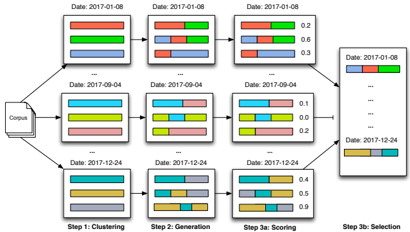
Timeline summarization (TLS) automatically identifies key dates of major events and provides short descriptions of what happened on these dates.Previous approaches to TLS have focused on extractive methods.In contrast, we suggest an abstractive timeline summarization system.Our system is entirely unsupervised, which makes it especially suited to TLS where there are very few gold summaries available for training of supervised systems.In addition, we present the first abstractive oracle experiments for TLS.Our system outperforms extractive competitors in terms of ROUGE when the number of input documents is high and the output requires strong compression.In these cases, our oracle experiments confirm that our approach also has a higher upper bound for ROUGE scores than extractive methods.A study with human judges shows that our abstractive system also produces output that is easy to read and understand.
Overview
The claims and statistics of this paper haven’t been checked yet.
Free: it reads the open-access text and checks the first 5 claims that cite a source we can check. Create a free account to check every claim.
Integrity signals
Registry
Cites
Statistics
Figures
Verification
Claims the paper makes
The claims and statistics of this paper haven’t been checked yet.
Free: it reads the open-access text and checks the first 5 claims that cite a source we can check. Create a free account to check every claim.
Self-check
Percentages, sums and reported differences re-computed from the paper’s own numbers.
The self-check needs the paper’s full text.
Citations
Cites
(1999) · Cited by 12,854
(2004) · Cited by 9,718
Exploring Network Structure, Dynamics, and Function Using NetworkX
Hagberg, A. A., Schult, D. A., & Swart, P. J. (2008) · Proceedings of the Python in Science Conference · doi:10.25080/tcwv9851 · Cited by 7,477 · cited 1×
“We use the shortest path algorithm of Yen (1971) as implemented in the networkx-library (Hagberg et al., 2008) to generate up to 2500 candidate summary sentences per cluster.”
MethodThe Stanford CoreNLP Natural Language Processing Toolkit
Manning, C., Surdeanu, M., Bauer, J., Finkel, J., Bethard, S., & McClosky, D. (2014) · Proceedings of 52nd Annual Meeting of the Association for Computational Linguistics: System Demonstrations · doi:10.3115/v1/p14-5010 · Cited by 7,037 · cited 1×
“4 We preprocess all corpora with Stanford CoreNLP (Manning et al., 2014) and use Hei-deltime (Str¨otgen and Gertz, 2013) for resolving time expressions.”
MethodClustering by Passing Messages Between Data Points
Frey, B. J., & Dueck, D. (2007) · Science · doi:10.1126/science.1136800 · Cited by 6,758 · cited 2×
“Preference values are the median of in-coming similarities (Frey and Dueck, 2007).”
BackgroundMethodGet To The Point: Summarization with Pointer-Generator Networks
See, A., Liu, P. J., & Manning, C. D. (2017) · Proceedings of the 55th Annual Meeting of the Association for Computational Linguistics (Volume 1: Long Papers) · doi:10.18653/v1/p17-1099 · Cited by 3,775 · cited 3×
“As an abstractive comparison, we use the popular Pointer Generator (See et al., 2017) (Neural).”
BackgroundMethodTextRank: Bringing Order into Text
Mihalcea, R. F., & Tarau, P. (2004) · Conference on Empirical Methods in Natural Language Processing (EMNLP) · Cited by 3,631
Finding the K Shortest Loopless Paths in a Network
Yen, J. Y. (1971) · Management Science · doi:10.1287/mnsc.17.11.712 · Cited by 2,618
Teaching Machines to Read and Comprehend
Hermann, K. M., Kočiský, T., Grefenstette, E., Espeholt, L., Kay, W., Suleyman, M., & Blunsom, P. (2015) · arXiv (Cornell University) · doi:10.48550/arxiv.1506.03340 · Cited by 2,521 · cited 1×
“It was trained on the CCN/Daily Mail single document summarization corpus (Hermann et al., 2015).”
MethodLexRank: Graph-based Lexical Centrality as Salience in Text Summarization
Erkan, G., & Radev, D. R. (2004) · Journal of Artificial Intelligence Research · doi:10.1613/jair.1523 · Cited by 1,700 · cited 1×
“Following Zhang et al. (2018) we use the LexRank score (Erkan and Radev, 2004) to rank the sentences in S d .”
Method
Research works printed but not linked: 3
- Siddhartha Banerjee, Prasenjit Mitra, and Kazunari Sugiyama. 2015. Multi-document abstractive sum- marization using ilp based multi-sentence compres- sion. In Proceedings of the 24th International Con- ference on Artificial Intelligence, IJCAI'15, pages 1208-1214. AAAI Press.
- Sebastian Martschat and Katja Markert. 2018. A tem- porally sensitive submodularity framework for time- line summarization. In Proceedings of the 22nd Conference on Computational Natural Language Learning, pages 230-240. Association for Compu- tational Linguistics.
- Rui Yan, Liang Kong, Congrui Huang, Xiaojun Wan, Xiaoming Li, and Yan Zhang. 2011a. Timeline gen- eration through evolutionary trans-temporal sum- marization. In Proceedings of the Conference on Empirical Methods in Natural Language Process- ing, EMNLP '11, pages 433-443, Stroudsburg, PA, USA. Association for Computational Linguistics.
Cited by
Mavi, V., Jangra, A., & Jatowt, A. (2024) · Foundations and Trends® in Information Retrieval · doi:10.1561/1500000102 · Cited by 168
Examining the State-of-the-Art in News Timeline Summarization
Ghalandari, D. G., & Ifrim, G. (2020) · Proceedings of the conference - Association for Computational Linguistics. Meeting · doi:10.18653/v1/2020.acl-main.122 · Cited by 98
Jain, R., Sojitra, D., Acharya, A., Saha, S., Jatowt, A., & Dandapat, S. (2023) · Conference on Empirical Methods in Natural Language Processing (EMNLP) · doi:10.18653/v1/2023.emnlp-main.418 · Cited by 92
Timeline Summarization based on Event Graph Compression via Time-Aware Optimal Transport
Li, M., Ma, T., Yu, M., Wu, L., Gao, T., Ji, H., & McKeown, K. R. (2021) · Conference on Empirical Methods in Natural Language Processing (EMNLP) · doi:10.18653/v1/2021.emnlp-main.519 · Cited by 58
“, 2016; Martschat and Markert, 2018), with a few abstractive methods (Steen and Markert, 2019; Chen et al., 2019; Ansah et al., 2019) that require a few gold summaries to work.”
BackgroundMethodResultInfluentialBiTimeBERT: Extending Pre-Trained Language Representations with Bi-Temporal Information
Wang, J., Jatowt, A., Yoshikawa, M., & Cai, Y. (2023) · International ACM SIGIR Conference on Research and Development in Information Retrieval (SIGIR) · doi:10.1145/3539618.3591686 · Cited by 58
“Event detection and ordering [14, 47], timeline summarization [2, 10, 36, 46, 50], event occurrence time prediction [54], temporal clustering [9], question answering [39, 52] and semantic change detection [41, 42] are other example tasks where utilizing temporal information has proven beneficial.”
Background
Metadata
- Authors
- Steen, J., & Markert, K.
- Affiliations
- Heidelberg University (DE)
- Venue
- Proceedings of the 2nd Workshop on New Frontiers in Summarization
- Published
- 2019
- Pages
- 21-31
- OpenAlex
- W2983651678
- Semantic Scholar
- 69783b65fab94ae1a9abf57dfcbaf445517abf8c
- Cited by
- 34
- References
- 40
- Citations by year
- 2026: 3 · 2025: 3 · 2024: 6 · 2023: 7 · 2022: 5 · 2021: 8 · 2020: 2
- Type
- conference abstract
- Language
- en
- Open access
- hybrid
- doi.org
- Licence
- cc-by
- Locations
- Workshop on New Frontiers in Summarization (NewSum) (publishedVersion, cc-by)
- Topics
- Physical Sciences › Computer Science › Artificial Intelligence › Advanced Text Analysis Techniques
- Physical Sciences › Computer Science › Artificial Intelligence › Topic Modeling
- Physical Sciences › Computer Science › Artificial Intelligence › Natural Language Processing Techniques
- Keywords
- timeline summarization, abstractive summarization, unsupervised summarization, event extraction, key dates, ROUGE evaluation, human evaluation of summaries
About these checks
Registry, retraction, Cites and statistics results are computed, not judged, with one exception: a printed reference that no index lists is read once by a model before it counts as a citation error. Claims are extracted by a model and kept only when their quote appears verbatim in the text; each cited source is then checked, with a model’s help, for whether it says what the claim relies on. Those verdicts can be wrong — read the claim’s quote and the cited source before relying on one.
Statistics and arithmetic are recomputed, not judged.
Confidence bands are shown only for fields calibrated on our annotated test set. None is calibrated yet, so no band is shown.
What counts as a claim ›How we measure confidence ›How we check this ›
Are you an author, or do you see a problem with this page? Request a review
Data sources
Bibliographic data: Semantic Scholar, OpenAlex, Crossref.
Contains information from the Semantic Scholar Academic Graph Datasets, made available under the ODC Attribution License (ODC-BY 1.0).
Semantic Scholar’s data is described in: Kinney, R., et al. (2023). The Semantic Scholar Open Data Platform. arXiv:2301.10140.
